


Walk down Amalias Avenue from Syntagma Square and at some point you will look left and simply stop. Rising from a flat meadow with the Acropolis hovering in the distance are a cluster of gigantic Corinthian columns: the remains of the Temple of Olympian Zeus, once the largest temple on the Greek mainland. Many travelers wonder if it is actually worth paying to go inside when so much of it is gone. The answer depends very much on your expectations, your budget, and how you plan the rest of your day in Athens.
Get the latest updates straight to your inbox!
What You Really See at the Temple of Olympian Zeus Today
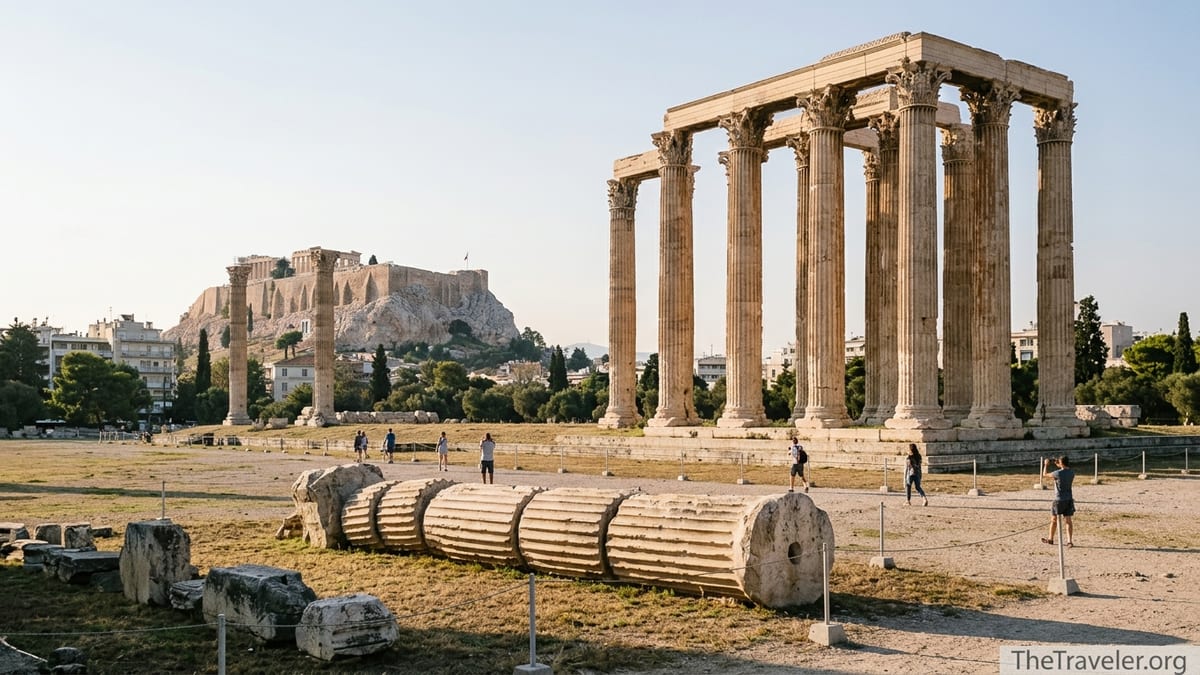
Modern visitors do not come to a complete temple. Out of the 104 towering Corinthian columns that once ringed the sanctuary, 15 still stand and one lies toppled on the ground like a stone giant. The rectangular footprint of the temple, roughly 100 by 50 meters, is still easy to read once you are standing on the archeological site, even though the roof, pediments, and colossal statue of Zeus have long since vanished. The scene feels more like an open field punctuated by monumental fragments than a dense ruin like the Roman Forum.
Inside the fenced site, you can walk fairly close to the columns, see the individual drum sections and carved capitals, and appreciate the engineering up close. Each column reaches almost 17 meters high, with fluted shafts thicker than an adult’s outstretched arms. On a typical summer afternoon you will see visitors standing at the base, craning their necks, or backing up across the grass trying to fit the whole height into a phone photo. The fallen column, blown down in a storm in the 19th century, lies in a neat row of drums that lets you visualize how the columns were stacked.
Beyond the main colonnade, there are low stone foundations and scattered blocks that hint at the wider sanctuary of Olympian Zeus. Informational panels, in Greek and English, sketch the long construction history from 6th century BC tyrants to completion under the Roman emperor Hadrian in the 2nd century AD. Most casual visitors spend 20 to 40 minutes on site, enough time to circle the columns, read a few signs, and take in the panoramic views toward the Acropolis and Ardittos Hill.
It is important to set expectations: you are mostly looking at negative space and scale rather than detailed sculpture. If your mental image of a Greek temple is the almost-intact Temple of Hephaestus in the Ancient Agora, Olympieion feels fragmentary. The reward is the sense of vastness and the unusual experience of standing in a wide open urban meadow framed by some of the tallest classical columns you will likely ever see.
How Impressive Are the Columns in Person?
Photographs hardly convey the physical impact of the surviving columns. Up close, their fluting is deeply carved, and the bases and capitals show the full Corinthian vocabulary of acanthus leaves and volutes. On a clear day, the creamy Pentelic marble picks up subtle tones of gold and pink in the late afternoon, and the shadows of individual flutes become pronounced, emphasizing the verticality. Many visitors who have just come from the Parthenon remark that the Parthenon feels refined and balanced, while Olympieion feels oversized and almost audacious.
What makes the site striking is not just the height but also the relatively small number of columns left. Standing between two of them, with empty sky on all sides, you get a sense of both the original grandeur and the fragility of what survives. From certain angles the cluster of 15 columns aligns with the rocky mass of the Acropolis behind, creating one of the classic Athens skyline views that often appears in guidebooks and airline magazines. Evening tour groups sometimes stop outside the fence purely for that shot, without entering.
If you are interested in the nuts and bolts of ancient construction, the fallen column is arguably the highlight. You can see the individual column drums, each with a central hole where metal dowels once connected them. Guides often pause here to explain how cranes and scaffolding in the Roman period would have lifted these multi-ton blocks into place. Children in particular tend to respond to this section because it reads like a toppled stone train stretching across the grass.
That said, the sense of awe can be affected by ongoing conservation work. At times in recent seasons, sections of the colonnade have been partially surrounded by scaffolding and safety fencing. This does not erase the monumentality, but it can detract from the “clean” postcard view some travelers expect. If your main goal is photography, you may find that shooting from the sidewalk outside the fence with a longer focal length lens gives you a more satisfying composition than standing immediately beneath the columns.
Who Will Get the Most Value Out of a Visit?
The Temple of Olympian Zeus tends to reward certain kinds of travelers more than others. If you are already enthusiastic about ancient architecture or classical history, the site fills an important gap between the Periclean Acropolis and later Roman Athens. For example, someone who has read even a basic history of Emperor Hadrian will appreciate seeing how his drive to monumentalize cities played out here in stone, then walking a few minutes north to Hadrian’s Arch, which is effectively the ceremonial entrance to this same sanctuary.
Independent travelers who like to build their own walking routes through a city also respond well to Olympieion. The site sits on the edge of the National Garden and just across from the Panathenaic Stadium. It works nicely as a breathing space in a day that might start with the morning rush at the Acropolis, continue down to the Ancient Agora, then later pass through Plaka and the Zappeion area. A couple might pick up takeaway souvlaki on nearby Vassilissis Amalias Avenue and eat it on a bench in the National Garden, then cross over to the temple for a relaxed late afternoon visit when the crowds thin.
The monument can also be unexpectedly meaningful for families. The open, mostly flat terrain gives younger children more room to roam than the steeper slopes of the Acropolis, and parents can use the towering columns to give a concrete sense of scale: “These are as tall as a six-story building.” Teens who may be numbed by seeing “another ruin” often wake up at the sight of the fallen column, which feels more like a disaster movie still frame than a static monument.
On the other hand, if your interest in antiquity is casual and you are already planning to fully explore the Acropolis, the Ancient Agora, and perhaps the Acropolis Museum, Olympieion can feel repetitive. Many first-time visitors later report that their main emotional high points came from walking through the Propylaea, standing beside the Parthenon, or discovering the almost intact Temple of Hephaestus, with Olympieion registering more as a secondary stop they were glad to see but would not have paid extra for on its own.
When It Might Not Be Worth Your Time or Money
Recent changes in ticketing policy are an important factor in deciding whether Olympieion is worth entering. For years the temple was part of a reasonably priced combined ticket that covered the Acropolis and six other sites over several days. That combined pass has been discontinued, and visitors now generally purchase separate entry for each site or book guided tours that bundle tickets into the price. As a result, some travelers feel that paying a full standalone ticket to walk around a mostly empty field for less than an hour is hard to justify, especially when traveling as a family of four or five.
Budget-conscious travelers with only one full day in Athens might reasonably decide to admire the columns from outside the fence and allocate their paid entries to the Acropolis and one additional site such as the Ancient Agora or the Acropolis Museum. The views from the perimeter are genuinely good: you can stand on the sidewalk along Amalias Avenue, look through the railings, and see both the standing columns and the collapsed one. For someone on a backpacker budget, the marginal benefit of stepping inside, compared with what you see for free, is real but modest.
The timing of your visit also matters. In the peak summer months, the open site offers little shade, and by early afternoon it can feel brutally hot. If your schedule only allows a midday visit in July or August, and you are already fatigued from climbing the Acropolis slopes, you may find yourself hurrying through without absorbing much. In that case, it may be wiser to skip the interior and instead plan a shaded coffee in nearby Plaka or a slower stroll through the National Garden.
Finally, travelers expecting a “checklist” of recognizable ancient icons might be disappointed. Unlike the Parthenon, which appears on every Athens postcard, or the Panathenaic Stadium, which you instantly associate with the Olympic Games, Olympieion does not have a single, universally recognizable angle. As one recent visitor described in a travel forum, it can feel like “a field with some very big columns and not a lot else” if you arrive without context. If you know that is what you are coming to see, and you value the mood as much as the quantity of ruins, you are more likely to enjoy it.
Practical Tips: Tickets, Timing, and Current Conditions
The Temple of Olympian Zeus is an official archaeological site managed by the Greek Ministry of Culture, with variable opening hours that usually start in the morning and end before sunset. Hours shift between the summer and winter seasons and occasionally change for heat waves or holidays, so it is worth checking the latest schedule shortly before your visit or asking at your hotel’s front desk when you arrive in Athens. During the long-light months, many travelers find that an early evening visit, roughly 60 to 90 minutes before closing, offers pleasant temperatures and softer light for photographs.
Tickets are sold at the small booth near the main entrance by Hadrian’s Arch and, during busy periods, online through the ministry’s official e-ticketing platform. In high season there can be a short line at the booth, but nothing like the queues at the Acropolis. The price point has risen in recent years, which is why some reviewers recommend prioritizing a site that offers more architectural variety if your budget is tight. Guided walking tours of central Athens sometimes include the exterior of the temple in their route without entering, while specialized archaeology tours may include full access and explanation.
Be prepared for a largely exposed site. There are usually basic facilities such as a small guard shelter and occasionally a vending machine, but do not count on shade or services like a café or gift shop inside the fence. Bring water, especially in summer, and consider a hat and sunscreen. The ground is a mix of dirt paths and grass, generally flat but uneven in places, so comfortable shoes are advisable. The site is compact enough that most visitors, including older travelers with moderate mobility issues, find it manageable, although you will not be able to walk directly beneath every column due to protective barriers.
Conservation work is ongoing, and at times one or more columns may be partially obscured by scaffolding or fenced off more tightly. This is not a construction site in the sense of heavy machinery everywhere, but it does mean the precise visual experience can change from year to year. Before committing precious time on a short layover, you might look at a very recent photo from another traveler on a mainstream review platform to calibrate expectations about current views.
How to Combine Olympieion With Nearby Sights
One of the strongest arguments in favor of visiting the Temple of Olympian Zeus is how easily it fits into a larger walking route through Athens. The site lies just a few minutes’ walk from the Acropolis Museum and the southern Acropolis entrance. A common pattern is to book a timed Acropolis slot first thing in the morning, descend through the old streets of Plaka around midday, have lunch near the Acropolis Museum, then walk to Olympieion in the mid to late afternoon when heat and crowds have eased slightly. From there you can continue on foot to the Panathenaic Stadium and loop back through the National Garden to Syntagma Square.
Hadrian’s Arch stands directly in front of the temple’s main entrance and essentially comes as a free extra. You can walk right up to the arch without a ticket and examine the inscriptions that symbolically divided “old Athens” from the “city of Hadrian.” Many visitors take five minutes here before or after entering the temple grounds. The combination of arch, columns, and Acropolis backdrop makes this little corner one of the densest clusters of classical and Roman-era remains in the city center.
If you are staying in the Plaka or Makrygianni neighborhoods, it is easy to fold Olympieion into your everyday movements. For example, you might visit the Acropolis Museum in the morning, break for a long lunch in Plaka, then stroll down Dionysiou Areopagitou and turn toward the temple for a quiet interlude before an evening in the bars and restaurants near Syntagma. Travelers with more time might reserve a half day for a slower, greener circuit: start at the Panathenaic Stadium, walk to Olympieion, continue into the National Garden and up to the Zappeion, then exit near the Parliament building in time to see the changing of the guard.
Those keen on photography could plan two encounters. One quick stop early or late in the day to shoot the columns from outside the fence with the Acropolis in the background, and a second visit, perhaps the next morning, to enter the site when the light is different. Because the temple is so close to many popular hotels and rental apartments in central Athens, this kind of flexible approach is practical even on a relatively short city break.
Making the Decision: Is It Worth It for You?
To decide if the Temple of Olympian Zeus deserves a slice of your Athens time, start by being honest about your priorities. If you have only one full day in the city and want an essential highlights checklist, the Acropolis and its museum, the Ancient Agora, and a walk through Plaka and Monastiraki will likely feel more rewarding. From that perspective, a free look at Olympieion from the outside, combined with a pause at Hadrian’s Arch, might be enough to satisfy your curiosity about the giant columns you see in the distance.
If, however, you have two or more days in Athens, enjoy quieter spaces, and are curious about the sheer scale of Rome’s impact on the city, entering the site becomes far more appealing. It seldom feels crowded, even in high season, and the wide open view of the Acropolis ridge from within the meadow of columns gives a perspective you do not get from anywhere else. Travelers who like to dwell on atmosphere rather than ticking off artifacts often cite Olympieion as the place where Athens suddenly feels airy and spacious after the constricted alleys of the old town.
Think too about how much money you want to allocate to archaeological admissions. For a couple on a midrange budget, the incremental cost of one more site may be negligible compared to a dinner in a central taverna. For a family or solo traveler on a tight budget, that same cost might instead cover a generous lunch or a taxi back to the airport. Because what you see from outside the fence is already visually impressive, the main question becomes whether standing closer to the columns and wandering the sanctuary adds enough personal value to justify that spend.
In practical terms, the temple is unlikely to be the emotional centerpiece of your Athens trip. Instead, think of it as a supporting chapter that deepens the story told by the Acropolis and the Roman remains scattered through the city. If that kind of layered historical understanding matters to you, then carving out 30 to 45 minutes to step inside Olympieion is likely to feel worthwhile.
The Takeaway
The Temple of Olympian Zeus today is more about scale, space, and imagination than about intact architecture. Fifteen standing columns and one fallen giant are all that remain of what was once a vast sanctuary, but they are enough to convey the ambition of both ancient Athens and Roman-era builders. Seen from outside the fence, the site is already impressive, particularly in combination with Hadrian’s Arch and the view back to the Acropolis.
Whether it is worth paying to go inside depends on your time, budget, and appetite for ruins. Enthusiasts of classical history, architecture fans, and travelers with at least two days in Athens will generally find it rewarding, especially if they combine it with a walk to the Panathenaic Stadium and a loop through the National Garden. Budget travelers on a short stay may be better off saving their ticket money for the Acropolis, the Ancient Agora, or the Acropolis Museum, while still detouring past Olympieion for a free look.
Used thoughtfully, a visit to the Temple of Olympian Zeus can do exactly what great travel moments should: shift your sense of scale, root you in the landscape of a city, and connect the dots between different eras. It may not be the most photographed monument in Athens, but for many travelers it becomes one of the most quietly memorable.
FAQ
Q1. Is the Temple of Olympian Zeus worth paying to enter if I am already visiting the Acropolis?
The interior is worth it if you care about scale, open space, and seeing the columns up close. If your budget or time is tight, you can get a good sense of the monument by viewing it from outside the fence and prioritizing the Acropolis and its museum for paid entry.
Q2. How long should I plan to spend at the Temple of Olympian Zeus?
Most visitors spend about 20 to 40 minutes inside. That is enough time to walk around the standing columns, study the fallen one, read a few information panels, and take photographs without rushing.
Q3. Can I see the Temple of Olympian Zeus without buying a ticket?
Yes. The columns are clearly visible from the surrounding streets and the National Garden, and you can stand very close to the perimeter fence on Amalias Avenue for unobstructed views that include the Acropolis in the background.
Q4. What is the best time of day to visit?
Early morning or late afternoon offers softer light and more comfortable temperatures, especially in summer. In the middle of the day, the site can be extremely hot and the bright overhead sun flattens the texture of the marble in photos.
Q5. Is the site suitable for children and older travelers?
Yes. The terrain is mostly flat, with open space for children to move around, and the visit is short enough for most older travelers. However, there is little shade and some uneven ground, so hats, sunscreen, and sturdy shoes are recommended.
Q6. Can I visit the Temple of Olympian Zeus and the Panathenaic Stadium on the same walk?
Absolutely. The two sites are within a short walk of each other. Many visitors combine a visit to Olympieion with a stop at the stadium and a stroll through the National Garden as part of a half-day circuit.
Q7. Are there guided tours specifically for the Temple of Olympian Zeus?
Some walking tours of central Athens include the temple as one of several stops, often in combination with the Acropolis, Plaka, and the Panathenaic Stadium. Dedicated tours focusing only on Olympieion are less common, but private guides can tailor an itinerary that gives the site more attention.
Q8. What should I wear and bring with me?
Wear comfortable walking shoes and light, breathable clothing suited to the season. In warmer months, bring water, a hat, and sunscreen, since there is almost no shade on site. A camera or smartphone with some form of sunshade helps with photographing the bright marble.
Q9. Is photography allowed inside the archaeological site?
Yes, casual photography for personal use is allowed, and the temple is a popular spot for wide-angle shots of the towering columns with the Acropolis in the distance. Tripods or professional equipment may require special permission, so check posted rules at the entrance.
Q10. How does the Temple of Olympian Zeus compare to other ancient sites in Athens?
Compared with the Acropolis or the Ancient Agora, Olympieion is much more fragmentary but offers a stronger sense of sheer vertical scale and open space. It is best seen as a complementary stop that enriches your understanding of ancient Athens rather than as a standalone headline attraction.