


More news on this day
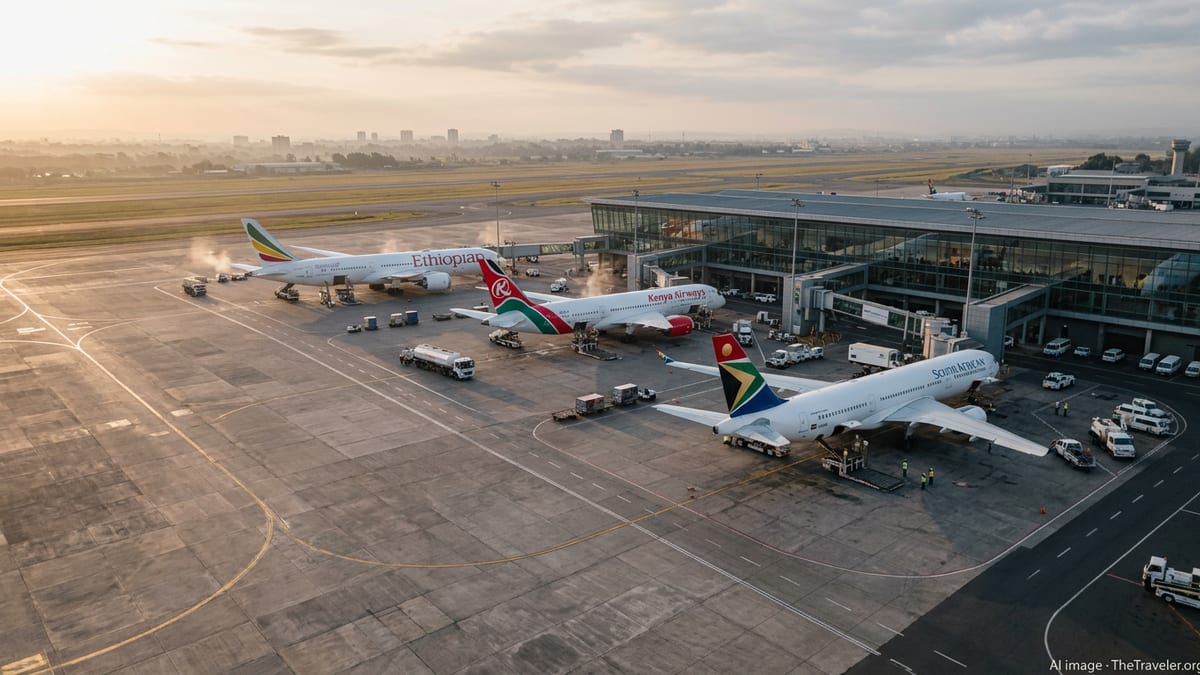
Kenya’s flagship airport is facing renewed scrutiny as delays in upgrading Jomo Kenyatta International Airport coincide with an aggressive airport expansion drive across East Africa, raising questions over how long Nairobi can retain its role as the region’s primary aviation gateway.
Get the latest news straight to your inbox!
Capacity pressure meets stalled expansion plans
Jomo Kenyatta International Airport (JKIA) remains Kenya’s principal international gateway and one of Africa’s busiest airports, yet it still operates with a single main runway and terminals originally designed for far fewer passengers than they handle today. Publicly available information describes JKIA as a key regional hub and home base of Kenya Airways, but also notes that long-discussed expansion projects, including a major new terminal and a second runway, have not materialised on the ground.
Plans for a large greenfield terminal at JKIA, conceived to add several million passengers of annual capacity, were cancelled in 2016 after Kenya’s government halted a contract worth more than 600 million dollars. Earlier reporting indicates that the contract termination followed concerns over financing and value for money, as well as subsequent disputes with the Chinese contractor over advance payments and procurement questions.
Although a new master plan and feasibility studies outlining a modern passenger terminal, runway enhancements and additional taxiways have been published, reports indicate that the programme is still at the planning and transaction-advisory stage. Recent government documents frame these works as essential to reposition JKIA as a world-class hub by the mid-2040s, but timelines and funding commitments for the first major construction phases remain unclear.
Regional rivals accelerate airport investments
While Nairobi weighs how to finance and structure its next round of aviation infrastructure, competing hubs in the region are pressing ahead with expansions. Addis Ababa’s Bole International Airport has undergone significant upgrades and is linked to a planned new airport project at Bishoftu with an eventual capacity in the tens of millions of passengers per year, according to regional aviation investment presentations. Kigali is developing a new international airport at Bugesera, and Uganda and Tanzania are advancing terminal expansions at Entebbe and Dar es Salaam.
Analyses of East African aviation trends suggest that Ethiopia and Rwanda, in particular, are using large-scale airport investments and national carrier strategies to consolidate transfer traffic and position themselves as long-haul connection points between Africa, the Middle East, Europe and Asia. New or upgraded terminals typically feature higher-capacity boarding gates, modern baggage systems and additional aircraft stands, enabling smoother banked connections for transit passengers.
Recent policy papers on the East African Community’s transport vision warn that JKIA’s current infrastructure, if not upgraded in step with regional peers, could erode Kenya’s market share of passengers and cargo. A 2025 assessment prepared for Kenyan policymakers lists expansion projects at Addis Ababa, Dar es Salaam and Entebbe among the developments that could dilute Nairobi’s long-held status as the de facto regional hub if response measures are delayed.
Financial and governance overhang from the Greenfield saga
The collapse of the earlier Greenfield terminal project continues to cast a shadow over JKIA’s expansion prospects. Parliamentary documents and media coverage detail how billions of Kenyan shillings were committed to preliminary works, consultancy fees and ground-breaking activities before the contract was terminated in 2016. Subsequent hearings in Kenya’s National Assembly have revisited questions over irregular payments and procurement procedures linked to the abandoned project.
This history has created a governance and financial overhang that complicates efforts to move forward with new large-scale works at JKIA. Public debate has focused on whether fresh expansion should rely on conventional public borrowing, public-private partnerships or concession models, and how to safeguard against a repeat of past disputes. A recent feasibility report commissioned for a new passenger terminal at JKIA underscores the need for a clear transaction structure to attract private capital while maintaining oversight and service standards.
The uncertainty around project delivery has also shaped perceptions among airlines and investors. Aviation studies highlight that carriers often base long-term route and fleet decisions on confidence that hub airports will deliver scheduled infrastructure upgrades, including additional gates, apron space and modern navigation systems. Repeated revisions to JKIA’s project pipeline risk weakening that confidence at a time when rival hubs are visibly adding capacity.
Infrastructure strain felt in day-to-day operations
Operationally, JKIA continues to function as a busy connecting hub, but the strain on existing facilities is increasingly visible. Publicly available passenger information notes that the airport still relies on a single main runway and a configuration of terminals that has been repeatedly adapted rather than comprehensively rebuilt. Congestion at peak hours, pressure on baggage systems and limited gate availability are frequently cited in traveller feedback and regional aviation commentary.
Kenya’s civil aviation authorities have moved ahead with specific upgrades, such as re-tendering for an advanced surface movement guidance and control system for JKIA to improve ground safety and efficiency. However, such systems enhancements do not on their own address structural capacity constraints in terminals and airside infrastructure. Sector analyses argue that, without new build works, JKIA risks operating close to its practical limits during busy travel seasons.
For Kenya Airways and other carriers that use Nairobi as a hub, these constraints can translate into tighter connection windows, limited room to add new routes during peak periods and greater vulnerability to disruptions when incidents occur on or around the single runway. Competing hubs that offer more stands, dual runways or more spacious terminals can market themselves as more resilient and convenient for transfer passengers.
Strategic choices ahead for Kenya’s aviation hub status
Kenyan policy papers and investment presentations consistently frame JKIA as central to national development plans, export growth and tourism. The airport connects Kenya’s horticulture and manufacturing exports to markets in Europe and the Middle East and underpins a services economy centred on Nairobi. Maintaining hub status is therefore not only a matter of prestige but also of economic strategy.
The latest JKIA master plan sets out a long-term roadmap involving a second independent runway, a new passenger terminal capable of handling significantly more passengers per year, and a reconfiguration of existing terminals for more efficient domestic and regional operations. According to these documents, the goal is to position JKIA as a premier Sub-Saharan African hub by 2045, with phased investments to match projected traffic growth.
The immediate challenge lies in turning these blueprints into funded, time-bound projects that can match the pace of regional competitors. Observers of the sector suggest that clear governance arrangements, transparent procurement and credible implementation schedules will be critical to restoring confidence after the Greenfield terminal episode. With neighbouring countries rapidly building up their own hub capacities, the window for Kenya to consolidate JKIA’s lead may narrow if upgrade delays persist.
The EastAfrican: JKIA upgrade delays leave Kenya exposed
Kenya Ministry of Transport: JKIA Master Plan report