


Landing at Kilimanjaro International Airport, many travelers are immediately focused on one question: how do I get safely and fairly priced to Arusha or Moshi? JRO sits in open countryside between these two gateway towns for Kilimanjaro and safari, so there is no metro or rideshare. Taxis and private transfers are the main way out of the airport, and understanding how fares work, how to negotiate, and how to avoid informal drivers will make your arrival far less stressful.
Get the latest updates straight to your inbox!
Orientation: Where Kilimanjaro Airport Sits and What That Means for Taxis
Kilimanjaro International Airport (JRO) lies on the main A23 highway between Arusha and Moshi, in northern Tanzania’s Kilimanjaro region. It is roughly 45 to 50 kilometers from both Arusha and Moshi, depending on your exact hotel location, and most transfers take about 45 to 70 minutes by road. There is no city directly attached to the airport, so nearly every arriving traveler must arrange some form of road transport immediately after exiting customs.
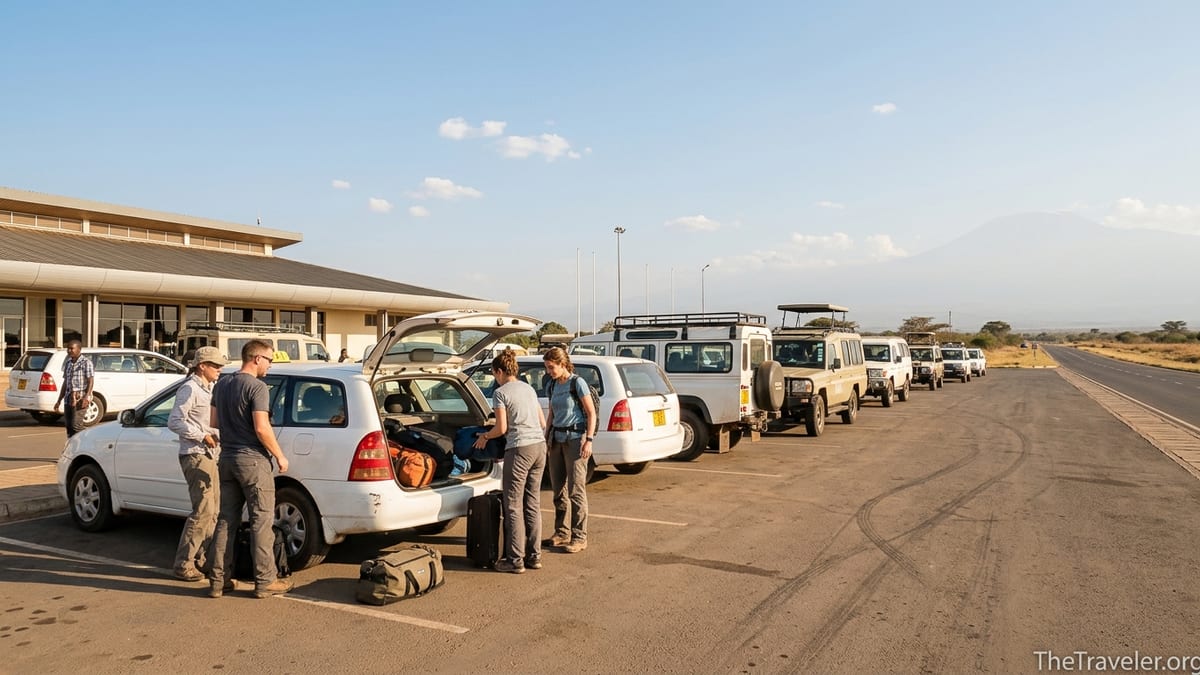
The airport forecourt is compact, with a single main terminal. As you exit the arrivals hall, you first pass a small group of tour company reps holding signs, then reach the official taxi rank in front of the building. Beyond the parking area is simply highway and fields, which means you cannot realistically walk anywhere or search for transport later. If you do not have a pre-booked transfer, your choice will be one of the official airport taxis waiting outside.
Traffic patterns also shape your taxi experience. Flights from Europe and the Middle East often arrive late evening or around midnight. At those times, public shuttles are less frequent, and taxis are the default option. In the early morning and daytime, there may be more shared shuttles heading for Arusha or Moshi, especially when big trekking or safari departures are scheduled, but solo travelers still often find a taxi fastest and simplest.
Because JRO is the main international gateway for both Arusha and Moshi, drivers are very used to visitors who have just stepped off long-haul flights. English is widely spoken among airport taxi drivers, and most know the main hotels and climbing lodges by name, from popular Moshi bases like Springlands Hotel and Kilimanjaro Wonders Hotel to Arusha spots such as Four Points by Sheraton, Arusha Serena and budget lodges in the city center.
Typical Taxi Fares: What You Can Expect to Pay in 2026
As of mid 2026, a standard sedan taxi from Kilimanjaro Airport to Moshi town typically costs in the region of 30 to 50 US dollars for the vehicle, not per person. To Arusha, most travelers report paying around 55 to 75 US dollars, again for the whole car. These ranges reflect what reputable transfer companies and airport taxis are currently charging for daytime arrivals for 1 to 3 passengers with regular luggage.
Several factors can push you toward the lower or upper end of that range. Distance within the town matters: a drop at Moshi’s central bus stand or popular climber hotels just off the main road often sits near the lower end, while transfers to lodges in the surrounding hills or to Arusha suburbs north of the city can cost more. Expect to pay a bit extra if you ask the driver to detour via an ATM in Boma Ng’ombe, or if heavy traffic around Arusha adds significant time.
Vehicle type makes a difference too. If you are a solo traveler with one suitcase and a daypack, a regular sedan or small hatchback is fine and cheaper. If you are a group of four with expedition duffels, or a climbing team with bulky gear, you may need a larger SUV or a safari-style Land Cruiser. Those often cost around 10 to 20 US dollars more per trip than a basic car. Families traveling with young children may prefer these larger vehicles for comfort and extra seat space.
Late-night and very early morning arrivals can also carry a slight premium. While not a formal rule, it is common for drivers to quote perhaps 5 to 10 US dollars more for pickups at 2 a.m. or 4 a.m., when there are fewer onward options and they may have waited at the airport for several hours. If a driver quotes a very low fare at that time, be cautious and confirm that they are an official taxi with a clearly marked vehicle and, ideally, an airport or company ID.
Airport Forecourt Taxis: How to Choose a Driver and Agree a Fare
Once you exit the terminal, you will likely be approached by several people offering taxis or transfers. The safest approach is to walk directly to the official taxi rank just beyond the main door, where recognized airport taxis wait in a line. These vehicles are usually white or light-colored cars and SUVs, many with a taxi sign on the roof or decals on the doors. Drivers typically wear casual shirts or jackets rather than uniforms, but many carry a visible ID card or business card for their company.
Before you put any bag into a trunk, calmly ask the driver, “How much to Moshi town?” or “How much to Arusha centre?” Do this for at least two or three drivers in the line if possible. If one quotes 80 US dollars to Arusha and the next says 60 US dollars, you immediately gain a sense of the going rate. At busy times, such as when two international flights land close together, you may have slightly less room to negotiate, but you still should not feel rushed into accepting a price that seems significantly above the typical range.
Agree a total price clearly before departure, including any planned stops. For example, if you know you must stop at an ATM in Boma Ng’ombe and then continue to a specific hotel like the Keys Hotel in Moshi, confirm: “Seventy dollars total, including one stop in Boma Ng’ombe, for two people and luggage.” Wait for the driver to repeat and confirm. This reduces the likelihood of disputes at the destination, where misunderstandings about extra stops or additional passengers sometimes appear.
Always keep your baggage with you until the fare is settled. A small but real source of friction is when a driver quickly loads all luggage, then quotes an unexpectedly high price once everything is in the trunk. If you find yourself in that situation, calmly insist on unloading while you clarify or renegotiate. It is better to sort the price out in front of the terminal than to argue late at night in an unfamiliar town.
Arusha and Moshi Routes: What the Drive Actually Looks Like
The road connection from JRO to both Arusha and Moshi follows the tarmac A23 highway, one of northern Tanzania’s main routes. The landscape is mostly open, with views of Mount Kilimanjaro or Mount Meru on clear days. From the airport gate, taxis join the highway and either turn west toward Arusha or east toward Moshi. The first small town in either direction is usually Boma Ng’ombe, about 15 minutes from the airport, where there are fuel stations, small shops and ATMs.
The journey to Moshi generally takes about 45 minutes in light traffic, slightly longer if your hotel is on the far side of town or up a side road. For instance, a ride from JRO to a central hotel like Kilimanjaro Wonders might be 45 to 50 minutes, while a lodge outside town on the road toward Marangu may take closer to an hour. The highway is paved and in reasonably good condition, although you should expect occasional speed bumps and slower sections where towns or police checkpoints appear.
To Arusha, plan on about 60 to 75 minutes. The approach to Arusha can be slower around morning and late-afternoon rush hours, especially heading to central hotels near the Clock Tower or the main bus terminal. Many safari companies base their offices in and around Arusha, so you will see plenty of branded 4x4 vehicles on this route. A typical transfer might drop a traveler at a mid-range hotel near the city center, then continue to a safari lodge on the outskirts for another passenger, which adds time but makes sense for small groups who have arranged a shared ride.
Night-time driving is common because of late-arriving flights. On these journeys, the highway is darker than many visitors expect, with long stretches of unlit road. That is normal; your driver will rely on headlights and local familiarity. You may pass long-distance buses, trucks carrying produce, and motorbikes. Do not be surprised if your driver slows for pedestrians crossing the highway or livestock near the road. This is another reason many travelers prefer using experienced airport drivers rather than informal taxis pulled from the roadside.
Cash, Payment and Currency: How to Pay Without Stress
Most airport taxis at JRO prefer to be paid in cash. US dollars are widely accepted for airport transfers, especially for fares quoted in dollars, while Tanzanian shillings are necessary for very small purchases along the way such as bottled water or snacks. If you plan to pay in US dollars, ensure you have relatively clean, recent notes in small denominations such as 10, 20 and 50; older or damaged bills can sometimes be refused by money changers or banks, which makes drivers wary.
If you arrive without local currency, consider using the ATMs inside the arrivals hall before exiting. These typically issue Tanzanian shillings and sometimes have better rates than money-exchange kiosks. With shillings on hand, you gain more flexibility if, for example, you decide to share a shuttle bus that charges per seat in local currency, or tip your driver at the end of the ride. A typical tip for a straightforward airport transfer might be the equivalent of 3 to 5 US dollars, a bit more if the driver helps with many heavy bags or waits while you sort out an issue at your hotel.
Some private transfer companies that operate at JRO accept card payments or online prepayment, especially those attached to hotels and safari operators. In that case, you will usually have a voucher or booking confirmation stating that the transfer is already paid. Even then, it is sensible to carry a small amount of cash in case of unexpected delays, a vehicle change, or a need to tip a replacement driver. Do not rely on paying with a card at the car itself unless this has been explicitly confirmed in advance.
Whatever method you use, avoid counting large wads of cash in full view of the crowd just outside the terminal. Instead, step to the side, prepare the approximate fare discreetly, and keep the rest secured in a money belt or zipped pocket. Kilimanjaro Airport is generally calm and not known for aggressive hustling, but like any busy travel hub, it is wise to be low-key with valuables and cash handling.
Luggage, Group Travel and Late Arrivals: Practical Scenarios
Many visitors arriving at JRO are either starting a Kilimanjaro climb or a multi-day safari, so they often carry bulky duffel bags, daypacks and sometimes equipment cases. Before committing to a taxi, take a quick look at the vehicle and consider whether it will comfortably fit your group and gear. Three climbers with large duffels and backpacks will fill the trunk of a small sedan very quickly, sometimes leaving a bag to ride on a passenger’s lap, which is not ideal for an hour-long highway journey.
If there are four or more people in your group, or if anyone is carrying oversized items like photographic equipment cases or camping gear, ask specifically for a larger SUV or minivan. At the airport, this might mean waiting a few extra minutes while a taxi coordinator calls one forward from the parking area, but the ride will be safer and more comfortable. For example, a group of five friends headed to a Moshi climbing hotel with two large duffels each might reasonably expect to pay around 70 US dollars for a private van, compared with perhaps 50 dollars for a compact car that would be uncomfortably full.
Late arrivals require a slightly different mindset. If you land around midnight and your luggage takes time to appear, you may walk into a half-empty forecourt with only a few taxis remaining. In that situation, prioritize safety and reliability over driving a hard bargain. Check that the driver is at the official rank, that the car is in reasonable condition with functioning seat belts, and that the fare is within a sensible range, even if it is on the higher side. A solo traveler arriving at 2 a.m. might accept 70 US dollars for a ride to Arusha from the last waiting official taxi rather than risk wandering outside the airport area.
Families with children or older travelers might also want to factor in a bathroom break before leaving the airport and possibly a brief stop at a convenience store if arriving during the evening. It is entirely reasonable to say to the driver, “Can we stop at a shop in Boma Ng’ombe so I can buy water?” and agree in advance that the fare remains the same for a short stop. Communication on these small details helps ensure everyone shares the same expectations for the journey.
Avoiding Informal Drivers and Staying Safe
At JRO, you will encounter a mix of official taxis, hotel drivers, safari company vehicles and a handful of informal drivers who may linger on the edges of the parking lot. Informal drivers might approach you inside the terminal with offers that sound cheaper than the going rates. While some may be genuine freelance drivers, others might lack proper insurance or licensing, or drive poorly maintained vehicles. For first-time visitors, especially after a long flight, it is usually not worth the small savings to take that risk.
A safe rule is to accept rides only from drivers at the official taxi rank or clearly marked hotel or tour-company vehicles. If someone approaches you saying, “Taxi, my friend, cheap price,” but leads you away from the main line of taxis toward the darker edges of the car park, politely decline. You can simply respond, “I already have a transfer, thank you,” and walk back toward the terminal area. Most people will not insist if you are firm and calm.
Inside the vehicle, basic road safety habits apply. Put on your seat belt, even if some locals do not. Keep your main valuables like passports, wallets and electronics in a small bag on your lap rather than in the trunk. Avoid displaying expensive cameras or phones near open windows in town traffic. If you ever feel uncomfortable with a driver’s speed or overtaking, it is acceptable to say, “Can you please drive a bit slower?” Most drivers will respond positively and respect the request.
Women traveling alone often report feeling reasonably secure using official airport taxis in northern Tanzania, but common-sense precautions still apply. Share your driver’s plate number and estimated arrival time with a friend or family member via message if you can. Once you arrive at your hotel, wait until the vehicle is fully stopped at the entrance or reception area before opening doors and collecting your luggage. Paying the agreed fare and stepping directly into a hotel lobby keeps the transition smooth and low-risk.
Negotiation Tips and When to Pre-book a Transfer
While airport taxi prices around JRO often feel semi-fixed, there is still room for polite negotiation. It helps to know your target range before you start. For example, if a driver quotes 80 US dollars to Moshi, you might reply with, “I was told it should be around 40 to 50 dollars. Can we agree on 50?” Say this with a friendly tone and a smile; bargaining is normal, but confrontational arguments are not expected. If that driver will not move, try the next one in line if there is one.
Be realistic about how much you can reduce the fare. Shaving 5 or 10 dollars off an initial quote is common, especially in less busy moments. Expecting to cut a reasonable 60-dollar fare in half is not. Sharing a taxi with another traveler heading in the same direction can be a more practical way to reduce your cost. For instance, two solo trekkers who meet in the baggage area might agree to split a 70-dollar Arusha transfer, paying 35 dollars each, which is often cheaper than individual shuttles.
Pre-booking a transfer is worth considering if you arrive very late, are traveling with children, or simply prefer a guaranteed, fixed price. Many hotels in Arusha and Moshi offer their own pickups for set rates, often similar to or slightly higher than regular taxi fares. A climbing lodge in Moshi might, for example, charge 50 to 60 dollars for a private airport pickup, billed to your room, which removes the need to carry cash on arrival. Safari companies routinely bundle airport transfers into their package prices, so in those cases, your driver will be waiting with a sign and you will not need to visit the taxi rank at all.
That said, you do not have to pre-book in order to travel safely. Countless travelers arrive at JRO every year, walk out to the taxi rank, and negotiate a fair price on the spot without issues. If you are comfortable with light bargaining and carry some local cash or small US dollar notes, using an official airport taxi can be straightforward and flexible, especially for independent travelers who have not yet decided how long they will stay in Arusha or Moshi.
The Takeaway
Kilimanjaro International Airport is small and manageable, but its rural location means you need a clear plan for getting to Arusha or Moshi by taxi. Knowing that typical fares run around 30 to 50 US dollars to Moshi and 55 to 75 US dollars to Arusha, depending on time of day, vehicle type and group size, helps you recognize fair offers when you step into the forecourt after a long flight.
The safest and simplest choice for most travelers is to use official taxis from the airport rank, agree the total fare before any bags go into the trunk, and avoid being drawn away by informal drivers promising unusually cheap rides. For groups, climbers with bulky gear and families arriving late at night, paying a little more for a larger vehicle or a pre-booked transfer can deliver real comfort and peace of mind on that first hour of Tanzanian roads.
With cash ready, luggage organized, and a realistic understanding of routes and prices, your first drive from Kilimanjaro Airport can be exactly what it should be: a straightforward link between the plane and the mountain or safari you came to enjoy. The more you prepare before landing, the more relaxed and confident you will feel as you walk past the drivers holding signs and choose the taxi that will safely carry you into northern Tanzania.
FAQ
Q1. How much does a taxi from Kilimanjaro Airport to Moshi cost?
The typical fare for a standard taxi from JRO to Moshi town is around 30 to 50 US dollars per car, varying with time of day, vehicle size and exact hotel location.
Q2. What is the usual taxi price from Kilimanjaro Airport to Arusha?
Most travelers pay approximately 55 to 75 US dollars for a private taxi from JRO to central Arusha, with slightly higher prices late at night or for larger vehicles.
Q3. How long does the drive from JRO to Arusha or Moshi take?
The journey to Moshi generally takes about 45 to 60 minutes, while the drive to Arusha usually takes 60 to 75 minutes, depending on traffic and your exact destination.
Q4. Can I pay my airport taxi by credit card?
Most regular airport taxis are cash-only, preferring US dollars or Tanzanian shillings. Some pre-booked hotel or tour-company transfers can be paid by card or online in advance.
Q5. Is it safe to take a taxi from Kilimanjaro Airport at night?
Using an official taxi from the airport rank is generally considered safe, even late at night. Stick to clearly identified taxis, agree the fare upfront, and avoid informal drivers away from the main forecourt.
Q6. Do I need to tip the taxi driver?
Tipping is not strictly required but is appreciated. Many travelers add the equivalent of 3 to 5 US dollars, or a bit more if the driver handles lots of luggage or waits during stops.
Q7. Are there shared shuttles between JRO and Arusha or Moshi?
Yes, there are occasional shared shuttles and hotel minibuses, especially during busy trekking and safari seasons, but schedules can be irregular. A private taxi is usually the most reliable option on arrival.
Q8. How can I tell if a driver is an official airport taxi?
Official taxis usually wait in a clear line in front of the terminal, often in light-colored cars with taxi markings. Their drivers tend to be near airport security and other hotel drivers, not lingering alone in dark corners of the car park.
Q9. Should I pre-book an airport transfer or just take a taxi on arrival?
Pre-booking is a good idea for very late arrivals, families with children, or large groups with lots of gear. Independent travelers arriving at reasonable hours can usually negotiate a fair taxi at the airport without problems.
Q10. Is it possible to stop for an ATM or shop on the way to town?
Yes, most drivers are happy to stop briefly at an ATM or small shop in Boma Ng’ombe or along the highway. Just mention this in advance and confirm the total fare still covers the short stop.