


Landing at Kuala Lumpur International Airport, most visitors headed for the city’s nightlife and shopping hub have one destination in mind: Bukit Bintang. The good news is that the route from KLIA and KLIA2 to Bukit Bintang is straightforward, with multiple options for different budgets, group sizes and arrival times. This guide walks you through the main routes using KLIA Ekspres, MRT and monorail, as well as Grab and taxis, so you can choose the best arrival plan for your hotel and your luggage.
Get the latest updates straight to your inbox!
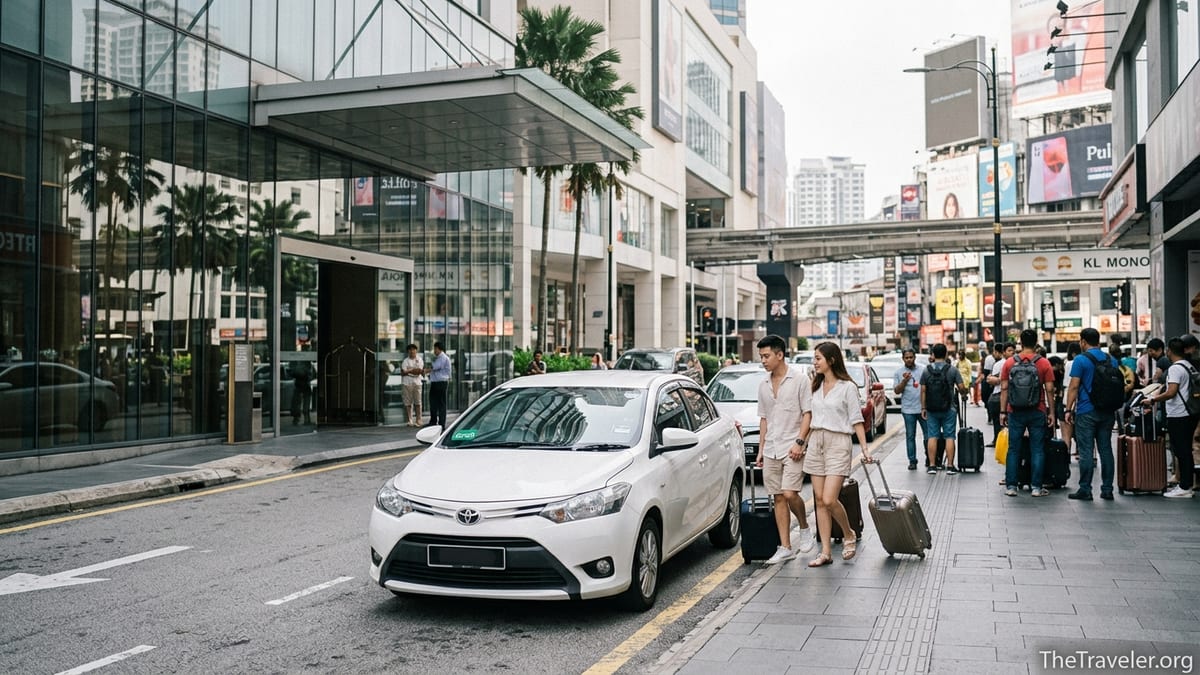
Understanding the Journey: KLIA, KL Sentral and Bukit Bintang
Kuala Lumpur International Airport has two main terminals: KLIA Terminal 1 (the original main terminal) and KLIA Terminal 2 (used heavily by AirAsia and other low-cost carriers). Both terminals are about 55 kilometers from central Kuala Lumpur, and roughly an hour by car in normal traffic to Bukit Bintang. Train and road options serve both terminals, so the route you choose will mostly depend on your budget, how much luggage you are carrying and what time you land.
Almost every public-transport route from the airport to Bukit Bintang passes through KL Sentral. KL Sentral is the city’s main rail hub and interchange, where the KLIA Ekspres airport train terminates and connects with the MRT Kajang Line, KTM Komuter, LRT Kelana Jaya Line and the KL Monorail via the adjacent NU Sentral mall. From KL Sentral, it is an easy onward hop to Bukit Bintang either by MRT, monorail or a short Grab or taxi ride.
Bukit Bintang itself is compact but dense. The MRT Bukit Bintang station on the Kajang Line and the KL Monorail Bukit Bintang station sit within the Golden Triangle, serving major hotels and malls such as Pavilion Kuala Lumpur, Lot 10 and Starhill. In practice, most hotels are within a 10 to 15 minute walk of one of these stations, or just a few minutes by car, so once you reach Bukit Bintang the last mile is usually simple.
Because of the clear rail link into the city and strong ride-hailing coverage, visitors rarely need to book expensive private transfers in advance. Choosing between rail and road mainly comes down to the time of day, your arrival terminal and whether you are traveling solo, as a couple or with a family group.
KLIA Ekspres: Fastest Link to the City
The KLIA Ekspres is the dedicated non-stop airport train from KLIA T1 and T2 to KL Sentral. As of 2026, the adult one-way fare is around RM55 per person, with a journey time of about 28 minutes from KL Sentral to KLIA T1 and just a few minutes more including the short hop to KLIA2. Trains typically run every 15 to 20 minutes during the day and are timed for airline schedules, making them a reliable option even if your flight is slightly delayed.
For most solo travelers and couples arriving in daytime or early evening, KLIA Ekspres strikes the best balance of speed and comfort. A visitor flying in from London and landing at 3 pm, for example, can expect to clear immigration, pick up luggage, walk directly to the KLIA Ekspres station in the terminal and be at KL Sentral in under an hour after landing, independent of road traffic conditions. The trains are air-conditioned, have luggage racks and wide aisles, and are generally much faster than taking a taxi during rush hour.
Tickets can be purchased at counters or machines in both terminals or via the KLIA Ekspres app, often with small online discounts or return-ticket savings. Families with children will find the spacious carriages easier than squeezing bags and strollers into a standard sedan. However, because pricing is per person rather than per car, a family of four will often pay more for the train plus onward transport than for a single Grab or taxi from the airport directly to the hotel.
For travelers who want a fully assisted arrival, KLIA Ekspres also offers a VIP service that bundles the train ride to KL Sentral with an executive car transfer from KL Sentral to your hotel. This is useful if you are nervous about navigating a new transit system alone or arriving late at night with bulky luggage, though it comes at a premium compared with arranging each leg yourself.
MRT and Monorail: Rail to the Heart of Bukit Bintang
Once you arrive at KL Sentral on the KLIA Ekspres, the most efficient rail route into Bukit Bintang is via the MRT Kajang Line. From KL Sentral, follow signs through the NU Sentral shopping mall to Muzium Negara MRT station, then ride the MRT Kajang Line four stops to Bukit Bintang station. The MRT ride itself usually costs under RM3 per person and takes around 10 minutes.
Bukit Bintang MRT station is an underground station located directly beneath the intersection of Jalan Bukit Bintang and Jalan Sultan Ismail, with exits feeding into or near major malls such as Pavilion Kuala Lumpur and Lot 10. If your hotel is connected to these malls or within short walking distance, such as the JW Marriott Kuala Lumpur, Grand Hyatt Kuala Lumpur via the covered Pavilion–KLCC walkway, or hotels along Jalan Bukit Bintang, the MRT route is typically the most direct and weather-proof option, especially in heavy rain.
The KL Monorail provides an alternative rail link into Bukit Bintang. From KL Sentral, you can ride the monorail to Bukit Bintang station, which runs on an elevated track above the streets and also stops at Imbi, Raja Chulan and other points in the Golden Triangle. The monorail is particularly useful if your hotel is closer to Imbi or the Times Square area. However, because the monorail can be crowded during peak hours and requires a short walk from KL Sentral through a connected corridor, many travelers now prefer the MRT route through Muzium Negara.
It is worth noting that while Bukit Bintang MRT and Bukit Bintang Monorail are very close to each other and function as an interchange in practical terms, they are separate stations and not a fully integrated paid-area transfer. In most cases, as a visitor going directly from the airport, you will either use the MRT route entirely or combine KLIA Ekspres with a short Grab ride from KL Sentral, rather than transferring between MRT and monorail at Bukit Bintang with luggage.
Grab and Taxis: Door-to-Door Convenience
For travelers who prioritize convenience over absolute cost, ride-hailing and taxis provide a straightforward door-to-door transfer from KLIA or KLIA2 to Bukit Bintang. Grab is the dominant ride-hailing app in Malaysia, and a typical non-peak fare from KLIA to Bukit Bintang usually falls in the range of about RM75 to RM90, including highway tolls, for a standard sedan. This is competitive when compared with two or more KLIA Ekspres tickets plus an onward taxi, especially for couples or families.
In practice, a couple landing at KLIA2 at 10 pm with two medium suitcases may find that a Grab ride costing around RM80, taking roughly 50 to 60 minutes depending on traffic, is both cheaper and more straightforward than buying two train tickets and then transferring to the MRT. Families of three or four with large suitcases often book a Grab 6-seater or similar larger-category car, which costs more than a standard sedan but is still cost-effective per person compared with buying multiple rail tickets.
Official airport taxis are also available at both terminals, typically using a coupon or metered system. Budget taxis have historically had fixed coupon fares by zone, with Bukit Bintang falling into the central city band. Exact fares can change periodically, but they usually sit in the same general range as Grab or slightly higher for larger vehicles, especially after midnight when surcharges may apply. The advantage is that you can arrange a taxi even without a local SIM card or ride-hailing account, simply by visiting the taxi counter in the arrivals hall.
When comparing Grab and taxis, consider not only the base fare but also waiting times. At busy times such as Friday evenings or major holidays, Grab prices can surge and the app may show longer estimated arrival times. In those situations, heading to the official airport taxi counter can sometimes be faster, particularly if you are traveling with children and want to minimize waiting. Conversely, during quiet mid-morning arrivals on weekdays, Grab often offers very competitive fixed fares with short dispatch times.
Choosing the Right Route for Your Hotel Zone
Bukit Bintang is not just one street but a cluster of overlapping hotel and entertainment zones. Knowing exactly where your hotel sits within the district will help you choose the smartest arrival route. Hotels directly along Jalan Bukit Bintang or connected to major malls such as Pavilion Kuala Lumpur, Starhill, Lot 10 and Fahrenheit 88 are usually best reached via the MRT Bukit Bintang station, using Exit C or D for Pavilion and related properties.
If you are staying closer to the Imbi or Berjaya Times Square area, such as at Berjaya Times Square Hotel or nearby serviced apartments, the KL Monorail Imbi station can be more convenient. In that case, you could still use KLIA Ekspres to KL Sentral and then change to the monorail, riding only two or three stops before getting off at Imbi. Guests staying further north near the Bukit Nanas and Raja Chulan side of the Golden Triangle might also consider the monorail, although a short Grab ride from KL Sentral remains an easy fallback.
For luxury hotels slightly outside Bukit Bintang yet within walking distance, such as Mandarin Oriental or Traders Hotel at KLCC, you might use the same airport-to-city options but then either take the MRT one more stop to Tun Razak Exchange and connect to other lines, or simply transfer to a short Grab ride from KL Sentral. In good weather, some travelers even walk from Bukit Bintang to KLCC using the air-conditioned pedestrian walkway connected to Pavilion, but if you are jet-lagged with luggage, a car from KL Sentral is usually more comfortable.
In practical terms, if you are unsure of your exact location, it is often better to get close using rail and then finish by car. For example, a traveler booked at a boutique hotel on a small side street behind Jalan Alor might find it easiest to take KLIA Ekspres to KL Sentral, ride the MRT to Bukit Bintang, and then order a short Grab ride from the station exit, which will cost only a few ringgit and save dragging suitcases through narrow, busy lanes.
Traffic Patterns, Arrival Times and Luggage Considerations
Traffic between KLIA and central Kuala Lumpur is generally smooth outside of peak periods, but there are consistent patterns worth considering. Morning rush hour into the city tends to build from around 7.30 am to 9.30 am, while evening congestion leaving the city towards the airport is most noticeable around 4.30 pm to 7.30 pm on weekdays. Within central Kuala Lumpur, roads around Bukit Bintang can be heavily congested in the late afternoon and early evening, particularly on Fridays and weekends.
For a midday arrival into KLIA, road-based options like Grab and taxis are usually straightforward. A family landing from Sydney at 11 am, for example, is likely to enjoy a relatively smooth one-hour drive to Bukit Bintang, with only moderate traffic near the city center. By contrast, a business traveler landing from Singapore on a Friday at 5.30 pm might be better served by the KLIA Ekspres to avoid sitting in traffic on the highway, then deciding between MRT or a short Grab ride from KL Sentral depending on how much luggage they are carrying.
Luggage is a practical factor many visitors underestimate. While the trains and MRT are well equipped to handle suitcases, navigating station escalators, occasional short staircases and busy platforms can be tiring after a long-haul flight. If you are traveling with two large checked bags and a carry-on each, or accompanying young children, the simplicity of stepping into a single door-to-door car transfer from the terminal to your hotel may be worth the extra cost compared with splitting the journey across train and metro lines.
For light or solo travelers, though, public transport works very well. A solo backpacker arriving from Bangkok with just a carry-on can move quickly through immigration, catch the KLIA Ekspres, and be on the MRT to Bukit Bintang with no trouble, often reaching their hostel on Changkat Bukit Bintang in little more than an hour from touchdown. In the evening, when sidewalks are busy and the air is humid, carrying only a small bag makes those final blocks on foot far easier.
Sample Arrival Plans for Different Types of Travelers
To make the choice clearer, consider a few real-world style scenarios. A solo traveler in their 20s flying into KLIA2 at 10 am with a small suitcase and a backpack, staying at a budget hotel near Jalan Alor, will usually find the KLIA Ekspres plus MRT combination ideal. They could buy a KLIA Ekspres ticket at KLIA2, ride to KL Sentral in under 35 minutes, walk to Muzium Negara MRT station, and then ride directly to Bukit Bintang. From there, a 10-minute walk or a brief Grab ride will complete the journey with minimal cost and good reliability.
By contrast, a couple in their 30s arriving from Europe at midnight with two large suitcases each and staying at a mid-range hotel on a side street off Jalan Bukit Bintang might lean towards a direct Grab or airport taxi. At that hour, train frequencies are lower and some rail services may be winding down for the night, while the walk from stations to the hotel could feel longer when you are exhausted. A single car transfer that takes them straight from the terminal arrivals curb to their hotel lobby, even at a slightly higher fare, often feels like a sensible investment in comfort and safety.
For a family of four arriving mid-afternoon with two adults, two children and several pieces of luggage, a balanced strategy could work best. They might choose KLIA Ekspres to avoid highway traffic during the busiest hours, then at KL Sentral transfer to a pre-booked larger Grab vehicle or a taxi van to Bukit Bintang. The children get a stretch and a change of scenery when moving between train and car, while the adults avoid wrestling bags through multiple local stations at rush hour.
Business travelers on tight schedules often prefer the predictability of KLIA Ekspres combined with a short Grab ride from KL Sentral. For example, someone flying in for a meeting at one of the offices above Pavilion Kuala Lumpur can reliably budget 30 minutes from clearing customs to arriving at KL Sentral via train, then another 15 to 20 minutes to be dropped off at their hotel or office entrance in Bukit Bintang, regardless of highway congestion. This consistency is particularly valuable if they are arriving on a morning flight and heading straight into a meeting.
The Takeaway
From Kuala Lumpur International Airport to Bukit Bintang, travelers have a flexible mix of fast rail connections and convenient car-based options. The KLIA Ekspres provides the quickest and most predictable link from both KLIA terminals into the city, while the MRT Kajang Line and KL Monorail extend that connectivity straight into the heart of Bukit Bintang’s hotel and shopping zones. Grab and official airport taxis add an easy, door-to-door alternative that becomes especially attractive for couples, families and late-night arrivals.
There is no single best route that suits every traveler. Your ideal plan will combine time of arrival, hotel location, luggage load and budget. As a general rule, solo visitors and light travelers arriving during the day will find the KLIA Ekspres plus MRT combination hard to beat for speed and value, while groups, families or anyone arriving late at night may value the simplicity of a direct car. Understanding these trade-offs before you land will help you move smoothly from the plane door to your hotel check-in, so you can spend more of your first day in Kuala Lumpur enjoying the bright lights of Bukit Bintang.
FAQ
Q1. What is the fastest way from KLIA to Bukit Bintang?
The fastest option in most cases is the KLIA Ekspres train to KL Sentral, followed by the MRT Kajang Line to Bukit Bintang station, taking around 45 to 60 minutes door to door depending on walking time to your hotel.
Q2. How much does a Grab from KLIA to Bukit Bintang usually cost?
A standard Grab car from KLIA or KLIA2 to Bukit Bintang typically costs in the region of RM75 to RM90 including tolls in normal conditions, with prices varying by time of day, demand and car type.
Q3. Is KLIA Ekspres cheaper than taking a taxi?
For solo travelers, KLIA Ekspres is often cheaper and faster than a taxi or Grab, but for couples and families, the total cost of multiple train tickets plus onward transport can exceed the price of a single car, making taxis or Grab more economical per person.
Q4. Which station should I use for hotels near Pavilion Kuala Lumpur?
For hotels around Pavilion Kuala Lumpur and Jalan Bukit Bintang, Bukit Bintang MRT station is usually the most convenient, with exits leading directly into or next to major malls and only a short walk to many hotels.
Q5. Is it easy to use the MRT and monorail with luggage?
Yes, but it depends on how much you are carrying. Stations are generally equipped with escalators and elevators, and trains have space for suitcases, but navigating crowds and short staircases can be tiring with multiple large bags or young children in tow.
Q6. Are there late-night transport options from KLIA to Bukit Bintang?
Late at night, train frequencies are reduced and some services stop around midnight, so many travelers arriving very late prefer Grab or official airport taxis, which operate 24 hours and provide direct hotel drop-off.
Q7. How long does the car journey from KLIA to Bukit Bintang take?
Under light traffic, the drive usually takes about 50 to 60 minutes. During peak rush hours or heavy rain, it can extend to 75 minutes or more, especially near central Kuala Lumpur.
Q8. Do I need to book airport transfers in advance?
Most visitors rely on the readily available KLIA Ekspres, MRT and Grab services without pre-booking. Advance bookings can be helpful during major holidays, for large family groups or if you prefer a guaranteed private car waiting on arrival.
Q9. Which route is best for a family with young children?
Families with young children often prefer a direct Grab or taxi from the airport for simplicity, or a combination of KLIA Ekspres to KL Sentral followed by a short pre-booked car ride to the hotel, minimizing walking and transfers.
Q10. Can I pay for transport with a foreign credit card or do I need cash?
KLIA Ekspres and most ticket machines accept major credit and debit cards, while Grab rides are easily paid by card through the app. Taxis may prefer cash, especially budget cabs, so it is sensible to have some Malaysian ringgit on hand for flexibility.