


More news on this day
Passengers traveling through Kuwait International Airport faced significant disruption after 32 flight delays and five cancellations rippled across key Middle East routes, affecting services operated by leading regional and Gulf carriers.
Get the latest news straight to your inbox!
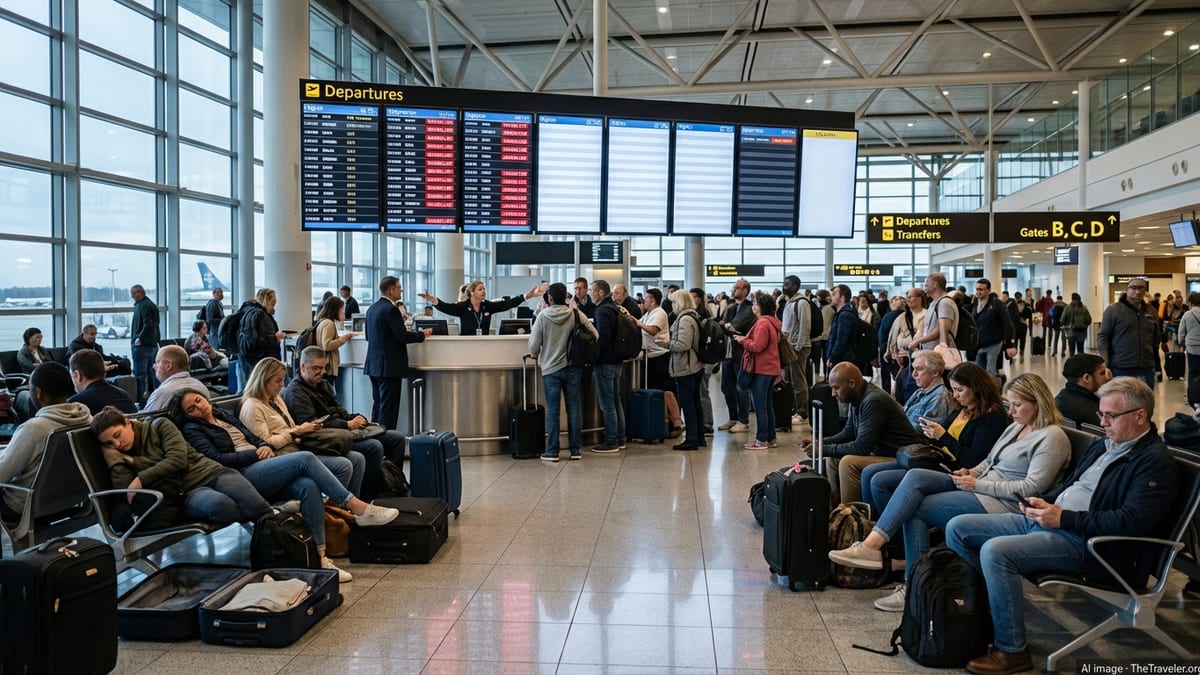
Wave of Disruptions Follows Turbulent Period for Kuwait Hub
The latest cluster of delays and cancellations at Kuwait International Airport comes on the heels of a volatile period for aviation in the Gulf, with regional security tensions and temporary airspace suspensions already straining airline operations. Publicly available airport flight boards and aviation tracking data for recent days show dozens of services departing or arriving behind schedule, along with a small but disruptive number of outright cancellations.
Operational data indicates that on the day of the incident highlighted by 32 delays and five cancellations, the impact was concentrated within a relatively short time window, compounding congestion across terminals. Even where flights eventually departed, extended ground holds and late arrivals disrupted onward connections and pushed crews and aircraft out of their planned rotations.
Published coverage of Kuwait’s aviation sector notes that the country’s primary airport has been operating under heightened pressure since airspace closures and drone strikes earlier in 2026 forced airlines to reschedule or reroute traffic. While airspace has reopened and most services have resumed, the system remains vulnerable to cascading disruption whenever schedules are compressed or operational capacity is temporarily reduced.
Travel industry observers say the pattern at Kuwait mirrors broader instability across Middle East air corridors, where airlines are juggling shifting routings, crew constraints, and evolving safety assessments. Against that backdrop, even a relatively contained episode involving a few dozen delayed services can be enough to knock a hub’s daily operation off balance.
Major Gulf and Regional Airlines Among Those Affected
The disruption at Kuwait International Airport has affected a mix of local carriers and major Gulf airlines that use the airport for dense shuttle-style traffic across the region. According to open flight-status data and media reports, services involving Emirates, Etihad Airways, Air Arabia, Kuwait Airways, and Jazeera Airways have all experienced schedule changes or cancellations in recent days as operations adjust to conditions at the airport.
Routes linking Kuwait with major Gulf hubs such as Dubai, Abu Dhabi, Doha, and Manama have been particularly exposed, given the high frequency of daily flights and their role as feeders into long-haul networks. When a single departure from Kuwait runs late or is cancelled, the impact can extend far beyond point-to-point passengers, affecting travelers headed to Europe, Asia, or North America via larger connecting hubs.
According to published coverage from regional outlets, several airlines have temporarily suspended or reduced certain rotations between the United Arab Emirates and Kuwait, citing operational or safety considerations. Others have opted for rolling schedule adjustments, maintaining core connectivity but with altered timings and intermittent cancellations as capacity, aircraft availability, and airspace conditions evolve.
The presence of multiple carriers on overlapping city pairs has offered some flexibility, but that redundancy has not fully shielded travelers. In several cases, passengers reported being moved to later departures on competing airlines, while others were left awaiting rebooking or refund processing as carriers worked through backlogs created by earlier disruptions.
Knock-On Effects Across Middle East and Long-Haul Networks
Although the headline numbers at Kuwait International Airport reference 32 delays and five cancellations within a specific operating window, the reverberations extend across a much broader geography. Flights to and from Bahrain, Qatar, the United Arab Emirates, and other Gulf Cooperation Council states have had to accommodate passengers displaced from Kuwait services, adding pressure to already busy summer schedules.
According to information compiled from regional news and airline advisories, some long-haul routes have also felt indirect strain. Aircraft and crew rotations that touch Kuwait can feed into services to Europe, South Asia, and North America, so delays on short regional legs have at times contributed to late departures or schedule reshuffles further afield.
Reports from travel-tracking communities and passenger forums describe a mix of extended layovers, missed connections, and last-minute changes to routings. In certain cases, travelers bound for destinations such as Chicago, London, or key South Asian cities have been rerouted around Kuwait altogether, traveling via alternative hubs to avoid the risk of additional disruption.
Analysts following Middle East aviation note that the region’s highly interconnected network structure can amplify the impact of localized issues. When a hub like Kuwait experiences even a temporary squeeze in capacity, knock-on effects can ripple outward quickly, especially during peak travel periods when spare seats and aircraft are limited.
How Passengers Are Being Managed Under Disruption
Publicly available airline advisories and regional reporting indicate that carriers serving Kuwait have been relying on a combination of rerouting, rebooking, and limited on-the-day support to manage affected passengers. Many travelers have been encouraged to monitor flight-status pages and mobile applications closely, as same-day schedule changes and rolling delays remain possible.
At the airport itself, airlines have been providing standard disruption assistance, which can include meal vouchers, hotel accommodation where required by local regulations or airline policy, and alternative travel dates when same-day options are unavailable. The level of support varies by carrier and ticket conditions, and some passengers have reported longer-than-usual waits at service desks as staff work through queues created by multiple delayed departures.
Consumer-rights guidance for Gulf travelers generally advises passengers to retain all documentation related to disrupted trips, including boarding passes, delay notifications, and receipts for incidental expenses, as these may be needed when seeking compensation or reimbursement. Legal frameworks differ across jurisdictions, but in many cases travelers can request refunds or changes without penalty when flights are significantly delayed or cancelled for operational reasons.
Travel agents in the region have also advised clients to allow greater buffer time for connections involving Kuwait in the short term, particularly when itineraries combine separate tickets on different airlines. Additional time between flights can reduce the risk of missed onward journeys if delays recur or schedules shift at short notice.
Outlook for Kuwait Airport Operations and Regional Travel
Recent statements and reporting about Kuwait’s aviation sector suggest that authorities and airlines are working to stabilize operations after months of intermittent disruption driven by regional tensions and infrastructure constraints. The reopening of airspace and the return of most scheduled flights have marked an important step, but the latest cluster of delays and cancellations highlights the fragility that still exists in the system.
Industry analysts expect that airlines will continue to make tactical adjustments to Kuwait schedules over the coming weeks, trimming frequencies on some routes while preserving core links within the Gulf and to key international destinations. Where feasible, carriers may also deploy larger aircraft on select rotations to accommodate backlogs created by earlier cancellations.
For travelers, the immediate outlook is one of cautious optimism mixed with the need for flexibility. While there is no indication that Kuwait International Airport faces a prolonged shutdown, the events surrounding the 32 delays and five cancellations underscore the importance of checking flight status frequently, considering travel insurance, and building contingency time into itineraries involving the airport.
Observers of Gulf aviation say that Kuwait’s experience is emblematic of a wider challenge facing Middle East hubs: maintaining reliable schedules in a region where security, airspace access, and infrastructure pressures can shift rapidly. How quickly Kuwait International Airport can convert recent turbulence into a more predictable operating rhythm will be closely watched by airlines and passengers across the region.