


Slovenia’s Triglav National Park is where bright turquoise rivers cut through limestone gorges, stone farmhouses sit beneath jagged peaks, and quiet mountain trails begin right behind village bus stops. For a first-time visitor it can feel overwhelming to choose between hiking to lonely alpine huts, cruising across glacial lakes, or driving dramatic passes. This guide breaks the park down into concrete experiences, with real-world examples of routes, prices and logistics so you can plan a rewarding first visit without feeling lost in the map of the Julian Alps.
Get the latest updates straight to your inbox!
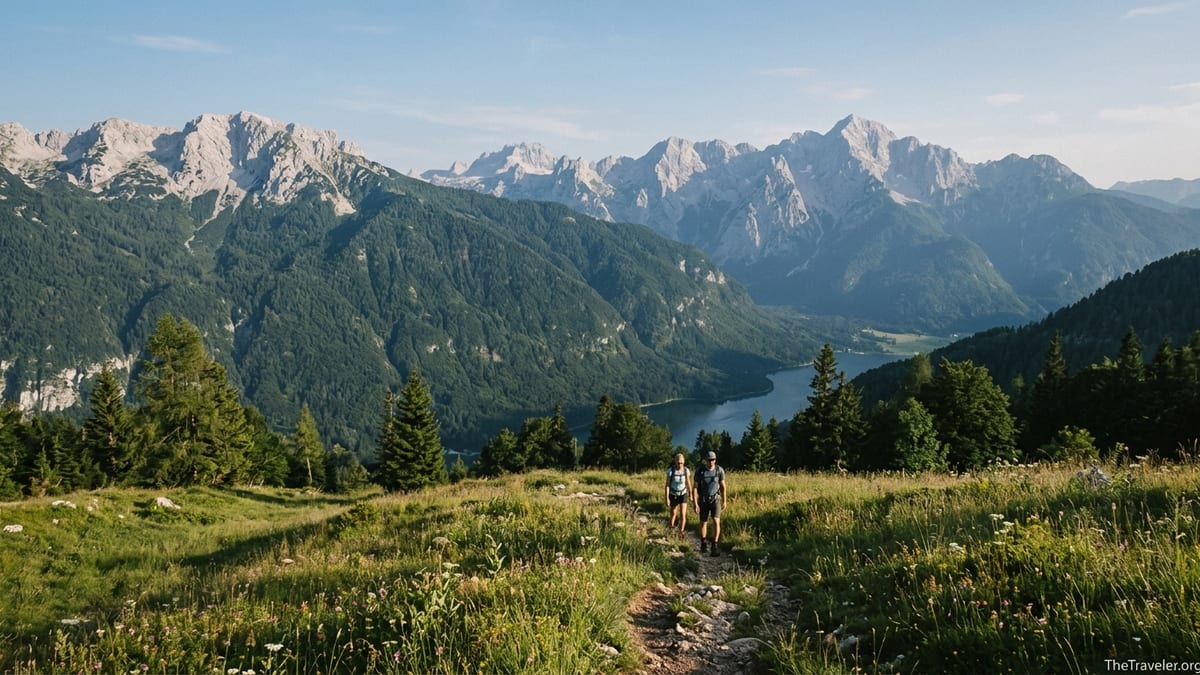
Getting Oriented in Triglav National Park
Triglav National Park covers much of Slovenia’s Julian Alps, roughly a two-hour drive northwest of Ljubljana. Mount Triglav, which tops out at about 2,864 meters, rises almost in the middle of the park, and the protected area stretches around well-known bases such as Lake Bohinj, Kranjska Gora and the Soča Valley. In practice, most first-time visitors experience the park through these gateway towns rather than by driving across the whole region in a single day.
If you stay in Ljubljana, regular buses run to Lake Bled and Lake Bohinj, taking about 1 hour 15 minutes to Bled and another 35 to 40 minutes on to Bohinj in normal traffic. From Bohinj, a separate bus line continues to the mountain village of Ukanc at the far end of the lake, where several classic hikes and the Vogel cable car begin. On the northern side of the park, Kranjska Gora works as a base if you plan to drive or cycle the Vršič Pass or explore the upper Sava Valley.
The park itself does not charge a general entry fee. Instead, you pay as you go for services such as parking and cable cars. Around Lake Bohinj, for example, day parking in official lots commonly runs in the range of 10 euros per day in high season, while short-stay roadside spots near trailheads can be a few euros per hour. You will also pay extra to use facilities like the Vogel cable car or the panoramic boats on Lake Bohinj and nearby Lake Bled.
For a first-time trip of three to five days, it is realistic to focus on one or two hubs rather than trying to cross the entire park. A typical introductory itinerary might include two nights at Lake Bohinj for lakeside walks, a cable car ride and an easier hike, then a transfer over to Bovec in the Soča Valley for rafting and short walks along the turquoise river, or to Kranjska Gora for alpine drives and family-friendly strolls.
Explore the Lakes: Bohinj, Bled and Triglav’s Reflections
If there is one place that captures the gentler side of Triglav National Park, it is Lake Bohinj. Unlike Lake Bled, which lies just outside the park boundary, Bohinj sits fully within the protected area and feels quieter and wilder. The lake is about 4 kilometers long, with a simple paved path that follows much of the north shore. Walking from the small lakeside village of Ribčev Laz to the far end at Ukanc typically takes 1.5 to 2 hours at a relaxed pace, with plenty of spots to stop for a swim in summer.
Boat services on Lake Bohinj usually operate from late spring through early autumn, carrying passengers between Ribčev Laz and Ukanc. A return ticket tends to cost somewhere around 15 to 20 euros for adults, with discounts for children. Many visitors choose to walk one way and return by boat, for example hiking along the quieter northern path in the morning, having lunch at a restaurant near Ukanc, then riding back in the afternoon as the light softens over the surrounding peaks.
Lake Bled, though technically outside the park boundary, is often combined with a Triglav visit on the same trip. Here, the experience is more developed: you can rent a traditional wooden pletna boat with a rower to reach the island church, hire a rowboat yourself by the hour, or simply complete the 6-kilometer loop around the shore in roughly 90 minutes. A short but steep trail from the western shore leads to the hill of Ojstrica, a popular sunrise viewpoint over the lake and the Julian Alps beyond. Many visitors will do Bled as a day trip from Ljubljana or as a half-day stop on their way toward Bohinj.
Beyond these famous lakes, Triglav National Park also hides a chain of high-altitude tarns known as the Seven Lakes Valley, reached by a full-day or overnight hike from Bohinj-side trailheads such as Planina Blato. You will not find boat rentals or cafes at these upper lakes. Instead, the experience is of rock-lined shores, small wooden bridges and a single mountain hut that offers simple dorm beds and warm meals. For a first-time visitor who is fit and already comfortable with mountain hiking, an overnight at the hut above the Seven Lakes can be a memorable way to taste the wilder interior of the park.
Ride the Vogel Cable Car and Hike Easy Alpine Trails
For visitors who want big-mountain views without committing to a full mountaineering ascent, the Vogel cable car is one of the best introductions to the Julian Alps. The lower station sits near Ukanc at the western end of Lake Bohinj, and parking is available in dedicated lots nearby. The cable car climbs in a few minutes to a plateau at roughly 1,500 meters, with sweeping views back over the lake and across to the central Triglav massif. Return tickets for adults frequently fall in a range of 30 to 40 euros, with family packages that reduce the total cost for parents with children.
At the upper station you find several gravel tracks and waymarked trails radiating out into the ski area and beyond. First-time hikers often start with a simple 30 to 45 minute walk along the ridge paths around the ski slopes, stopping at one of the mountain restaurants for coffee or a bowl of jota, the local bean and sauerkraut stew. Wooden terraces at these huts look directly down onto Lake Bohinj far below, making them an easy place to linger on a clear morning.
Those looking for something more active but still manageable can tackle one of the marked peaks reachable from the Vogel plateau. A classic choice is the walk toward the summit of Šija or a traverse to the Komna plateau, both offering half-day outings on well-trodden paths. Guided hikes can be booked through local agencies in Bohinj and Bled, some of which will meet you in Ljubljana and provide transport. Prices commonly start from around 80 to 120 euros per person for a full-day small-group tour, depending on the exact route and how inclusive the package is.
For families or travelers worried about changeable weather, Vogel also works as a flexible destination. On days when clouds wrap the highest summits, you might still find the plateau above Bohinj bathed in sun. The upper station area remains manageable for those with limited mobility, offering short, almost level strolls between terraces, viewpoints and the cable car itself, so it can be enjoyed even by visitors who do not plan to hike far.
Walk Gorges and Waterfalls: Vintgar, Mostnica and Savica
One of the most photogenic experiences near Triglav National Park is a walk through a gorge. Vintgar Gorge, located a short drive from Lake Bled, is the most famous example. A boardwalk path clings to the side of the rock walls above the Radovna River, leading visitors along roughly 1.5 kilometers of turquoise pools and small rapids. Because of its popularity, Vintgar now uses timed entry slots in high season, and adult tickets typically cost around 10 to 15 euros. It is wise to book earlier slots in the day if you would like to take photos without crowds pressed close behind you.
Inside the park itself, the Mostnica Gorge near the village of Stara Fužina at Lake Bohinj offers a quieter but just as atmospheric option. The trail follows the narrow canyon of the Mostnica stream, where potholes, rock arches and small cascades have earned it the nickname “Little Vintgar” among some visitors. You pay a modest trail fee at the entrance, often only a few euros, which goes toward path maintenance. The easiest section takes 1.5 to 2 hours round-trip from the trailhead, making it a good choice for families or for an afternoon outing after a morning swim.
At the far end of the Bohinj Valley, the Savica Waterfall offers perhaps the park’s most iconic cascade, feeding Lake Bohinj through underground channels. From the car park near Ukanc it is about a 20 to 30 minute climb up stone steps to a viewing platform that faces the waterfall directly. There is a small entrance fee at the ticket hut, again typically a few euros. Practical details matter here: in summer, arriving early in the morning or late in the day lets you avoid both the heat and the tour buses, and you will want proper shoes with some grip, since the stone steps can be slick after rain.
Further north, outside the core lake region but still within reach of a day’s drive, the Peričnik Waterfall near the Vrata Valley is another standout. A short forest trail leads to a lower cascade where, in late spring and early summer, a curtain of water drops from a horseshoe-shaped cliff. A narrow path allows walkers to pass carefully behind the fall itself. During peak season local authorities sometimes require visitors to park farther down the valley and take a shuttle, with round-trip shuttle fares in the range of a few euros per adult. Bringing a lightweight rain jacket and a dry bag for your camera will make the experience more comfortable.
Drive or Cycle the Vršič Pass and Discover the Soča Valley
The Vršič Pass is Slovenia’s highest paved mountain pass, topping out at about 1,611 meters. The road begins near Kranjska Gora on the northern side, climbs via 24 cobbled hairpin bends, then descends in another 26 switchbacks into the Soča Valley on the southern side. In good summer conditions, the full drive takes about 45 minutes to an hour between Kranjska Gora and the town of Bovec, not counting scenic stops. It is important to know that the pass typically closes for regular traffic from late autumn through late spring, reopening once snow and ice conditions allow, usually around late May or June depending on the year.
For a first-time visitor with a rental car, a day spent crossing Vršič is a practical way to link the northern and southern sides of Triglav National Park. Many travelers start from Kranjska Gora mid-morning, stop at the Russian Chapel and at several roadside viewpoints, then have lunch at one of the mountain lodges near the pass summit where simple hot dishes like goulash and štruklji dumplings are served. Afterward they continue down into the Soča Valley, where the river’s unusually bright turquoise color often surprises even seasoned alpine travelers.
Cyclists consider Vršič one of the classic road climbs in the region. The gradients reach into the low double digits on some of the switchbacks, and the old stone-set hairpins can be jarring under narrow road tires, so this outing suits reasonably fit riders used to mountain passes. Some bike tour operators based in Kranjska Gora, Bled and Bovec rent road and e-bikes specifically for the pass, with day rates commonly starting around 40 to 60 euros for a well-maintained e-bike including a helmet. In high summer, it is best to start early to avoid midday heat and heavier car traffic.
On the southern side of the pass, the Soča Valley centers on villages such as Trenta, Kobarid and Bovec, all popular bases for water-based activities. In Bovec, agencies line the main street offering guided rafting, canyoning and kayaking trips. A typical half-day family rafting trip on the Soča might cost somewhere around 60 to 90 euros per person, with all equipment and transport to the river access point included. Most companies will run tours even if you do not have a car, picking you up at central meeting points in town and dropping you back outside your guesthouse or campsite.
Sample Iconic Hikes Without Committing to a Summit of Triglav
For many Slovenians, climbing Mount Triglav itself is a rite of passage, but the normal routes to the summit involve exposed sections and steel cables, and are best left to experienced mountain hikers or those accompanied by professional guides. Guided ascents usually take two days, with a night in a high hut such as Planika or Kredarica, and prices often begin somewhere in the region of 300 euros per person for small groups, including guiding but not hut meals or cable cars. For a first visit, especially if you are new to the high Alps, it is often wiser to choose less committing routes that still deliver a strong sense of the park’s character.
A standout choice is the Komna plateau, reached on a long series of zigzagging paths from near the Savica Waterfall parking area above Lake Bohinj. The ascent takes most people between 2.5 and 3.5 hours one way, climbing through forest to an open plateau dotted with low pines and scattered huts. The Komna hut offers simple hot food, drinks and basic overnight accommodation in shared rooms. Many travelers treat Komna as a full-day hike, enjoying a late lunch and a coffee on the terrace before descending the same way in the afternoon.
Another rewarding option is a partial hike into the Valley of the Seven Lakes. Starting from trailheads such as Planina Blato, which can be reached via a toll access road above Bohinj, fit walkers can reach the first of the lakes and the mountain hut beside it in roughly 3 to 4 hours. The full traverse of all seven lakes requires more time and good preparation, but even a shortened version gives a taste of the park’s limestone plateaus, mountain pastures and clear tarns without demanding technical skills.
On the northern side of the park, day hikes above Kranjska Gora take you to vantage points over the Mojstrana and Vrata valleys. A simple outing is the walk into the Vrata Valley itself, where the north face of Triglav rises nearly vertical at the head of the valley. From the Aljaž Hut at the end of the road, non-climbers can still wander along marked forest paths and riverbank trails, watching climbers with binoculars and reading route diagrams on information boards. For first-timers, this is a way to feel the scale of the main summit without committing to the exposure of the actual ascent.
Experience Village Life and Mountain Culture
One of the best things about Triglav National Park for first-time visitors is how alpine nature and everyday village life blend together. Around Lake Bohinj, the village of Stara Fužina sits within walking distance of both the lakeshore and trailheads for the Mostnica Gorge. Traditional stone-and-wood farmhouses front narrow lanes where you might see hay drying on wooden racks in summer or residents cycling back from the local shop. Guesthouses here often serve hearty breakfasts featuring local cheese, cured meats and seasonal jam, making it easy to start a hiking day without hunting for a cafe.
In Kranjska Gora, the feel is more that of a compact alpine resort, with gear shops, bakeries and restaurants lining a pedestrian-friendly center. It is a practical base if you want to rent equipment such as trekking poles or e-bikes, or if you are traveling with children who will appreciate the playgrounds and short lakeside walks around nearby Lake Jasna. The lake’s small beaches and wooden piers are a popular spot on warm afternoons, and a cafe on the shore makes it easy to linger with coffee while watching locals jump from the diving platform.
Down in the Soča Valley, Bovec has developed a reputation as an outdoor sports hub, while Kobarid offers a calmer atmosphere with a strong layer of First World War history. In Kobarid you can combine a short circular walk that passes a suspension bridge over the Soča and the Kozjak Waterfall with a visit to the town’s museum, which documents the fierce mountain battles that took place here. Many travelers pair this outing with lunch on a terrace overlooking the valley, choosing from local dishes such as frika, a thick potato and cheese skillet, or trout from the river.
Across the park, small cultural experiences add depth to time spent on the trails. You might visit an information center operated by the park administration to learn about wildlife and geology, or join a guided nature walk organized during school holidays. In villages such as Bohinjska Bistrica, local tourist farms open their doors for tastings of products like mountain cheese and honey. These visits are usually informal and affordable, often costing not much more than a standard meal in a mid-range restaurant but leaving a stronger memory of place.
Practical Tips for First-Time Visitors
Triglav National Park is a protected area with strict rules designed to preserve its ecosystems. Wild camping is prohibited throughout the park, and rangers routinely issue fines to those sleeping outside official campsites, mountain huts or licensed accommodations. If you are traveling with a campervan or motorhome, it is important to use designated campsites around Bohinj, Bovec or Kranjska Gora rather than pulling off onto forest tracks or lakeside parking areas, no matter how tempting an empty spot might look.
Weather in the Julian Alps changes quickly, even in summer. On a typical July or August day, you might start in bright sun at Lake Bohinj with temperatures around 25 degrees Celsius and encounter afternoon thunderstorms on the Vogel plateau or Vršič Pass. Packing a lightweight waterproof jacket, an extra warm layer and proper footwear with good grip will make most outings more comfortable. Even for short gorge walks, running shoes or light hiking shoes are preferable to sandals, as boardwalks and rocks can be slick.
Costs in and around the park are broadly comparable to those in neighboring alpine regions. A simple main dish in a mountain hut might be in the region of 10 to 15 euros, while a coffee on a lakeside terrace runs around 2 to 3 euros. Overnight stays in shared dorm rooms at high huts above the tree line are usually cheaper than hotels in Bled or Bohinj, but you should factor in the cost of half-board and cash-only payment policies. Many huts accept reservations only by email or phone, and in August it is common for the most popular huts to be fully booked on weekends.
Finally, travel logistics have become easier for those without a car. Seasonal shuttle buses often supplement regular services around Lake Bohinj and in the Soča Valley, especially during the main summer months, helping reduce private car traffic at crowded trailheads and gorges. When planning your trip, it is worth checking current shuttle timetables through local tourist information centers shortly before you arrive, since routes and operating dates are adjusted year by year in response to demand and road conditions.
FAQ
Q1. How many days should I spend in Triglav National Park on a first visit?
Most first-time visitors find that three to five days lets them see a mix of lakes, gorges and easier hikes without feeling rushed. With three days you might focus on Lake Bohinj and nearby trails; with five days you can add a crossing of the Vršič Pass and a day in the Soča Valley or Kranjska Gora.
Q2. Do I need a car to enjoy the main sights?
No, but a car gives you more flexibility. Buses connect Ljubljana with Lake Bled and Bohinj, and seasonal shuttles link many trailheads. Without a car you can still visit key spots like Lake Bohinj, Savica Waterfall, Mostnica Gorge and the Vogel cable car, though reaching remoter valleys and the Soča area will require more planning or guided tours that include transport.
Q3. Is it realistic to climb Mount Triglav on my first trip?
It depends on your experience. The normal routes involve long days, some exposure and fixed cables, and are best for fit hikers already comfortable on alpine terrain. Many first-time visitors choose to hike to high huts or panoramic viewpoints instead, leaving a full Triglav ascent for a later trip or booking a professional guide for safety.
Q4. When is the best time of year to visit?
Late June through September is ideal for hiking, with higher trails and the Vršič Pass usually open and huts operating. July and August are busiest and warmest, while June and September often bring slightly cooler temperatures and fewer crowds but a higher chance of changeable weather. Outside this window, some facilities and high routes close due to snow.
Q5. Can I swim in the lakes and rivers?
Yes, swimming is allowed in many places, especially at designated spots around Lake Bohinj and some sections of the Soča and Sava rivers. Water temperatures in alpine lakes are cool even in summer, so expect refreshing rather than bath-like conditions. Always respect local signage, avoid slippery rocks and stay clear of hydropower infrastructure or fast currents.
Q6. Are trails and signs easy to follow for non-Slovenian speakers?
Generally yes. Main hiking routes are well marked with painted red-and-white circles and signposts listing destinations and approximate times. Information boards at popular trailheads often include English and German text. Carrying a paper map or offline map app is still recommended, especially if you plan to venture away from the most frequented areas.
Q7. What should I wear for day hikes?
Plan for layered clothing: breathable base layers, a warm mid-layer and a lightweight waterproof jacket, plus sturdy shoes with good grip. Even in summer, temperatures can drop quickly with altitude or storms, so a hat, gloves and an extra layer are advisable for higher routes. Sunscreen, a refillable water bottle and a small first-aid kit are also sensible additions.
Q8. Are there food and water sources on the trails?
Many popular routes pass mountain huts where you can buy hot meals, snacks and drinks during the main season, but distances between huts vary. You should start each hike with enough water and food for the day. In general, do not rely on drinking directly from streams without treatment, as livestock and wildlife can affect water quality.
Q9. Is Triglav National Park suitable for children and less experienced hikers?
Yes, as long as you choose appropriate activities. Lakeside walks around Bohinj and Bled, gorge paths like Mostnica and shorter cable-car-accessed walks around Vogel and Lake Jasna work well for families. Steep summit routes or exposed ridge trails are better reserved for more experienced parties or done with local guides.
Q10. How far in advance should I book accommodation and huts?
For July and August, reserving hotels, guesthouses and mountain huts several months in advance is wise, especially for weekends. In shoulder seasons you may find more last-minute options, but popular lakeside towns and key huts can still fill quickly during holidays or good-weather periods, so booking at least a few weeks ahead is recommended.