


More news on this day
Long haul passengers are facing higher fares and longer journeys as airlines thread their way around a shrinking patchwork of safe sky, reconfiguring routes in response to a series of overlapping airspace restrictions from Eastern Europe to the Middle East.
Get the latest news straight to your inbox!
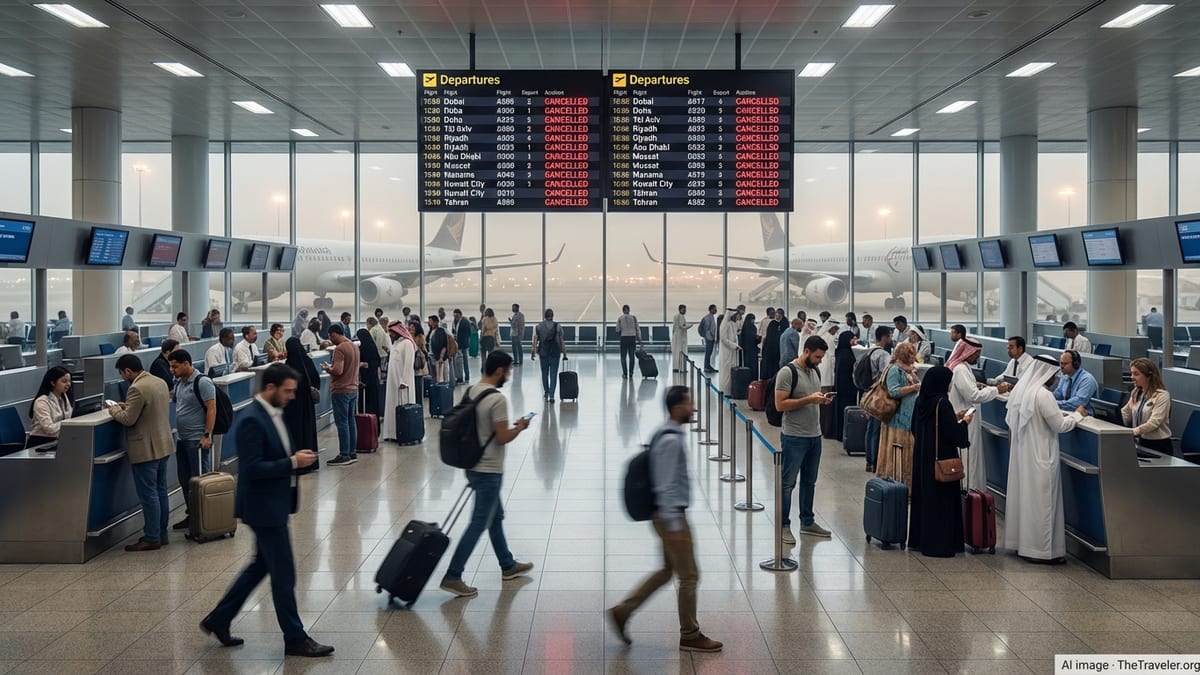
Geopolitics Redraws the Global Flight Map
Publicly available industry data shows that the amount of usable airspace for commercial aviation has shrunk markedly since the closure of Ukrainian and much of Russian airspace in 2022, with further constraints emerging across parts of the Middle East from 2024 onward. Routes that once took the most direct great circle paths between Europe, Asia and the Pacific are increasingly being bent south or north, adding distance, time and fuel burn.
Analyses from flight tracking platforms indicate that Europe to North Asia services are among the most affected, with some Helsinki to Tokyo journeys now flying thousands of additional kilometers compared with pre-2022 routings. Eurocontrol reporting on 2024 network performance highlights systematic route extensions for traffic skirting Russian, Belarusian and Ukrainian airspace, with knock-on effects for congestion and delay in surrounding regions.
The conflict-driven volatility in the Middle East has compounded these pressures. Reports from aviation consultancies and airline schedule data point to repeated waves of temporary airspace closures and reroutes following missile and drone activity around Iran, Iraq, Israel and the Gulf. Traffic between Europe and South or Southeast Asia, which historically relied on corridors through Iran and the eastern Mediterranean, has been forced onto longer detours over Central Asia or deeper into the Arabian Sea.
Industry assessments from organizations such as Airports Council International Asia-Pacific and Middle East describe the result as a structural change in east west connectivity rather than a short-lived disruption, with long haul networks being rebuilt around a smaller number of viable corridors and hub airports.
Longer Routes Translate Directly Into Higher Costs
For airlines, the basic economics of these changes are straightforward. Longer routings mean more fuel burned and more crew time consumed on every sector, while aircraft are tied up for extra hours instead of flying additional revenue-generating rotations. Case studies circulated within the aviation safety and operational planning community describe reroutes around sensitive Middle Eastern airspace adding 45 to 90 minutes to typical long haul flights, and in some instances around 1,200 kilometers and an hour and a half of extra flying on widebody sectors.
European and Asian carriers avoiding Russian skies report similar burdens on their Asia bound operations. Public remarks from airline executives and independent route modeling suggest that detours on some Europe to North Asia city pairs can add up to three or four hours per flight segment. That additional flying time, multiplied across an entire season and fleet, represents a significant recurring cost that is difficult to absorb without adjustments to ticket pricing.
Fuel price volatility is amplifying the impact. Industry commentary from 2024 through 2026 notes that renewed upward pressure on oil prices has coincided with the period of longest reroutes, magnifying the cost of each additional mile flown. At the same time, supply constraints on new long haul aircraft deliveries and persistent maintenance bottlenecks have limited carriers’ ability to add capacity to offset inefficiencies.
Airport and airline financial assessments in the Middle East and Europe underline that these cost increases are creeping rather than catastrophic. Instead of a single disruptive event, operators are contending with a series of overlapping airspace adjustments that collectively erode margins on many trunk long haul routes, particularly those linking Europe with Asia, Australasia and Southern Africa.
Fares Climb as Capacity Tightens on Key Corridors
For travelers, the most visible consequence is on the fare screen. Comparative booking data and network analyses indicate that average ticket prices on some of the longest and most strategically important routes have risen faster than inflation, driven by both higher operating costs and constrained capacity on viable routings.
Reports synthesizing global air traffic trends point out that a small cluster of carriers based in resilient hub airports now controls a substantial share of capacity across certain Europe to Asia and Europe to Australasia markets. With competition thinned by sanctions, airspace bans and security considerations, those airlines face less pressure to undercut each other on price, particularly in premium cabins where demand from corporate and high-yield travelers remains solid.
In parallel, seat supply has been reduced by both deliberate schedule cuts and the longer cycle times of each flight. Industry data providers have tracked millions of seats and tens of thousands of flights removed from timetables across affected regions in single months at the height of recent conflict escalations. Even after temporary restrictions ease, some of that capacity has not fully returned, reflecting a cautious approach by carriers to redeploying widebody aircraft into volatile airspace environments.
Analysts note that these dynamics are especially evident on connecting itineraries that once relied on now-constrained hubs. Travelers who previously routed through certain Gulf or Eastern European airports to reach Asia or Africa may now find fewer options and higher prices, as traffic consolidates through alternative hubs that offer safer or more stable airspace corridors.
Passenger Experience: Longer Journeys, More Uncertainty
Extended flight times are increasingly noticeable to passengers, particularly on ultra long haul sectors that already push the limits of comfort. Travel reports and airline advisories show that routings between cities such as London, Paris or Frankfurt and destinations in East or South Asia can now be scheduled at durations well above pre-2022 norms, with further buffers added to account for possible tactical reroutes on the day of operation.
In practical terms, this can mean earlier departures, later arrivals and tighter connections at intermediate hubs. Publicly available flight tracking data illustrates more frequent use of backup routings that swing further south over the Arabian Sea or north via the Arctic when certain airspace segments become temporarily constrained, sometimes leading to last minute adjustments announced only close to departure time.
The lengthening of flights also has implications for crew duty limits and rest requirements, which airlines must manage precisely to remain within regulatory frameworks. As sectors extend, more services require augmented crews or additional rest days, feeding back into operating costs and network flexibility.
Travelers are being advised by airlines and aviation regulators to pay closer attention to connection times and schedule change notifications on itineraries touching regions with heightened geopolitical risk. While modern commercial aircraft are designed with substantial performance margins, the operational environment around them is proving less predictable than it was a decade ago.
Environmental Ambitions Clash With Security Realities
The rerouting of long haul flights is also complicating aviation’s climate ambitions. Many airlines and industry bodies have committed to decarbonization pathways that rely heavily on incremental efficiency gains, including more direct routings, optimized cruise levels and reduced holding times. Public analyses produced by regional air navigation agencies show that route extension caused by airspace closures now represents a measurable drag on these efforts.
Each additional hour of widebody flying adds to carbon dioxide emissions, even as carriers begin to incorporate more fuel efficient aircraft and sustainable aviation fuels into their fleets. Environmental groups and policy think tanks have warned that prolonged detours around conflict zones risk offsetting some of the gains achieved through fleet renewal and operational optimization.
Industry associations are responding by calling for closer coordination between states, aviation authorities and air navigation service providers to reopen or redesign routes wherever safely possible. Proposals in recent policy papers range from expanding alternative high-altitude corridors over sparsely populated regions to investing in enhanced surveillance and risk assessment tools that could allow more nuanced use of contested airspace.
For now, however, the balance between safety, security and sustainability is tilting toward caution. With geopolitical tensions in several regions showing few signs of rapid resolution, publicly available forecasts suggest that airlines and passengers alike should expect long haul flights to remain longer, and often pricier, for the foreseeable future.