


More news on this day
Passengers planning to connect through major Middle Eastern hubs are facing mounting uncertainty as conflict-related airspace warnings, rerouted flight corridors and fuel supply concerns increasingly disrupt one of the world’s busiest aviation regions.
Get the latest news straight to your inbox!
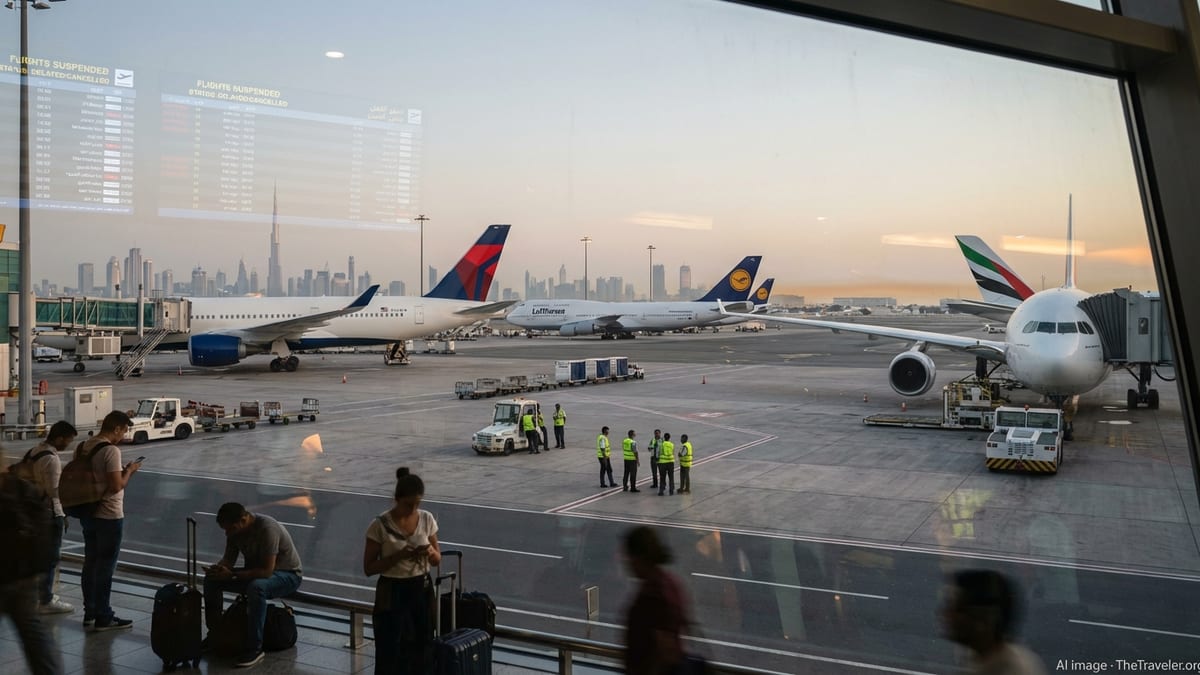
Heightened Conflict Pushes Region Onto Aviation Watchlists
Publicly available security notices and conflict assessments show that the Middle East has re-emerged as a focal point of global aviation risk in 2026. The resurgence of open conflict involving Iran, Israel and the United States, combined with intermittent missile and drone activity across parts of the region, has prompted aviation authorities and airlines to re-examine how and where commercial aircraft operate.
According to recent coverage of the Iran war and retaliatory strikes, airspace closures or severe restrictions have periodically affected Iran, Israel and neighboring states since late February 2026, at times leaving large portions of the regional flight map devoid of civilian traffic. In several instances, flight tracking data cited in media reports has shown long-haul services between Europe and Asia detouring hundreds of miles to avoid areas identified as higher risk.
These developments come against the backdrop of a longer trend in which commercial aviation routes have been squeezed by overlapping conflict zones, from Ukraine to the Red Sea. Industry analyses indicate that the Middle East now accounts for a significant share of remaining east west corridors, meaning any disruption reverberates far beyond the region itself.
New European Bulletins Cover Broad Middle East and Gulf Airspace
The European Union Aviation Safety Agency has become a central reference point for how regulators are framing the risk. In March 2026, EASA and the European Commission revised a wide ranging Conflict Zone Information Bulletin that applies to the airspace of the Middle East and Persian Gulf, extending its validity into 2027 and reflecting what officials describe in public documents as evolving military dynamics.
The most recent iterations of that bulletin, published in late May, list an extensive set of flight information regions across Bahrain, Iran, Iraq, Israel, Jordan, Kuwait, Lebanon, Oman, Qatar, Saudi Arabia and the United Arab Emirates. While the language does not equate to an outright ban, it urges operators subject to European rules to maintain current risk assessments and, in certain portions of airspace, to avoid all altitudes and flight levels.
Separate conflict zone status pages maintained by EASA show the Middle East and Persian Gulf grouping categorized as an active advisory, underlining that risk is considered ongoing rather than episodic. The bulletin is addressed both to EU operators and to non European airlines that hold EASA authorizations to serve the bloc, giving it practical weight beyond the continent’s carriers.
For passengers, these technical notices translate into real world impacts such as longer routings, schedule changes or last minute aircraft swaps when airlines adjust their operational plans to remain aligned with evolving European guidance.
US Restrictions and Missile Threats Complicate Routing Choices
The United States Federal Aviation Administration also maintains long standing prohibitions and advisories affecting parts of the Middle East, which together create a complex patchwork of constraints for airlines flying to, from or over the region. FAA notices currently in force restrict US operators in the airspace of Iran, Iraq, Syria and Yemen, among other locations, focusing on the risk posed by anti aircraft weapons, militant activity and military operations.
One detailed FAA security notice concerning Yemen, updated in late 2025 and still active in 2026, describes Sana’a airport and surrounding airspace as being at constant risk of attack. The document highlights both past attempts to target civil aviation and the presence of hostile groups with access to surface to air missiles, leading US authorities to direct their operators to avoid the area except under narrow circumstances.
At the same time, open source reporting on the broader conflict environment points to a pattern of missile and drone launches affecting or threatening airspace near key Middle Eastern corridors, whether from Iranian forces, non state actors such as Yemen’s Houthi movement, or other armed groups. Even when interceptions are successful and infrastructure remains intact, each incident can trigger temporary route closures, holding patterns and diversions that ripple through airline networks.
For travelers flying on non US airlines, these US directives do not automatically apply. However, many global carriers reference FAA assessments in their own risk planning, meaning the indirect influence on schedules and routings can be significant.
Airlines Reroute, Hubs Strain and Fuel Concerns Grow
Recent media coverage from outlets following live flight tracking data indicates that a growing number of intercontinental services are being rerouted north or south of the traditional Gulf corridor. Some European and Asian airlines have reportedly suspended or curtailed flights to certain Middle Eastern destinations, while others have introduced longer routings that avoid particular conflict-adjacent sectors.
This shifting pattern places additional pressure on alternative hubs in Turkey, the Caucasus and parts of North Africa, which are now handling increased volumes of connecting traffic that once passed routinely through Dubai, Doha, Abu Dhabi and other Gulf gateways. Travel forums and social media posts from passengers describe extended travel times, missed connections and complex rebookings as airlines attempt to keep itineraries viable without exposing aircraft to higher risk flight paths.
On 8 May 2026, the European Commission issued guidance to the transport and tourism sector on how to manage potential jet fuel shortages linked to the Middle East crisis. The document notes that airlines may need to uplift extra fuel at departure points to account for detours or uncertainty about fuel availability at destination airports, a practice that can further constrain capacity and affect scheduling.
Industry economic research published in late May by the International Air Transport Association underscores that geopolitically driven airspace closures have materially increased operating costs and reduced available airspace worldwide. The recent escalation in the Middle East, the analysis notes, is among the most disruptive episodes for the region’s aviation sector since the pandemic, with extended impacts expected on ticket prices and route planning.
What Passengers Flying Through the Region Should Expect
For individual travelers, the emerging warning narrative does not mean that all flights via the Middle East are halted, but it does suggest a more volatile operating environment than in previous years. Regulators and airlines continue to emphasize that commercial routes that remain on sale are subject to ongoing risk assessments, yet disruptions can now materialize on much shorter notice than many passengers are accustomed to.
Travel industry advisories and consumer rights guidance from European institutions recommend that passengers transiting the region pay close attention to airline notifications, monitor itineraries in the days before departure and allow additional buffer time for connections, particularly on journeys that cross or skirt conflict affected airspace. Flexible tickets, comprehensive travel insurance and a willingness to accept rerouting via alternative hubs are increasingly presented as practical ways to manage uncertainty.
With conflict dynamics still fluid and both European and US aviation authorities updating their security publications on a regular basis, analysts suggest that the Middle East is likely to remain a prominent risk hotspot for global aviation in the near term. For now, passengers who choose to fly through the region are being urged by travel providers and regulators alike to stay informed, expect possible last minute changes and factor the evolving risk picture into their planning.