


More news on this day
A serious overnight collision on the M25 in Surrey shut a key stretch of the motorway for hours on Tuesday morning, triggering severe delays and disruption for drivers travelling towards Heathrow and Gatwick airports.
Get the latest news straight to your inbox!
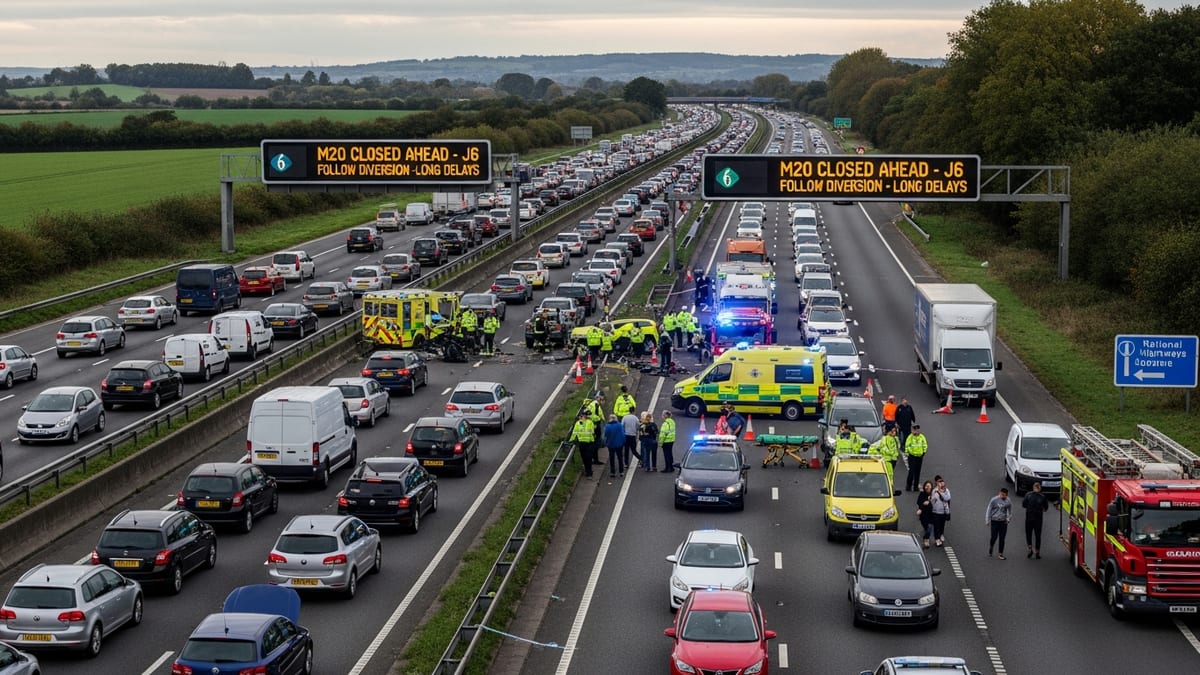
Key section of M25 closed for hours after late-night crash
Traffic data and live reporting show that the anti-clockwise carriageway of the M25 was closed between Junction 11 at Chertsey and Junction 10 at Wisley after a serious collision shortly before midnight on Monday, 31 August. The incident quickly led to long queues building on one of the busiest sections of the London orbital route.
National travel updates described the crash as a serious collision and indicated that the closure was expected to remain in place throughout the morning peak while specialist teams worked at the scene and investigations were carried out. Multiple sources reported congestion stretching back towards Junction 13 at Staines, as well as delays on connecting routes.
Both carriageways were initially shut while emergency responders dealt with the incident, according to publicly available information from regional traffic and police channels. By Tuesday, the clockwise side had reopened, but anti-clockwise lanes between Junctions 11 and 10 remained closed for several hours into the rush hour, with drivers warned to expect extended journey times.
Fatal collision investigation and limited details released
Later on Tuesday, a public witness appeal from Surrey Police confirmed that the incident on the anti-clockwise M25 involved a pedestrian and multiple vehicles and resulted in a fatality. The statement said an 18-year-old man was pronounced dead at the scene and that no arrests had been made, with enquiries continuing into the circumstances of the crash.
The appeal outlined that officers were called to the stretch between Junctions 11 and 10 just before midnight on Monday night following reports of a collision, and that both directions of the motorway remained closed between Wisley and Chertsey overnight, along with a section of the nearby A245. The force thanked motorists for their patience while the road was shut and asked anyone with dashcam, CCTV or helmet-camera footage to come forward.
At the time of writing, authorities have not publicly released further details on how the collision occurred, how many vehicles were directly involved or any additional information about other road users at the scene. Investigators are continuing to gather evidence, and the fatal nature of the incident means the stretch of motorway was subject to extensive examination before it could be fully reopened.
Severe congestion and delays for Heathrow and Gatwick traffic
The M25 in west and south-west London is a key route for airport traffic, carrying flows to junctions serving both Heathrow and Gatwick. Live traffic services reported that queues on Tuesday morning built well beyond the immediate closure, with knock-on congestion reported around Staines, Byfleet, Addlestone and Weybridge as drivers diverted away from the motorway.
Public travel updates indicated that journey times for those heading towards Heathrow and Gatwick were significantly extended, with drivers urged to allow extra time and check conditions before setting out. One radio bulletin warned that anyone travelling to either airport should confirm their route and departure time as the motorway closure was likely to affect access.
Long delays were also recorded on the diversion corridors, as local roads struggled to absorb the displaced motorway traffic. Reports highlighted queues on approaches to the A3 and on sections of the A245 and A320, with some drivers experiencing stop start conditions over several miles.
Diversion routes and advice from highways officers
National Highways guidance directed drivers on the anti-clockwise M25 to leave at Junction 11 and follow a diversion route using the A320 through Ottershaw and Woking before continuing on the A245 towards Cobham to rejoin the motorway at Junction 10. The diversion, signposted with the hollow square symbol, added considerable time to journeys as volumes built along the alternative corridor.
Travel services advised motorists to consider postponing non essential journeys or seeking completely different routes around the affected area while the closure remained in force. Drivers already committed to the M25 were encouraged to follow signed diversions and avoid attempting ad hoc shortcuts through residential areas, where congestion and delays were also increasing.
Highways updates later confirmed that the scene had been cleared and the carriageway fully reopened in both directions after approximately 12 hours of disruption. Even after barriers were lifted, residual queues of several miles remained as trapped traffic filtered through and normal flow gradually returned.
Busy orbital route highlights vulnerability of airport access
The M25 is one of the busiest motorways in the United Kingdom and forms a crucial ring around London, with signed links to Heathrow and Gatwick among its primary destinations. Technical assessments of the corridor have long highlighted its importance for airport connectivity, freight, commuter traffic and long distance journeys.
The latest collision underlines how incidents on relatively short stretches of the motorway can have outsized impacts, particularly during peak hours and on days when passenger numbers are high at London airports. When a key section closes, even briefly, drivers can face delays that cascade across neighbouring motorways and A roads.
Travel planners routinely advise airport bound passengers using the M25 to build in additional contingency time, especially when weather, major events or planned roadworks are in play. Tuesday morning’s disruption is likely to reinforce that guidance for regular users of the route, many of whom rely on real time updates from National Highways and traffic services before setting out.
Evening Standard live coverage of the M25 collision
Surrey Police witness appeal on the M25 fatal collision