


More news on this day
A serious overnight collision on the M25 in Surrey has shut a key stretch of the motorway between Junctions 10 and 11, triggering widespread disruption for motorists and fresh travel warnings for passengers heading to Gatwick and Heathrow airports.
Get the latest news straight to your inbox!
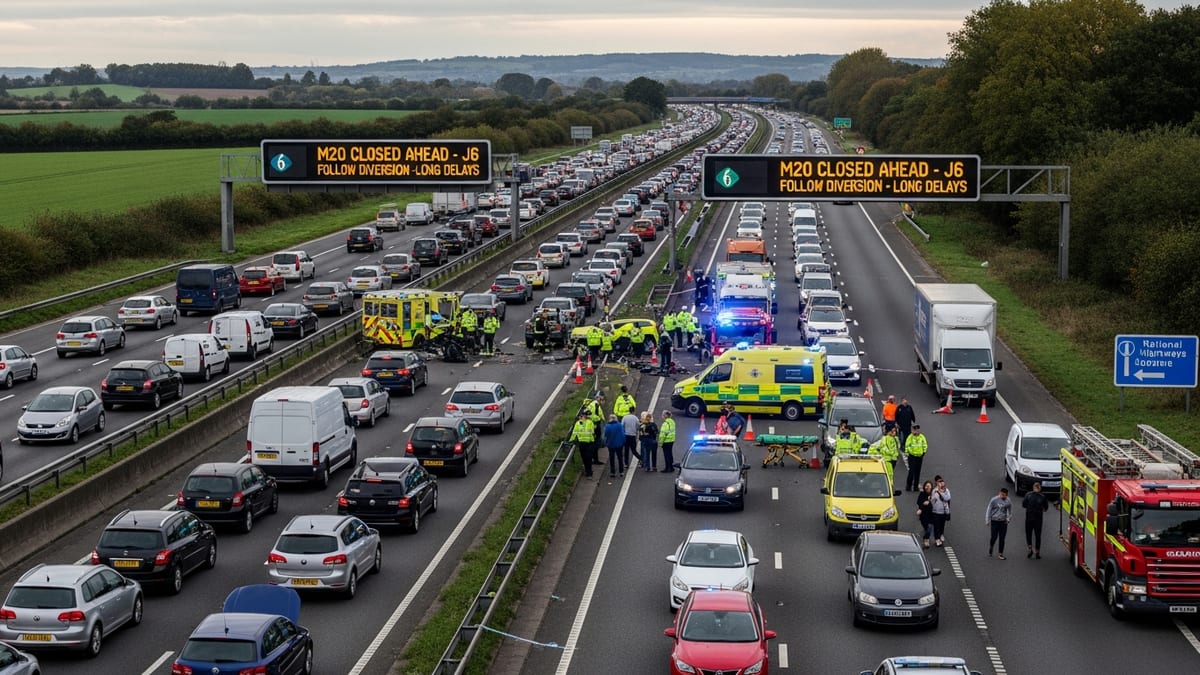
Fatal collision closes M25 between Chertsey and Wisley
Publicly available information indicates that the crash occurred shortly before 11.50pm on Monday, 31 August 2026, on the anticlockwise carriageway of the M25 between Junction 11 at Chertsey and Junction 10 at Wisley in Surrey. Reports describe a serious incident involving a pedestrian and multiple vehicles, leading to the death of an 18 year old man at the scene.
According to published coverage and statements reproduced on news sites, both carriageways of the motorway were closed overnight between Junctions 10 and 11 while emergency responders attended and collision investigators examined the scene. A245 Parvis Road, which runs close to the affected section, was also shut in both directions to support the operation and manage diverted traffic.
Information published by Surrey Police and regional outlets characterises the crash site as one of the busiest parts of the London orbital, close to the upgraded Junction 10 interchange where the M25 meets the A3. The closure came at the end of the late summer holiday period, a time when long distance traffic, airport transfers and local commuting flows all converge on the route.
News reports indicate that no arrests had been made in the hours following the collision. An appeal for dashcam footage and witnesses is under way as investigators examine the sequence of events that led to the fatality.
Airport passengers warned of delays and longer journey times
The shutdown of this section of the M25 has had a rapid knock on effect for road access to both Heathrow and Gatwick airports, which lie on or close to the orbital motorway. Travel updates shared across broadcast, digital and social channels on Tuesday morning advise passengers to leave significantly more time than usual for journeys to either airport.
Coverage from London and Surrey based outlets notes that queues quickly developed on approach to Junctions 10 and 11, as well as on surrounding A roads used by drivers attempting to bypass the closure. Congestion on the diversion routes is reported to be substantial, with some services warning of delays of an hour or more for traffic attempting to rejoin the M25.
Publicly available travel advisories reproduce the same core message for airport bound travellers: check live traffic conditions before setting out, allow extra time, and consider alternative routes or modes of transport wherever possible. Passengers with early flight departures or tight connection windows are being urged to monitor their airline and airport feeds closely in case of knock on disruption to check in and security queues.
Regional news reports also highlight that the affected section of motorway is frequently used by coach operators running direct services between central London and Heathrow or Gatwick. Delays on these corridors are expected to ripple through timetables throughout the day.
Strategic importance of the M25 for Gatwick and Heathrow access
The incident has underlined the strategic role that the M25 plays in connecting London and the wider South East to the United Kingdom's two busiest airports. Heathrow sits directly off the western arc of the motorway, while Gatwick is linked via the M23, with the M25 providing the main orbital connection for passengers and freight moving between the airport, London and other regions.
Official route information for Gatwick highlights that the airport is around 10 minutes from the M25 via the M23, placing it firmly within the motorway's surface access catchment. Heathrow meanwhile lies immediately north of the M25, with multiple junctions feeding traffic into its terminals. When a key segment of the orbital is restricted, surface access to both airports can be affected at the same time.
Previous transport assessments of the London orbital and M23 corridor have flagged the vulnerability of airport journeys to incidents on the M25, particularly where there are limited parallel high capacity alternatives for road traffic. The latest collision near Junctions 10 and 11 reinforces those findings, with disruption radiating well beyond the immediate crash scene and into cross regional travel patterns.
Travel industry observers note that while rail links provide important alternatives, many passengers, staff and freight movements still rely on the motorway. This is especially true for early morning departures, late night arrivals and inter airport transfers that may not align neatly with rail timetables.
Impact on local roads and regional commuters
As traffic has been diverted away from the closed stretch of the M25, nearby communities in Surrey have experienced a surge in congestion. Reports from local outlets indicate that roads through towns near Chertsey and Byfleet, as well as routes feeding into the A3 corridor, have seen heavier than usual volumes as drivers follow diversion signs or attempt to navigate around delays using satellite navigation apps.
Morning peak travel on Tuesday has therefore been affected not only for airport bound motorists but also for regular commuters, freight operators and local bus services. Journey times on key commuter routes into London and across the county are reported to be significantly extended, with some drivers facing stop start conditions well outside the immediate closure zone.
Local travel updates stress the importance of following official diversion routes rather than cutting through residential streets, warning that rat running can contribute to safety risks and gridlock in smaller communities. Motorists are being encouraged to consider delaying non essential journeys, using rail where possible, or working remotely if their circumstances allow.
Transport commentators suggest that the timing of the incident, coinciding with the early September return to work and school period, is likely to intensify the impact on daily routines and highlight the limited resilience of some parts of the regional road network.
Advice for travellers heading to the airports
With disruption expected to continue while investigations proceed and traffic clears, publicly available guidance for passengers heading to Gatwick and Heathrow centres on building flexibility into travel plans. Motorists are advised to allow substantially more time for their journey than they would under normal conditions, particularly if travelling via the western and south western sections of the M25.
For those able to switch modes, transport planners often point to rail as a more predictable option during major motorway incidents. Direct rail links such as Heathrow Express, Elizabeth line services to Heathrow, and Gatwick Express or mainline trains from central London can help bypass road congestion, although peak time crowding and occasional service changes still need to be factored in.
Passengers travelling from outside London are being encouraged, where practical, to park at stations with direct airport rail links or to use coach services that can respond dynamically to diversion information. Travel experts also recommend checking whether airlines offer the ability to move to earlier departures when severe traffic disruption is forecast, especially for long haul itineraries.
As the investigation into the M25 collision continues, the incident is likely to prompt renewed discussion about resilience on the orbital motorway and the balance between road and rail access to the United Kingdom's major airports. For now, travellers heading to Gatwick and Heathrow are being urged to stay informed, stay flexible and treat advertised journey times as a minimum rather than a guarantee.
Surrey Police M25 closure update
Evening Standard live M25 crash coverage
Radio Jackie regional traffic bulletin