


Landing at Malaga Costa del Sol Airport is often the first glimpse of sunshine after an early flight from northern Europe. Whether you are heading into Malaga city, straight to a Costa del Sol resort or onward by train across Spain, knowing what happens after the aircraft doors open will save you time, stress and unnecessary costs. This guide walks you through every stage of arrival at Malaga Airport, from passport control and baggage claim to trains, buses, taxis, car rental and onward connections.
Get the latest updates straight to your inbox!
Understanding Malaga Airport on Arrival
Malaga Costa del Sol Airport (AGP) is Spain’s main gateway to the Costa del Sol and one of the country’s busiest airports. Almost all international flights arrive at Terminal 3, which is directly connected to Terminal 2 inside the same building, so you will usually follow clear signs for “Llegadas / Arrivals” and “Equipajes / Baggage claim” as soon as you leave the aircraft. The terminal is modern and relatively compact, but in summer and on weekend mornings it can feel crowded as multiple UK, German and Nordic flights land within minutes of each other.
From the aircraft, you will either disembark directly onto an airbridge or be taken by bus to the terminal. Both options lead you into the same arrivals flow, separated into Non Schengen and Schengen areas. Flights from other EU and Schengen countries are funneled toward Schengen arrivals, where you normally bypass passport control and head straight to baggage claim. Non Schengen passengers, such as those arriving from the United Kingdom, Ireland, the United States or Morocco, are directed to the immigration hall before baggage reclaim.
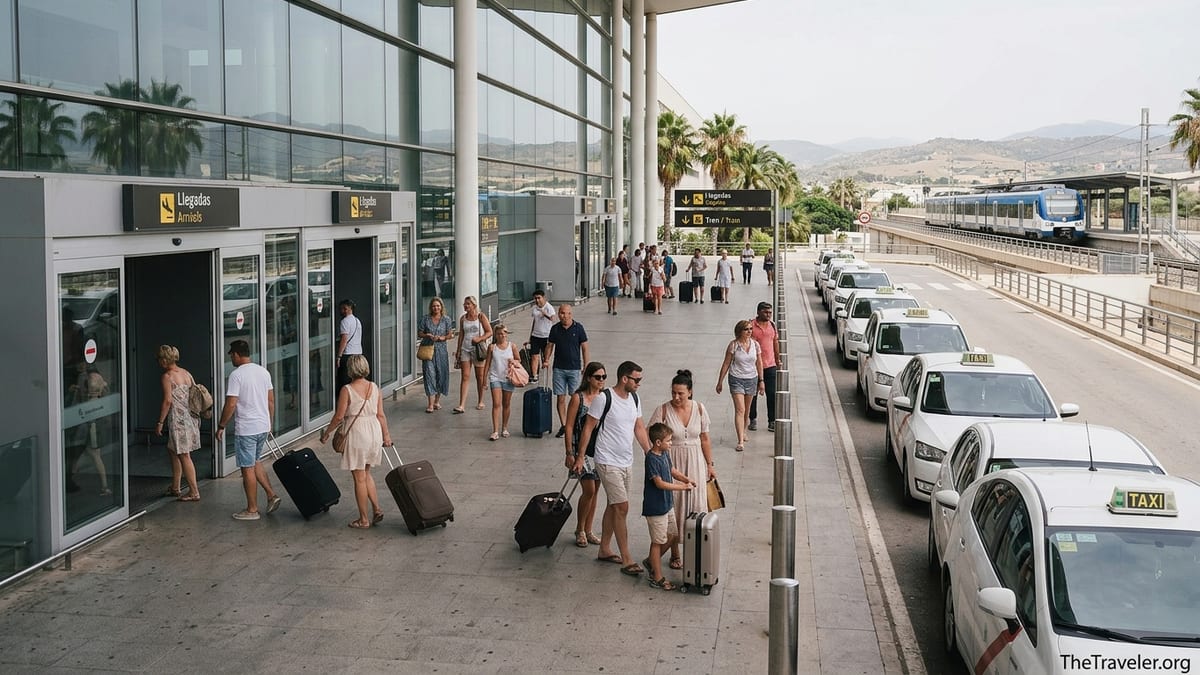
Signage throughout the terminal is in Spanish and English, with pictograms for baggage, customs, trains and buses. Digital screens show your flight number and the assigned baggage belt in real time. If you are meeting someone, note that the official public meeting point is outside the arrivals doors on the ground floor of Terminal 3, in front of the taxi rank and just before the walkway to the train and buses.
Malaga Airport operates 24 hours a day, but service availability varies by time. The suburban C1 train to the city and coastal resorts starts early in the morning and runs roughly every 20 to 30 minutes into the night, while shops, cafes and SIM card points in arrivals keep typical daytime hours. If you land on a late night or very early morning flight, expect fewer open counters and plan essentials like snacks, water and data in advance.
Clearing Passport Control and Customs
For Non Schengen arrivals, passport control is the first major step after leaving the aircraft. EU and EEA citizens follow the “EU / EEA” lane, while UK post Brexit, US, Canadian and other third country nationals use the “All passports” or “Non EU” queue. During peak holiday periods, especially on Saturday mornings in July and August, queues for non EU passengers can be significantly longer than those for EU citizens. Families arriving from London Heathrow or Manchester often report waiting 30 to 45 minutes in line when several UK flights land at once, while those arriving midweek in low season may pass through in under 10 minutes.
Border officers will typically ask for your passport, the address of your accommodation and length of stay. For visitors who need a Schengen visa, ensure your entry visa, onward travel and travel insurance documents are easily accessible. Children traveling with only one parent or with relatives may occasionally be asked for authorization letters. Having everything in a small document wallet speeds up interaction at the counter and helps keep the line moving.
After passport control you follow the flow to baggage claim. Customs at Malaga Airport is usually low key. Once you have your luggage, you will see two exits: the green “Nada que declarar / Nothing to declare” and the red “Bienes a declarar / Goods to declare.” Most holiday travelers walk through the green channel without being stopped. Random inspections do happen, so always respect duty free allowances and avoid bringing restricted items. For example, a traveler arriving from outside the EU with several cartons of cigarettes clearly for resale, or carrying large amounts of cash, could be pulled aside for inspection.
There are no extensive questioning booths like in some long haul hubs. Instead, customs officers observe passengers exiting baggage claim and may ask you to place your bags through a scanner. If you are carrying professional camera equipment for a film shoot, high value electronics intended for resale or food products like meat and dairy from outside the EU, it is safer to use the red channel and declare them proactively.
Baggage Claim, Lost Luggage and Arrivals Facilities
The baggage reclaim hall at Malaga Airport is on the same level as arrivals and connected directly to passport control. Overhead screens list arriving flights, baggage belt numbers and status such as “luggage on belt” or “delayed.” Typical delivery time for luggage on short haul European flights ranges from 15 to 30 minutes after landing, although in peak summer or during handling disruptions you may wait longer. Charter flights arriving from Scandinavia with many checked bags and sports equipment often take extra time to unload.
If your suitcase does not appear, the first step is to visit the lost luggage or baggage service desk for your airline or ground handler, usually located beside the baggage belts. For example, passengers flying with Ryanair, easyJet or Norwegian will find handling agents such as Aviapartner or Groundforce at clearly marked counters. You will need your passport, boarding pass and baggage tag to file a Property Irregularity Report. In many cases where a bag has missed a tight connection in Madrid or Barcelona, it arrives later the same day or the following morning and is delivered to your hotel or apartment.
Once you exit from baggage claim into the public arrivals hall, you will find basic facilities: ATMs, a currency exchange desk, car rental counters, a small duty free shop and a handful of cafes and snack outlets. There is usually at least one TravelWifi or similar kiosk selling portable Wi Fi units and prepaid SIMs in or near the arrivals area, aimed at travelers who need instant connectivity for navigation and messaging. Note that opening hours may align with daytime bank style hours rather than 24/7 coverage, so very late night arrivals might find these counters closed.
Several major car rental brands, including companies like Hertz, Avis, Europcar and Spanish operators, maintain desks along the arrivals corridor. Some smaller or low cost rental agencies use shuttle buses from the terminal to off airport lots; in that case you will normally see a representative holding a sign just outside arrivals or instructions in your booking confirmation telling you to walk to a specific minibus bay. If you have checked in online, pick up can be quick, but in high season queues at car rental counters can exceed 45 minutes, so families with tired children sometimes choose to take a taxi to their hotel and return for a hire car a day later.
Money, ATMs and Mobile Connectivity on Arrival
As soon as you enter the public arrivals hall, you will see ATMs from major Spanish banking groups. These machines usually accept Visa, Mastercard and many international debit cards. Fees and exchange rates vary by operator, so it is wise to decline the ATM’s “conversion” in your home currency and instead be charged in euros, letting your own bank handle the conversion whenever possible. For example, a traveler from the United States withdrawing 100 euros may see an on screen option that converts at a poor rate and adds a service fee. By choosing to be charged in euros only, they can often save several dollars on the same withdrawal.
Currency exchange kiosks are also present in arrivals, but exchange rates are typically less favorable than withdrawing cash from an ATM or paying by card. On the Costa del Sol, contactless payments by card or phone are widely accepted in taxis, supermarkets, restaurants and tourist attractions. Many visitors from the UK and Scandinavia travel happily for a week with only 50 to 100 euros in cash for small purchases, relying on contactless for everything else.
For mobile connectivity, you have three main options on arrival. The easiest for most short stay visitors is to use an eSIM, activated before landing from providers such as Airalo or Holafly, which start working as soon as you switch off airplane mode. For those whose phones do not support eSIM, Malaga Airport has vending machines and counters operated by brands like Vodafone or other telecom providers that sell prepaid physical SIM cards. Travelers report seeing packages in the 15 to 25 euro range that include about 50 to 100 GB of data valid for 10 to 20 days, with EU wide roaming included.
If the airport vending machine or counter is closed or busy, you can wait until you reach the city. In central Malaga, large phone shops from Spanish operators and electronics chains sell prepaid SIMs with staff on hand to help with activation. This can be simpler if you speak some Spanish or are comfortable taking a number and waiting your turn. Whichever option you choose, be sure your phone is unlocked and bring a SIM pin tool or small paper clip in case you need to open the tray yourself at the airport.
Trains, Buses and Taxis from Malaga Airport
One of Malaga Airport’s strengths is its direct connection to the Cercanías C1 suburban train line. The station is directly beneath Terminal 3, reached by following signs for “Tren / Train” from the arrivals hall and crossing the short forecourt and bus bays via a covered walkway. From here, frequent trains run toward Malaga Centro Alameda in one direction and toward Torremolinos, Benalmádena and Fuengirola in the other. Journey time to Malaga Centro is around 12 minutes, while reaching Fuengirola at the end of the line takes roughly 35 minutes.
Tickets for the C1 train are bought from machines at the station entrance. Instructions are available in several languages and you can pay with coins, notes or bank cards. A single ticket into Malaga city usually costs under 3 euros per person, making the train the cheapest option for solo travelers and couples with light luggage. For example, a British couple arriving from Birmingham with only cabin bags can be in the historic center within half an hour of landing by walking straight to the train, skipping taxi queues entirely.
In addition to the train, an express bus line connects the airport with Malaga city center, typically terminating near the main bus hub close to the Alameda area. Buses depart from just outside the arrivals level of Terminal 3 and can be a useful option if you are staying closer to certain neighborhoods not directly on the train line. For those heading to resort towns beyond Fuengirola, long distance buses usually depart from Malaga’s main bus station next to Maria Zambrano railway station, which you can reach first by taking the C1 train into the city.
Taxis are lined up immediately outside the arrivals exit doors in Terminal 3, with an official rank supervised by attendants. Vehicles are white with a blue stripe and display fixed price charts for common destinations. A daytime ride into central Malaga typically costs in the region of 25 to 30 euros, depending on traffic and luggage supplements, while a taxi to Torremolinos or Benalmádena might be slightly more. For late night or public holiday arrivals, surcharges apply and prices rise accordingly. Many visitors now choose pre booked private transfers, which operate from nearby pick up points and offer a set fare to popular resort towns such as Marbella or Nerja, something especially appreciated by families or groups with multiple suitcases and golf bags.
Car Rental, Driving and Safety Considerations
For travelers planning to explore beyond the immediate coast or stay in hillside villas, renting a car at Malaga Airport is a popular choice. Major international brands and local companies have desks in the arrivals area or just above in departures, and their car parks are usually a short walk or shuttle ride away. When you exit customs, follow signs for “Car rental / Alquiler de coches.” Some companies, particularly low cost brands, require you to exit the terminal and catch a small shuttle bus from a designated bay to reach their off airport lot where you complete paperwork and collect the vehicle.
Before signing any rental agreement, read fuel and insurance policies carefully. Many agencies offer a basic price with a high excess and then attempt to upsell full coverage insurance at the counter. As an example, a compact car advertised at 15 euros per day may jump to 30 or 40 euros per day if you agree to full insurance on arrival. If you already hold a separate excess insurance policy, be ready to decline additional coverage confidently. Also check for charges related to adding extra drivers or driving into neighboring countries such as Portugal or Gibraltar.
Driving away from Malaga Airport is straightforward. The main A 7 and AP 7 highways run along the coast, and clear signs direct you toward Malaga, Marbella, Motril or inland routes. Inside the airport, speeds are low and there are several roundabouts as you exit the rental car areas, so take your time, adjust the seat and mirrors, set your navigation and ensure everyone has their seat belt fastened before joining faster traffic. For nervous drivers landing after a long flight, it can be worth staying the first night in Malaga city without a car, then collecting the vehicle the following morning when you are rested.
As in any busy tourist airport, keep an eye on your belongings when loading luggage into a hire car. There are occasional reports of opportunistic thefts targeting distracted visitors juggling keys, GPS devices and children at the same time. A simple routine helps: place valuables like passports and electronics in the boot before you move the car, lock all doors while you check the vehicle for existing damage, take photographs of any scratches and only then drive away. Avoid leaving bags visible on seats when you stop at supermarkets or viewpoints on the way to your accommodation.
Onward Travel by Rail and Around Andalusia
For longer journeys into Spain, Malaga Airport connects conveniently with Malaga Maria Zambrano railway station via the C1 suburban train. From the airport station, trains headed toward Malaga Centro Alameda stop at Maria Zambrano only a few minutes later, and the station sits directly beside the main intercity and high speed rail platforms. This allows you to land at Malaga, hop on the C1 train with your luggage and, within half an hour, be boarding an AVE or other long distance service to cities such as Madrid, Cordoba or Seville.
For example, a traveler from Berlin might arrive on a morning low cost flight into Malaga, clear passport control and collect luggage by 11:00, take the 11:20 C1 train to Maria Zambrano, arrive at around 11:30 and then board a midday high speed train to Madrid that takes roughly two and a half to three hours. This can be more flexible and often cheaper than routing through Madrid Barajas directly, especially if you plan to spend a few days on the coast before heading inland.
Within Malaga city itself, both the C1 train and local buses make it easy to transfer from the airport to various neighborhoods. From Maria Zambrano, you can transfer to the city’s metro lines for areas not served by the suburban rail, or simply walk or take a short taxi ride into the historic center around the cathedral and Alcazaba. If your accommodation is near Malaga Centro Alameda station, taking the C1 train all the way to the terminus means you step out within walking distance of many central hotels and apartments.
For those heading to the eastern Costa del Sol, such as Nerja or Torre del Mar, there is no direct train line from the airport. The usual route is to take either a taxi or the train into Malaga and then connect to a regional bus from the main bus station. Planning your timetable in advance helps avoid long waits. As an example, landing at 15:00, taking the 15:20 C1 into Malaga and catching a 16:00 bus to Nerja can have you at your final destination by early evening without needing a car.
The Takeaway
Arriving at Malaga Airport does not have to be confusing or stressful. The key is to think in stages: first passport control, then baggage, then money and connectivity, and finally transport to your final destination. International passengers from outside the Schengen Area should be prepared for variable queues at passport control, especially in high season, and keep documents handy. At baggage reclaim, keep an eye on screens and know where your airline’s lost luggage desk is in case a bag goes missing.
As you enter the arrivals hall, decide whether you truly need cash or can rely mostly on cards, and whether to activate an eSIM, buy a local SIM at the airport or wait until you reach the city. When it comes to getting into Malaga or the resorts, the C1 train offers a fast and inexpensive solution for many travelers, while taxis and pre booked transfers are often worth the extra cost for families or those arriving late at night. Car hire is straightforward but benefits from careful reading of insurance conditions and a bit of patience at busy counters.
By understanding the layout of Terminal 3 and knowing how to reach the train station, bus stops and taxi rank, you can move confidently from aircraft door to hotel lobby. With a little preparation, your first hour in Malaga can be smooth and efficient, leaving you more time to enjoy tapas in the old town, a stroll along the palm lined promenade or a sunset swim on the Costa del Sol.
FAQ
Q1. How long does it usually take to get through Malaga Airport after landing?
Typical total time from landing to exiting arrivals ranges from 30 to 60 minutes, depending on passport control queues, baggage delivery and time of year.
Q2. Is the train or taxi better from Malaga Airport to the city centre?
The C1 train is usually fastest and cheapest for solo travelers or couples with light luggage, while taxis or private transfers suit families, late arrivals and those with many bags.
Q3. Where do I buy train tickets at Malaga Airport and how much do they cost?
Tickets are purchased from machines at the airport train station entrance beneath Terminal 3 and a single trip into Malaga city typically costs under 3 euros.
Q4. Can I get a SIM card on arrival at Malaga Airport?
Yes, there are vending machines and counters from major providers in or near the arrivals area selling prepaid SIMs and data packages, though hours may be limited late at night.
Q5. Are taxis from Malaga Airport safe and metered?
Official taxis from the rank outside Terminal 3 are licensed, metered and display fixed tariffs for common destinations, making them a safe and predictable option.
Q6. What should I do if my luggage is lost or delayed at Malaga Airport?
Go to your airline’s or handler’s baggage service desk in the reclaim hall, file a report with your baggage tag details and arrange delivery once the bag arrives.
Q7. Is it better to exchange money or use an ATM at Malaga Airport?
Using an ATM and choosing to be charged in euros usually offers a better rate than currency exchange counters, though your own bank’s fees will also apply.
Q8. How do I reach Malaga Maria Zambrano train station from the airport?
Take the C1 suburban train from the airport station toward Malaga Centro Alameda and get off at Maria Zambrano, a journey of only a few minutes.
Q9. Can I rent a car directly at Malaga Airport on arrival?
Yes, many car hire companies have desks in the arrivals or departures halls, but availability is limited in peak season so advance booking is strongly recommended.
Q10. Is Malaga Airport open at night and are there late transport options?
The airport operates 24 hours, but shops and SIM counters may close at night; the C1 train runs late into the evening and taxis are available around the clock.