


Landing at Malaga Costa del Sol Airport and wondering what is the quickest or best-value way to reach the historic city centre? Whether you are watching your budget, travelling with kids and suitcases, or arriving after midnight, Malaga offers several solid options including the C1 commuter train, the Airport Express bus, taxis and app-based rides such as Uber and Cabify. This guide walks through each of them with typical prices, journey times and practical advice so you can choose what really fits your arrival.
Get the latest updates straight to your inbox!
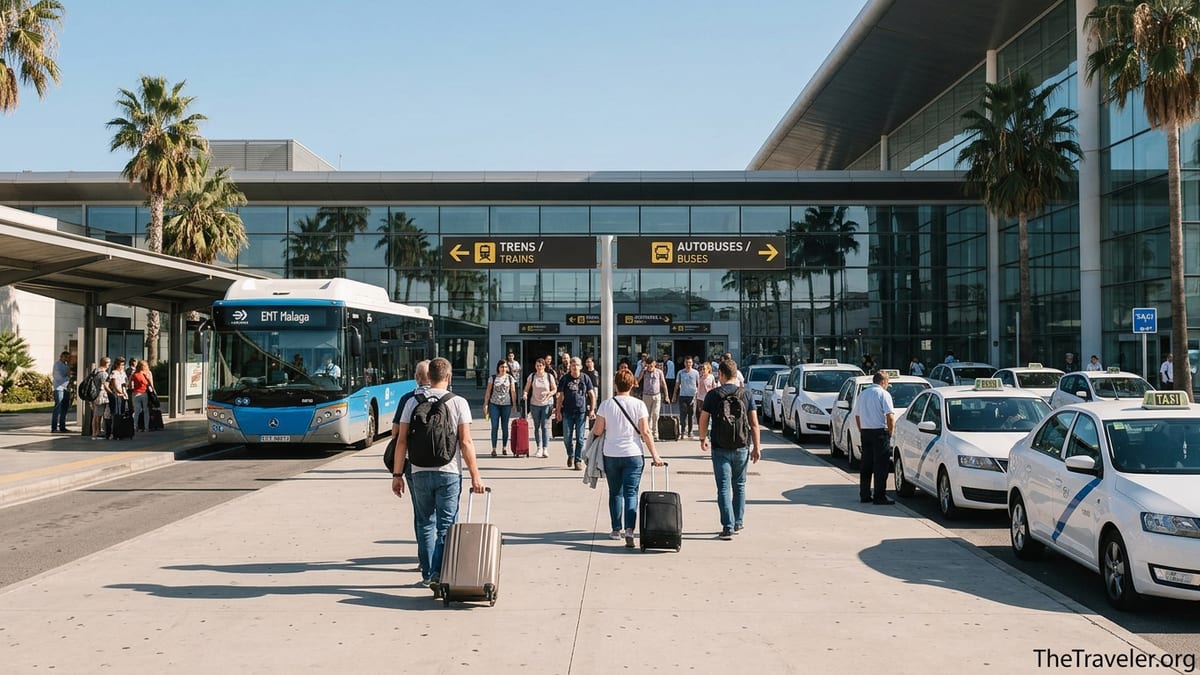
Overview: Choosing the Right Transport From Malaga Airport
Malaga Costa del Sol Airport (AGP) sits roughly 8 to 10 kilometres southwest of the city centre, so transfer times are short compared with many European airports. In normal conditions you can be at the main Alameda Principal or Plaza de la Marina area in around 12 minutes by train, 20 to 25 minutes by bus, or 20 minutes by taxi or ride-hailing car. The right choice depends less on distance and more on what time you land, how much luggage you have and how comfortable you are with public transport after a flight.
As of mid 2026, the main options are the C1 Cercanías train, the EMT Airport Express bus Line A, white city taxis from the official rank, and ride-hailing services such as Uber, Bolt and Cabify. All are well established and commonly used by arriving passengers. Trains and buses are cheapest but do not run all night, while taxis and ride-hailing cover late arrivals and door-to-door access. For most travellers staying close to Malaga Centro Alameda, the C1 train is the fastest and best value in daytime hours.
In the sections below, you will find what to expect in real terms: the type of ticket you buy at the station, where exactly you catch the Airport Express, what a typical taxi meter fare might look like to the old town on a weekday afternoon, and how much more to factor in if you arrive at 01:00 with two large suitcases.
C1 Train: Fastest and Best Value for the City Centre
The C1 Cercanías train line runs between Fuengirola and Málaga Centro Alameda and stops at Aeropuerto station, directly in front of Terminal 3. From the arrivals area you follow the signs for “Tren / Cercanías” and walk a few minutes across a short footbridge to the station. Trains are typically every 20 minutes in daytime and early evening, and the journey to Málaga Centro Alameda (the final city-centre stop) takes about 12 minutes once you are on board.
Single tickets from the airport to Malaga city centre are low cost compared with taxis. Travellers in 2026 commonly report paying around 2 to 3 euros for a one-way adult ticket, depending on the exact zone and any card discounts. You buy your ticket from the Renfe machines at the station entrance; they have an English-language option and accept cards as well as cash. Keep the ticket handy because you need it both to enter and to exit the platform barriers at Malaga Centro Alameda.
For luggage, the C1 is practical for most visitors. Trains are modern, low-floor units with space near the doors where people routinely park cabin cases and medium suitcases. At busy times, such as summer weekends or Easter, the carriages can feel crowded between the airport and Malaga María Zambrano station, but there are no official luggage surcharges and people are used to sharing space with travellers. If you are a couple with two large checked bags and two carry-ons, you will usually manage fine by boarding near a door and staying with your bags.
Service hours matter. The first and last trains vary slightly by season and day, but broadly speaking the C1 starts running early in the morning and stops around midnight. If your flight lands very late, for example 00:30, you may find the last train has already departed and need to switch to a taxi or app-based ride. Similarly, if you have mobility challenges and are staying in a hilly part of the centre such as near the Gibralfaro climb, the train still leaves you with a short urban walk or a connecting local bus or taxi from Centro Alameda or María Zambrano.
Airport Express Bus Line A: Good When Staying Near the Route
Malaga’s EMT Airport Express bus, known as Line A, runs between the airport and the city centre, continuing beyond to the main bus station and key downtown stops. The stop at the airport is just outside the arrivals area at Terminal 3; once outside, you follow signs for buses and look for the blue and white EMT vehicles marked with an A. Buses are adapted for luggage with racks inside and are designed for airport passengers, not just commuters.
As of recent official information, the single ticket price for the Airport Express is around 4 euros per person, paid directly to the driver in cash or, increasingly, with contactless cards and local transport cards. The journey into the heart of the city typically takes 20 to 25 minutes in light traffic, though at peak times with congestion around the port and Alameda Principal it can stretch closer to 35 minutes. Unlike the train, the bus stops at multiple central locations such as Avenida de Andalucía, Alameda Principal and Paseo del Parque, which can be convenient if your hotel is near the port, the cathedral or the Soho district.
Line A is a particularly good choice if you are staying on or near its route and you do not mind handling your own luggage. For example, if your apartment is close to the Alameda Principal or you are booked at a hotel near the port or along the main Avenida de Andalucía, it may drop you within a very short walk of your door. The buses have low floors and wide doors, and drivers are used to passengers loading suitcases onto the interior racks. For a solo traveller or couple with one or two pieces of luggage each, this is usually manageable.
In terms of hours, the Airport Express runs roughly from early morning into late night, with relatively frequent departures during the day. However, it is not truly 24 hours, and the gap between the last late-night service and the first early-morning one may be several hours. If you land around 02:00 or have a 05:00 flight and need to get to the airport before dawn, you should not rely on the bus and instead plan on a taxi, Uber, Bolt or Cabify. Also, if you are travelling in a group of three or four adults, the combined bus fare can approach the cost of a standard taxi while being less convenient with heavy bags.
Taxi: Door-to-Door Convenience at a Predictable Cost
Official white taxis line up outside the terminal on the arrivals level, in a clearly marked taxi rank. Vehicles are metered and operate under city-regulated tariffs that are updated periodically. For a typical journey from Malaga Airport to the central area around Calle Larios, Alameda Principal or the main train station, travellers in 2025 and 2026 frequently report paying somewhere in the region of 25 to 35 euros in normal daytime conditions. This range reflects the meter starting fare, per-kilometre charge, supplements and any night, weekend or holiday surcharges.
Current surcharge structures usually include small extra amounts for each large suitcase placed in the boot and different tariffs for night-time and special dates. For example, there may be a fixed supplement for services with destination to the airport or late-night surcharges between midnight and 06:00. The city has adjusted these add-ons in recent years, so the exact breakdown can change, but the key point for travellers is that you can expect a higher fare if you arrive at 01:30 on a Saturday in August compared with 11:00 on a Tuesday in February.
From a comfort perspective, taxis are the easiest option if you are tired after a long flight, travelling with children or carrying bulky luggage like golf clubs. The driver helps you with bags at the boot, and you are dropped directly at your hotel or apartment door. If you are staying in the historic centre within pedestrianised streets, the taxi will take you to the nearest point accessible by car, for instance a corner of Calle Larios or the edge of Plaza de la Merced, and you walk the final metres.
If you are concerned about cost, you can ask the driver for an approximate estimate before setting off. While Malaga taxis are metered rather than offering a fixed airport-to-city tariff, most drivers can give a ballpark figure. Payment is widely possible by card as well as cash, although it is smart to confirm as you get in. For a family of four with two big suitcases choosing a taxi around midday, the higher price compared with the train is often offset by the convenience of being dropped at the exact address and not needing to navigate streets from the station.
Uber, Bolt and Cabify: App-Based Transfers From the Airport
Ride-hailing services including Uber, Bolt and the Spanish company Cabify all operate at Malaga Airport and in the city. For many visitors who already use these apps at home, they offer a familiar way to request a ride, see an estimated fare in advance and pay within the app without dealing with cash. The services use private-hire vehicles and, in some cases, local taxis linked to the platform.
Pick-up locations at the airport are usually in a designated ridesharing area near the arrivals road. After you collect your luggage and enter the arrivals hall, you connect to airport Wi-Fi or your mobile data, open the app and set “Málaga-Costa del Sol Airport” as the pick-up point and your hotel as the destination. The app then directs you to a specific meeting point, which may be signed as “Ride sharing / VTC” on airport roadways. This location can shift as the airport rearranges traffic flows, so it is worth following the app’s current instructions rather than relying solely on older descriptions.
Prices for an app-based ride from the airport to the centre vary based on demand, time of day and the service level you select. In quiet periods, visitors often see quotes in the general region of 20 to 30 euros for a standard car to central Malaga, which can be competitive with a metered taxi. At very busy times, such as during the August Fair or Easter week processions, dynamic pricing can push fares higher than a standard taxi, though the app will show you the estimate before you confirm. Services such as Uber Van XL in Malaga provide higher-capacity vehicles that are useful for groups travelling together from the airport, usually at a premium over the base fare.
One advantage of ride-hailing is the ability to schedule rides in advance in the app. Travellers catching early flights frequently book a pick-up from the city centre to the airport for around 03:30 or 04:00. While most scheduled rides proceed smoothly, there are occasional reports of early-morning bookings being cancelled if a driver is not available, so it is wise to have a backup plan such as the phone number of a local taxi company or knowledge of the nearest taxi rank. For late-night arrivals after public transport stops, on the other hand, real-time requests from the airport usually find a driver, though waiting times can vary.
Comparing Cost, Journey Time and Luggage Practicalities
When deciding between the C1 train, Airport Express bus, taxi and ride-hailing, it helps to think in three dimensions: cost, journey time door to door and how manageable the option feels with your luggage. For a couple arriving midday with one suitcase each and staying a short walk from Málaga Centro Alameda station, the train is almost always the standout choice: it is cheap, frequent, avoids road traffic and delivers you close to the historic centre in about 12 minutes of travel time.
For travellers whose accommodation is not near a train station or bus stop, the calculation changes. Imagine a family of four staying in an apartment deep inside the old town near the Picasso Museum, with two large suitcases and three smaller bags. If they take the train, they will likely need to change to a local bus or walk 10 to 15 minutes on cobbled streets, which can be uncomfortable. A taxi costing in the region of 30 euros might feel like better value once they factor in the four bus or train tickets plus the effort of manoeuvring bags through the pedestrian zone.
Luggage considerations are also important for people with oversized items. Golfers heading to courses on the Costa del Sol, cyclists with bicycle cases or travellers with bulky musical instruments will find taxis and ride-hailing vehicles more straightforward than public transport. While the bus and train do not prohibit larger items, finding space on a busy service can be awkward. In contrast, arranging a larger Uber or Cabify category, or booking a private transfer van in advance through a specialist provider, can give guaranteed room for special equipment.
In terms of reliability, train and bus services are generally punctual, but they operate on fixed schedules that might not perfectly match your arrival, especially if your flight is delayed. It is not uncommon for travellers to land at Malaga, clear passport control and then find they have just missed a C1 train, which means waiting up to 20 minutes for the next one. In that situation, some people choose to go straight to the taxi rank instead, valuing immediate departure over saving a few euros. Journey times by road can also fluctuate with traffic, particularly on summer evenings when residents and tourists are heading towards the seafront, so the fastest theoretical option on paper may not always be the fastest in practice.
Late-Night and Early-Morning Options
For flights that land after the last train or bus, or departures that require you to be at the airport before services start, the realistic choices are taxis, ride-hailing or pre-booked private transfers. Malaga is a busy tourism hub, and the taxi rank at the airport typically has vehicles waiting even after midnight, especially in peak season. Travellers who arrive around 01:00 often report simply walking out to the rank and finding a cab without difficulty, though on particularly busy summer nights there can be short queues.
App-based services such as Uber, Bolt and Cabify also operate 24 hours, but actual driver availability can be thinner in the very early hours of the morning. People catching 06:00 flights from Malaga sometimes schedule an app ride for 03:30 or 04:00 the night before and successfully reach the airport, while others report last-minute cancellations and end up searching for a street taxi. If making an early-flight connection is critical, it is prudent to add a time buffer or consider booking a reputable local private transfer company that confirms your pick-up in advance and sends the driver’s contact details.
Cost-wise, the difference between night and day travel can be noticeable. Taxi tariffs include night supplements, and ride-hailing prices can rise during times of high demand. A journey that costs around 25 euros at 11:00 might easily reach the low to mid-30s in the small hours, especially on weekends. For a solo traveller on a tight budget, one strategy is to choose accommodation for the last night of the trip within walking distance of Malaga Centro Alameda station, allowing them to use the first morning C1 train to the airport instead of paying a night surcharge.
If you are arriving very late and particularly anxious about having a guaranteed pick-up, booking a private transfer in advance is worth considering. Many operators offer fixed prices for standard cars and minivans from Malaga Airport to city-centre addresses. While these can cost slightly more than a metered taxi in the daytime, they sometimes become competitive at night once taxi supplements are applied, and you benefit from a driver waiting with your name in the arrivals hall.
Real-World Scenarios: What Works Best for Different Travellers
Consider a solo backpacker arriving from London at 10:00 on a weekday with one carry-on bag, staying at a hostel near the Soho district. In this case, the C1 train is almost ideal: after exiting the plane, the traveller walks to Aeropuerto station, buys a ticket for a few euros, rides 12 minutes to Málaga Centro Alameda and then walks about 10 minutes through flat streets to the hostel. Total transfer cost is low, and the only trade-off is a short walk with the backpack.
Now imagine a couple on a city-break weekend landing at 21:30 on a Friday, with one large suitcase each and a hotel inside the old town near the cathedral. The train remains an option if they move briskly and catch one of the late-evening services, but they will still have to walk from the station into the historic centre, partly over cobbles and potentially in crowded streets. Many people in this situation prefer to take an official taxi from the rank, accepting a fare somewhere around 30 euros for the comfort of being dropped near their hotel and not having to navigate with luggage at night.
For a family of five landing at midday in summer, with three children and multiple bags, a private transfer or an Uber Van XL or similar high-capacity ride-hailing category can be the most stress-free choice. This sort of vehicle can accommodate everyone and their luggage in one go, takes them directly to a family apartment in the centre or at the port, and may end up costing roughly the same per person as separate public transport tickets once convenience is factored in. Booking this in advance also eliminates any uncertainty about space for child seats.
Finally, business travellers heading straight to a meeting near the María Zambrano station often combine modes. Some take the C1 train from the airport to María Zambrano, which is both a long-distance rail hub and a commercial area with offices and hotels, then walk or take a brief taxi hop for the last stretch. Others, particularly when on expense accounts or carrying presentation materials, choose a direct taxi or Uber for door-to-door reliability, accepting the higher cost in exchange for saving a few minutes and not worrying about schedules.
The Takeaway
Getting from Malaga Airport to the city centre is generally simple and quick, with several options that cater to different budgets and travel styles. The C1 Cercanías train is usually the best-value and fastest choice for most daytime arrivals, particularly if your accommodation is within walking distance of Málaga Centro Alameda or María Zambrano stations and you are comfortable handling your own bags.
The Airport Express Line A bus offers a good compromise of price and convenience when your hotel or apartment lies along its route, especially around Alameda Principal, the port or central avenues. Taxis from the official rank, along with Uber, Bolt and Cabify, provide door-to-door service that shines when you have heavy luggage, are travelling in a group, or arrive after public transport has stopped for the night.
Ultimately, the best option is the one that aligns with your priorities on the day you land: if saving money is key and you are arriving in daylight with light luggage, head for the train. If you value comfort, privacy and minimal walking, especially late at night or with children in tow, budget for a taxi, ride-hailing car or pre-booked private transfer. With realistic expectations around prices and schedules, you can step off the plane at Malaga and be enjoying tapas in the old town within a remarkably short time.
FAQ
Q1. How much does a taxi from Malaga Airport to the city centre usually cost?
In normal conditions many travellers pay somewhere in the region of 25 to 35 euros, depending on time of day, traffic and any night or luggage supplements.
Q2. Is the C1 train from Malaga Airport safe and easy to use with luggage?
Yes, the C1 is widely used by locals and visitors, with modern, low-floor trains and space near the doors for suitcases. At busy times it can be crowded, but most travellers manage standard holiday luggage without difficulty.
Q3. How often does the C1 train run between Malaga Airport and the city centre?
The C1 typically runs about every 20 minutes during most of the day and evening, though exact times can vary by season, day of the week and time of day.
Q4. What is the current price of the Airport Express Line A bus?
Recent information indicates the single fare for the Airport Express Line A is around 4 euros per person, paid to the driver or via contactless methods, though small adjustments are possible over time.
Q5. Do Uber, Bolt and Cabify pick up directly at Malaga Airport?
Yes, these services operate at Malaga Airport and typically pick up from a designated ridesharing area near arrivals. The exact meeting point is shown in the app when you request a ride.
Q6. Which option is best if my flight lands after midnight?
After midnight, the train and bus may no longer run, so your realistic options are an official taxi from the airport rank, a ride-hailing service such as Uber, Bolt or Cabify, or a pre-booked private transfer.
Q7. Is it worth buying a transport card just for the airport transfer?
For a short city break, most visitors find single tickets for the C1 train or Airport Express bus sufficient. A transport card only becomes useful if you plan to use local buses or trains frequently during your stay.
Q8. How long does it take to reach Malaga city centre from the airport?
In typical conditions, the C1 train takes about 12 minutes of travel time, the Airport Express bus around 20 to 25 minutes, and a taxi or ride-hailing car roughly 20 minutes, depending on traffic.
Q9. What should I do if my flight is delayed and I miss the last train or bus?
If you miss the last public transport service, head to the official taxi rank or use a ride-hailing app from the arrivals area. In very late hours, be prepared for slightly higher fares and possible short waits.
Q10. Are there fixed-price private transfers from Malaga Airport to the centre?
Yes, several companies offer pre-booked private transfers at fixed prices, using standard cars or minivans. These can be good value for families or groups, especially for late-night arrivals or travellers with lots of luggage.