


More news on this day
Passengers flying from Manchester Airport today, 2 September, are experiencing a patchwork of delays across short-haul and long-haul routes, with disruption concentrated around busy morning and late-afternoon departure peaks.
Get the latest news straight to your inbox!
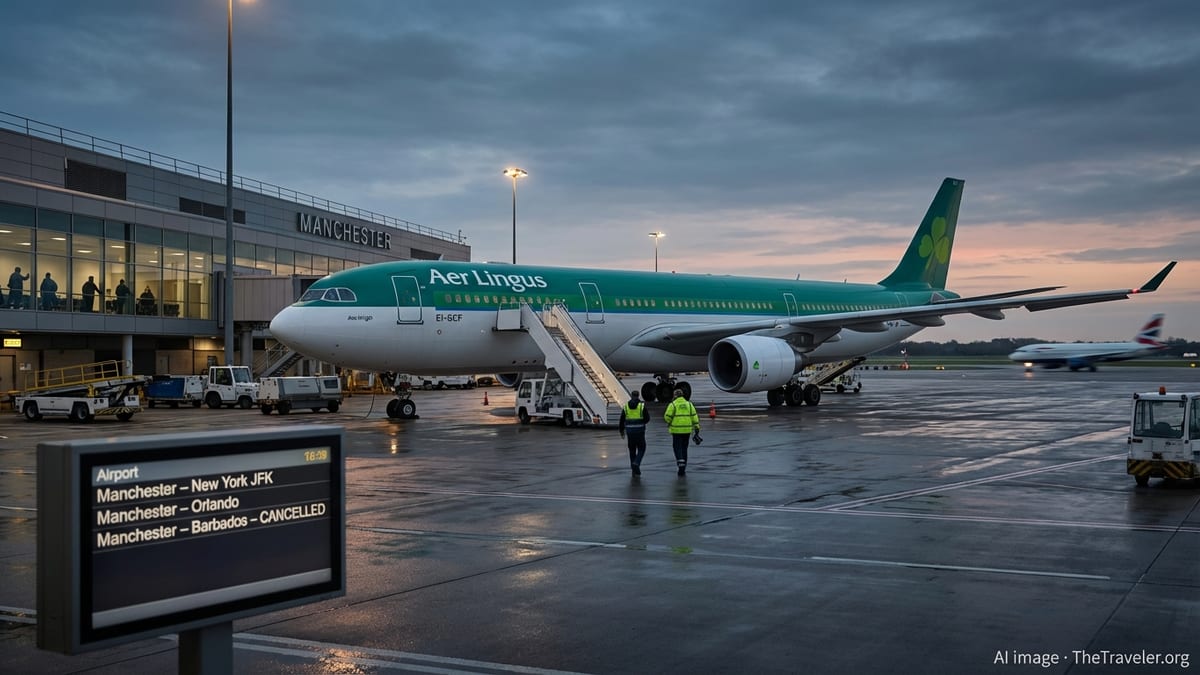
Live picture of delays across today’s departures
Publicly available live departure boards for Manchester Airport on 2 September show a rolling sequence of short and moderate delays rather than a single prolonged shutdown. Flights are departing from Terminals 2 and 3 with varying levels of disruption, and many services are still marked on time alongside those running behind schedule.
Independent flight-tracking boards indicate that a number of early-morning and mid-morning departures experienced pushback times running beyond their scheduled slots, typically by 15 to 45 minutes. Later in the day, some services in the early evening wave are also showing revised estimated departure times, reflecting ongoing congestion in the schedule.
Information services that aggregate airline data stress that flight status can change rapidly and that listings for Manchester Airport are updated frequently. Passengers are advised to re-check flight numbers close to departure, as flights initially listed as on time may subsequently move into delayed status, while others recover lost time and revert to an on-time listing.
Airport information pages emphasise that departure and arrival times shown on online boards and in-terminal displays are intended as guidance only. Travellers are directed to validate any delay information directly through their airline’s chosen communication channels, especially where connection times or tight onward travel plans are involved.
Routes and airlines most affected by delays
Departures to popular leisure destinations in Spain, Turkey and other Mediterranean markets feature prominently among today’s delayed flights. Live boards show several services to coastal airports, including routes to the Balearic and Aegean regions, running behind schedule, reflecting both heavy seasonal demand and broader European airspace pressures.
Medium-haul and long-haul services are also affected, although patterns vary by route. Some transatlantic and Middle Eastern departures remain scheduled on time, while others show estimated departure times pushed back by around half an hour or more. Published travel updates note that airspace constraints in certain regions continue to generate knock-on effects for European hubs, including Manchester, contributing to extended block times for selected services.
Low-cost and leisure carriers operating dense schedules from Terminal 2 appear particularly exposed to small rotational delays, where an inbound aircraft arriving late compresses the turnaround window for its next departure. This can translate into a run of modest delays across the day rather than isolated, longer disruptions to single flights.
Network and flag carriers operating from Manchester are seeing a more mixed picture, with some key European hubs still reporting on-time departures while others show minor slippage. Because these services often feed into complex connecting banks, even relatively short delays from Manchester can have implications for onward connections, underlining the importance of checking connection windows before travel.
Terminal-by-terminal disruption at Manchester Airport
Recent changes at Manchester Airport mean the main flow of passenger departures is now concentrated through Terminals 2 and 3, with the legacy Terminal 1 largely closed as a departures facility. Live departure boards for 2 September reflect this configuration, listing most international and domestic flights from the two active terminals, with flight status, gate information and estimated departure time displayed together.
Terminal 2, which handles a high volume of leisure, low-cost and long-haul traffic, is experiencing the broadest spread of delays. Morning bank flights to European holiday destinations, along with selected long-haul services later in the day, show estimated departure times slipping beyond the original schedule. However, a significant proportion of Terminal 2 flights remain on time, indicating that disruption is uneven rather than systemic.
Terminal 3, which accommodates a mix of short-haul and regional services, is also seeing some delays, particularly on busy UK and near-Europe routes. These tend to be shorter in duration, with many services reported as departing within approximately half an hour of the planned time. The overall impact for Terminal 3 passengers is therefore more about compressed buffer time than severe extended waits in the gate area.
Across both terminals, available guidance for passengers highlights the importance of monitoring display screens in the check-in halls, departure lounges and at individual gates. Where delays are reported, gate assignments can still change, and boarding may begin quickly once an updated slot is secured, so remaining close to the designated area once airside is recommended.
Underlying causes and wider operational context
Travel updates associated with Manchester Airport indicate that ongoing geopolitical tensions and related airspace closures in parts of the Middle East continue to affect a small number of flights. These factors can prompt reroutings that lengthen flight times and compress turnaround schedules, adding strain to already busy departure periods.
Summer 2026 capacity planning documents for Manchester Airport show that the airport is operating with tightly managed runway and stand capacity during peak daytime hours. When combined with strong holiday demand and occasional weather or air traffic control restrictions elsewhere in Europe, this environment can increase the likelihood of short-notice departure delays, even when local conditions at Manchester remain stable.
Industry observers note that Manchester Airport, like many major European hubs, is still balancing robust passenger demand with finite infrastructure and staffing resources. The result is a schedule that generally operates close to planned timings, but which can be vulnerable to external shocks or small operational disruptions that ripple across multiple flights.
Today’s pattern of delays at Manchester therefore aligns with a wider trend across regional hubs in the UK and Europe, where persistent but mostly moderate disruption has become common during peak travel days. For most passengers this translates into longer-than-expected waits at the gate rather than outright cancellations, but the impact can still be significant for those with tight onward connections or fixed ground transport bookings.
How passengers can check specific flights today
For travellers departing from Manchester Airport on 2 September, the most precise picture of any delay is obtained by combining several live sources. The airport’s own departure board provides an overarching snapshot of all flights, including destination, terminal, gate and current status, and is updated regularly throughout the day.
Independent flight-tracking platforms offer an additional layer of detail, showing delay minutes, recent status changes and, in some cases, the movement of the specific aircraft operating a route. These tools can help passengers understand whether a delay is likely to grow, shrink or remain stable, based on the location and progress of the inbound flight that will operate their service.
Consumer advice sources generally emphasise that travellers should also refer to airline-specific channels, such as mobile apps, SMS updates and email notifications. Airlines often provide tailored guidance on check-in cut-off times, boarding expectations and rebooking options where delays exceed certain thresholds, information that may not be visible on generic airport boards.
Passengers with rail or coach connections from Manchester Airport station are encouraged to check separate live departure boards for ground transport, as rail services operate on distinct schedules. Aligning real-time flight data with live rail information reduces the risk of missed trains when flight delays compress already tight interchange windows.
Manchester Airport live departures board
Aggregated Manchester Airport departures and delay data
Manchester Airport live departures on Plane Finder
Manchester Airport passenger information and FAQs
Further coverage of Manchester Airport delays on 2 September