


More news on this day
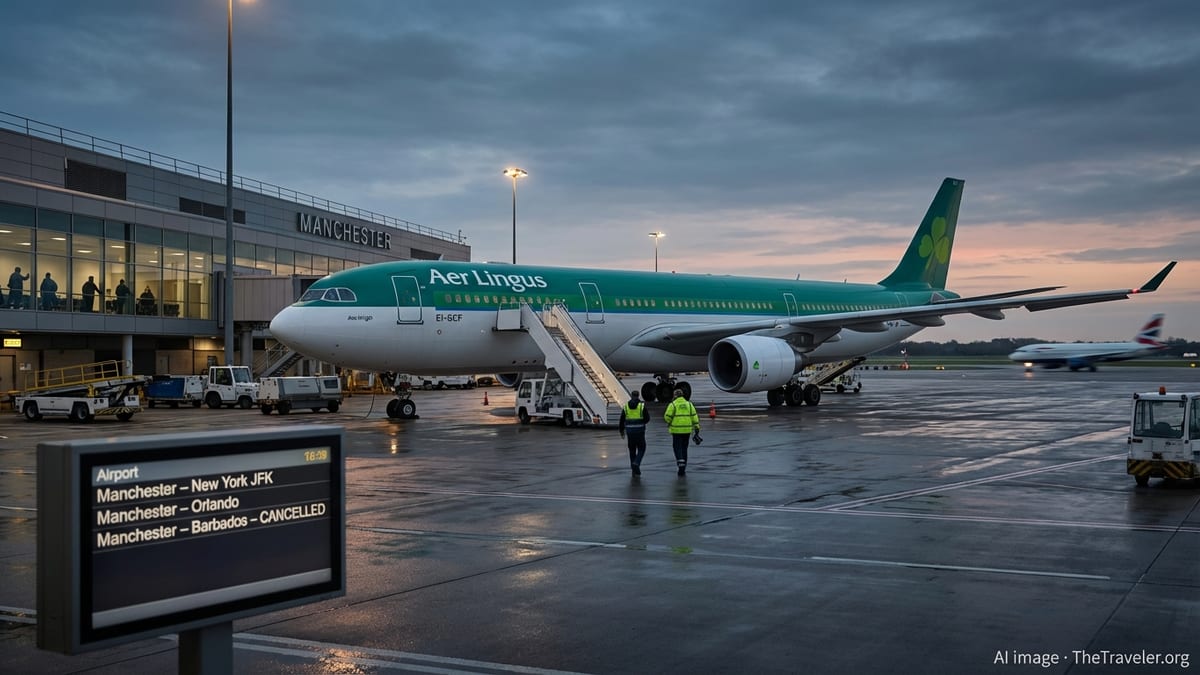
Flights at Manchester Airport were hit by delays after published coverage described a runway surface defect, with disruption continuing after the affected runway reopened and schedules worked through a backlog.
Get the latest news straight to your inbox!
What happened and when
Published coverage on Sunday, September 20, 2026, linked the disruption to an incident the day before, Saturday, September 19, when a defect was identified on Manchester’s main runway, 05L/23R, sometimes referred to operationally as Runway 1. Reports described the issue as a “hole” or pothole in the runway surface.
According to multiple aviation and travel reports, the runway was restricted for roughly two hours while maintenance work took place. Even after flight operations resumed, knock-on delays persisted into the evening as aircraft and crews were repositioned and departure sequences were rebuilt.
Manchester Airport routinely operates with two parallel runways, 05L/23R and 05R/23L. Operational documents and airport guidance show the airport alternates between single-runway and dual-runway use depending on time of day and conditions, which can make any unplanned restriction to the primary runway especially disruptive during busier periods.
How the disruption affected flights
Reports indicated that the runway issue led to delays across both departures and arrivals, with some flights unable to land at their scheduled time. One aviation-focused report described average departure delays around 40 minutes during the disruption window, a figure that can fluctuate as the schedule recovers.
Coverage also indicated a small number of inbound flights were diverted to nearby airports, including Liverpool, during the period when the main runway was affected. Diversions, even when limited, can have an outsized impact because the aircraft then need new slots, refueling, and crew duty-time adjustments before continuing to Manchester or operating subsequent rotations.
Live flight status boards and trackers typically show the recovery phase as uneven: some flights depart close to schedule while others accumulate longer waits due to aircraft positioning, airport stand availability, and air traffic flow management. For travelers, that can translate into rolling updates at the gate, revised boarding times, and changed aircraft assignments.
Why a short runway restriction can cause hours of delays
Even a brief closure on a major runway can create delays that linger well beyond the repair window. Manchester’s main runway 05L/23R is the most used runway at the airport, and airport-published material about planned works highlights how much routine inspection and maintenance is required to keep the surface and adjoining taxiways in good condition.
When the main runway is unavailable or its capacity is reduced, traffic may be funneled onto the secondary runway 05R/23L. That runway can handle normal operations, but any temporary reduction in movements per hour can quickly create a queue of departures and arrivals, particularly around peak banks when aircraft are scheduled close together.
Industry coverage around this incident emphasized the “tail” of disruption that follows a runway defect: once aircraft are out of sequence, the operational recovery is constrained by crew availability, stand and gate capacity, and the ability to secure new air traffic slots for delayed flights.
What passengers should do right now
Travelers flying to or from Manchester in the next 24 to 48 hours should rely on their airline’s live tools for the most current departure time, gate, and aircraft information, since recovery often continues into the next day as schedules normalize. Checking the airport’s departures and arrivals pages before leaving for the terminal can help identify early changes.
If a flight is delayed, passengers on UK departures generally have consumer protections that can include duty of care such as meals or accommodation during longer disruptions, depending on circumstances and wait times. The appropriate pathway is typically to request assistance through the operating airline, which manages rebooking and on-the-day logistics.
For those already at the airport, travelers can reduce risk by keeping boarding passes and booking receipts accessible, enabling notifications in airline apps, and monitoring boarding announcements closely. During disruption periods, airlines may consolidate flights, swap aircraft, or adjust check-in and bag-drop cutoffs to manage throughput.
Context: planned maintenance and other airfield constraints
Manchester publishes scheduled runway maintenance windows in advance, including overnight closures for Runway 1 (05L/23R) on certain dates in 2026, when Runway 2 (05R/23L) is used as the sole runway. Those planned works are separate from this reported unplanned defect, but they illustrate how operational capacity can change depending on which runway is available.
Separately, aeronautical information sources also show ongoing airfield works and operational constraints that can influence day-to-day movements, such as taxiway diversions and navigation or approach-related notices that may affect how aircraft are sequenced. While these measures are routine within airport operations, they can reduce flexibility when an unexpected runway event occurs.
For passengers, the key takeaway is that runway defects are typically resolved quickly from an engineering perspective, but the travel impact often depends on when the restriction happens in the daily schedule and how many aircraft are already committed to arriving and departing in that period.