


If you are dreaming of the French Riviera but hesitating between a quieter base in Mandelieu la Napoule or the historic energy of Antibes, you are not alone. These two towns sit less than 40 minutes apart by train or car, share the same sparkling Mediterranean, yet deliver very different styles of holiday. Choosing the right one can shape everything from your daily budget to how you spend your evenings and which day trips actually feel relaxing instead of rushed.
Get the latest updates straight to your inbox!
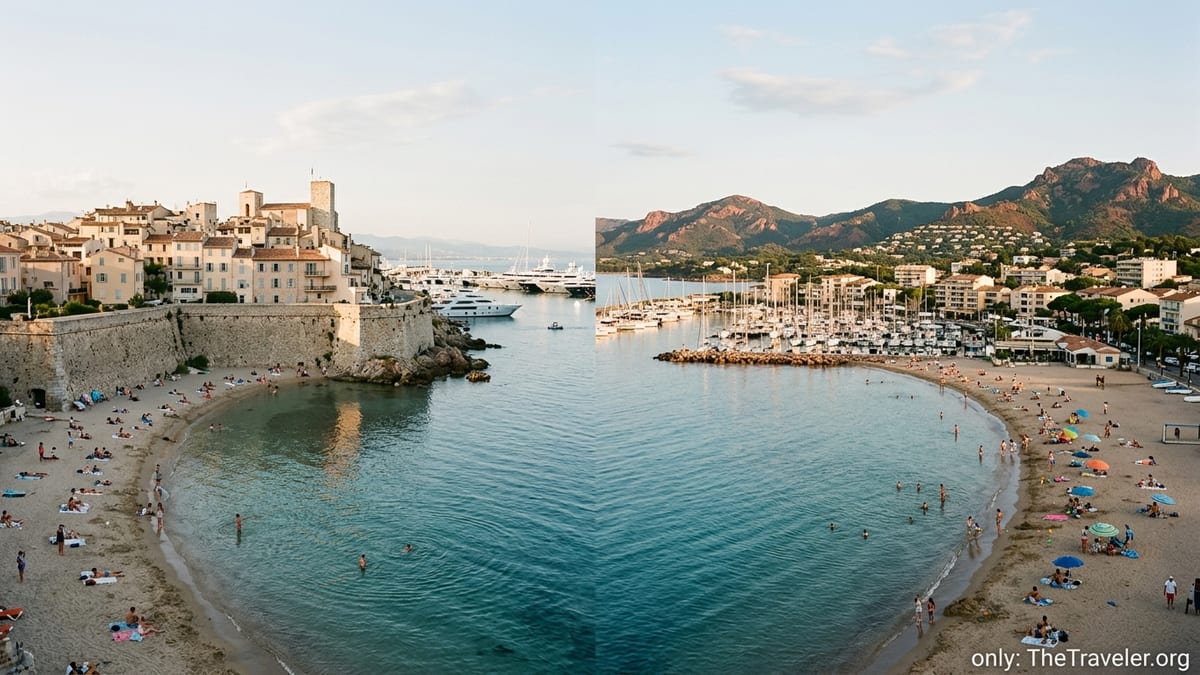
First impressions: two Riviera moods side by side
Mandelieu la Napoule and Antibes share the essentials that draw travelers to the Côte d’Azur: sandy beaches, clear water, marinas full of gleaming yachts and an almost guaranteed dose of sunshine between late spring and early autumn. Beyond that, each town has its own personality. Mandelieu, a community of roughly twenty‑odd thousand residents spread between sea and hills, feels like a lived‑in nautical suburb of Cannes, with harbors such as Port la Napoule and Port de la Rague, residential complexes, and low‑rise hotels lining the coastline. You are never far from a marina, a roundabout and a bakery, and the pace is slow outside peak French summer holidays.
Antibes, by contrast, is instantly recognizable from photos: medieval ramparts perched above the sea, the Picasso Museum tower rising over the old town, and Port Vauban, often described as one of the largest marinas in Europe. Within the walls of Vieil Antibes you find tightly packed 16th‑century streets, covered food markets and pocket‑sized city beaches like Plage de la Gravette tucked under the fortifications. It feels more like a classic Mediterranean town where you wander from café to café, with a constant background buzz even outside July and August.
In practice, travelers who picture quiet evening walks along a seafront, easy parking and days organized around boating or golfing tend to feel at home in Mandelieu la Napoule. Those who imagine stepping out of an apartment into a maze of restaurants and wine bars, browsing galleries before a swim and using trains for day trips often gravitate to Antibes. Your ideal Riviera escape starts with deciding which of those images feels more like a holiday.
Beach time: wide family sands or pocket coves by the ramparts
On paper, both destinations offer sandy beaches and calm water, but the way you use them is different. Mandelieu la Napoule has around 3 kilometers of coastline, with a string of public and private beaches such as Plage de la Rague, Plage des Dauphins, Fon Marina, and Plage du Château near the fairy‑tale Château de la Napoule. These beaches tend to be broader and less hemmed in by buildings than those inside Antibes, and they suit families who want to set up for half or a full day without walking far from a car. Many stretches are shallow and sheltered, and the local tourism office highlights that much of the seafront is easily accessible with nearby free parking.
Antibes offers a more varied but more compact beach experience. Right by the old town, Plage de la Gravette is a small, enclosed sandy cove under the ramparts, just a few minutes’ walk from the covered market and the harbor. Slightly further along are Plage du Ponteil and Plage de la Salis, popular sandy strips lining the start of the Cap d’Antibes peninsula. On the opposite side of town, towards Juan‑les‑Pins, you reach busier, club‑lined beaches with more nightlife. The upside is that you can leave your apartment in the old town, grab a baguette from a nearby bakery and be swimming at La Gravette in ten minutes, without needing a car or even flip‑flops if you are used to cobblestones.
For many travelers, the decision comes down to rhythm. In Mandelieu, you might drive or stroll down to Plage de la Rague after breakfast, rent two loungers and an umbrella from a private concession in high summer for perhaps 25 to 40 euros for the day, break for a long lunch at a marina bistro and wander back in the late afternoon. In Antibes, a typical day might be more fragmented: a couple of morning hours at La Gravette, back through the gate in the ramparts for lunch at a small brasserie, then a late‑afternoon dip at Salis Beach before aperitif in the old town. Night‑swimming with the sound of a bar’s live music drifting over the water is more of an Antibes than a Mandelieu experience.
Vibe and nightlife: sleepy nautical village or lived‑in art town
The atmosphere in Mandelieu la Napoule is shaped by boats, second‑home owners and families. The town promotes itself as a leading nautical destination, with active marinas and boatyards. Port la Napoule and Port de la Rague host yachting events, sailing schools and dive centers, and many apartments look straight onto moorings. In the evenings, activity concentrates around waterfront restaurants, hotel bars and a few relaxed venues clustered by the harbor. You can expect seafood platters, pizzas and rosé sipped on terraces that close at a reasonable hour, especially outside peak season.
Antibes wears several hats at once: it is a historic walled town, a yachting hub and a place with a strong art and café culture. In summer evenings, the old streets between the market and the cathedral fill with people heading for wine bars, gelato counters and bistros. Small venues near the ramparts and in the lanes of Rue Sade or Rue Thuret stay busy late, without the consistent club‑heavy scene you might find in Cannes or Nice. A short walk or a one‑stop train ride carries you to Juan‑les‑Pins if you want louder beach bars and nightlife, while still letting you retreat to quieter stone streets.
Travelers who want complete calm by 10 pm are often happier in Mandelieu, particularly if they choose a residence slightly set back from the seafront or near the golf course. Couples and solo travelers who enjoy strolling out with no fixed plan, choosing between a harbor‑view aperitif, a gallery opening or an ice‑cream under the ramparts usually find Antibes more rewarding. A frequent pattern is to base in Antibes for three or four nights, then add two or three quieter nights in Mandelieu or in the surrounding hills to decompress.
Budget and accommodation: where your money goes further
Neither town is cheap in high season, especially during late July and most of August, when the Riviera is at its busiest. However, Mandelieu la Napoule generally offers slightly better value for space, parking and proximity to the sea. Many seaside apartment complexes were designed around marina or golf tourism, so it is common to find one‑ or two‑bedroom rentals in residences such as those around Port de la Rague or the Port la Napoule area with a shared pool and parking. Outside school holidays, a week in a basic but well located one‑bedroom near the harbor can in many cases come in several hundred euros cheaper than an equivalent option within the ramparts of Antibes.
Antibes, especially the old town and streets between the ramparts and Boulevard Albert 1er, commands a premium because of the historic setting and walkability. A small, characterful studio overlooking a square near the Marché Provençal might be priced similarly to a larger apartment facing the marina in Mandelieu. Many first‑time visitors are surprised that they are paying old‑town prices while still having to manage with compact bathrooms and steep staircases. That said, if you choose accommodation slightly up the hill between the center and the train station or over towards Juan‑les‑Pins, you can often secure a bigger modern apartment or mid‑range hotel room at a more moderate nightly rate, with a 10 to 20 minute walk into the heart of Antibes.
Food budgets also differ subtly. In both towns you can grab a takeaway slice of pizza for under 10 euros or shop for picnic supplies in supermarkets. Yet Antibes’ denser restaurant scene means you are more tempted by sit‑down meals: a bistro main course can easily sit in the 20 to 30 euro range, with a two‑course dinner for two and wine at a mid‑range place landing between 70 and 100 euros. In Mandelieu, you still find smart marina restaurants with similar prices, but you also have strip‑side pizzerias, hotel brasseries and snack bars near beaches where a simpler plate of moules‑frites and a drink keep costs lower. Travelers watching their wallet often self‑cater breakfasts and some dinners in Mandelieu while splurging on a couple of special evening meals in Antibes or Cannes.
Getting around and day trips: trains vs car keys
One of the biggest practical differences between Mandelieu la Napoule and Antibes is transport. Antibes sits right on the main coastal rail line linking Marseille, Cannes, Nice, Monaco and the Italian border. From the station, which is within a 10 to 15 minute walk of the old town, frequent regional trains allow straightforward day trips to Cannes, Nice, Villefranche‑sur‑Mer, Menton and Monaco. Buses connect to nearby coastal spots and to hill villages like Biot. Travelers without a car consistently report that Antibes works well as a base where they can combine beach time with two or three low‑stress train excursions.
Mandelieu la Napoule does have a station on the same rail line, but frequencies and connections typically require more planning, and many local activities assume you have a vehicle. The town spreads inland along the Siagne River and towards the Esterel hills, so some residential complexes and campsites are several kilometers from the nearest large supermarket or beach. If your idea of a holiday is a rental car in the parking lot, a quick drive to the boulangerie in the morning and the freedom to hop over to Théoule‑sur‑Mer, the Esterel red‑rock coves or the backcountry villages, Mandelieu can feel ideal. If you prefer stepping off a train with a suitcase and not seeing a steering wheel all week, Antibes is clearly the more convenient choice.
For concrete examples, consider a five‑night stay in September focused on sightseeing: from Antibes, you could take a morning train to Nice for a full day in the old town and promenade, another day to Monaco and Menton, and still have time for a half‑day walk around Cap d’Antibes followed by beach time. You would buy relatively inexpensive regional train tickets and not worry about parking. From Mandelieu, the same itinerary is possible, but transfers often start or end with a local bus or car journey to Cannes or La Bocca before joining the main line, which makes day trips more time‑consuming unless you drive.
What you actually do all week: concrete trip scenarios
When deciding between Mandelieu la Napoule and Antibes, it helps to picture a typical day of your holiday rather than just comparing photos. Imagine a family with two small children booking an August week in Mandelieu. They choose a two‑bedroom apartment in a gated residence behind Port la Napoule, with a pool and on‑site parking. Mornings start with a bakery run to pick up croissants, then a short drive to Plage des Dauphins where they spread out under a parasol and let the kids paddle in the shallows. After lunch at a simple seafront café, perhaps ordering a kids’ menu and sharing a carafe of local rosé, they return for nap time by the pool. In the evening, parents take turns walking along the marina while the other stays back with sleeping children, maybe sharing a takeaway pizza on the balcony. One or two days in the week they drive along the Esterel corniche to find a snorkel‑friendly cove or pop into Cannes in the late afternoon.
Now picture a couple on a four‑night shoulder‑season break in Antibes. They rent a small but charming one‑bedroom apartment near the covered market. After a quick breakfast from the boulangerie around the corner, they wander the stalls buying olives, cheese and fruit. They spend a couple of hours at Plage de la Gravette, then head to the Picasso Museum after lunch. On another day they take a mid‑morning train to Villefranche‑sur‑Mer, swim in the bay, and are back in Antibes by early evening for drinks on the ramparts followed by a late bistro dinner on a lantern‑lit terrace. On their last full day, they walk the coastal path around Cap d’Antibes, swim at Salis Beach and finish with sunset from the port, watching superyachts with an ice‑cream in hand.
Both of these weeks are very French‑Riviera, but they suit different expectations. The Mandelieu version minimizes logistics with kids and focuses on space, driving and lazy beach days. The Antibes version maximizes walking, café culture and easy access to neighboring towns. Solo travelers often find that Antibes offers more built‑in distraction and the chance to join walking tours or small‑group excursions, while groups of friends with a hire car sometimes appreciate Mandelieu’s roomier rentals and simple access to outdoor activities like kayaking or coastal hikes in the Esterel.
Who should choose Mandelieu la Napoule
Mandelieu la Napoule is a strong fit if you want the Riviera but are allergic to feeling cramped or rushed. It suits travelers who like to unpack in a roomy apartment, stock the fridge at a large supermarket and design each day around water sports, golf or quiet beach time. Boat owners and enthusiasts gravitate to the area for its marinas and nautical facilities, including sailing schools and diving operators based in Port de la Rague and Port la Napoule. If you have your own car or plan to rent one at Nice airport, basing here makes day trips to the Esterel massif, inland perfume towns and nearby coastal resorts straightforward without battling the denser traffic around Nice.
Families with young children often appreciate practical details: easier street parking, the option of free public beaches within a short drive, and a general absence of late‑night noise under bedroom windows. Multigenerational groups who prioritize having a pool on site, perhaps traveling in May, June or September when the weather is warm but not oppressive, can often secure good‑value villas or apartments here compared with headline names like Antibes or Cannes. The town also appeals to repeat visitors who have already done the classic Riviera sights and now prefer a base that feels more like a local community than a postcard.
On the other hand, Mandelieu is not the ideal choice if you dream of wandering medieval streets every evening or plan to rely entirely on public transport. While there are buses and local trains, you will feel their limitations if you try to sightsee in multiple towns every day without a vehicle. If you are the kind of traveler who likes to step outside and spontaneously join a walking tour, duck into a museum, then choose between dozens of wine bars at night, Antibes will likely feel more rewarding.
Who should choose Antibes
Antibes works especially well for first‑time visitors to the Côte d’Azur who want a single base, a mix of beach and culture, and the ability to explore without a car. Staying in or near the old town puts you within walking distance of the covered food market, port, Picasso Museum, city beaches and train station. You can swim in the morning, take a mid‑day train to Nice or Cannes, and still be back for dinner under the ramparts. Travelers who enjoy people‑watching, browsing independent shops and tasting menus in different bistros every night rarely run out of options during a week‑long stay.
Antibes also appeals to art and history lovers. Beyond the Picasso Museum, you have smaller galleries, the Archaeology Museum and informal street‑level art dotted around the lanes. The town’s Venetian‑influenced ramparts and pastel façades photograph beautifully at golden hour, drawing amateur photographers and content creators. Because of the frequency of trains and regional buses, Antibes is a practical base for those interested in day trips to hilltop villages, perfume factories or neighboring beach towns, all without parking headaches.
If your priorities lean towards quiet seafront apartments with pools, all‑day free parking and quick escapes into nature, Antibes may not be your best match. The compact old town comes with cobblestone noise, occasional nightlife spillover and higher accommodation prices for less internal space. However, travelers who value walkability over square meters and can tolerate some evening bustle usually come away feeling that Antibes delivered a quintessential yet manageable Riviera experience.
The Takeaway
Choosing between Mandelieu la Napoule and Antibes is less about which town is objectively better and more about which one matches the way you like to travel. If your perfect Riviera escape involves a rental car, a spacious apartment overlooking a marina, quiet evenings on the balcony and long, unbroken beach days with the kids, Mandelieu offers excellent value and a softer version of the coast. It places you near boat harbors, golf fairways and the wild red cliffs of the Esterel, with Cannes a short drive away when you crave a little glamour.
If your ideal holiday centers on walking narrow lanes, browsing markets, stepping straight from sightseeing into a swim under city walls and hopping on trains for low‑effort day trips, Antibes is likely the better fit. It gives you iconic Riviera views, a lived‑in old town and a rich café and restaurant scene, all without requiring a car. Many travelers find that starting in Antibes for energy and exploration, then finishing with a few slower nights in Mandelieu or a nearby village, delivers the best of both worlds.
Before you book, picture a single ordinary day of your trip: where you wake up, how you reach the beach, what you see from your terrace and how you get home after dinner. If that imagined day unfolds mostly on foot among old stone streets, choose Antibes. If it unfolds between car, harbor and wide sandy beaches with plenty of elbow‑room, Mandelieu la Napoule may quietly win your heart.
FAQ
Q1. Is Mandelieu la Napoule or Antibes better if I will not have a car?
Antibes is usually the better choice without a car because its train station sits close to the old town and beaches, making day trips to Cannes, Nice, Monaco and other Riviera towns straightforward. Mandelieu has public transport, but many accommodations and beaches are more spread out, so you would either walk farther or rely on occasional buses.
Q2. Which destination is more budget friendly in peak summer?
Prices fluctuate each year, but for comparable space and proximity to the sea, Mandelieu la Napoule often comes out slightly cheaper than central Antibes in July and August. Old‑town Antibes accommodation carries a premium for its charm and walkability, while Mandelieu offers more mid‑range apartments and residences with pools at gentler nightly rates.
Q3. Where will I find better beaches for young children?
Both towns have family‑friendly sandy beaches with relatively calm water. Mandelieu’s wider stretches such as Plage des Dauphins or Plage de la Rague are convenient for full‑day setups with easy parking. Antibes offers sheltered coves like Plage de la Gravette under the ramparts and gently shelving sands at Salis, ideal if you prefer to walk from your accommodation rather than drive.
Q4. Is Antibes very crowded and noisy in the evenings?
In high season Antibes old town feels lively, with busy terraces and bars, but it rarely reaches the nightclub intensity of Cannes or central Nice. Streets around the covered market and main restaurant lanes stay active late, while some residential corners inside and just outside the ramparts remain comparatively calm. If you are sensitive to noise, look for accommodation on quieter side streets or slightly up the hill towards the station.
Q5. Can I stay in Mandelieu la Napoule and still visit Antibes and Nice easily?
Yes, but it is simpler with a car. By road you can reach Cannes in under 20 minutes and continue along the coast to Antibes and Nice. Trains and buses exist, yet connections may be less frequent than from Antibes, so day trips take more planning and travel time. Many visitors in Mandelieu schedule just a handful of outings and otherwise enjoy local beaches, marinas and the Esterel coast.
Q6. Which town is better for a long weekend without packing and unpacking?
For a short three‑ or four‑night break, Antibes usually delivers more variety with less effort. You can arrive by train, settle into an old‑town apartment and fill your days with a mix of beaches, museums and easy rail excursions, all on foot. Mandelieu suits longer, slower stays where you settle into a routine and use a car to explore at your own pace.
Q7. Is Mandelieu la Napoule a good base for outdoor activities?
Yes, especially if you enjoy boating, kayaking, paddleboarding or hiking. The town’s ports host numerous nautical operators, and the nearby Esterel massif offers coastal trails with sea views and red‑rock scenery. With a car, you can also reach inland lakes and hill villages. Antibes has coastal walks and water sports too, but Mandelieu places you closer to wilder stretches of coastline.
Q8. Where will I find more dining and nightlife options?
Antibes has a denser concentration of restaurants, cafés and wine bars, particularly in the old town and along the harbor. You can dine somewhere different every night for a week without repeating yourself. Mandelieu’s scene focuses on marina‑side and hotel restaurants, with a handful of relaxed bars; it is pleasant but quieter and more limited, especially outside peak months.
Q9. Which destination suits a couple’s romantic getaway?
Both can work, but Antibes generally offers more romantic ambiances, from sunset walks on the ramparts to candlelit dinners in stone‑walled lanes and evening swims at city beaches. Mandelieu appeals to couples who prefer seafront apartments, privacy, long drives along the coast and quiet harbor dinners. If you value atmosphere and strolling options over seclusion, Antibes usually wins.
Q10. Is it worth splitting a week between Mandelieu la Napoule and Antibes?
For travelers with seven to ten days, splitting time can be rewarding: start with three or four nights in Antibes for exploration and day trips, then move to Mandelieu for three or more nights of slower beach and marina time. The transfer between the two is short, so you gain variety without losing much time to logistics.