


Manila’s Ninoy Aquino International Airport (NAIA) can be confusing even for seasoned travelers, especially when you are connecting from a domestic flight to an international one. With four terminals, airline reshuffles, and traffic between buildings, a smooth connection depends on knowing your airline, which terminal you use, and how your ticket is booked. This guide walks you through the process step by step, with realistic time estimates and concrete examples for Cebu Pacific, Philippine Airlines, AirAsia and others.
Get the latest updates straight to your inbox!
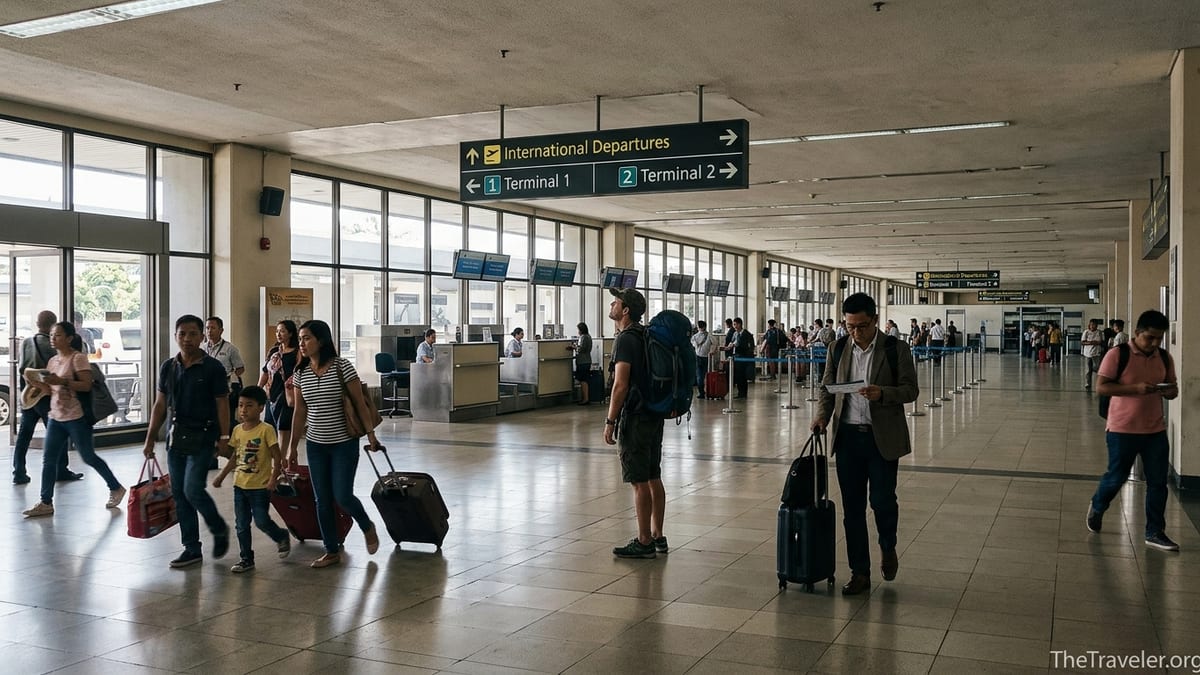
How NAIA’s Terminals Work Today
Before you can plan a connection, you need a clear picture of how NAIA is laid out and which airlines use which terminal. As of mid-2026, NAIA has four terminals: Terminal 1 (mainly full-service international carriers plus Philippine Airlines long-haul), Terminal 2 (a domestic hub for Philippine Airlines and several low-cost carriers), Terminal 3 (Cebu Pacific’s primary base and a mix of international airlines), and Terminal 4 (a small domestic terminal used less for major trunk routes than in the past). For many travelers, the crucial point is that domestic and international flights are mixed across several terminals rather than being cleanly separated.
Philippine Airlines (including PAL Express) operates its international flights from Terminal 1 and its domestic flights from Terminal 2, which means most PAL connections involve a T1–T2 transfer. Cebu Pacific, by contrast, keeps its main domestic and international operations under one roof at Terminal 3, which can make connections easier when you fly Cebu Pacific all the way. AirAsia Philippines uses Terminal 2 for domestic flights, while its international operations moved from Terminal 3 to Terminal 1 starting March 29, 2026, so an AirAsia domestic to AirAsia international connection usually means crossing between T2 and T1.
In practical terms, this means that a traveler flying, for example, Cebu Pacific from Cebu to Manila and then connecting to Cebu Pacific from Manila to Singapore might stay entirely inside Terminal 3. Another traveler flying Philippine Airlines from Davao to Manila and connecting to a PAL flight to Los Angeles will almost certainly arrive at Terminal 2, collect bags if necessary, then transfer to Terminal 1. Understanding this structure lets you judge how much time you really need between flights.
Airline-by-Airline: Cebu Pacific, PAL, and AirAsia
Cebu Pacific is generally the most straightforward for domestic to international connections at NAIA, simply because most of its routes are consolidated in Terminal 3. If you are flying Cebu Pacific from Dumaguete to Manila and then on to Tokyo Narita, you will usually arrive at a domestic gate at T3, collect your bags at the domestic carousel, exit into the arrivals hall, then walk upstairs or across to the international departures check-in area. You will still need to check in, drop bags, and clear exit immigration and security, but you avoid inter-terminal transfers and external traffic.
Philippine Airlines is more split. Domestic flights such as Manila to Iloilo or Cebu to Manila operate from Terminal 2, while long-haul and regional international flights like Manila to San Francisco or Manila to Singapore depart from Terminal 1. PAL sells many of these connections on a single ticket, which means your bags are usually tagged through to your final destination. A passenger on a PAL ticket from Cagayan de Oro to Manila to Sydney, for instance, will collect a boarding pass for the full journey, fly to Terminal 2, then follow PAL’s dedicated transfer procedures to reach Terminal 1 without needing to re-check baggage, provided everything is on one booking.
AirAsia Philippines and its regional sister carriers, such as AirAsia Berhad, complicate things a little. Domestic flights like Manila to Tacloban depart from Terminal 2, while international routes such as Manila to Kuala Lumpur or Bangkok now operate from Terminal 1. AirAsia offers a “Fly-Thru” product on some routes that allows through-checking of baggage and coordinated connections within the AirAsia network. In practice, a guest flying AirAsia from Kalibo to Manila to Bangkok may arrive into T2, clear domestic arrival procedures, use the AirAsia transfer arrangements to reach T1, then proceed through international check-in and exit immigration, with bags handled automatically if Fly-Thru is on the booking. Travelers without Fly-Thru or with separate tickets should plan to collect bags and check in again at T1.
Through Tickets vs Separate Tickets
One of the biggest factors in how easy your Manila connection will be is whether your journey is on a through ticket or on separate bookings. A through ticket means a single reservation code covering your domestic and international legs, often with one airline or partners. For example, a Philippine Airlines ticket issued as Manila to Bacolod and then Bacolod to Tokyo Haneda might actually route via NAIA, with your bags tagged from origin to final destination and the connection protected. If the first flight is late, the airline has an obligation to assist, potentially rebooking you on a later service.
By contrast, separate tickets are common among budget travelers and can save money, but they add risk. Booking Cebu Pacific from Iloilo to Manila on one ticket and then a completely separate ticket on Scoot or JAL from Manila to another country means you are effectively ending one trip in Manila and starting another. You must collect your luggage, clear customs if applicable, transfer between terminals if needed, check in again, and go back through security and immigration. If your incoming flight is delayed by three hours and you miss your onward plane, the second airline will treat you as a regular no-show, and replacement tickets can easily cost several hundred US dollars at the last minute.
In the real world, this difference is why a 2-hour domestic to international connection on a single Philippine Airlines ticket from General Santos to Manila to Dubai might be workable, while the same 2-hour gap on separate tickets from General Santos to Manila on Cebu Pacific and Manila to Dubai on Emirates is risky. For separate tickets, treat Manila as a full arrival, not a transit point, and build in ample buffer time, ideally half a day or more if you are connecting to a long-haul flight.
Step-by-Step: Domestic to International Transfers
While details vary by airline and terminal, most domestic to international transfers at NAIA follow a similar pattern. First, your domestic flight lands and you disembark into the domestic area of your arrival terminal. If you are arriving on Cebu Pacific at Terminal 3 or Philippine Airlines at Terminal 2, you follow signs to baggage claim and collect checked luggage unless your airline and ticket allow bags to be tagged through. Many PAL and some AirAsia itineraries permit through-checking; with Cebu Pacific, through-checking is more limited and usually applies only within its own network on a single ticket.
Next, you exit into the public arrivals hall. If your international flight leaves from the same terminal, you simply walk to the international departures area, which may be one level up or through clearly marked corridors. At Terminal 3, domestic arrivals often feed into a common arrivals hall shared with international arrivals. From there, you move upstairs to the departure level, find your airline’s check-in counters, and complete standard international check-in and baggage drop. If your onward flight leaves from a different terminal, this is where you locate transfer services or the airport shuttle. Philippine Airlines, for example, has dedicated transfer desks and shuttle buses connecting Terminal 2 and Terminal 1 for PAL passengers on through tickets.
Once at the international departure terminal, you join the regular process: check-in and baggage drop if you have not already done so, exit immigration, and final security screening before reaching your gate. For example, a passenger flying PAL from Cebu to Manila to Vancouver might arrive at Terminal 2, be directed to a transfer counter, ride a shuttle to Terminal 1, pass through a separate security checkpoint, then proceed directly to immigration and boarding. Another traveler on separate tickets with Cebu Pacific and Qatar Airways would need to retrieve bags at T3, take a public or airport shuttle to T1, find Qatar’s check-in counters, and only then proceed to immigration. In both cases, terminal changes and Manila’s traffic patterns can add unpredictability, so generous connection times are strongly advised.
Baggage Recheck, Immigration, and Security Nuances
Baggage handling is one of the most important practical issues in Manila. On a through ticket with a single airline group, your bags will often be checked all the way through to your final destination. On a PAL itinerary such as Davao to Manila to Los Angeles, airport staff in Davao check your passport and visa details for the United States, tag your bags to Los Angeles, and issue boarding passes for both flights. In Manila, you usually follow signs for transferring passengers, may undergo a security screening, and then head straight for international immigration at Terminal 1 without needing to pick up your suitcase.
For separate bookings or different airlines, you must assume you will need to recheck luggage. Consider a common scenario: a traveler from Bacolod flies Cebu Pacific to Manila, then connects to an ANA flight to Tokyo. Cebu Pacific will treat Manila as the final destination. You collect your bags at Terminal 3, go through customs if you have arrived from a domestic point connecting to international the same day, then exit into the public area. To continue to Tokyo, you transfer to Terminal 3’s international check-in area for ANA if it operates there or take a shuttle to Terminal 1, then recheck bags. This recheck process can easily consume 45 to 60 minutes during busy periods, even before you join immigration queues.
Immigration and security procedures also vary depending on whether you are entering or exiting the Philippines and whether you have already been screened. When you leave on an international flight, you must pass through exit immigration in the departure terminal, which can take anywhere from 10 minutes during early-morning lulls to more than an hour during weekend peaks. For example, travelers departing on a Saturday evening flight to Hong Kong or Singapore often report longer waits. Security lines at NAIA terminals similarly fluctuate. A midday departure to Seoul or Dubai might involve multiple security checkpoints: one at the terminal entrance, one before immigration, and occasionally additional screening at the gate.
Realistic Connection Times and Sample Itineraries
Official “minimum connection times” at NAIA tend to be optimistic from a leisure traveler’s perspective. Figures of roughly 45 minutes for domestic to domestic, 1 hour for international to international, and 2 hours for domestic to international are sometimes used for scheduling. In reality, these numbers assume everything runs smoothly, your flights are on time, and you hold a through ticket that allows baggage to be checked through. For most travelers, especially those on separate tickets, these minimums are far too tight for comfort.
A more realistic rule of thumb is to allow at least 3 hours for a same-terminal domestic to international connection on a through ticket, and 4 to 5 hours if you need to change terminals or recheck bags. Consider a Cebu Pacific itinerary from Cagayan de Oro to Manila to Singapore, all on one booking and both flights from Terminal 3. A 3-hour connection would typically give you time to collect luggage, recheck at the international counters if needed, clear exit immigration, and navigate security even if your incoming flight is delayed by 30 minutes. On busy days or holidays, though, you might still feel rushed.
When you hold separate tickets, especially mixing a low-cost carrier with a full-service international airline, think in terms of half a day rather than hours. For example, a traveler flying AirAsia from Puerto Princesa to Manila Terminal 2 and then on a separate Qatar Airways ticket from Terminal 1 to Doha would be wise to schedule at least 6 hours between flights. This accounts for potential delays on the domestic leg, baggage collection, inter-terminal transfer, long-haul check-in cutoffs (often 60 to 90 minutes before departure), and exit immigration. For very high-stakes flights, such as a once-a-week long-haul service or a departure with non-changeable tickets, some travelers choose to arrive in Manila the night before and stay at an airport hotel.
Terminal Transfers and On-the-Ground Logistics
Moving between terminals at NAIA is a critical part of many domestic to international connections. Officially, there are airport-operated shuttle services that circulate between terminals, as well as dedicated airline transfer buses for passengers holding through tickets. Philippine Airlines, for instance, directs connecting passengers between Terminal 2 and Terminal 1 onto its own shuttle bus, which avoids some of the curbside congestion and keeps you within the airport’s security perimeter where possible.
If you are not on a protected connection, you may need to rely on the regular airport shuttle or metered taxis and app-based rides. The physical distance between terminals is not large, but Manila traffic and curbside congestion can stretch a simple inter-terminal drive into a 20- to 40-minute exercise during peak hours. Travelers report that early morning transfers between T2 and T1 can take as little as 10 to 15 minutes, while late-afternoon or early-evening moves sometimes double that. When you add in the time to queue for a ride, load baggage, and then go back through security at your departure terminal, a terminal change can easily cost you an hour.
On the ground, signage at NAIA has improved in recent years but can still feel sparse compared to larger regional hubs. When you land from a domestic flight and know you have an international departure from another terminal, look for “transfer” or “connecting flights” signs immediately, and do not hesitate to ask airline staff. For example, a PAL agent in Davao can tell you whether your bags will be checked through to your final international destination and what to do in Manila. Similarly, at Terminal 3, Cebu Pacific staff can advise whether your connecting international flight uses the same hall and what time check-in closes. These small, real-world interactions can simplify what might otherwise be a stressful layover.
The Takeaway
Manila’s NAIA can be an efficient gateway or a stressful bottleneck depending on how you plan your domestic to international connections. The airport’s multi-terminal layout, ongoing airline reshuffles, and variable traffic conditions all mean that a generous buffer of time is usually your best insurance. When possible, choose through tickets with a single airline group, such as Philippine Airlines via Terminal 2 and Terminal 1 or Cebu Pacific via Terminal 3, so that your bags can be checked through and missed connections are the airline’s responsibility.
If you must use separate tickets, treat Manila as a full stop rather than a quick transit point. Build in at least 4 to 6 hours between flights, more if you are traveling with young children, elderly relatives, or heavy luggage. Familiarize yourself with your specific terminals in advance, confirm luggage policies at check-in, and use airline transfer desks whenever they are available. With realistic expectations and careful scheduling, even complex domestic to international connections at NAIA can be navigated calmly.
FAQ
Q1. How much time should I allow for a domestic to international connection at NAIA on one ticket?
For a through ticket on a single airline group, aim for at least 3 hours if both flights use the same terminal, and closer to 4 hours if they involve a transfer between terminals.
Q2. Is 2 hours enough for a domestic to international connection on separate tickets?
In most cases 2 hours is not enough on separate tickets. You will likely need to collect bags, change terminals, recheck in, and clear immigration and security. Plan for at least 4 to 6 hours.
Q3. Do Cebu Pacific domestic and international flights use the same terminal in Manila?
Most Cebu Pacific domestic and international flights operate from Terminal 3. This often allows you to connect without changing terminals, although you still need time for check-in and immigration.
Q4. Where do Philippine Airlines domestic and international flights operate at NAIA?
Philippine Airlines runs its domestic flights from Terminal 2 and its international flights mainly from Terminal 1. Many PAL itineraries are sold as through tickets with coordinated transfers.
Q5. How do AirAsia domestic flights connect to AirAsia international flights at NAIA?
AirAsia Philippines operates domestic flights from Terminal 2, while its international flights use Terminal 1. Some itineraries include Fly-Thru or similar services that allow through-checking of bags and arranged transfers.
Q6. Will my baggage be checked through to my final destination in Manila?
Bags are usually checked through when your entire journey is on a single ticket with one airline group. If you booked separate tickets, assume you must collect and recheck your luggage in Manila.
Q7. Is there a free shuttle between NAIA terminals for connecting passengers?
There are airport shuttles between terminals, and some airlines operate their own transfer buses for passengers on through tickets. For separate tickets you may also use regular airport shuttles or taxis.
Q8. What happens if my domestic flight is delayed and I miss my international connection?
If your flights are on one ticket, the airline usually rebooks you on the next available service. On separate tickets, you will generally need to buy a new international ticket at your own expense.
Q9. Do I need to clear immigration in Manila if I am only in transit?
You must clear exit immigration when departing the Philippines on an international flight. If you are arriving from a domestic point, Manila is your first international departure, so you will go through immigration before boarding.
Q10. Is it safer to overnight in Manila before a long-haul international flight?
For high-stakes long-haul flights, especially on separate tickets or during peak seasons, many travelers choose to arrive in Manila the day before and stay at an airport hotel to remove the stress of tight same-day connections.