


Landing at Mexico City International Airport (AICM) can feel overwhelming, especially if it is your first time in the capital and you are tired after a long flight. The good news is that you have several solid options to reach the city center, from budget friendly public transport to door to door private transfers. This 2026 guide walks you through each option with real prices, time estimates, safety tips and recommendations by neighborhood so you can choose the best way to start your stay.
Get the latest updates straight to your inbox!
Understanding Mexico City’s Airports and Main Areas
Most international visitors still arrive at Mexico City International Airport, officially Aeropuerto Internacional Benito Juárez (airport code MEX or AICM), located in the borough of Venustiano Carranza about 10 to 12 kilometers east of the historic center. The airport has two terminals connected by an internal train and shuttle buses. Terminal 1 handles many legacy international airlines and some domestic carriers, while Terminal 2 is home to Aeroméxico and SkyTeam partners. Both terminals are connected to the city’s transport network, but the options and walking distances vary slightly between them.
When people talk about “the city center” they usually mean a few key areas where visitors tend to stay. The Centro Histórico is the colonial core around the Zócalo and Alameda Central. Just to the west are Roma and Condesa, leafy districts full of cafes and boutique hotels. Farther northwest is Polanco, a more upscale area with high end hotels and shopping. Reforma, the main boulevard that runs from the historic center toward Chapultepec Park, is lined with business hotels and offices. Knowing roughly where you are staying is essential to choosing the best transport option from the airport.
There is also a newer airport, Felipe Ángeles International Airport (AIFA, code NLU), around 45 to 60 kilometers north of the city in the State of Mexico. Some low cost and regional flights use NLU. From there, most travelers rely on intercity buses, authorized taxis or ride hailing services to reach central neighborhoods. However, for the majority of visitors landing at AICM, the focus will be on Metrobus, Metro, authorized airport taxis, ride share apps like Uber and DiDi, and pre booked private transfers.
Traffic in Mexico City is highly variable, especially on weekdays between 07:00 and 10:00 and again from 17:00 to 20:30. A trip that takes 25 minutes at midday can easily stretch to over an hour at rush hour. Keep that in mind as you compare options, and consider your arrival time, luggage and comfort level with public transport when deciding how to get into town.
Using Metrobus Line 4: The Airport Workhorse
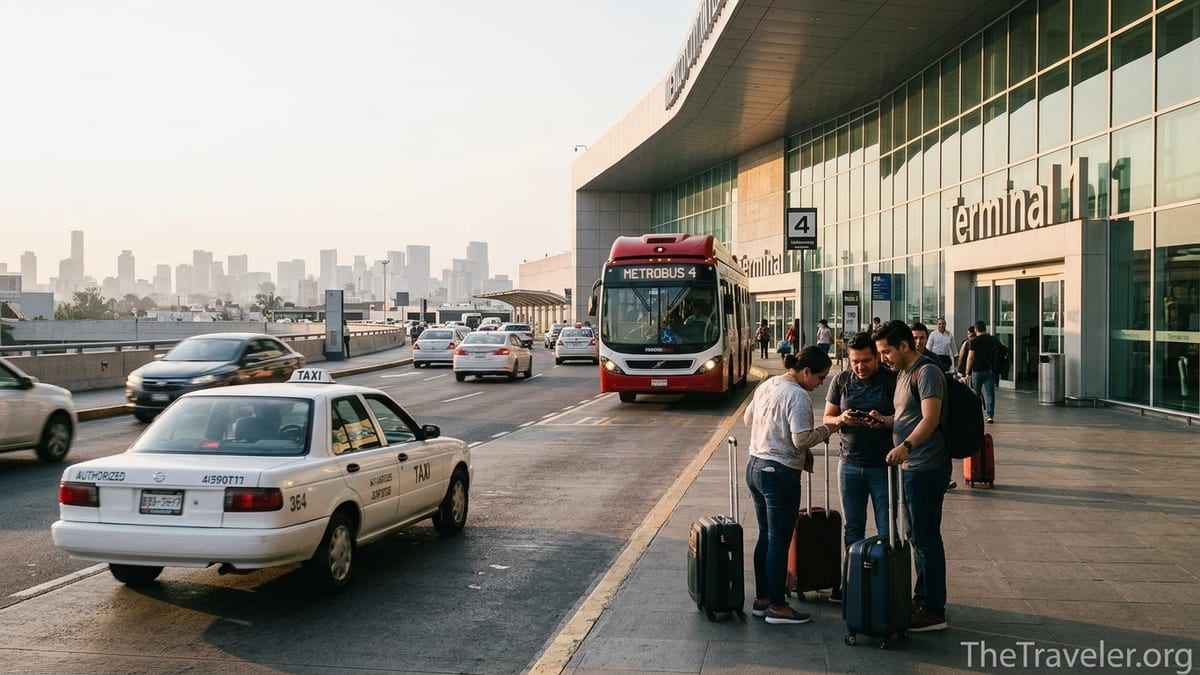
For many travelers, Metrobus Line 4 is the best balance of cost, safety and convenience from AICM to the city center. Metrobus is a bus rapid transit system that uses dedicated lanes and raised platforms. Line 4 connects both airport terminals to the historic center and to the Buenavista transport hub. Importantly, there is a special airport service on Line 4 that accepts luggage and stops at Terminal 1 and Terminal 2, then continues through downtown along routes signposted for “Centro” and “Norte”.
As of 2026, the special airport fare on Metrobus Line 4 is around 30 pesos for the trip from the terminals to central stops such as San Lázaro, Bellas Artes, Hidalgo or Buenavista. The rest of the Metrobus network costs around 6 pesos per ride, so this airport price is higher but still very inexpensive by international standards. To board you need a rechargeable Integrated Mobility (MI) card, which costs a little over 20 pesos to buy and can be reused on Metro, Metrobus and other systems across the city. Machines to buy and top up the card are located at the airport stations and major stops.
Travel time from Terminal 1 to the historic center on Metrobus is usually 40 to 60 minutes, depending on traffic and how many stops your service makes. The buses are modern and have space for luggage, although they can be crowded during peak hours. Metrobus Line 4 is especially convenient if you are staying near Alameda Central, Bellas Artes, the Zócalo, or along the Reforma corridor toward Hidalgo and Buenavista, because you can often walk from stations to your accommodation.
In practical terms, Metrobus works best for travelers who have manageable luggage, are comfortable with a bit of walking and want to keep costs low without sacrificing too much comfort. For example, a solo traveler arriving at 14:00 on a weekday and staying in a guesthouse two blocks from Alameda Central will generally be well served by taking Metrobus Line 4 directly from the airport, tapping their MI card and hopping off at Bellas Artes, rather than paying several times more for a taxi.
Taking the Metro: Cheapest but Most Demanding
Mexico City’s Metro is still one of the cheapest and most extensive urban rail systems in the world. A single ride costs around 5 pesos, valid for unlimited distance and transfers once inside the system. From the airport, Terminal 1 is connected directly to the station called Terminal Aérea on Line 5. From there you can change to other lines to reach the historic center, Roma, Condesa and beyond. Terminal 2 is not directly connected to a station, so you would first need to transfer by shuttle or internal train to Terminal 1, or walk or take a short ride to another nearby station such as Pantitlán.
While the price is extremely attractive, the Metro is also the most demanding option for new arrivals with luggage. Stations can be crowded, particularly at rush hours, and you may have to navigate stairs, long corridors and multiple transfers. Pickpocketing does sometimes occur in very busy cars, so you need to keep close watch on your bags and pockets. During off peak times in the late morning, early afternoon or mid evening, the experience can be much more relaxed.
In real terms, the Metro is worth considering if you are an experienced urban traveler, speak at least some Spanish and are carrying a backpack or small suitcase rather than multiple heavy bags. A common route from the airport to the historic center is to take Line 5 from Terminal Aérea to Pantitlán, then transfer to Line 1 toward Observatorio and exit at stations like Pino Suárez or Isabel la Católica. To reach Roma or Condesa, many travelers transfer again at Chapultepec or Sevilla to access nearby streets. Even with transfers, the total fare remains around 5 pesos per person, but you pay with the same Integrated Mobility card used on Metrobus rather than paper tickets.
Because of the crowds and stairs, most families with young children, older travelers, and visitors arriving after dark choose other options. However, for a budget conscious backpacker arriving at 11:00 on a weekday and staying in a hostel near the Zócalo, the Metro can be a very fast and cheap way to reach the city center in around 35 to 45 minutes, provided they are comfortable with the system.
Authorized Airport Taxis: Official and Predictable
Authorized airport taxis are one of the most straightforward options from both terminals to any address in Mexico City. These taxis are licensed to operate inside the airport perimeter and use fixed zone based fares rather than a meter. You do not hail them on the street. Instead, you purchase a ticket at one of the official taxi booths located in the arrivals halls, then hand the ticket to the driver at the designated taxi rank outside.
Prices vary depending on the zone and the type of vehicle (sedan or larger van), but as of 2026 many journeys from AICM to central neighborhoods fall in the range of roughly 250 to 400 pesos for a standard car, and 450 to 600 pesos for a larger vehicle. For example, an official taxi from Terminal 2 to a hotel in Roma Norte or Condesa for two people with luggage might cost around 300 to 350 pesos, while a ride to Polanco or parts of Santa Fe can cost closer to 400 pesos or more. The fare is displayed at the booth before you pay, so there is little room for surprise.
From a safety perspective, the key advantage of authorized taxis is that they are regulated, operate from inside the terminal and do not require you to negotiate on the street. You pay at the counter, receive a printed ticket and keep a receipt. If there is any issue, the company and plate number are on that slip. Drivers are used to transporting foreign visitors and know the most common hotel districts. However, traffic affects them in the same way as any other road transport, so travel times can vary from 25 minutes in light traffic to over an hour during rush hour.
Authorized taxis make the most sense for travelers who value simplicity and do not mind paying more than public transport for a private, direct ride. This could be a couple arriving late at night, a solo traveler with several suitcases, or a business traveler who wants to get to a hotel on Paseo de la Reforma without dealing with ticket machines or crowded buses. As a rule, it is better to ignore freelance drivers that approach you in the arrivals hall and instead walk directly to one of the official counters, which are clearly marked and staffed.
Uber and DiDi: Convenience With Important Caveats
Ride hailing services like Uber, DiDi and Cabify are widely used across Mexico City and are often the preferred option for moving around the city once you are already in town. Many locals and visitors consider them safer and more transparent than hailing random street taxis, thanks to GPS tracking, driver profiles and upfront pricing. In most central neighborhoods, it is straightforward to request a car at any hour.
The situation at the airport is more complicated. Officially, app based ride services are not authorized to operate pick ups in the restricted airport zone, and local authorities have carried out enforcement operations at times. In practice, many travelers still use Uber or DiDi to leave the airport by meeting their driver just outside the official perimeter, such as on nearby streets, pedestrian bridges or hotel entrances. Recent reports in 2026 describe mixed experiences: some passengers request Uber Black or higher categories at specific doors inside Terminal 1 and exit without issues, while others mention that enforcement has temporarily limited the number of drivers willing to enter the terminal area.
Because of this gray area, travelers who want to use Uber or DiDi from AICM should be prepared for two scenarios. On some days, the app will show plenty of nearby drivers willing to pick up at a numbered door in your terminal, with prices that are often lower than authorized taxis, especially for rides to Roma, Condesa or the historic center. On other days, the app may show no drivers available inside the airport and you might need to walk a few minutes to a nearby hotel or public street to request a ride, or switch to Metrobus or an authorized taxi instead.
In terms of price, typical Uber or DiDi fares from AICM to Roma, Condesa or the historic center often fall between 180 and 300 pesos, depending on demand and time of day, while rides to Polanco, Coyoacán or Santa Fe are usually higher. Surge pricing can increase costs significantly during peak hours or large events. A practical example: a group of three arriving at 21:00 on a Friday and staying near Parque México might see an Uber quote of 240 pesos compared to 320 pesos for an official taxi. If the app shows a nearby driver and recent reviews are good, many will choose the ride hailing option. If the wait time is long or there is confusion about pickup points, the taxi booth becomes the more predictable choice.
Private Transfers and Hotel Cars: Highest Comfort at a Cost
Pre booked private transfers and hotel vehicles are the most comfortable and predictable ways to travel from the airport to your accommodation, especially if you are arriving after a long intercontinental flight or with a group. Several companies offer door to door transfers from AICM to any address in the city. These are typically booked online in advance and priced per vehicle, with a driver waiting in the arrivals hall holding a sign with your name.
Prices for private transfers vary widely depending on vehicle class and provider, but as a general guideline, a standard sedan or small SUV for up to three passengers from AICM to central areas like Reforma, Roma or Condesa often costs between 700 and 1200 pesos. Larger vans for families or groups can range from roughly 1000 to 1600 pesos or more. Some higher end hotels on Reforma or in Polanco also offer their own transfer services, which can be even more expensive but include premium vehicles and drivers familiar with the property.
The main advantages are comfort, safety and certainty. Your driver tracks your flight, adjusts to delays and meets you inside the terminal. There is no need to deal with ticket machines, lines at the taxi booth or questions about where to meet an Uber. For a family of four arriving late at night with several suitcases and children, knowing that a large van will be waiting just outside customs can be worth the extra cost. This is particularly true if you are staying in a residential area where taxi drivers or Uber might have more trouble locating the exact address.
Private transfers are also a good option for travelers arriving at Felipe Ángeles International Airport (AIFA), which is much farther from central Mexico City. While shuttle buses and authorized taxis are available there, many visitors choose pre arranged transfers to avoid navigating an unfamiliar airport and the long, traffic prone routes into the city. Here, the price difference between a private transfer and arranging a taxi plus possible app ride can be smaller relative to the total travel time and complexity.
Comparing Cost, Safety and Luggage Friendliness
When choosing how to get from the airport to the city center, it helps to compare each option across three key dimensions: cost, safety and luggage friendliness. At the low cost end, the Metro is the absolute cheapest at around 5 pesos per ride, making it attractive to solo backpackers and budget travelers. Metrobus Line 4’s airport service, at roughly 30 pesos plus the cost of the MI card, remains very affordable while adding airport specific conveniences like luggage space and a route that goes directly through tourist friendly areas.
On the safety front, official airport taxis, Metrobus and pre booked private transfers provide clear structures and traceability. You buy a ticket or have a booking, there is documentation of the company and vehicle, and you depart from designated, monitored areas. Uber and DiDi add safety features like GPS tracking and payment through the app, but the legal situation around airport pickups introduces some uncertainty at AICM. The Metro is generally safe during the day for attentive travelers, but the combination of crowds and luggage can make some visitors uncomfortable, particularly late at night.
Luggage friendliness is another decisive factor. Private transfers and authorized taxis are the most forgiving, with drivers who will help load bags into the trunk. A standard taxi can usually handle two or three suitcases; larger vans can take more. Metrobus Line 4 accepts luggage, but during busy times you may have to stand and manage your bags in a crowded aisle. The Metro can be challenging with big suitcases, as not all stations have elevators or escalators and corridors can be narrow. If you are traveling with sports equipment, musical instruments or very large bags, the simplicity of a taxi or private transfer is often worth the extra pesos.
Putting this together, a practical ranking for a typical visitor might look like this: the Metro is best for ultra budget, backpack style travel during daylight hours; Metrobus Line 4 is the sweet spot for many solo travelers or couples with moderate luggage arriving at reasonable hours; authorized taxis and private transfers are best for late night arrivals, families, business travelers and anyone with heavy bags; Uber and DiDi are ideal once you are already in the city, and can work from the airport when pickup is available and straightforward.
The Best Option by Neighborhood and Travel Style
Your final choice also depends strongly on where you are staying. For accommodation in the Centro Histórico, Alameda, Bellas Artes or near Paseo de la Reforma between Hidalgo and the Angel of Independence, Metrobus Line 4 is usually the most practical budget to midrange option. Many hotels and hostels in these zones are within a 5 to 10 minute walk of Line 4 stops. A solo traveler staying at a hotel near Alameda Central, for instance, can ride Metrobus from Terminal 1 to Bellas Artes in under an hour for a fraction of the price of a taxi.
If you are staying in Roma or Condesa, you have a couple of solid strategies. One is to take Metrobus Line 4 to a central stop like Hidalgo or Buenavista and then request an Uber or DiDi for the shorter, cheaper hop into your neighborhood. Another is to use an authorized taxi or private transfer for a direct ride, which is more expensive but avoids transfers and walking with luggage. Many visitors choose authorized taxis at arrival and then rely on ride hailing within the city for everyday movements between Roma, Condesa, the historic center and neighborhoods like Coyoacán.
For Polanco, Lomas and the upper Reforma area near Auditorio Nacional, direct options become more attractive because distances are greater and public transport connections require multiple changes. Here, authorized taxis, Uber or private transfers are often the most practical. A business traveler staying in a high rise hotel on Reforma or in Polanco might easily justify the cost of an airport taxi or hotel car service to save time and arrive in comfort, especially if they are carrying work equipment or wearing business attire.
For longer stays in more residential zones, such as Narvarte, Del Valle or areas farther south near Coyoacán, a hybrid approach can work well. You might take Metrobus or the Metro into a central hub like Hidalgo, San Lázaro or Tasqueña, then switch to Uber or a local taxi from there. However, given the relatively low price of ride hailing in Mexico City, many visitors simply book an Uber or authorized taxi door to door from the airport, especially if they arrive at night or on weekends when public transport frequencies are lower.
The Takeaway
There is no single best way to get from Mexico City Airport to the city center. The right choice depends on your budget, arrival time, luggage and comfort with navigating a big Latin American city. The key is to decide in advance which option matches your travel style so you can step out of customs with a clear plan rather than making a rushed decision in the arrivals hall.
For most first time visitors arriving in daylight with manageable luggage and staying near the historic center or Reforma, Metrobus Line 4 offers the best overall balance of price, safety and convenience. Budget conscious travelers comfortable with crowds can save even more by using the Metro from Terminal Aérea, provided they avoid peak hours and keep a close eye on their belongings. Those arriving late at night, with children or heavy bags, or staying in areas like Polanco or Santa Fe will usually be happier paying extra for an authorized taxi or pre booked private transfer.
Once you are settled in your hotel or apartment, ride hailing apps like Uber and DiDi become some of the easiest ways to move between neighborhoods. By understanding the strengths and weaknesses of each option from the airport, you can start your Mexico City trip calmly, safely and on budget, ready to explore one of the most vibrant capitals in the Americas.
FAQ
Q1. Is Metrobus Line 4 safe for tourists arriving at Mexico City Airport?
Metrobus Line 4 is widely used by both locals and visitors and is generally considered safe during the day and early evening. Stations at the airport and in the historic center are monitored, and the buses use dedicated lanes. As in any big city, keep an eye on bags, avoid displaying valuables and consider other options late at night if you are traveling alone or feel uncomfortable.
Q2. How do I buy the Integrated Mobility card at the airport?
At both AICM terminals you will find vending machines near the Metrobus and Metro entrances that sell the Integrated Mobility (MI) card. You pay a small one time cost for the card itself and then load credit onto it. The machines usually accept cash and sometimes bank cards. You use the same card for Metrobus, the Metro and several other official transport systems across the city.
Q3. Are Uber and DiDi officially allowed to pick up at Mexico City Airport?
Officially, ride hailing apps are not authorized to operate pickups within the restricted airport zone, and authorities occasionally enforce this. In practice, many passengers still use Uber or DiDi by meeting drivers at specific doors or just outside the airport perimeter. Availability can vary from day to day. If the app does not show nearby drivers, be prepared to switch to Metrobus or an authorized taxi instead.
Q4. How much does an authorized taxi from the airport to the city center cost?
Authorized airport taxis use zone based fares. As of 2026, rides from AICM to central neighborhoods like the historic center, Roma or Condesa often cost roughly 250 to 400 pesos for a standard car, with prices higher for larger vehicles or more distant areas like Santa Fe. You pay at the official taxi booth inside the terminal and receive a printed ticket before heading to the taxi rank.
Q5. Is it safe to take the Metro with luggage?
The Metro is generally safe, but it can be very crowded, especially at rush hours. With luggage you may find it difficult to move through stations, and pickpocketing can occur in packed cars. For small backpacks or a single medium suitcase during off peak hours, many experienced travelers use the Metro without problems. Families with children, older travelers or anyone with multiple bags may prefer Metrobus, authorized taxis or private transfers.
Q6. Which option is best if I arrive late at night?
If your flight lands late at night, authorized airport taxis and pre booked private transfers are usually the best choices. They operate 24 hours, depart from well lit, monitored areas and take you directly to your accommodation. Metro and Metrobus timetables are more limited at night, and many visitors prefer to avoid waiting at outdoor stops with luggage after dark.
Q7. What is the best way to reach Roma or Condesa from the airport?
For Roma and Condesa, many travelers choose an authorized taxi or a pre booked private transfer for a direct, door to door ride. If you want to save money and are arriving in daylight, you can also take Metrobus Line 4 to a central stop like Hidalgo or Buenavista and then request an Uber or DiDi for the short final leg into your neighborhood.
Q8. How long does it take to get from the airport to the city center?
In light traffic, a taxi or Uber from AICM to central areas like the historic center, Roma or Reforma can take 25 to 40 minutes. During rush hour it can easily stretch to 60 minutes or more. Metrobus Line 4 typically takes around 40 to 60 minutes, depending on traffic and the exact stop. The Metro can be fast between stations but total journey time depends on transfers and walking distances inside stations.
Q9. Can I pay for transport from the airport with a foreign credit or debit card?
Some Metrobus and MI card machines accept international bank cards, but cash remains the most reliable method. Authorized taxi booths inside the terminal may accept cards, but this can vary by company and sometimes machines are out of service. It is wise to withdraw a modest amount of pesos from an ATM in the arrivals area or exchange a small sum before heading to the transport counters.
Q10. What is the best option for families with small children?
Families with small children usually appreciate the simplicity of authorized taxis or pre booked private transfers. These options minimize walking, avoid crowded platforms and let you keep everyone and everything together in one vehicle. If you need a child seat, ask your transfer company in advance. Once you are in the city, ride hailing apps can be a convenient way to move between parks, museums and restaurants without navigating complex public transport lines with kids.