


Mexico’s financial infrastructure is relatively sophisticated for a middle-income economy, yet it remains uneven and heavily cash-oriented compared with North America and Western Europe. For prospective expats, understanding how accessible banking, payments, deposit protection, and fintech solutions actually work on the ground is essential for judging whether everyday financial life in Mexico will be straightforward or operationally challenging.
What the Financial Infrastructure Score Covers in Mexico
When evaluating Mexico’s financial infrastructure score for expats, analysts typically examine several core dimensions: bank coverage and access points, quality and reliability of payments systems, use of electronic versus cash transactions, availability of credit and deposit products to foreigners, safety and oversight of the banking system, and the maturity of digital and fintech solutions. Together, these elements indicate how easily a new arrival can receive income, pay for goods and services, move money internationally, and manage savings in a predictable and secure environment.
Mexico’s banking sector is moderately concentrated, with around 50 licensed banks and a handful of large institutions dominating deposits and loans. Retail banking market size has been estimated in the mid tens of billions of US dollars annually, with gradual expansion projected over the next few years as formalization and digitalization progress. However, more than half of Mexican adults remain unbanked or underbanked according to recent financial inclusion surveys, which has direct implications for how widely card and digital payments are accepted and how cash-dependent everyday life remains.
For expats, the score is therefore mixed. On the one hand, large cities offer a familiar banking and payments experience, with international brands present, widespread ATMs, and modern digital banking apps. On the other hand, gaps in rural coverage, persistent cash dominance for many in-person transactions, and relatively low financial inclusion mean that some aspects of financial life may feel less frictionless than in more financially mature jurisdictions.
Any interpretation of Mexico’s financial infrastructure score should therefore distinguish between the experience in major metropolitan areas and that in smaller towns or remote regions, as the gap in available services, card acceptance, and digital options can be significant.
Bank Network, Access Points, and Service Availability
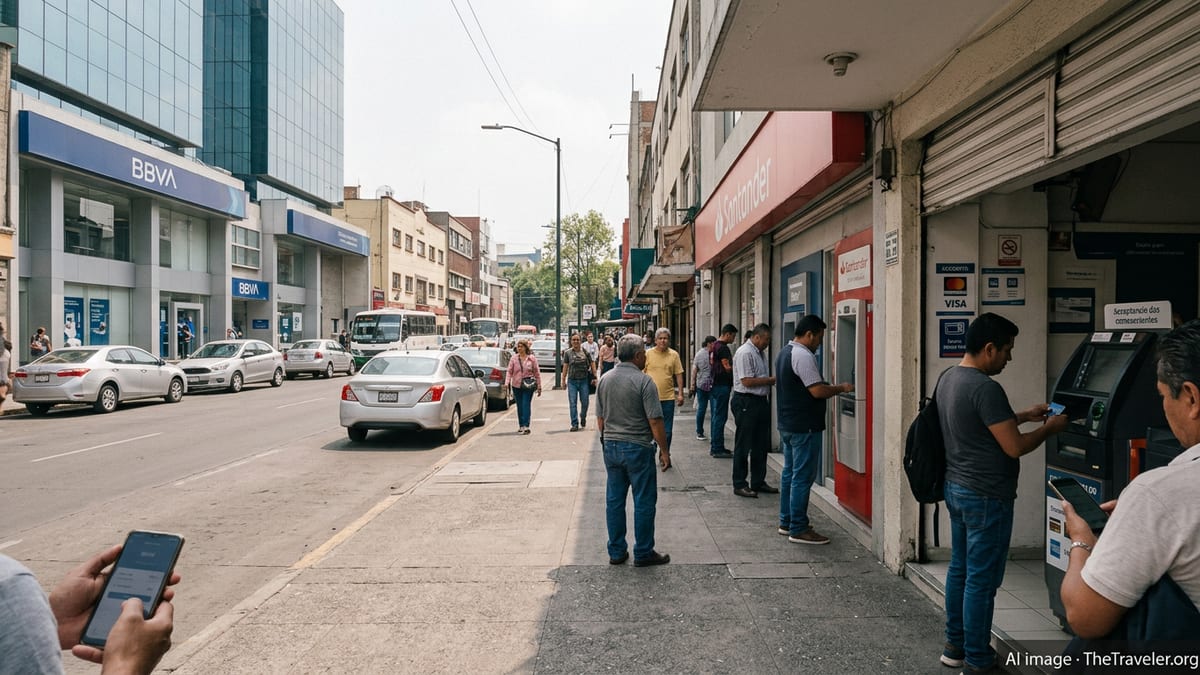
From a network standpoint, Mexico offers reasonably dense banking coverage in urban corridors. Major institutions such as BBVA Mexico, Banorte, and Banco Azteca operate large branch and ATM footprints that collectively span all states. BBVA alone maintains more than 1,600 branches and over 14,000 ATMs nationwide, while Banorte and Banco Azteca contribute thousands of additional access points. Other regional and niche banks supplement this network, giving most expats in cities multiple choices for local banking relationships.
Despite this apparent breadth, access is uneven. Official statistics indicate that Mexico still has a relatively modest number of ATMs per 10,000 adults compared to developed markets, and branch presence thins out rapidly in rural municipalities. Banco Azteca, for example, is the only private bank in well over a hundred small municipalities, highlighting how dependent many areas are on a single provider. For expats considering secondary cities or smaller towns, this geographic concentration can reduce redundancy and resilience in case of local service outages or institution-specific issues.
Branch service quality is variable. Large banks offer full-service branches with foreign exchange, investment products, and English-speaking staff in districts frequented by international clients, especially in Mexico City, Monterrey, Guadalajara, and major expat hubs. Outside of these zones, English support is less reliable and processes may be more paper-based and time-consuming than expats from highly digital banking environments are accustomed to. Queues at peak times and occasional system outages are not uncommon.
Overall, Mexico’s bank network supports a mid-to-high financial infrastructure score for expats in major cities, but the score drops for those planning to live in smaller communities where branches and ATMs are fewer, operating hours more limited, and competition among providers weaker.
Cash Dominance, Card Usage, and Day-to-Day Payments
Mexico remains structurally cash-heavy. Recent surveys from central banking and competition authorities suggest that roughly seven out of ten everyday transactions are still conducted in cash, despite a clear trend toward digital and card-based payments. In retail, over 90 percent of consumers report continued use of cash even as card payments and online wallets expand. This contrasts sharply with many OECD countries where card and digital payments now dominate point-of-sale spending.
At the same time, card usage is growing quickly and reshaping parts of the economy. By 2024, card payments represented a substantial and rising share of in-person and online transactions, accounting for roughly one quarter to one third of sales volume at the point of sale and over half of some categories of e-commerce transactions. The volume of card payments has more than doubled over a period of just a few years, and by 2025 transaction counts exceeded ten billion annually, indicating that a growing share of formal-sector activity flows through the banking system rather than in cash.
For expats, the practical implication is dual. In large supermarkets, chain restaurants, hotels, fuel stations, and most urban service providers, debit and credit card acceptance is the norm, including international cards on major networks. Contactless and chip-and-PIN transactions are widely supported. Many merchants also accept digital wallets linked to local cards. However, smaller merchants, street vendors, informal services, and some provincial businesses remain cash-only or apply minimum thresholds for card payments. Expats therefore need to operate with a higher baseline of cash on hand than in many European or North American cities, particularly outside prime urban neighborhoods.
This mix affects the financial infrastructure score by introducing friction in daily life for those who prefer to operate almost entirely electronically. The environment rewards expats who are comfortable managing both cash and digital channels and who can tolerate occasional card refusals or terminal outages. Nevertheless, the direction of travel is clear: cash reliance, while still high, is slowly declining as card penetration, POS terminals, and digital payment acceptance expand.
Digital Payments Systems, Mobile Apps, and Fintech Solutions
Mexico has made significant progress in digital payments, though adoption lags behind some peer markets. The central bank operates a real-time interbank transfer system that enables low-cost electronic transfers between accounts, and mobile banking apps for major banks now routinely support real-time domestic transfers, QR payments, and online bill settlements. Surveys show that close to seven in ten adults with smartphones use financial apps for some form of transaction, a sharp increase from earlier in the decade.
Fintech and neobank activity is extensive. Mexico hosts hundreds of fintech startups across payments, consumer credit, digital wallets, and embedded finance. Digital-only players offer peso accounts, prepaid and debit cards, budgeting tools, and in some cases multi-currency capabilities oriented toward users with international income or expenses. Embedded finance has grown into a multibillion-dollar segment, integrating credit and payment functionality into e-commerce platforms, mobility apps, and merchant tools. This competition has expanded access to digital accounts for consumers who previously had no relationship with traditional banks.
However, digital financial inclusion remains incomplete. Estimates still place more than half of the adult population outside the formal banking system, and debit card usage rates remain in the mid-thirties percent range, with credit card penetration even lower. Concerns about fraud, data breaches, and distrust of online payments continue to dampen adoption among certain demographics, and patchy mobile data coverage in rural areas limits the practical use of app-based services away from urban centers.
For expats, the digital landscape is relatively favorable but not seamless. Those living in major cities can expect functional mobile banking, fast domestic transfers, and growing acceptance of QR or wallet payments at modern merchants. Neobanks and digital wallets can provide additional flexibility, particularly for managing small balances and online purchases. Still, expats should not assume universal digital acceptance. The financial infrastructure score therefore reflects both the strength of the underlying systems and the still-limited penetration in everyday commerce, especially outside the formal economy.
Currency, Cross-Border Transfers, and FX Practicalities
From a currency and cross-border perspective, Mexico’s financial infrastructure provides reasonable, but not frictionless, support for expats with foreign income or assets. The Mexican peso is freely convertible, and residents can hold foreign currency accounts with certain banks, although such accounts are less common than in some other international finance hubs. The interbank FX market is liquid, and spreads for major currency pairs such as USD/MXN and EUR/MXN are generally competitive by emerging-market standards.
International transfers into Mexico are straightforward via SWIFT, with major banks well integrated into global correspondent networks. Processing times for standard incoming transfers typically range from one to three business days. However, retail-level fees and FX margins charged by banks can be materially higher than those in North American or European home markets, particularly for small and medium-sized amounts. Many expats therefore rely on specialized international transfer services or multi-currency fintech platforms for recurring transfers, pension payments, or rental income remittances, achieving lower spreads and more transparent fees.
On the outbound side, sending money from Mexico to foreign accounts can involve more documentation and higher transaction costs, especially when amounts are large or frequent. Banks are required to comply with anti-money-laundering controls and may request evidence of income or source of funds for significant international movements. While this is standard globally, expats accustomed to more automated cross-border services may perceive Mexico’s procedures as relatively manual and bank-specific.
The combination of a liquid FX market, availability of international accounts at major institutions, and a growing ecosystem of cross-border fintech services supports a generally positive financial infrastructure score for currency and transfers. Nevertheless, the need to manage bank fees and documentation carefully, and to understand variation in service quality between providers, points to a slightly more complex environment than in highly integrated financial centers.
System Stability, Regulation, and Deposit Protection
Financial stability and regulatory safeguards are crucial components of any expat-focused financial infrastructure assessment. Mexico operates a modern regulatory framework overseen by specialized authorities responsible for banking supervision, securities markets, and competition. Capital and liquidity requirements follow international norms, and large banks regularly report strong profitability and capitalization ratios, which contributes to overall system resilience.
Mexico also maintains a deposit insurance scheme through a dedicated savings protection institute that covers deposits in qualifying institutions up to a limit expressed in inflation-indexed units known as UDIs. In recent years, the coverage cap has been set at around 400,000 UDIs per person per institution, equivalent to approximately 3.4 million pesos. The UDI value is periodically adjusted for inflation, so the peso equivalent fluctuates over time. This level of coverage is high enough to fully protect most retail and many affluent expat depositors in the event of a bank resolution.
Recent bank interventions illustrate how the system operates in practice. When a smaller specialized bank lost its license and entered liquidation, the deposit insurer stepped in to guarantee eligible deposits up to the insured limit, while larger uninsured balances became subject to the resolution process. For expats, this underscores the importance of holding funds only with licensed institutions fully covered by the scheme, and of diversifying balances across banks when holding very large sums in local currency.
Systemic risks remain manageable but not negligible. A substantial informal sector, high cash usage, and uneven financial inclusion can reduce the visibility of certain risks, while concentration of banking assets in a small number of large institutions increases the importance of robust supervision. Overall, however, Mexico’s regulatory architecture and deposit protection arrangements support a moderate-to-strong financial infrastructure score from a safety and oversight viewpoint, provided expats apply standard risk management practices.
Regional Disparities and Practical Implications for Expats
Mexico’s financial infrastructure is highly heterogeneous across regions, which is critical for expats evaluating specific relocation destinations. Mexico City and other major metros such as Monterrey and Guadalajara benefit from dense branch and ATM networks, higher levels of financial inclusion, more widespread card and wallet acceptance, and stronger competition among banks and fintech providers. These areas offer a financial experience closer to that of developed markets, particularly for salaried professionals and corporate transferees.
In contrast, many smaller cities and rural municipalities remain underserved. Branch presence may be limited to a single bank, ATMs can be sparse or located only at central points, and cash usage is even more dominant than the already high national average. Merchants may not accept cards or may face frequent connectivity and terminal issues, leading to intermittent refusal of electronic payments. Digital wallet usage is growing, but it remains far from universal, and data connectivity constraints can impede real-time app-based transactions.
These disparities create a two-track financial infrastructure score. For expats employed by multinational firms and living in well-served districts, the score is relatively high: bank account opening, salary receipt, everyday card payments, and digital transfers are largely routine, with only modest reliance on cash. For retirees or remote workers choosing smaller communities, the score is lower, and daily life may require more cash handling, additional trips to ATMs, and contingency planning for service disruptions.
Expats should therefore map their specific location and lifestyle plans against local financial infrastructure indicators: number of bank branches and ATMs, card acceptance rates among local merchants, availability of international banks or partner institutions, and quality of mobile data coverage. This granular assessment can be more informative than the national-level score, which averages across environments with starkly different characteristics.
The Takeaway
Mexico’s financial infrastructure for expats is characterized by a solid, moderately concentrated banking system, a rapidly evolving but still incomplete shift from cash to digital payments, and an active fintech ecosystem that is gradually expanding access and functionality. Deposit insurance and modern regulatory oversight provide a reasonable safety net, while liquid currency markets and the presence of international players support routine cross-border financial needs.
However, persistent cash dominance, significant unbanked and underbanked populations, pronounced regional disparities, and sometimes high banking fees mean that Mexico does not yet offer the fully frictionless financial environment found in the most advanced financial centers. The overall financial infrastructure score is best understood as medium-to-high in major cities and medium or lower in smaller towns, with individual expat experiences depending heavily on location, institution choice, and appetite for managing both cash and digital channels in parallel.
For decision-makers, the practical conclusion is that financial infrastructure in Mexico is unlikely to be a deal-breaker for most corporate transferees or internationally mobile professionals, but it does require informed planning. Selecting well-capitalized banks, understanding deposit protection limits, optimizing cross-border transfer channels, and realistically assessing local cash and card usage patterns can substantially improve the day-to-day financial experience after relocation.
FAQ
Q1. How easy is it for expats to open a bank account in Mexico?
Account opening is generally straightforward at major banks in large cities, though documentation requirements are strict and processes can feel slower and more paper-based than in some developed markets.
Q2. Is Mexico still a cash-based economy for everyday spending?
Yes, cash remains dominant, with an estimated majority of everyday in-person transactions conducted in cash, although card and digital payments are growing steadily each year.
Q3. Are international debit and credit cards widely accepted?
International cards on major networks are widely accepted in supermarkets, chain stores, hotels, and urban service providers, but smaller merchants and rural businesses may be cash-only or set minimum card amounts.
Q4. How reliable are ATMs and card terminals in Mexico?
In major cities, ATMs and POS terminals are broadly reliable, but occasional outages and connectivity issues occur, especially in smaller towns, so expats should maintain some cash reserves.
Q5. What level of deposit insurance protection exists in Mexico?
Eligible deposits at licensed institutions are insured up to a limit of around 400,000 inflation-indexed units, roughly equivalent to several million pesos per person per bank.
Q6. Can expats easily move money between Mexico and their home country?
Yes, international transfers via banks and specialized providers are routine, though bank fees and FX margins can be high, making dedicated transfer services attractive for regular flows.
Q7. How advanced are mobile banking and digital wallets in Mexico?
Mobile banking apps from major banks are well developed, and digital wallets are expanding, particularly in e-commerce and urban retail, but usage is still less universal than in leading cashless markets.
Q8. Are foreign currency accounts commonly available?
Some banks offer foreign currency accounts, typically in US dollars, but they are less common than in major financial hubs, and availability and conditions vary by institution.
Q9. Does financial infrastructure differ significantly between cities and rural areas?
Yes, large cities enjoy dense bank and ATM networks and higher card acceptance, while many rural areas rely heavily on cash and may have only one local bank or limited digital connectivity.
Q10. Overall, should financial infrastructure be a concern when relocating to Mexico?
For most expats in major cities, financial infrastructure is adequate to good, though more cash-reliant and fee-intensive than in some home countries; those choosing smaller towns should plan around sparser banking and payments options.