


More news on this day
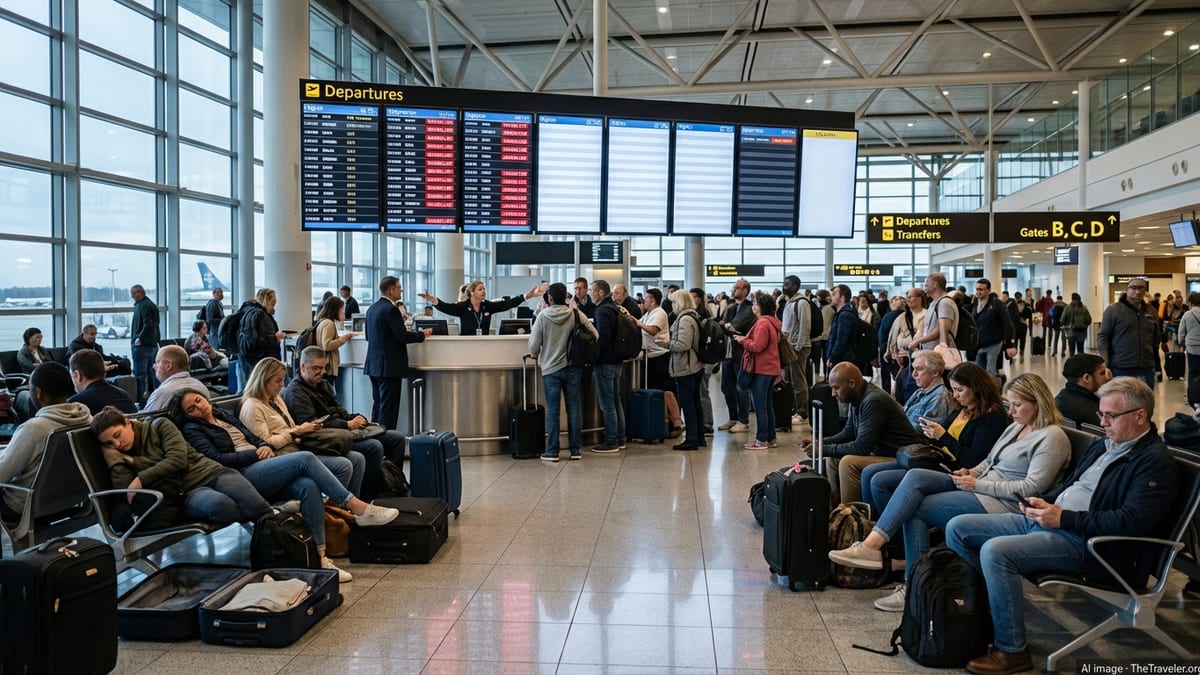
Flight disruption across the Middle East has surged past 1,100 delayed and cancelled services as conflict-related airspace closures and reroutings ripple through some of the world’s busiest long-haul corridors.
Get the latest news straight to your inbox!
Airspace Closures Choke Key Transit Routes
Published data from flight-tracking platforms and aviation advisories indicates that large sections of airspace over Iran, Iraq, Israel, parts of the Gulf and adjacent conflict zones have been intermittently closed or heavily restricted in recent months. These measures followed U.S. and Israeli military action against Iran and subsequent regional escalation, prompting civil aviation authorities to limit overflights on safety grounds.
The Middle East forms a critical bridge between Europe, Asia and Africa, and the sudden loss of multiple flight information regions has effectively removed several primary east–west corridors from the global network. International carriers that previously routed nonstop services through these skies are being forced either to cancel flights outright or detour around the affected zones, adding hours to journey times and creating a cascade of aircraft and crew scheduling problems.
Industry assessments describe Saudi Arabian airspace as one of the few remaining high-capacity corridors linking Europe and Asia, placing unprecedented strain on local air traffic control. As overflow traffic funnels through the limited routes that remain open, congestion is building in the skies and on the ground, with knock-on effects visible at airports far beyond the immediate conflict area.
These airspace and routing constraints underpin the tally of more than 1,100 flight delays and cancellations now recorded across the wider Middle East network and on connecting services worldwide. Aviation analysts note that the figure is likely to understate the total disruption, since many longer routings show up as late arrivals rather than formally classified cancellations.
Gulf Hubs Struggle With Reduced Capacity
Major Gulf hubs such as Dubai, Abu Dhabi and Doha, normally among the world’s busiest transit points, have been operating under a mix of temporary closures, reduced schedules and capacity caps since the latest conflict flare-up. Publicly available reporting shows that these airports, which collectively handle a substantial share of global east–west traffic, have at times been forced to halt departures or restrict movements as nearby airspace briefly shuts or military operations intensify.
Airlines based in the region have gradually restored parts of their networks but remain constrained by both airspace limits and airport congestion. Some Gulf carriers are operating reduced frequencies to key destinations, redeploying widebody aircraft to alternative routes or extending block times to accommodate longer flight paths around closed zones. Even where flights operate, passengers are frequently facing rolling delays, irregular connections and last-minute gate changes.
Independent travel and aviation advisories point to crowding at transfer hubs, particularly during peak bank periods when complex waves of arrivals and departures usually connect. With fewer usable runways and altered routings, the carefully sequenced hub-and-spoke models built up over decades are under strain, and modest schedule shocks can rapidly turn into multi-hour delays.
Regional observers note that while some Gulf airports have reopened more fully since the initial shock, operations in several cases are still running below pre-crisis capacity. That gap, combined with persistent airspace restrictions around conflict areas, continues to contribute to the rising count of delayed and cancelled flights across the network.
Global Carriers Reroute and Trim Schedules
The impact of Middle Eastern airspace restrictions has extended far beyond regional airlines. European and Asian carriers that rely on overflights through the Gulf and surrounding states are rerouting services over Central Asia, Africa or the Mediterranean, in some cases adding several hundred nautical miles to each leg. These diversions increase fuel burn, complicate crew duty limits and compress already tight aircraft utilization plans.
According to recent factbox-style coverage from international newswires, airlines such as British Airways, Air France, Lufthansa, Finnair, IndiGo and others have temporarily suspended or reduced flights to specific Middle Eastern cities, including Tel Aviv, Beirut and some Gulf destinations, while maintaining limited operations elsewhere. Some have announced that previously regular services will return at lower frequencies or with smaller aircraft, reflecting both operational constraints and softer demand during the crisis.
Across the Atlantic, North American carriers have prolonged suspensions of nonstop links into Israel and adjusted schedules on connecting services to the region. These moves are framed publicly as risk-management steps and responses to regulatory guidance on conflict-zone overflights. The result for passengers has been a shrinking menu of nonstop options between certain city pairs and heavier reliance on multi-stop routings through secondary hubs.
Rerouted long-haul flights also contribute to congestion in alternative corridors. As airlines stack more services into already busy airways over parts of Europe, Central Asia and the Indian Ocean, air navigation providers are warning of thicker traffic flows and potential knock-on delays, even for flights not directly touching the Middle East.
Passengers Face Longer Journeys and Limited Alternatives
For travelers, the immediate consequence of the evolving airspace picture has been a sharp rise in irregular operations. Reports from airports, airlines and traveler communities describe passengers facing overnight delays, missed connections and unexpected stopovers as carriers adjust routes in real time to comply with new restrictions or take advantage of briefly reopened corridors.
Rebooking options are often constrained. With many carriers reducing frequencies into the region and operating at lower capacity through remaining corridors, available seats on alternative flights can be scarce. Some airlines have issued travel waivers that allow passengers to change dates or routings without standard penalties, but these policies are heavily dependent on individual carrier rules and booking channels.
Travel advisories circulating within the industry urge passengers to allow additional buffer time between connections, to monitor airline notifications closely and to keep itineraries as flexible as possible. Long-haul travellers transiting the Middle East are being encouraged to consider routing via alternative hubs in Europe, South Asia or Africa where feasible, though such options may be more expensive or less convenient.
For those already in affected hubs, airport facilities and local hospitality providers are experiencing a surge in demand from disrupted passengers in need of accommodation, food and ground transport. This secondary strain on local infrastructure is emerging as another visible sign of the wider disruption behind the growing total of more than 1,100 delayed or cancelled flights.
Uncertain Timelines for Normalization
Industry bodies and aviation consultants caution that a rapid return to normal traffic flows in the Middle East is unlikely as long as the geopolitical backdrop remains volatile. Airlines are typically hesitant to commit aircraft, crew and marketing resources to previously affected routes until they see a sustained period of stability in both security conditions and regulatory guidance.
Analytical reports on the broader economic impact of the 2026 Iran conflict highlight aviation as one of the sectors most exposed to prolonged disruption. The closure or partial closure of several key hubs, coupled with the reduction in available airspace, has disturbed carefully balanced global networks that were still consolidating after the pandemic-era downturn.
Even as some airspace corridors reopen and selective routes restart, operators face the challenge of rebuilding schedules that are commercially viable under longer flight times and higher operating costs. Passengers, for their part, may continue to see irregular schedules, extended journey times and elevated fares on routes that depend on Middle Eastern overflight rights.
With flight delays and cancellations already exceeding 1,100 and climbing, the Middle East’s role as a central artery for global air travel remains under pressure. Market participants widely view the situation as a live test of how resilient today’s interconnected aviation network can be when one of its core transit regions is constrained for an extended period.