


More news on this day
A software defect that unfolded in about a millisecond helped trigger a UK air traffic control failure that cascaded into more than 2,000 cancelled flights, disrupting travel far beyond the day of the outage and leaving airlines and airports scrambling to recover.
Get the latest news straight to your inbox!
What happened and when
Published coverage points to September 8, 2026 as the trigger date, when the UK’s National Airspace System experienced a technical failure that forced air traffic managers to slow the flow of aircraft and, in practice, sharply cut the number of departures and arrivals the network could handle. The immediate technical issue was addressed within hours, but the knock-on effects continued as aircraft and crews ended up out of position across tightly scheduled networks.
Airlines and passengers felt the biggest impact at the UK’s busiest airports, where slot constraints, gate availability, and crew duty-time limits can quickly turn a temporary restriction into a multi-day backlog. Even when airspace restrictions ease, airlines still have to reposition aircraft, reassign crews, and reaccommodate passengers onto flights that may already be full.
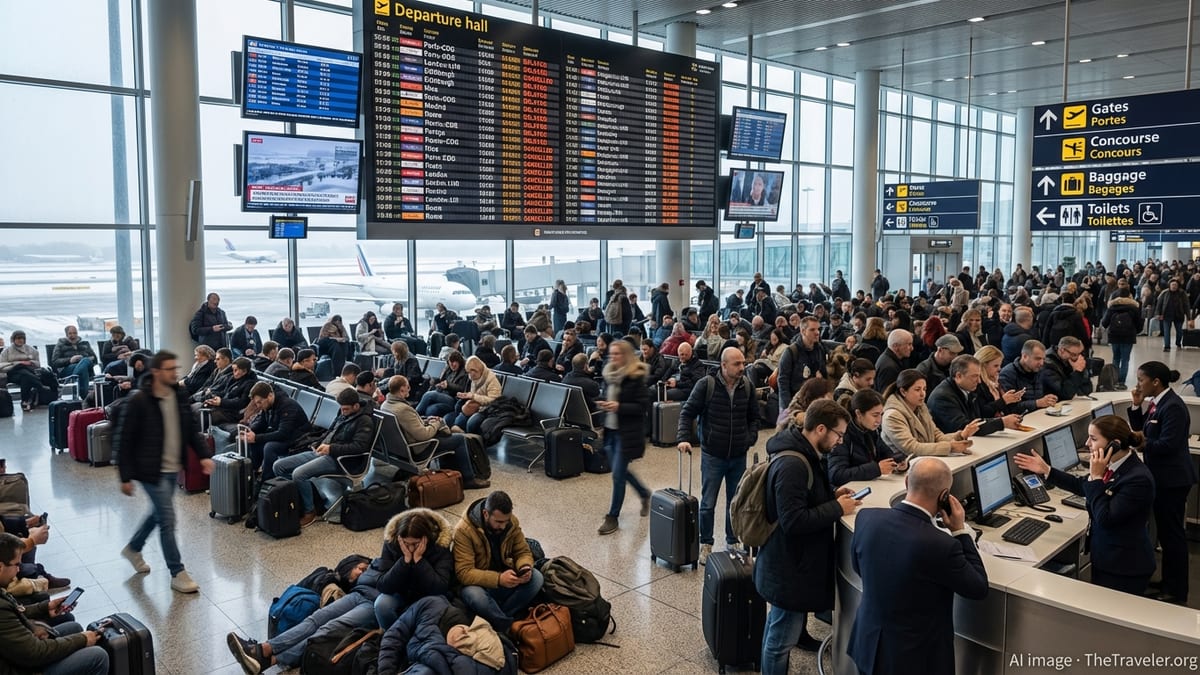
While disruption is often described in terms of a single day’s technical incident, the practical impact can extend longer. Reports describe passengers spending hours on aircraft or in terminals as carriers worked through cancellations, diversions, and late-arriving inbound flights needed to operate subsequent legs.
How a millisecond defect cascaded through the system
According to published reporting on a preliminary investigation, the failure centered on software involved in flight data processing and code allocation used by controllers to identify flights. The incident was linked to a valid manual request for a squawk code, a standard identification code used in air traffic control, that encountered a rare software defect at precisely the wrong moment.
The investigation described a narrow “exposure window” of roughly one millisecond, in which the code could produce corrupted output if a higher-priority message arrived while the system was part-way through updating a value. The outcome was not an unsafe situation in the air, but a loss of normal system function that required conservative operational steps to keep traffic moving safely.
Once that core flight data system could not be relied upon in its normal mode, controllers shifted to fallback procedures, and the network had to be throttled. That reduction in capacity is what tends to create the largest passenger impacts: fewer takeoffs and landings means airlines must cancel flights outright, not simply delay them.
The scale of cancellations and where travelers felt it most
Across the UK, the disruptions added up to more than 2,000 cancelled flights, with delays and diversions also affecting a wider set of journeys. Some tracking estimates cited in coverage place the total cancellations over September 8 and September 9 at roughly the low-to-mid 2,000s, highlighting how the aftershocks persisted into the following day as airlines rebuilt schedules.
For travelers, cancellations often create a tougher problem than delays because rebooking capacity can evaporate quickly. When many flights are cancelled in a short window, available seats on the remaining departures can disappear, and the next available routing may be one or two days later, especially on popular trunk routes or long-haul flights with limited frequency.
International itineraries can be particularly vulnerable, since a missed or cancelled short-haul segment can strand a passenger away from home or cause them to miss long-haul connections. Even travelers who never touched UK airspace directly can be affected if aircraft rotations or crew pairings were built around UK turns.
Passenger rights and what to do if your flight is cancelled
In the UK, publicly available guidance from the Civil Aviation Authority explains that when a flight is cancelled on eligible itineraries, passengers are generally entitled to a choice between a refund for the unused parts of the ticket or re-routing, as well as “care and assistance” while they wait, which can include meals, communications, and hotel accommodation when an overnight stay is necessary.
Compensation is more complicated. UK rules generally tie cash compensation to situations where the airline is considered at fault, while events outside the airline’s control may fall under an “extraordinary circumstances” concept. Coverage of the September 8 disruption frames the cause as an air traffic control system failure, which may affect whether compensation applies, but it does not remove the airline’s duty to provide care and rerouting or refunds where required.
For travelers managing disruption in real time, documentation matters. Saving cancellation notices, boarding passes, and rebooking communications can help clarify what was cancelled and when. If you pay out of pocket for necessary expenses during a prolonged wait, keeping itemized receipts can support a later claim, especially if airline-provided assistance was not available at the time.
Resilience questions for aviation technology
The episode is renewing attention on how modern aviation depends on complex software systems whose failure modes can be difficult to predict. A defect that only manifests under a very specific timing collision can still have national-scale effects if it sits within a system that operates as a single point of operational dependency.
Published reporting indicates mitigation measures were put in place after the incident while a permanent fix is tested and deployed. Separately, coverage describes plans for further scrutiny of resilience and investment in the systems that keep UK airspace moving, reflecting a broader trend: regulators and industry are increasingly focused on how quickly critical infrastructure can fail over, recover, and keep passengers moving when a key component goes down.
For travelers, the practical takeaway is less about the technical detail and more about the reality of network recovery. Even if an outage is brief, the backlog can be long. When flying during busy periods, building extra buffer time into connections, keeping an eye on inbound aircraft status, and having a backup plan for an overnight delay can reduce the stress when the system hits an unexpected bottleneck.