


Montenegro is one of Europe’s smallest countries, yet its roads link Adriatic beaches, fjord-like bays and alpine peaks in just a few hours of driving. With a rental car and a bit of planning, you can swim in the sea in the morning, stand at a 1,900-metre mountain pass in the afternoon and be back on a café terrace by sunset. This practical guide explains how to plan a one-week Montenegro road trip, from car hire and coastal highways to the Kotor serpentine, Durmitor Ring, Lake Skadar, border crossings, parking and summer traffic.
Get the latest updates straight to your inbox!
Renting a Car in Montenegro and Driving Basics
Montenegro is built for road trips. The main coastal highway runs the length of the country, while a web of mountain roads climbs quickly into the interior. Most travellers pick up a rental car in Tivat, Podgorica or at Dubrovnik Airport across the Croatian border, then cross into Montenegro to continue with a local hire. Local agencies in Kotor, Budva and Podgorica typically offer small manual cars from roughly 35 to 60 euros per day in high season, with compact automatics starting higher. Booking early for July and August is important because fleets are small and last-minute prices rise sharply.
To rent a car, you generally need a full driving licence held for at least one year and a passport or national ID. Agencies routinely accept EU, UK, US, Canadian and Australian licences. If your licence is not in the Latin alphabet, an International Driving Permit is strongly recommended and may be required at pickup. Check your rental includes mandatory third-party liability insurance and that the paperwork, including the so-called Green Card, covers any neighbouring countries you plan to enter.
Road rules are similar to the rest of Europe. Drive on the right, always wear seatbelts, and do not use a handheld phone while driving. Speed limits are usually about 50 km/h in towns and 80 to 100 km/h on open roads, but many coastal and mountain sections are too narrow or winding to reach the posted maximum safely. Expect frequent local police checks on main roads. They typically focus on speed and seatbelts rather than tourists specifically, but you should keep licence, passport, registration and insurance documents in the car at all times.
Fuel is widely available and broadly similar in price to neighbouring Croatia and Albania. Major petrol stations sit at the entrances to coastal towns like Budva, Bar and Herceg Novi, as well as at Podgorica and along the route up to Žabljak near Durmitor. In the north, do not assume you can refuel in remote villages; instead, fill up in larger centres such as Nikšić or Žabljak before tackling mountain loops.
Driving the Montenegrin Coast and Bay of Kotor
Montenegro’s coastal backbone is the M-1 highway, part of the historic Adriatic route that runs from the Croatian border at Debeli Brijeg through Herceg Novi, Kotor, Budva, Bar and Ulcinj to the Albanian frontier. It is a simple two-lane road, but it carries almost all coastal traffic, from local cars and buses to heavy trucks and summer holiday traffic from Croatia and Serbia. The speed limit may suggest you can move quickly, yet in July and August you should plan for 40 to 50 km/h averages during the day and allow generous margins for delays.
The most scenic stretch winds around the Bay of Kotor. From Herceg Novi, the road hugs the shoreline through small stone villages to Perast and on to Kotor. This “inner bay” circuit is one of Europe’s great short coastal drives: at Perast, you see the twin island churches set in the water, while around Dobrota and Prčanj the road runs so close to the bay that stone jetties double as informal viewpoints. Traffic here is slow but constant, with delivery vans, pedestrians and cyclists sharing tight space. Many first-time drivers find this an easy place to adjust to local habits because speeds are low and there are frequent pull-outs to let faster cars pass.
For a quicker run toward Budva, the Vrmac and Sozina tunnels take you beneath the mountains rather than over them. The Vrmac Tunnel links the Kotor side of the bay to the Tivat side in minutes; you enter near the airport and emerge above the Porto Montenegro marina. From there, the coastal highway continues south to Budva and Sveti Stefan. This corridor carries intense holiday traffic, especially on weekends when visitors from Podgorica and Serbia stream to the beaches. A 30-kilometre drive between Kotor and Budva can take more than an hour on a Saturday afternoon in late July.
Parking on the coast is a daily consideration. Kotor’s walled Old Town is car-free, so you must use paid car parks outside the walls or hotel parking along the waterfront. In high season, central lots can fill by late morning, leaving drivers circling narrow streets. Budva has more space but also more cars, with large paved lots behind the Old Town and around shopping centres. In smaller coastal towns, parking is a patchwork of private hotel spaces, informal roadside spots and a growing number of municipal pay zones marked by coloured lines and ticket machines. In practice, it is worth choosing accommodation that explicitly confirms on-site or reserved parking and budgeting for daily parking costs in busy centres.
The Kotor Serpentine and Mountain Roads to Lovćen and Cetinje
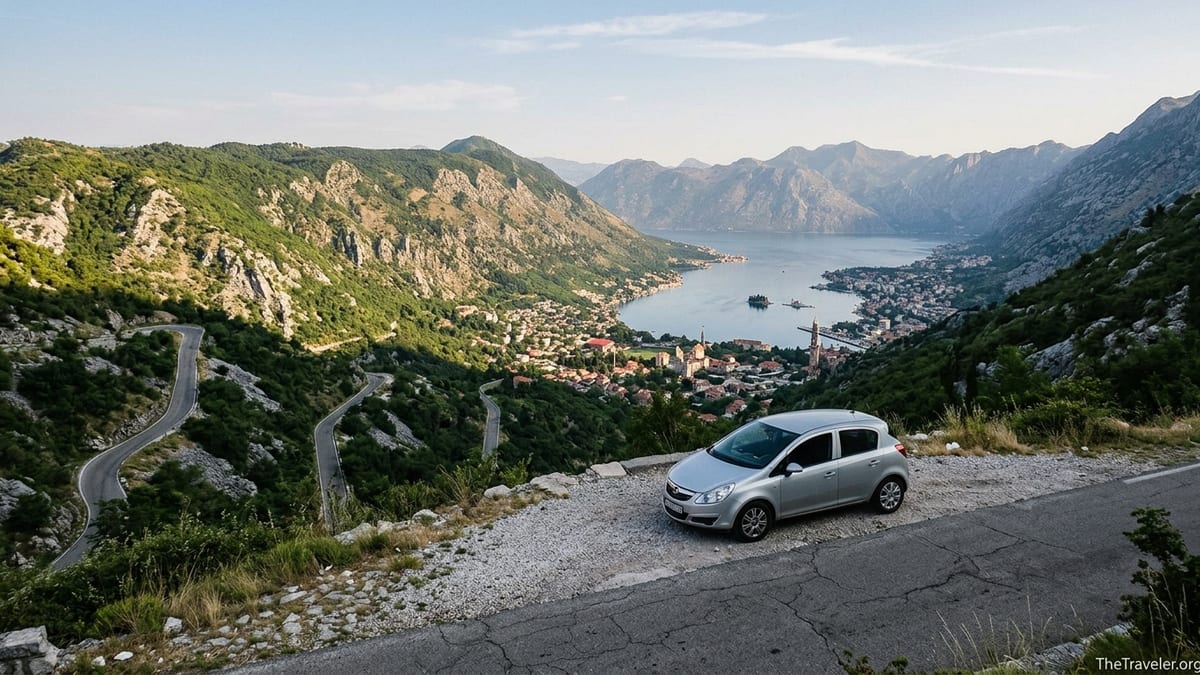
Above Kotor, the famous serpentine road climbs more than 900 metres in a sequence of tight hairpins to the edge of Lovćen National Park and the village of Njeguši. This is the old Austro-Hungarian route toward the former royal capital Cetinje and remains one of the most dramatic drives in the Balkans. From viewpoints along the bends, you look straight down over the bay and the stone ramparts of Kotor’s walls, with cruise ships and ferries appearing like toys in the water below.
The serpentine is paved but narrow, with many sections wide enough for only one vehicle. Passing bays are frequent, but to use them calmly you need to drive slowly and anticipate oncoming traffic. Buses and campervans do take this road, but many local companies now advise larger vehicles to approach Lovćen from the inland side to avoid getting stuck on the tightest bends. Low gears and light braking are essential, and drivers prone to vertigo may find the unguarded drops on the outer edge intimidating.
In response to congestion, local authorities have periodically introduced timed one-way systems on busy summer days, with uphill traffic allowed in certain hours and downhill flows in others. Rules and timings can vary by season, so before you set off, ask your accommodation host or a local rental agency if any restrictions are in place. If two-way traffic is operating, avoid peak times around late morning and late afternoon when tour groups and excursion buses are most common. An early start around 7 or 8 am from Kotor can give you both cooler temperatures and clearer views.
Once on the plateau, the driving becomes gentler. From Njeguši, known for its smoked ham and cheese, a rolling road continues through Lovćen National Park toward Cetinje. The asphalt is reasonably good, though winter damage can leave occasional potholes at the end of the cold season. Car parks serve trailheads and viewpoints, including the access point for the steep staircase up to the mausoleum of Petar II Petrović-Njegoš. From Cetinje, a broader road descends through forests to Budva, giving you a full mountain-to-sea circuit in one day.
Durmitor, the Tara Canyon and Mountain Driving Safety
Northern Montenegro is a different world from the coast. Around Žabljak, in Durmitor National Park, the landscape shifts to alpine meadows, dark pine forests and a ring of jagged limestone peaks. The highlight for many drivers is the Durmitor Ring, a roughly 80-kilometre loop on predominantly single-lane paved roads that climbs past Sedlo Pass, skirts the Tara and Sušica canyons and returns to Žabljak via small pastoral villages.
The Durmitor Ring is not technically difficult in dry summer weather, but it is remote. The asphalt is narrow, in places only one vehicle wide, with gravel lay-bys carved into the slope to let oncoming cars pass. Sheep and cattle wander freely, and in early morning you may find entire herds drifting across the road. There are no fuel stations on the loop itself and only occasional cafés or guesthouses, so you should start with a full tank, drinking water and at least a rough sense of where the main viewpoints and villages lie.
Weather is the key safety factor. Sedlo Pass stands close to 1,900 metres and snow can linger into late spring. Even in June, cold fronts can bring fog and drizzle that close in the views and make the road slick. In these conditions, locals sometimes advise postponing the loop by a day rather than pushing on. In high summer, afternoon thunderstorms are more likely, and short downpours can create slick patches or wash small stones onto the asphalt, particularly on bends just above the canyons.
Elsewhere in the north, driving through the Morača and Piva canyons is memorable but demanding. The main road between Podgorica and Kolašin follows the Morača River through a chain of tunnels and galleries, some of them older and poorly lit. Between Nikšić and the Piva reservoir on the way toward the Bosnian border, a dramatic road slices into cliffs with a series of unlit tunnels opened directly onto the gorge. Speeds are usually low, and heavy trucks or buses can create convoys that move at 40 km/h for long stretches. Plan your driving so that you tackle these canyon sections in full daylight, avoid tight deadlines and stop at official pull-outs rather than on blind bends.
Exploring Lake Skadar and the Inland Villages
Lake Skadar, shared between Montenegro and Albania, is the largest lake in the Balkans and forms a wide freshwater basin southeast of Podgorica. From a driver’s perspective, it offers a change of pace from hairpins and tunnels. The main entry point on the Montenegrin side is the village of Virpazar, about a 30-minute detour off the Podgorica to Bar road. Here, a short causeway and stone bridge cross the reeds and lily pads, and dozens of small boats depart for birdwatching and swimming trips.
The road into Virpazar is straightforward, with a small junction off the main highway and a gentle descent through vineyards. Parking, however, is limited in the compact village centre, particularly on weekends when tour buses arrive from the coast. A handful of paid lots sit close to the bridge, while some guesthouses offer private parking on gravel terraces just outside the core. In peak season, it is wise to arrive before 10 am if you want to park close to the waterfront and secure a boat tour without waiting.
On the northern shore of the lake, the old road via Rijeka Crnojevića features one of Montenegro’s most famous viewpoints at Pavlova Strana, where an S-bend in the river forms a striking horseshoe shape beneath a rocky lookout. Reaching it involves a tight, twisting minor road that climbs from the Podgorica to Cetinje corridor. The asphalt is passable but narrow, with local drivers familiar with every bend. When you reach the viewpoint, a small gravel lay-by is all that separates you from a steep drop, so parking neatly and keeping the car fully off the asphalt is important both for safety and for other traffic.
Around the lake’s fringes, small villages and vineyards line up along narrow lanes. Many have simple family-run wineries and homestays that welcome drivers for tastings and overnight stays. Access roads here can become dusty and rutted, particularly after rain, but most standard rental cars manage without issue if you drive slowly. In wet weather, be wary of muddy verges that can swallow a tyre; if a roadside pull-in looks soft or flooded, continue to the next firm gravel lay-by rather than risk getting stuck in an area where recovery services are slow and expensive.
Border Crossings, Summer Traffic and Practical Tips
Montenegro shares land borders with Croatia, Bosnia and Herzegovina, Serbia, Kosovo and Albania, and many visitors combine countries on a single road trip. The most used crossing for coastal itineraries is the Croatian frontier near Herceg Novi, where the Adriatic highway continues between Dubrovnik and Kotor. In peak summer, queues can build on both sides, especially for vehicles entering or leaving the European Union. Waiting two to three hours in a midday line of cars is not unheard of in August, so plan border days with patience, water and snacks, and, if possible, cross early in the morning or later in the evening.
To the southeast, the main border with Albania follows the Adriatic highway from Ulcinj to the Sukobin crossing, while another route links Podgorica to Shkodër via the Božaj post near Lake Skadar. Both are straightforward drives, but they can be busy at commuter times and summer weekends. If you are in a rental car, check in advance that your contract allows you to take the vehicle across international borders and that the Green Card insurance document explicitly lists the country codes for each neighbour you intend to visit. Some agencies charge a cross-border fee or limit travel to specific countries, and drivers who discover this only at the frontier sometimes have to turn back or purchase temporary local insurance.
Summer traffic is the defining feature of driving in Montenegro between late June and early September. On the coast, two-lane roads with limited alternatives quickly clog when a minor accident or roadside breakdown occurs. A common real-world example is the Budva to Bar section on a Saturday afternoon, when rental cars leaving beach resorts converge with buses heading to Podgorica and beyond. A journey that takes 45 minutes off-season can stretch to two hours or more, with little opportunity to detour. Starting long coastal legs before 8 am or after dinner reduces frustration and heat stress, and many locals simply avoid non-essential driving during the hottest, busiest part of the day.
Parking etiquette and enforcement are also tightening, particularly in tourist hotspots. In Kotor, Budva and Bar, local authorities have expanded paid zones with ticket machines and introduced wheel clamping or towing for cars left on pavements or pedestrian crossings. Fines are not ruinous by northern European standards, but they can still easily consume the cost of a good dinner. Look for clear signs indicating whether a spot is reserved, paid or forbidden, and if in doubt, ask a nearby shopkeeper or café staff where you may safely leave the car.
Sample 7-Day Montenegro Road Trip Itinerary
Montenegro is compact enough that you can see much of its variety in seven days without rushing, provided you keep driving days reasonable. The following example assumes a circular trip starting and ending on the coast, either in Tivat, Kotor or Budva, and focuses on Montenegro alone. Travellers combining the country with Croatia or Albania can easily adapt the start and finish points.
Day 1 is arrival and the Bay of Kotor. Pick up your rental car at Tivat Airport or in Kotor and spend your first afternoon driving the bay loop to Perast. The distance is modest, about 40 kilometres if you complete the full circle, but the scenery is dramatic, and there are plenty of stops for photos and coffee along the waterfront. Overnight in Kotor, Dobrota or Perast, ideally at a hotel or apartment with confirmed parking.
Day 2 focuses on the Kotor serpentine and Lovćen. Leave Kotor early and drive the hairpin road to Njeguši, stopping at one or two lay-bys to photograph the bay. Continue across the plateau into Lovćen National Park and, if you wish, visit the Njegoš mausoleum before descending to Cetinje for lunch. In the afternoon, follow the main inland road down to Budva and spend the evening exploring the Old Town or walking the coastal path toward the islet of Sveti Stefan. Total driving is roughly 100 kilometres but split into short scenic stages.
Day 3 links the coast to the north. From Budva, follow the coastal highway southeast toward Bar, then turn inland via Podgorica toward Kolašin and on to Žabljak. This is a full driving day, typically five to six hours of moving time even in fair traffic, crossing first low coastal passes and then the Morača canyon. Plan fuel and rest stops in or near Podgorica and again around Kolašin. Arrive in Žabljak before dark if possible and settle into a guesthouse or small hotel with on-site parking.
Day 4 is for Durmitor and the Tara Canyon. If weather is clear, tackle the Durmitor Ring as a relaxed full-day circuit, stopping at Sedlo Pass, panoramic lay-bys above the canyons and small hamlets where you can buy simple mountain lunches of grilled meat, cheese and bread. If the high loop is cloudy or closed by late snow, keep to lower altitudes around Black Lake and short walks along the Tara canyon rim, saving the full Ring for another visit.
Day 5 heads south again, but via a different route. From Žabljak, drive toward Nikšić and then down to the northern edge of Lake Skadar or Podgorica. Depending on your energy, you might detour up to Ostrog Monastery, perched high on a cliff, before continuing to Virpazar on the lake. Overnight here or in a nearby village, making sure your accommodation offers parking, as the central village streets are tight.
Day 6 is dedicated to Lake Skadar. Take a morning boat tour from Virpazar into the lily-covered channels, then in the afternoon drive the twisting road toward Rijeka Crnojevića and the Pavlova Strana viewpoint. From there, continue on to Cetinje and either loop back down to the coast at Budva or return directly to Kotor or Tivat, depending on where you started. Total driving is again moderate in distance but slow in speed due to the narrow roads and frequent photo stops.
Day 7 is your buffer and departure day. Use it to revisit a favourite spot on the bay, tour a coastal town you missed such as Herceg Novi or Bar, or simply drop the car and relax before an onward flight or drive across the border. Keeping the last day light allows for surprises such as a longer-than-expected border queue, a sudden summer storm on a mountain road or discovering a village where you decide to linger longer over lunch.
The Takeaway
A Montenegro road trip connects beaches, bays, lakes and high mountains in a compact, drivable package. With careful planning, realistic daily distances and respect for the country’s narrow roads and summer crowds, drivers can enjoy some of Europe’s most varied landscapes without long motorway hauls. Renting a small, nimble car, prioritising daylight for canyon and mountain sections, and booking accommodation with confirmed parking all make a tangible difference.
Above all, allow time for unscheduled stops. The most memorable moments often come not at headline sights but at unmarked lay-bys above the Bay of Kotor, at a wooden jetty on Lake Skadar or at a roadside stall in the Durmitor highlands where a family sells homemade cheese and honey. Montenegro rewards unhurried travel, and a well-paced seven-day loop leaves space to pull over, step out and let the landscape set the rhythm of your journey.
FAQ
Q1. Do I need an International Driving Permit to rent a car in Montenegro?
Many travellers can rent a car in Montenegro with their regular EU, UK, US, Canadian or Australian licence, but if your licence is not in the Latin alphabet, an International Driving Permit is strongly recommended and some rental companies may insist on it. Even when not formally required, carrying one can simplify any police checks or border crossings.
Q2. Is the Kotor serpentine road safe for inexperienced drivers?
The Kotor serpentine is paved and widely driven, but it is very narrow with many tight hairpin bends and steep drop-offs. Inexperienced drivers should attempt it only in clear daylight, drive slowly in low gears and be prepared to reverse into passing bays for oncoming traffic. If you feel uncomfortable, consider visiting Lovćen from the inland side instead.
Q3. When is the best time of year to do a Montenegro road trip?
The most comfortable months for driving are usually May, June, September and early October, when traffic is lighter and temperatures are milder. July and August offer guaranteed swimming weather but bring heavy coastal congestion and higher accommodation prices, while winter conditions can make northern mountain roads around Durmitor and the canyons hazardous or temporarily closed.
Q4. Can I take a Montenegrin rental car into Croatia or Albania?
Many local rental companies allow cross-border travel into neighbouring countries, but you must confirm this at booking and ensure your Green Card insurance document lists each country you plan to visit. Some agencies charge an extra fee for cross-border travel or restrict entry to certain states, and you may be refused exit at the border if the paperwork is not in order.
Q5. How bad is summer traffic on the coastal highway?
In peak season, particularly from late June to late August, the two-lane coastal highway can be heavily congested, especially near Budva, Bar and the Croatian border. Short distances can take much longer than expected, and minor accidents or breakdowns easily create long tailbacks. Starting drives early in the morning or after dinner and avoiding weekend changeover days helps reduce delays.
Q6. Are there toll roads in Montenegro?
Montenegro currently has very few tolls for private drivers. The main exception is for certain tunnels or newly built road sections that may charge small fees, usually paid in cash at booths. Most major tourist routes, including the coastal highway, the Kotor serpentine, the Durmitor Ring and roads around Lake Skadar, are toll-free, although this can change as new infrastructure opens.
Q7. Is parking easy to find in Kotor, Budva and other coastal towns?
Parking in major coastal towns can be challenging in high season, especially in Kotor where the Old Town is car-free and central lots fill quickly. Budva and Bar have more structured parking, but paid zones are expanding and illegal parking is increasingly enforced. Booking accommodation with guaranteed parking and being prepared to park slightly outside the centre often saves time and stress.
Q8. How long does it take to drive from the coast to Durmitor National Park?
From Budva or Kotor to Žabljak, the main base for Durmitor, driving usually takes around five to six hours in good conditions, including the section through the Morača canyon. Heavy summer traffic, roadworks or poor weather can add to this, so it is wise to treat it as a full travel day and aim to arrive before dark, especially if you are unfamiliar with mountain roads.
Q9. Is it difficult to navigate Montenegro’s roads without local language skills?
Most road signs use the Latin alphabet and follow standard European symbols, and major destinations such as Kotor, Budva, Podgorica and Žabljak are clearly indicated. Smartphone navigation works well on main roads, although mobile coverage can be patchy in deep canyons. Download offline maps before you set off and keep a basic paper map as backup for remote areas.
Q10. Do I need a 4x4 vehicle for a Montenegro road trip?
For the vast majority of visitors, a regular compact car is sufficient. Main roads, the Kotor serpentine, the Durmitor Ring and access roads around Lake Skadar are paved or have short, manageable gravel sections. A higher-clearance vehicle or 4x4 is only necessary if you plan to explore unpaved forest tracks or remote mountain villages beyond standard tourist routes, which is generally not recommended in a rental car.