


More news on this day
Gulf airlines are tightening their operations to Kuwait as Qatar Airways suspends services to Kuwait International Airport, joining a growing list of regional carriers that have halted or curtailed flights in response to heightened security risks and intermittent airport closures.
Get the latest news straight to your inbox!
Qatar Airways joins widening pullback from Kuwait
Publicly available timetable data and travel alerts indicate that Qatar Airways has halted regular passenger services between Doha and Kuwait City amid the latest wave of operational disruption at Kuwait International Airport. The move places the Doha carrier among a cluster of Gulf airlines that have recently reduced or suspended Kuwait operations as security concerns continue to affect airspace and airport availability.
The suspension follows weeks of unstable conditions in Kuwaiti airspace linked to regional conflict, during which international carriers have periodically rerouted, delayed or cancelled services. Flight-tracking analyses show a marked drop in scheduled movements on the Kuwait–Doha city pair compared with earlier in the summer season, suggesting that Qatar Airways has opted for a precautionary pause while conditions remain volatile.
The Doha-based airline has been gradually rebuilding its wider network this year, with updated schedules showing expanded frequencies across more than 160 destinations. The pause in Kuwait flights contrasts with that broader growth strategy and underlines how the security situation in and around Kuwait is now the main constraint on connectivity rather than aircraft availability or passenger demand.
Travel industry specialists note that, for Qatar Airways and other Gulf carriers, Kuwait City functions both as a point-to-point market and as a feeder for long haul services to Europe, Asia and the Americas. The latest suspensions therefore have a knock-on effect that extends beyond regional traffic, complicating itineraries for connecting passengers who previously relied on Kuwait as the starting point for one-stop journeys via Gulf hubs.
Emirates, Etihad and flydubai extend Kuwait cancellations
Qatar Airways’ decision comes on the heels of fresh disruptions by major United Arab Emirates carriers. Recent operational updates compiled by regional media show Emirates and Etihad cancelling multiple rotations to Kuwait over the current weekend period, citing the knock-on effects of temporary airport closures and rapidly changing airspace restrictions.
Dubai-based flydubai has also repeatedly adjusted its Kuwait schedule since the first major shutdown of Kuwait International Airport earlier in the year. Earlier advisories and local coverage documented full cancellations on specific days as the airline navigated shifting safety assessments and slot availability. While some services have returned at times, the pattern in recent weeks has been one of sporadic cancellations rather than a stable timetable.
Other Gulf operators, including Air Arabia and Gulf Air, have likewise trimmed their Kuwait operations during recent spikes in regional tension. Industry data aggregated by aviation analytics platforms shows overall flight volumes by leading Gulf carriers dipping whenever Kuwait’s status shifts from open to restricted or closed, then partially recovering during brief periods of stability.
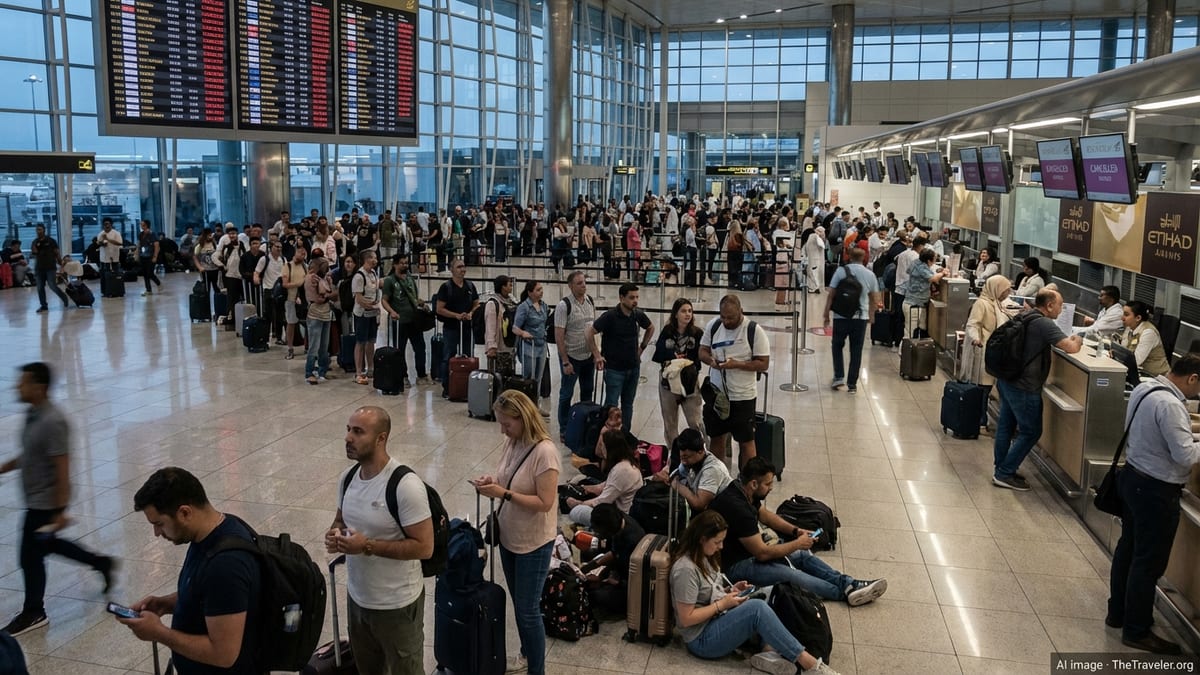
For passengers, the practical impact has been a patchwork of last-minute schedule changes. Carriers have generally offered free rebooking, refunds or rerouting via alternative hubs where capacity allows, but the concentration of disruptions in a small number of peak travel weekends has led to congested call centres, long queues at ticket desks and a shortage of same-day alternatives on popular routes.
Airport security situation keeps Kuwait schedules unstable
The latest wave of cancellations is rooted in the ongoing security challenges facing Kuwait International Airport. Since a series of missile and drone incidents earlier this year, aviation authorities have repeatedly suspended takeoffs and landings at short notice, leading airlines to divert or ground flights while damage assessments and airspace reviews are carried out.
Official updates from Kuwait and regional regulators show that operations have resumed several times on a limited basis, only to be scaled back again when airspace risk levels rise. This start-stop pattern has made it difficult for carriers to plan coherent schedules, particularly for widebody aircraft that are tightly integrated into global networks and require stable turnaround windows.
Local media reports indicate that Kuwait Airways and Jazeera Airways, the country’s two main home carriers, have in some cases shifted flights to alternative airports in neighbouring Saudi Arabia to maintain a minimum level of connectivity. However, for foreign airlines based in the UAE, Qatar or Bahrain, replicating that model is more complex because it would require wholesale changes to crew bases, handling contracts and passenger ground transport arrangements.
Industry observers say that for many international airlines, the operational risk of repeatedly dispatching aircraft into a potentially unstable environment now outweighs the commercial benefits of preserving a full Kuwait schedule. As a result, most non-Kuwaiti carriers appear to be favouring conservative capacity cuts and temporary suspensions over ad hoc day-by-day adjustments.
Regional network ripple effects for Gulf hubs
The cumulative impact of Kuwait-related cancellations is now being felt more widely across Gulf aviation networks. Before the current crisis, Kuwait City functioned as an important spoke feeding traffic into major hubs such as Doha, Dubai and Abu Dhabi, particularly for expatriate and business travel markets linking South Asia, Europe and North America.
With Kuwait demand disrupted, airlines are repositioning capacity to more stable regional routes, a trend visible in rising frequencies on select Saudi Arabian, Omani and intra-UAE sectors. Analysts suggest that this redeployment strategy enables carriers to keep aircraft productively employed while preserving flexibility to reinstate Kuwait flights once conditions allow.
At the same time, connecting passengers who previously used Kuwait as an origin or destination are increasingly being encouraged to start their journeys from alternative gateways. Travel advisory bulletins and corporate travel management notes point to options such as flying from Dammam, Riyadh, Dubai or Doha directly, combined with overland transfers to and from Kuwait when practicable and safe.
The rebalancing of networks has consequences for airfare levels and seat availability across the wider region. Reduced capacity into Kuwait can tighten supply on neighbouring routes during peak periods, raising fares and limiting last-minute options, while Gulf hubs remain under pressure to manage surging transfer volumes without compromising punctuality.
What passengers flying to or from Kuwait should expect
For travellers with imminent plans involving Kuwait, the main takeaway from recent developments is that schedules are likely to remain fluid in the short term. Published timetables can change quickly, and same-day cancellations are still being reported when airspace conditions deteriorate or when airlines make late adjustments to optimise aircraft utilisation.
Airlines and travel management firms consistently advise passengers to monitor their bookings through official mobile apps and websites rather than relying solely on itinerary PDFs or third-party confirmations. Given the frequency of changes, digital channels are typically updated first when flights are retimed, rerouted or cancelled.
Flexible booking policies remain in place across much of the Gulf airline sector, especially on routes touching conflict-affected airspace. Many carriers are allowing at least one free date change or refund when flights are cancelled, though specific conditions vary by fare type and route. Passengers are also being encouraged to leave longer connection windows if their journeys involve multiple Gulf airports.
Looking ahead, aviation analysts expect that airlines will continue to take a cautious approach to Kuwait operations until there is sustained evidence of stable airspace conditions and predictable airport availability. For now, Qatar Airways’ decision to suspend its Kuwait services adds new weight to a trend that has already seen several of the region’s biggest names scale back their presence at the country’s main gateway.