


More news on this day
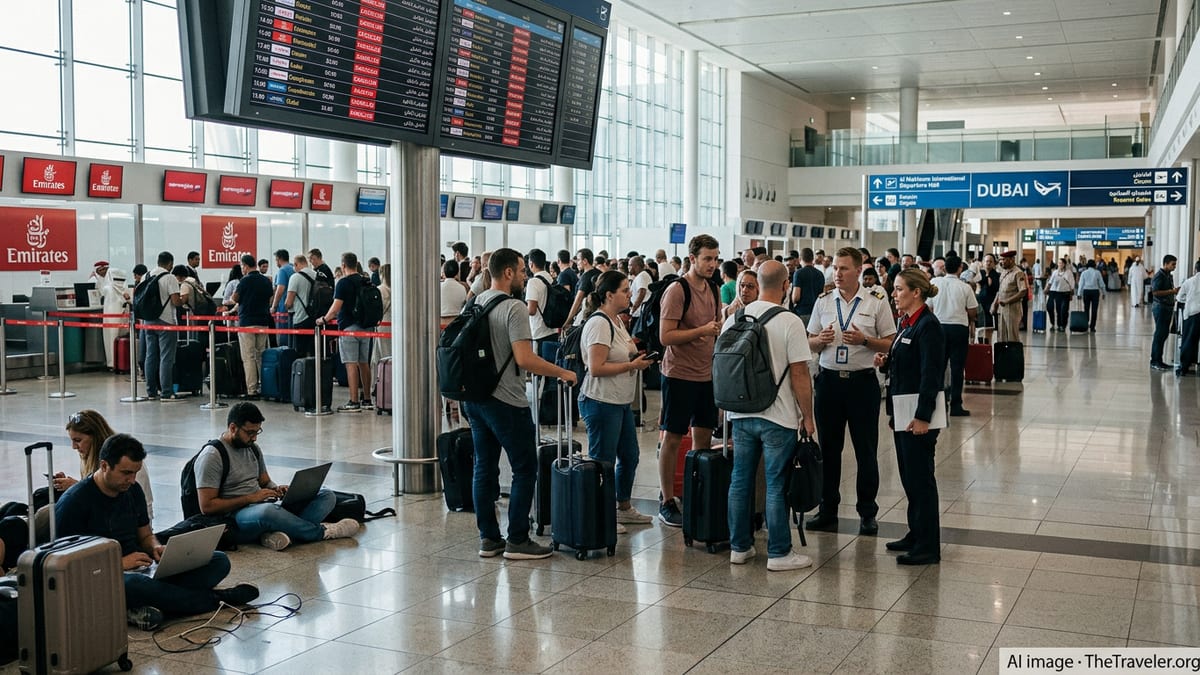
More than 170 flights were reported delayed across Dubai and Abu Dhabi on Sunday, as the United Arab Emirates’ two main hubs coped with schedule knock-ons from earlier disruptions, heightened regional tensions and sustained late-summer travel demand.
Get the latest news straight to your inbox!
Wide Ripple Effect Across UAE’s Two Major Hubs
According to published flight-tracking data and regional media coverage, a combined total of more than 170 flights experienced delays at Dubai International Airport and Abu Dhabi’s Zayed International Airport on Sunday. The disruptions affected both arrivals and departures, with hold-ups ranging from minor schedule slips of 20 to 30 minutes to extended waits of more than two hours on some long-haul services.
Dubai International, one of the world’s busiest international hubs, handled hundreds of scheduled movements during the day. Operational summaries from independent trackers indicate that Dubai alone accounted for the majority of Sunday’s delayed flights, reflecting the volume of services operated by Emirates, flydubai and a wide mix of international carriers. While cancellations remained limited, the level of delay meant some passengers missed onward connections or faced tight transfer windows.
In Abu Dhabi, data reviewed from the airport’s departure and arrival boards showed a smaller but still noticeable cluster of late-running services. Zayed International Airport, the home base of Etihad Airways, reported pockets of disruption particularly on long-haul routes to Europe and Asia, as well as selected regional services. Taken together, the two airports created a picture of a tightly stretched but still largely functioning network.
Operational Pressures, Regional Tensions and Airspace Constraints
Publicly available airline advisories and regional news coverage link the latest wave of delays to a mix of operational factors, including aircraft rotation challenges, crew availability, and airspace restrictions tied to the broader regional security environment. Carriers serving the Gulf have spent recent weeks adjusting routings and schedules around sensitive airspace, which can add flying time and compress turnarounds on the ground.
Analysts following Gulf aviation note that even modest increases in en-route flight time can cascade through the network over a weekend, when schedules are already dense and aircraft utilization is high. When one long-haul aircraft arrives late into Dubai or Abu Dhabi, subsequent services using the same aircraft or crew may depart behind schedule, creating a knock-on effect that can last throughout the day.
Separately, coverage in regional business media has highlighted that some international carriers into the UAE are still dealing with residual effects from air traffic control issues and disruptions in European and UK airspace earlier in the month. As those networks stabilize, delays can still show up on individual sectors into or out of Dubai and Abu Dhabi, even when local weather conditions and airport systems are operating normally.
Mixed Impact on Major UAE Carriers and Foreign Airlines
Reports indicate that UAE-based airlines, including Emirates, Etihad Airways, flydubai and Air Arabia, managed to keep the majority of their schedules intact on Sunday, despite the elevated number of delayed flights. Many of the time slips logged across their networks were categorized as minor, and aircraft generally continued to operate rather than being grounded or heavily rescheduled.
However, the same data shows that several regional and international airlines serving the UAE experienced more significant punctuality challenges. A number of flights operated by non-UAE carriers arrived late into Dubai and Abu Dhabi from Europe, North America and key regional hubs, in some cases after already departing behind schedule from their origin airports. These inbound delays then fed into later departures back out of the UAE.
Industry observers say the pattern is consistent with the UAE’s position as a global transfer point. Because so many itineraries involve connections via Dubai or Abu Dhabi, any upstream disruption in another part of the world can quickly surface in the Gulf, regardless of whether the original problem occurred in local airspace or at a UAE airport.
Airports Advise Early Check-in and Constant Status Monitoring
Airport and airline information channels reviewed on Sunday evening continued to emphasize the importance of checking live flight status before heading to the airport. Online flight boards for Dubai International and Zayed International, along with carrier-specific trackers, urged travelers to monitor their departure and arrival times, as schedules remained subject to short-notice changes.
Travel industry guidance circulating in the region also encouraged passengers with tight connections to build in additional time or to consider earlier departures where possible. For those already holding tickets on affected services, airlines have generally directed customers to manage changes through official websites, mobile apps or travel agents, with standard rebooking and fare rules applying unless otherwise specified.
Passenger rights guidance from consumer groups and travel advisers continues to stress that compensation or special accommodations may depend on the cause and length of the delay, as well as the jurisdictions involved in each itinerary. Observers recommend that travelers retain boarding passes and confirmation emails, and keep a record of delay durations, in case they wish to pursue formal claims at a later date.
Outlook for the Coming Days
Looking ahead, aviation weather forecasts for Dubai and Abu Dhabi over the next 24 to 48 hours indicate stable conditions, with clear skies and high temperatures typical for the season. This suggests that any further disruption is more likely to stem from operational or airspace issues rather than from local storms or reduced visibility.
Airline communications monitored on Sunday point to an ongoing effort to normalize schedules as quickly as possible, while maintaining flexibility to adjust routings if regional conditions change. Some carriers are using spare aircraft and crew where available to absorb extended delays on long-haul routes, in an effort to prevent additional knock-ons.
Travel analysts expect that as the weekend surge passes and midweek traffic patterns return, the number of heavily delayed flights should gradually ease, provided no new external shocks emerge. For now, however, the experience of more than 170 delayed flights on a single day underlines how sensitive tightly synchronized hub operations remain to even modest disturbances elsewhere in the global aviation system.