


Capri arrived in my imagination long before I saw its cliffs rise out of the Tyrrhenian Sea. I pictured movie-star yachts, glittering boutiques, and perhaps an overhyped island that would feel smaller in real life than it did on Instagram. Instead, during a single day on Capri, everything felt bigger than expected: the crowds, the cliffs, the price of a simple coffee, and above all the drama and beauty of the landscape itself. What surprised me most was how a place so famously glossy could still stir up such raw, cinematic emotion in the span of a few hours.
Get the latest updates straight to your inbox!
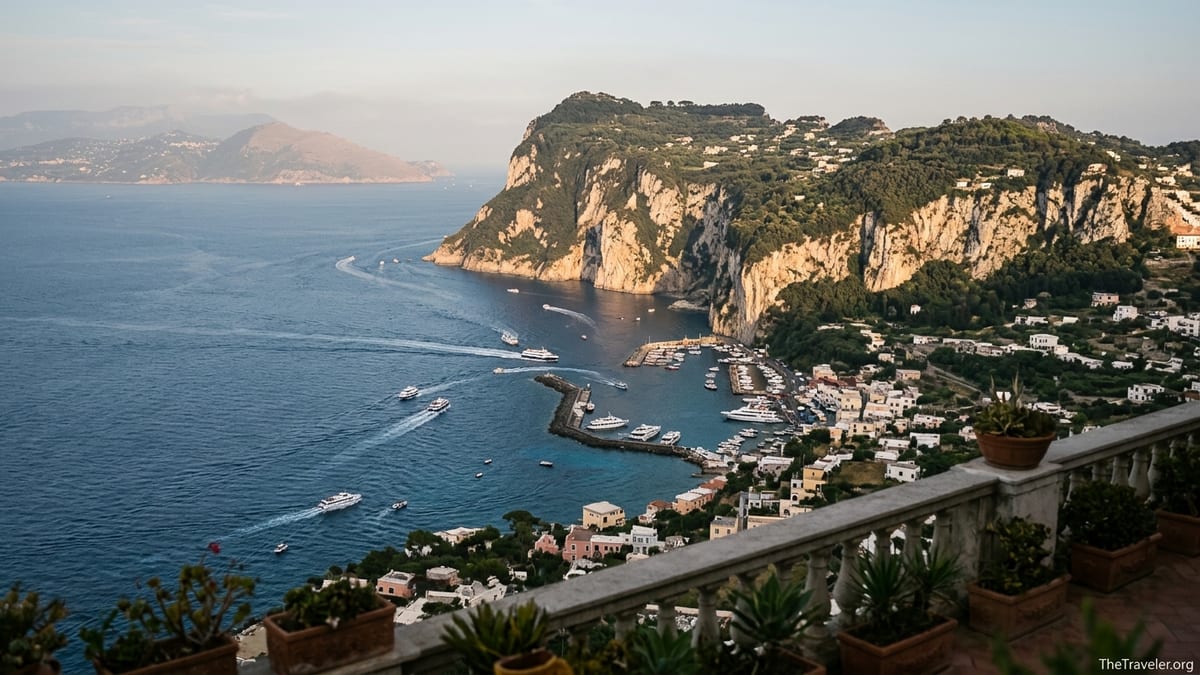
Arriving by Ferry: Chaos, Sea Spray and First Impressions
My day began in Naples, in the tangle of traffic and vendors around Molo Beverello. Even before sunrise, the ferry ticket offices were open, selling crossings that typically start around 19 to 25 euros one way to Capri, depending on the company and speed of the hydrofoil. The ticket line was already packed with day trippers clutching rolling suitcases and backpackers debating whether Capri was “worth it” for just a day. It felt like boarding a commuter train to someplace ordinary, not a legendary island that emperors once chose as their escape.
On board, the hydrofoil was utilitarian rather than glamorous: rows of airplane-style seats, fluorescent lights, and windows speckled with dried salt. The crossing from Naples takes roughly 45 to 50 minutes in calm seas. As we pulled away, the city shrank into a hazy outline and Mount Vesuvius loomed behind us, a dark presence that made the whole bay feel like a natural amphitheater. I watched commuters fall asleep against the windows while tourists rushed onto the rear deck to film the receding shoreline.
The drama arrived in an instant. The flat horizon suddenly broke into vertical walls of rock as Capri appeared, its cliffs rising nearly sheer from the sea. White villas clung to terraces, lemon groves stepped up the slopes, and the port of Marina Grande tucked itself into a narrow crescent of color. Any suspicion that Capri might feel small or overproduced disappeared. The island looked like a stage set for some ancient play, built at 1:1 scale and still very much in use.
Disembarking, reality snapped back. Dock workers shouted directions, taxis honked, and tour operators waved signs for private boat trips and island tours. A hand-lettered board advertised a two-hour boat circuit around the island for about 25 to 30 euros per person, while full-day private boats listed prices in the four figures. It was chaotic, noisy, and deeply practical. Capri might be beautiful, but it is also a working island where everything, including that beauty, has a price tag.
Riding the Funicular Into Capri’s Famous Piazzetta
The quickest way out of the port chaos is the funicular that climbs from Marina Grande up to Capri town. The ticket kiosk sits at the end of the arrival pier, and a single ride currently costs around 2.40 euros. Instead of feeling like a tourist gimmick, the funicular is the island’s backbone: commuters with briefcases, hotel staff in uniform, and delivery workers all share the cars with visitors and their cameras.
The ride itself takes only about four minutes, but the transition is startling. One moment you are at sea level, breathing in diesel fumes and salt spray; the next you are gliding silently through tunnels of greenery and glimpses of the port far below. Through the windows, terraces planted with lemons and vines slip past, and for a few seconds the island’s famous luxury feels rooted in actual soil instead of appearing only in shop windows.
The funicular deposits you into the Piazzetta, the tiny main square that has become Capri’s living room and symbol. It is smaller than it appears in photos: just a handful of cafe terraces facing the clocktower and the dome of the church of Santo Stefano. By midmorning, almost every table is occupied. A cappuccino on the square can easily cost between 5 and 7 euros, and a simple spritz in the afternoon can climb past 12 euros. Yet people happily pay for the privilege of watching other people, and I found myself doing the same, rationalizing that my overpriced coffee was really a front-row ticket to Capri’s ongoing show.
What surprised me was how local and ordinary some moments felt between the designer sunglasses and linen outfits. A barista carried a tray of cornetti to a back table where older residents read newspapers. A delivery scooter sputtered up a side alley with crates of mineral water. Despite the postcards and polished storefronts around the square, this was still a village, with all the prosaic details that sustain a place when the Instagram stories disappear.
The Blue Grotto That Wasn’t: Managing Expectations on the Water
No modern story about a day in Capri is complete without mentioning the Blue Grotto, or explaining why you did not see it. Like many first-time visitors, I arrived convinced I would float inside that luminous cave. At the marina, signs promoted boat trips that included a Blue Grotto stop, but the reality is more complicated. Official information on the island makes it very clear that the grotto only opens when sea conditions and swell are favorable, and that it can close with little warning even on sunny days.
On the morning of my visit, crews at the dock were shaking their heads. The sea outside the grotto’s tiny entrance, which is only about a meter high, was too choppy for the small rowboats. That meant no entry for anyone. It was a small heartbreak to accept that a place so central to Capri’s image might remain off limits, but it also made the island feel more alive and less like a theme park. Nature, not a schedule, decides whether the grotto is open.
Instead, I joined one of the standard boat circuits around the island, paying about 25 euros for a two-hour tour that departed from Marina Grande. The skipper explained that if the Blue Grotto miraculously opened, those who had paid extra for it would transfer into the official rowboats at the cave entrance, each of which charges an additional fee plus a small state-run admission ticket. In peak season, the full experience can easily total more than 40 euros per person and require over an hour of queuing on the water.
Circumnavigating Capri without entering the grotto turned out to be its own kind of drama. The boat nosed into hidden coves, brushed past sea caves streaked with mineral colors, and paused beneath the sheer cliff that supports Villa Jovis, the ruins of Emperor Tiberius’s villa. As we approached the Faraglioni rock stacks, everyone on board fell silent. The skipper steered us through the natural archway in the central stack, and for a few seconds the sky became a bright keyhole above us. The absence of the Blue Grotto no longer felt like a loss; the whole island had become a living, open-air grotto in its own right.
Up to Anacapri: Slower Streets and the Monte Solaro Chairlift
Back on dry land, I escaped the tightening crowds in Capri town by heading for Anacapri, the quieter village higher up the island. Public minibuses leave from the terminal just off the Piazzetta and cost the same as the funicular, around 2.40 euros per ride. The road between Capri and Anacapri is a series of hairpin turns carved into the cliff, and from my seat I could see the sea straight down between stone guardrails. Oncoming buses and taxis seemed to pass with only centimeters to spare, a reminder that drama on Capri is not confined to the seascapes.
In Anacapri, the mood shifted noticeably. Whitewashed houses lined narrow lanes, and ceramic shop signs replaced luxury brand logos. Here, gelato from a family-run bar might cost 3 to 4 euros rather than 6, and a plate of simple ravioli capresi with tomato and basil at a trattoria near Piazza Vittoria could be found for around 14 to 18 euros. It still was not cheap, but there was less performance and more everyday life: children on bicycles, laundry across balconies, a shopkeeper chatting in the doorway.
The most dramatic surprise in Anacapri was the chairlift to Monte Solaro, the island’s highest point. Tickets for the single-seat lift typically run in the low teens in euros for a round-trip, purchased at a small booth near Piazza Vittoria. The chairs are individual and exposed, like something from a tiny ski resort suspended above a Mediterranean postcard. Sitting alone, feet dangling over terraced vineyards, I felt the island drop away beneath me.
The ascent takes about 13 minutes, long enough to feel the temperature dip slightly and to watch the geometry of Capri rearrange itself. Villas shrink to white dots, hiking paths reveal themselves as pale threads, and the surrounding sea widens to a nearly continuous band of blue. At the top, a cafe terrace offers cold drinks and panini at predictable summit markups, but the real reward is the view. From Monte Solaro, you can see the Sorrentine Peninsula, the outline of the Amalfi Coast, and on clear days the faint silhouette of the Cilento coast. What I had imagined as a pretty island turned out, from this height, to be a rugged mountain moored in the sea.
Hidden Paths, Cliffside Views and Quiet Corners
Coming back down from Monte Solaro, I realized my favorite moments on Capri were happening far from its famous square. In Anacapri, a short walk along narrow streets led me to stretches of silence broken only by church bells and the buzz of cicadas. One lane dead-ended at a belvedere where two elderly residents sat on a bench watching the ferries trace white lines across the water. They nodded a greeting as I approached, then went back to their companionable quiet. It was the opposite of the Piazzetta’s polished spectacle, and yet equally part of the island’s character.
Later in the afternoon, back near Capri town, I followed Via Tragara, a pedestrian lane that drifts away from the center past bougainvillea-draped villas and hotels. The path ends at Belvedere Tragara, a panoramic terrace facing the Faraglioni. Despite the number of people there, the space felt expansive enough for everyone to claim their own section of stone railing. Couples took photos, a painter set up a small easel, and a group of hikers shared a bag of almonds. No ticket, reservation, or dress code was required to stand there and let your eyes adjust to the scale of rock and sea.
On another short walk along Via Krupp, which zigzags down the cliffs when it is open, the island’s human and natural drama blended together. The path was once carved into the cliffside to connect the Charterhouse of San Giacomo with Marina Piccola, and when safety conditions allow it to open, you can walk a series of switchbacks that feel improbably glued to the rock. Looking back up from one of the hairpins, the terraces above seemed to float. Walking down, I passed a pair of local teenagers using the same path as a shortcut to reach the beach, backpacks slung casually over one shoulder. For them, this dizzying trail was simply the walk home.
What I had expected to be an island of only glamorous surface moments continually revealed deeper textures: quiet workers’ neighborhoods, shared public benches at scenic overlooks, and networks of paths that belong as much to residents as to paying visitors. The beauty was not just in the postcard views, but in how those views intertwined with daily life.
Sticker Shock, Small Luxuries and the Emotional Arc of a Day
Capri’s prices are notorious, and my day confirmed their reputation. A quick budget tally made it obvious how a simple excursion can add up fast. A return ferry from Naples or Sorrento can easily total 40 to 60 euros per person, depending on speed and season. Add a couple of funicular or bus rides at 2.40 euros each, a basic boat tour around the island for about 25 to 30 euros, a chairlift ticket in Anacapri, and lunch plus gelato, and you can watch a budget day approach or exceed the 120-euro mark without trying very hard.
Yet not every cost felt cynical. My priciest coffee of the trip was in the Piazzetta, but it came with a front-row seat to an ever-changing cast of characters. The boat tour around the island cost about as much as a midrange restaurant meal, but it provided a front-row view of cliffs, sea caves, and ancient villas that no dining room could match. Even the bus ticket between Capri and Anacapri felt like a bargain for the sheer drama of clinging to the cliffside road.
Emotionally, the day followed a surprising curve. I arrived half skeptical, assuming Capri would be crowd-choked and superficial, a place more concerned with selling a brand than offering a genuine experience. By midday, the heat, congestion, and sticker shock had me considering that initial suspicion again. But somewhere between the quiet bench in Anacapri, the solitude of the Monte Solaro chairlift, and the view from Belvedere Tragara at golden hour, the island broke through my defenses.
As the late afternoon light turned the cliffs honey-colored, I walked back toward Marina Grande along a path lined with stone walls and wild fennel. Above me, laundry snapped in the breeze. Below, ferries traced their routes back to the mainland. It struck me that while Capri’s luxury veneer can be dazzling or exhausting depending on your mood and budget, the underlying geology of the place is what truly shapes the experience. You are always aware of height, depth, and exposure: cliffs, staircases, sudden drops, and endless water. That elemental drama is what lingered long after the shock of prices faded.
The Takeaway
Looking back on my single day in Capri, I remember less the brand names in shop windows and more the feeling of standing on edges. Edges between sea and cliff, public and private, glamour and ordinariness, expectation and reality. The island is not an easy bargain: it can be crowded, expensive, and logistically chaotic, especially in high season when ferries are full and queues for the funicular and buses spill into the streets.
Yet Capri also offers genuine, unscripted moments if you are willing to step slightly off the most obvious routes. A short bus ride up to Anacapri yields slower streets and local rhythms. A chairlift ride to Monte Solaro turns the island into a three-dimensional model beneath your dangling feet. A walk to Belvedere Tragara or along cliff paths at the edges of town reveals views that cost nothing but time and a bit of effort.
If you arrive expecting a quiet, undiscovered refuge, Capri will likely disappoint you. If you come prepared for crowds, higher prices, and a fair amount of uphill walking, the island may surprise you with how quickly it can feel intimate and emotional. My day in Capri was more dramatic and beautiful than I expected, not because it was perfect, but because its contradictions stayed visible. In the end, that tension between polished surface and raw landscape is exactly what makes the island so memorable.
FAQ
Q1. Is Capri worth visiting for just one day?
Yes, a well-planned day can be very rewarding. You will not see everything, but you can combine a boat tour, Capri town, Anacapri, and at least one viewpoint for a varied first impression.
Q2. How much should I budget for a day trip to Capri?
Plan on roughly 100 to 150 euros per person, including ferries, local transport, a basic boat tour, meals, and small treats. Costs vary by season and choices.
Q3. Do I need to book ferry tickets to Capri in advance?
In high season and on weekends, it is wise to book ferries a few days ahead, especially for early departures. In shoulder seasons, same-day tickets are often available.
Q4. Is the Blue Grotto always open?
No. The Blue Grotto opens only when sea and wind conditions are favorable, and it can close suddenly. Treat it as a “maybe” bonus rather than a guaranteed highlight.
Q5. What can I do if the Blue Grotto is closed?
You can still take a boat tour around the island to see sea caves and Faraglioni, ride the Monte Solaro chairlift, explore Anacapri, or walk to viewpoints like Belvedere Tragara.
Q6. Is Capri very crowded in summer?
Yes. From roughly June through early September, ferries, buses, and the Piazzetta can be extremely busy. Early mornings and late afternoons are noticeably calmer.
Q7. Can I visit both Capri town and Anacapri in one day?
Yes, if you move efficiently. Many visitors spend the morning in Capri town and on the water, then ride the bus to Anacapri for the afternoon and return before dinner.
Q8. Is Capri walkable or do I need to use buses and taxis?
Capri is walkable within each town, but it is steep. You will likely use the funicular or buses between the port, Capri town, and Anacapri unless you enjoy long uphill climbs.
Q9. Are there budget-friendly food options on Capri?
While many venues are upscale, you can find more modest prices at bars and family-run spots away from the Piazzetta, especially in Anacapri and side streets off main squares.
Q10. What should I wear for a day on Capri?
Opt for breathable clothing, comfortable walking shoes or sandals with good grip, a hat, and sunscreen. Evening ferry rides can feel cooler, so a light layer is useful.