


On paper, Asbury Park is another compact Jersey Shore town with a beach, a boardwalk, and a famous rock club. In person, on a warm night when the music from The Stone Pony spills into Ocean Avenue and locals are still ordering slices on Cookman at 1 am, it feels like something else entirely. My night in Asbury Park was supposed to be a quick concert trip. Instead, it became a crash course in why people fall for this place and keep arranging their summers, weekends, and even their friendships around coming back.
Get the latest updates straight to your inbox!
Arriving in a Town Built on Myth and Second Chances
I arrived on the evening rush-hour train from New York, one of the regular NJ Transit locals that slide down the North Jersey Coast Line and empty out at Asbury Park station. The walk from the station to the beach is only about 15 minutes, but it functions like a moving introduction: past old brick apartment buildings, then bars along Cookman Avenue, until the salt air hits and you catch your first glimpse of the ocean beyond Convention Hall’s green copper roof.
This is a town that should not have survived the way it has. Asbury Park’s heyday as a resort city peaked in the mid-20th century before decades of economic decline and empty storefronts. Its modern comeback, accelerated over the last fifteen years, is visible everywhere: in the restored pavilions along the boardwalk, indie restaurants on once-quiet side streets, and a calendar that now includes big events like the Sea.Hear.Now music festival each September, when surf competitions and headlining bands take over the waterfront.
Most travelers, though, first meet Asbury Park through its night. They come for a show at The Stone Pony, a drag performance at Paradise in The Empress Hotel, a rooftop cocktail above the sand, or simply the experience of wandering a boardwalk that feels lived-in rather than manufactured. That was my plan too: check into a modest room a block off the beach, catch a gig, and head home the next day. What I found instead was a layered, oddly intimate city that reveals itself in small scenes, not big attractions.
Even in early evening, the energy felt different from larger shore towns. There were families in line at Maruca’s tomato pie window on the boardwalk, but also queer couples holding hands, tattooed locals wheeling bikes, and older Springsteen fans in tour T-shirts comparing past shows. It felt like a crossroads between nostalgia and the present tense.
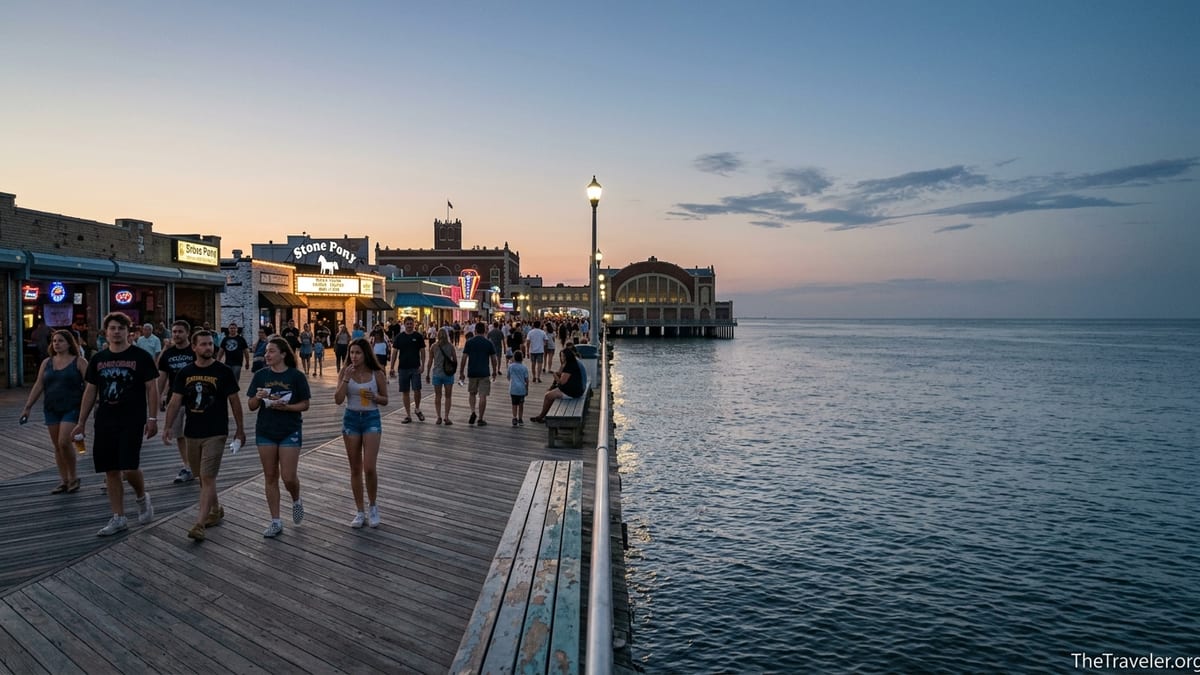
Golden Hour on the Boardwalk: First Glimpse of the New Asbury
I reached the boardwalk just as the light turned honey-colored, the kind photographers and travel marketers dream about but rarely get on command. Convention Hall’s ornate facade threw long shadows, and the Atlantic was a soft gray-blue, dotted with surfers catching the last workable sets. Street musicians set up just beyond the benches, playing everything from acoustic Springsteen covers to indie-pop originals for small semi-circles of listeners.
Asbury’s boardwalk today is a mix of old and new. To the south, the historic carousel building still anchors an area now filled with murals from the Wooden Walls public art project, turning brick walls into a kind of open-air gallery. Farther north, renovated pavilions house places like AP Rooftop, a third-floor bar and restaurant with floor-to-ceiling windows over the sand, and casual walk-up counters selling things like Korean tacos, frozen custard, and paper boats of fries. Prices are what you would expect for a resort town in 2026: a cocktail will often run in the mid-teens, and a sit-down dinner with drinks at one of the better boardwalk restaurants can easily reach 40 to 60 dollars per person.
What struck me most was the mix of visitors. At one boardwalk bar, a row of college kids in tank tops shared a rum bucket, while at the next table a retired couple from central New Jersey sipped wine and pointed out details on the horizon. Families with strollers passed by groups in band merch pre-gaming for a show. Nobody looked out of place. The atmosphere was relaxed, confident, and more diverse than many East Coast resort towns of similar size.
By the time the sun slid behind the low-rise skyline of Cookman Avenue, the neon signs flickered on. The light from The Stone Pony’s facade glowed across Ocean Avenue. A DJ tested the speakers at the rooftop bar above my field of vision. On the sand, a few late stragglers packed up chairs while lifeguard stands turned into silhouettes. The town felt ready.
Pre-Show Rituals: Pizza, Cocktails, and the Art of Lingering
Locals will tell you that what you do before a show in Asbury is almost as important as the show itself. My night started the way many do: with pizza and a drink on Cookman Avenue, the downtown strip that has become the city’s culinary backbone. I grabbed a table at Porta, one of the places frequently mentioned by regulars, where wood-fired Neapolitan-style pies arrive blistered and airy. A margarita pizza and a spritz came to roughly 30 dollars with tip, standard for a popular restaurant in a trendy beach town, but the shared picnic tables and open garage doors facing the street kept the vibe casual.
As I ate, groups filtered past clearly heading toward the same destination I was. Some were in Stone Pony T-shirts from past summers, others carried small posters from an earlier signing at a nearby record store. A couple at the next table, who said they make the hour-long drive from North Jersey “twice a month in the summer, minimum,” debated whether to catch a quick drink at Watermark, an upstairs lounge closer to the ocean known among locals for its cocktails and ocean views, or to head straight to the venue.
The temptation in Asbury is to keep lingering. You could wander into Talula’s for a naturally leavened slice and a glass of natural wine, slip into a bar like Johnny Mac’s for a chaotic round of free pizza with every drink, or follow the crowd toward the Asbury Festhalle & Biergarten building, which until recently housed a hulking rooftop beer hall. You learn quickly that people here measure evenings not in hours but in combinations of spots. A “simple night out” might be described as “cocktails at AP Rooftop, then Wonder Bar, then we see where we end up.”
For travelers, the cost of this kind of grazing night adds up, but there are ways to keep it in check. Happy hours at some Cookman Avenue bars offer discounted drafts or wine by the glass, and grabbing a couple of slices from Crust & Crumble or a takeout taco from MOGO on the boardwalk can be far cheaper than a sit-down meal every time. The key is to decide which part of the night you want to splurge on: the rooftop drinks, the concert ticket, or the late-night feast.
The Stone Pony and Wonder Bar: Where the Soundtrack Never Stops
Eventually, logic wins over lingering, and the slow migration toward The Stone Pony begins. The venue sits across the street from the ocean, modest in size by national standards but oversized in myth. Since the 1970s, it has been a launchpad for the Jersey Shore sound associated with Bruce Springsteen, Southside Johnny, and a long list of local bands. On summer weekends, its outdoor Summer Stage can hold several thousand fans in a fenced-in lot, while the indoor space fits under a thousand, which keeps even mid-level touring acts feeling intimate.
The night I was there, the show was an early-summer tour stop for an indie rock band big enough to headline medium festivals but still hungry onstage. General admission tickets hovered around the 40 to 60 dollar range, typical for a national act here. Inside, the room felt almost like a community center that happened to have world-class sound: concrete floors, posters of past gigs, a bar off to one side, and a crowd that mixed die-hard fans with locals who show up “because there’s always something worth seeing.”
During the set, I kept noticing how many in the crowd clearly had their own Asbury stories. A group of women near the soundboard traded memories of seeing punk bands here in the late 1990s. Two men in their 50s compared notes on Springsteen’s surprise appearances in the area over the years. From the side door, you could see glimpses of Ocean Avenue, lit by passing cars and the red glow of traffic lights, as if the town itself was keeping an eye on the show.
After the last encore, some fans headed home, but many drifted a few blocks up to Wonder Bar, the other legendary live-music staple painted bright enough to be visible from half the waterfront. Known for its laid-back shows, friendly staff, and the outdoor space that hosts the well-known Yappy Hour dog parties in warmer months, Wonder Bar that night hosted a local cover band and a room full of people who seemed in no hurry to call it quits. The cover charge was modest, around the price of a drink, and it bought access to yet another layer of Asbury’s soundscape.
Rooftop Views and Poolside Beats: The Asbury After Dark
By the time the band at Wonder Bar launched into their second set, someone suggested heading to Salvation, the rooftop bar atop The Asbury Hotel a few blocks inland. The hotel, one of the anchors of Asbury’s modern revival, is a sort of social hub: part boutique lodging, part event space, part all-purpose hangout. Its rooftop, open seasonally, shifts across the night from a sunset-viewing platform to something closer to a compact outdoor club with DJs and a dance-focused crowd, especially on weekends.
Rooftop bars in resort towns can feel interchangeable, but Salvation leans into its setting. From the edge, you can see the dark line of the ocean, the silhouettes of Convention Hall and the Stone Pony, and the glow from Cookman Avenue stretching inland. Drinks are not cheap, with many cocktails in the 16 to 20 dollar range, but the setting makes a strong case for at least one round. When major events like Sea.Hear.Now are in town, locals say the rooftop becomes a vantage point to hear and partially see the park stage without plunging into festival crowds.
What impressed me was how seamlessly visitors and residents mixed here. A group of twenty-somethings from Brooklyn in festival outfits claimed a corner, while at the same time, a couple in their forties from suburban New Jersey slow-danced near the railing. I chatted briefly with a bartender who said they had moved to Asbury five years ago for “a single summer job” and ended up staying, in part because of nights like this: long, social, and full of familiar faces.
Back at street level, The Asbury’s lobby and pool area acted as a quieter counterpoint, with people lounging on couches, flipping through vinyl at a small record display, or ordering late-night snacks. For those staying at the hotel, the convenience is obvious. For budget travelers in more modest motels or short-term rentals nearby, it is still an accessible slice of the scene: you can nurse one drink, people-watch, and absorb the energy without committing to a luxury hotel stay.
Queer-Friendly, Come-As-You-Are Nights at Paradise and Beyond
No account of an Asbury Park night is complete without mentioning its queer nightlife, centered most visibly around Paradise at The Empress Hotel. Just a short walk from the boardwalk, the complex has become one of the longest-running LGBTQ+ hubs in New Jersey, with a poolside deck, dance floor, and regular drag shows that draw both locals and weekend visitors from across the region.
On the night I visited, the line for a drag revue snaked past the entrance, a mix of regulars greeting security staff by name and first-timers checking the posted schedule. Cover fees can vary depending on the night and event but are often comparable to a typical big-city club. Inside, the space felt less like a niche scene and more like an integral piece of Asbury’s identity. Friends had come down from New York for the weekend, couples checked into the adjoining hotel specifically to be steps from the dance floor, and groups of queer travelers treated the night as both celebration and homecoming.
What stands out here, and in much of Asbury, is the lack of sharp divisions between “straight spaces” and “queer spaces.” Earlier in the evening on the boardwalk, rainbow flags flew from storefronts that did not advertise themselves as explicitly LGBTQ+ venues. At the Wonder Bar, groups in leather harnesses shared bar rail space with parents in stonewashed denim still wearing their kids’ swim-park wristbands. At Paradise, more than a few obviously straight couples danced in the back, simply because this was where the best party seemed to be.
For travelers used to resort towns that pay lip service to inclusion without really making space, Asbury can feel refreshing. That is not to say it is utopia. Housing prices have climbed, and some longtime residents worry that the city’s success will narrow who can afford to live here. But on a Saturday night, it is easy to see why queer travelers in particular talk about this place with a sense of ownership and affection that goes beyond a typical party destination.
Late-Night Slices, Dawn Walks, and the Pull to Return
At some point after Paradise, the night softened around the edges. The streets were still busy but less frenetic. I followed a small group toward a Cookman Avenue pizzeria where a line of post-club customers queued up for slices and garlic knots. The dining room buzzed with overlapping conversations: a couple weighing whether to book a Sea.Hear.Now weekend for 2026, a group from Philadelphia ranking their favorite shore towns, a trio of locals trading gossip about which new restaurant might open next season.
Back near the water, the boardwalk had thinned to a steady trickle of people. A few late-shift workers from the bars and restaurants walked home in branded T-shirts. Clusters of friends sat on the sand, legs tucked into hoodies against the Atlantic wind. Somewhere behind me, a distant bassline leaked from an after-hours set. In front of me, the ocean moved in its relentless rhythm. It was the kind of scene that feels both cinematic and completely ordinary to the people who live it every weekend.
I finally made it back to my room in the small hours, sandy, a little hoarse, and more attached to the place than a single night should logically allow. The next morning, coffee in hand from a cafe on Cookman, I walked the shoreline again. In the bright light, Asbury’s imperfections were more obvious: construction lots waiting on new development, aging buildings a few blocks off the water, a visible contrast between polished new businesses and more fragile blocks inland.
And yet, that tension is part of what hooks people. Asbury Park is not a theme park version of a beach town. It is a living place in flux, where a long musical heritage and a strong queer community meet rising rents and renewed investment. You can feel the stakes in the conversations at bar tops, in the flyers for local fundraisers, in late-night debates about whether the town is becoming “too Brooklyn” or still retaining its unique grit.
The Takeaway
My night in Asbury Park did not make me a local, but it did make me understand the loyalty it inspires. People come back here for reasons that are both simple and specific. They return for the thrill of hearing a favorite band sweat through a set at The Stone Pony, for the comfort of a poolside afternoon at The Empress Hotel before a night at Paradise, for the sunset view from a rooftop like Salvation or AP Rooftop with a plastic cup in hand.
They also come back because Asbury Park offers something rare in American resort towns: a sense of community that visitors can plug into, even briefly. You do not need to know the history of every venue to feel its weight, or the details of every redevelopment plan to sense the stakes. You just need to walk from the train station to the boardwalk at golden hour, hear the sound check drifting over Ocean Avenue, watch couples of all kinds dance under the same neon, and realize that this beach town, once written off, has become a place where people of many stripes can recognize themselves.
If you are considering a trip, know this: you can absolutely do Asbury Park as a simple overnight. A train ride from the city, a modest hotel, a single show, a walk on the sand. But do not be surprised if, on the ride home, you are already pulling up the calendar for the next Stone Pony Summer Stage lineup, checking dates for Sea.Hear.Now, or messaging friends with a casual, “We should go back in August.” That quiet, persistent urge to return might be Asbury Park’s most convincing magic trick of all.
FAQ
Q1. How do I get to Asbury Park without a car?
From New York City, the simplest option is the NJ Transit North Jersey Coast Line train from Penn Station to Asbury Park station, then a 15 to 20 minute walk or short rideshare to the beach and venues.
Q2. What is the best time of year to experience Asbury Park nightlife?
Late spring through early fall, roughly May to October, offers the fullest experience, with outdoor shows at The Stone Pony’s Summer Stage, rooftop bars open, and beach weather.
Q3. Is Asbury Park safe to walk at night for visitors?
In the main entertainment areas around Cookman Avenue, Ocean Avenue, and the boardwalk, there is usually a steady crowd and visible security, though standard city awareness is still recommended.
Q4. How expensive is a typical night out in Asbury Park?
A moderate evening with a casual dinner, a couple of drinks, and a club or concert ticket can easily run 75 to 150 dollars per person, depending on choices and venues.
Q5. Do I need to buy concert tickets in advance for The Stone Pony?
For well-known touring acts and busy summer weekends, advance tickets are strongly advised, while some smaller local shows may still sell tickets at the door if capacity allows.
Q6. What should I wear for a night out in Asbury Park?
Dress codes are generally relaxed. Beach-casual by day and smart-casual at night work almost everywhere, though some rooftop or club events may lean slightly dressier.
Q7. Is Asbury Park welcoming to LGBTQ+ travelers?
Yes. Asbury Park has a long-standing queer community and dedicated spaces like Paradise, and many bars, restaurants, and hotels actively market themselves as LGBTQ+ friendly.
Q8. Can I enjoy the nightlife without staying at an expensive hotel?
Absolutely. Many visitors book more affordable motels, guesthouses, or nearby rentals and still spend evenings at spots like The Asbury Hotel, Wonder Bar, and downtown bars.
Q9. Are there late-night food options after the bars close?
Several pizzerias and casual eateries on and near Cookman Avenue, along with some boardwalk spots in peak season, stay open late enough to feed post-show and post-club crowds.
Q10. Is Asbury Park suitable for both party trips and low-key getaways?
Yes. You can build a high-energy weekend around clubs and concerts, or opt for quiet walks, small-venue shows, and early dinners by the ocean, often within the same visit.