


Landing at Lynden Pindling International Airport in Nassau, many visitors are unsure how best to reach downtown and the cruise port. Taxis quote different prices, jitney buses seem mysterious, and transfer companies all promise to be the easiest option. This guide breaks down what actually works in practice, with realistic travel times, sample fares and what to expect on the ground so you can choose the right way into the city for your trip.
Get the latest updates straight to your inbox!
How far is downtown Nassau from the airport really?
Lynden Pindling International Airport (NAS) sits on the western side of New Providence Island, roughly 16 kilometers from central Nassau. In normal traffic, the ride into downtown or the cruise port area takes about 20 to 30 minutes by road. The airport is modern and compact, so you will typically be outside and looking at transport options within 20 to 30 minutes of clearing immigration and customs, depending on how many flights land at once.
Downtown Nassau and the Nassau Cruise Port cluster along Bay Street around Prince George Wharf. The cruise terminals are within walking distance of key downtown spots such as Rawson Square, the Straw Market and the British Colonial hotel. For planning purposes, assume that “downtown” and “cruise port” are effectively the same destination zone from the airport. If your hotel is near Junkanoo Beach, the British Colonial, a small inn on East Bay Street, or you are heading directly to a cruise ship, the same transfer advice applies.
What makes the journey unpredictable is not distance but congestion. Bay Street and the roads feeding into downtown can back up badly when several large cruise ships are in port or when locals are heading home from work. On a quiet Sunday evening, the drive from the airport to downtown might be 20 minutes. On a busy weekday afternoon when three mega-ships are docked, it can easily stretch to 40 minutes or a bit more, particularly for the last mile into the port district.
Because the airport is west of town, any transfer that goes into downtown and then continues east to Paradise Island or some out-island ferry terminal will involve cutting through this same traffic. If your main goal is to catch a cruise ship or onward ferry, it is worth building at least 60 to 90 minutes of buffer between your scheduled landing and your required check-in time, especially in the afternoon.
Taking a taxi: the default and most practical option
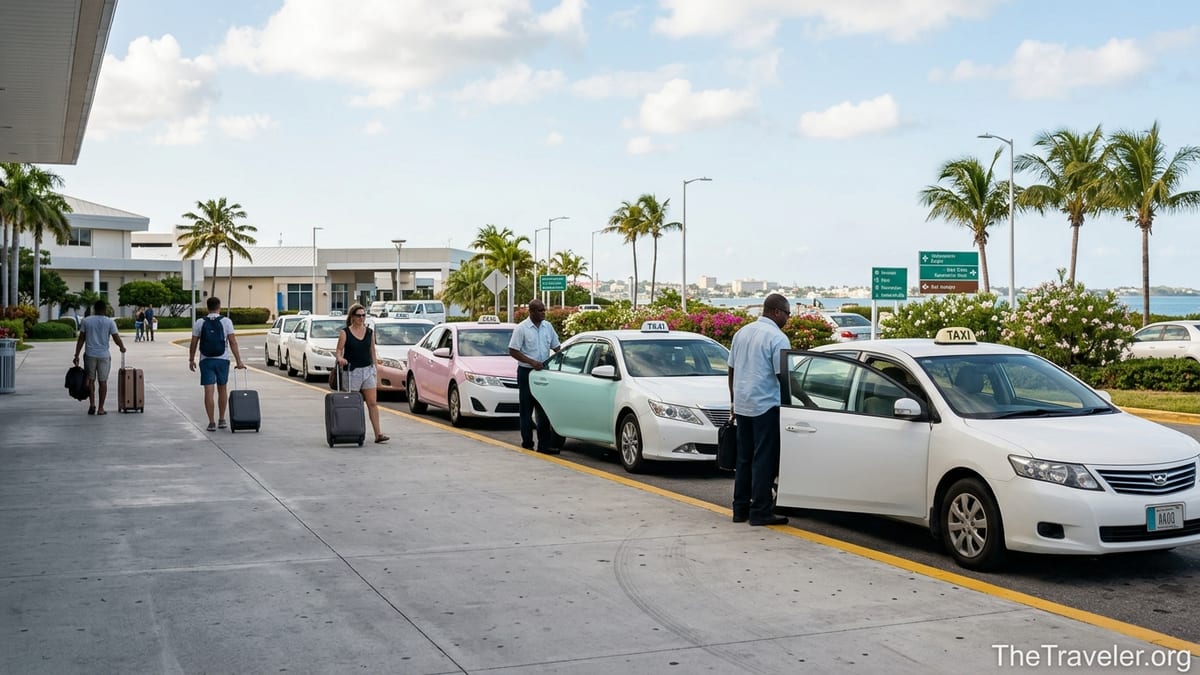
For most visitors, a standard taxi is the simplest and most realistic way to travel from Lynden Pindling International Airport to downtown Nassau. Taxis line up directly outside the arrivals area at the US, international and domestic terminals. You do not need to prebook and you do not need a local SIM card or app to find a car. Walk out, follow the “Taxi” signs and you will see a dispatcher and a row of vehicles, usually a mix of sedans and minivans.
Taxi fares from the airport are based on official zone rates. As of mid 2026, the posted flat rate from Lynden Pindling International Airport to downtown Nassau is around 36 US dollars for up to two passengers, with a small surcharge per additional person. Oversized bags, golf bags and large boxes may incur an extra fee of about 3 US dollars per item. That means a couple with two checked suitcases and two carry-ons can expect to pay in the high 30s in total to reach a downtown hotel or the cruise port, assuming no heavy oversize gear.
In practice, visitors report a range of prices, especially during peak season. Some share paying between 40 and 45 US dollars to downtown or the cruise port once tolls, extra bags and tips are added. Others describe being asked for 50 to 60 US dollars when heading onward to Paradise Island. The key is to politely confirm the total fare before you get in. A simple question such as “How much to Bay Street by the cruise port for two people with two suitcases?” will usually settle the matter. If the quote seems far above the posted zone rate, you can calmly mention that you understand downtown is about 36 dollars from the airport, or you can step back to the dispatcher and ask for clarification.
For timing, assume 20 to 30 minutes travel time in light traffic and 30 to 45 minutes when multiple cruise ships are in. For example, a mid-morning arrival on a Tuesday in October when only one ship is docked might see you at a Bay Street hotel 25 minutes after leaving the terminal. By contrast, a Friday afternoon in February with several large ships in port can mean your taxi slows to a crawl from Junkanoo Beach into the cruise area, adding 10 to 15 minutes. Even then, you are unlikely to spend more than an hour in the car unless there has been an accident or weather-related disruption.
Private transfers and hotel cars: when to prebook
If you prefer a confirmed price and a meet-and-greet service, private transfers can be a stress-free alternative. Several local companies in Nassau specialize in prebooked airport runs using sedans, SUVs, or small vans. Services marketed under names such as RideUp Nassau and other local operators offer door to door transfers from Lynden Pindling International Airport to downtown hotels and the cruise port for a fixed price quoted in advance. These services are especially popular with families, small groups and cruise passengers who are flying in on the day of sailing.
Typical published rates from the airport to central Nassau for a private transfer in a standard vehicle sit in the range of about 45 to 70 US dollars per car, depending on the size and whether bottled water or brief sightseeing stops are included. A family of four heading to a downtown hotel might pay 55 to 60 US dollars total for a prebooked minivan instead of roughly 40 to 45 dollars in a regular taxi. The premium buys a driver who will wait if your flight is delayed, help with baggage immediately inside or just outside the arrivals hall, and take you directly to your exact address without negotiating at the curb.
At the higher end, luxury car services and hotel affiliated chauffeurs provide transfers in black SUVs or sedans. A historic waterfront property such as the British Colonial works with dedicated chauffeur services that can meet guests with a name sign, offer chilled towels, and drive them into downtown in a well maintained vehicle. Prices for this type of transfer generally start around 90 to 120 US dollars per vehicle from the airport to downtown, more if you combine the ride with a short island tour. This is a good fit if you are celebrating an anniversary, arriving late at night with small children, or simply prefer a quieter, more controlled arrival after a long-haul flight.
Private transfers make the most sense when your schedule is tight or your group is larger. For example, two couples flying in together to catch a cruise the same afternoon might reserve a six passenger van for around 70 US dollars all in. Split four ways, the per person cost ends up similar to or even cheaper than two separate taxis, while guaranteeing that you travel together with space for all your luggage. Conversely, a solo traveler with only a backpack who is not in a hurry will rarely need more than a standard airport taxi.
The truth about buses and jitneys from the airport
Visitors looking for the cheapest transfer into Nassau quickly discover references to local “jitneys” the small privately operated buses that link many parts of the island. These are indeed the low cost option for getting around New Providence, but using them directly from the airport involves trade-offs. There is no official city bus terminal inside the airport grounds and no public bus bay directly at the arrivals curb. To reach a jitney, you typically need to walk out of the airport property to one of the nearby roads where local buses pass.
The most commonly discussed routes for travelers are jitney 10 and 12 or 12B. These head between downtown Nassau and the western part of the island, passing not far from the airport. Riders report that you can catch a jitney near the airport by walking a short distance out to the main road and flagging it down, then paying the driver a flat cash fare when you get off. Current anecdotal fares sit at a few Bahamian dollars per person, with some visitors mentioning about 2 to 2.50 Bahamian dollars for longer runs that include the airport area. The fare is paid in cash only and drivers will expect small bills.
While the savings compared with a taxi are real, the downsides are significant for many air passengers. Jitneys are not designed with airport travelers in mind. They are often crowded with local commuters, have narrow aisles, very limited luggage space and no special racks for suitcases. If you have only a cabin size bag that fits on your lap, you may be fine. If you are juggling two large checked bags, you will likely be uncomfortable and may be asked to move or wait for a less crowded bus.
Schedules are also informal. Jitneys run frequently during the day but they do not typically operate late at night, and there may be gaps of 15 to 30 minutes or more between buses depending on time of day and route. Visitors report that waiting by the road near the airport with luggage can feel exposed in the tropical heat, and there is limited shade. For these reasons, local tourism authorities and many experienced travelers do not recommend relying on jitneys as your primary airport transfer, especially if you are on a tight timetable or arriving after dark. Consider the jitney more as a way to explore between downtown, Cable Beach and other neighborhoods once you are already settled and can travel light.
Connecting to the Nassau Cruise Port from the airport
For cruisers flying into Nassau on embarkation day, the key question is how efficiently you can get from Lynden Pindling International Airport to the Nassau Cruise Port. The port sits at Prince George Wharf in the heart of downtown, about 22 kilometers from the airport by road. Official port information notes that it is approximately 20 minutes away by car under favorable traffic conditions, a figure that aligns with taxi experiences outside peak times.
The most straightforward method is an airport taxi directly to the cruise port entrance. Tell the driver the name of your cruise line or ship and that you are boarding at Nassau Cruise Port. They will know where to drop you, typically near the arrivals terminal where port security and check in staff are located. For two passengers with standard luggage, budget around 36 to 45 US dollars for the taxi fare from the airport to the port, plus a tip of 10 to 20 percent if service is good. On days when multiple ships are in, drivers often have a steady stream of port runs, so it is worth confirming both price and destination clearly before departing.
Cruise lines sometimes sell transfers from Nassau airport to the port as an add on. These are typically by shared coach or van and cost more per person than a regular taxi if you are traveling as a pair or family. For example, cruise transfer packages might charge 25 to 35 US dollars per person one way, which quickly adds up for a family of four. The advantage is that your ship will wait for its own transfer buses within reasonable limits, and staff will guide you directly from baggage claim to the correct vehicle, which can be reassuring for first time visitors.
Independent private transfer companies also market “airport to cruise port” packages. A small group coming in on the same flight can book a private van, agree a flat price in advance, and be driven straight to Prince George Wharf without sharing with strangers. This can be worth it if you want to add a brief island orientation drive past Cable Beach, Fort Charlotte or the Fish Fry at Arawak Cay before boarding. The driver can often accommodate a 15 to 20 minute photo stop, as long as you are not cutting arrival too close to the ship’s final check in deadline.
Walking from the airport to the cruise port is not realistic. The distance is long, the roads are busy and there are no continuous pedestrian friendly routes for travelers with luggage. If you are determined to use public transport, you would need to walk out of the airport to a jitney stop, ride to downtown, then walk from Bay Street to the cruise terminal gates. In practice, most air arriving cruise passengers choose a taxi or prebooked transfer for safety and convenience.
Managing luggage, timing and traffic
Nassau’s airport is used to handling visitors with beach gear, cruise attire and golf bags, but it is still worth planning your arrival with luggage and traffic in mind. If you are traveling with multiple large suitcases, a foldable stroller, dive gear or sports equipment, it is wise to seek out a taxi van rather than a standard sedan. At the taxi queue, you can indicate to the dispatcher that you have “four big bags” or “golf clubs and a stroller” and they will usually direct you to a larger vehicle. Expect to pay the base zone fare plus any surcharges for oversize items.
Time of day matters. Morning flights that land between about 9 am and noon often get the smoothest ride into town before afternoon cruise traffic peaks. By contrast, arrivals after 3 pm on busy cruise days can encounter significant slowdowns approaching downtown. Likewise, weekday commuter traffic into and out of central Nassau can create bottlenecks at key roundabouts and intersections. If you are landing midafternoon and need to be somewhere in downtown by a specific time, such as a wedding, business meeting or tight cruise boarding window, allowing extra buffer can save a lot of stress.
Weather is another variable. Heavy tropical showers can cause brief flooding on some low lying stretches of road, slowing traffic even when distances are short. Visibility can drop quickly during a squall, and drivers may take alternative back routes that feel circuitous but keep you moving. If you see dark clouds building as you exit the airport, it is even more important to go straight to the taxi line or meet your driver promptly and get on the road rather than lingering in the terminal.
With all these factors, build your plans around what is typical but leave room for what is possible. If you are catching a cruise, try to schedule inbound flights so that you land at least three hours before final check in time, even though the drive itself may be only half an hour. If you are heading into downtown simply to drop bags and explore, you can be more relaxed, but it still makes sense to have your first transport choice in mind before you land.
Is downtown Nassau worth visiting straight after you land?
Many travelers wonder whether it is worth heading into downtown Nassau at all, especially if they are staying at a resort further west around Cable Beach or at a major property on Paradise Island. Downtown is busy, sometimes chaotic, and it can feel overtouristed when several large ships are docked. Yet for many first time visitors, a few hours here deliver some of the most memorable impressions of Nassau, particularly if you know what to expect and choose your timing.
The heart of downtown stretches along Bay Street and the waterfront. From the cruise port you can walk to landmarks such as Rawson Square, Parliament Square, and the pastel colored buildings that house government offices. The Straw Market is a few minutes away on foot, offering stalls of straw bags, T shirts and souvenirs. Junkanoo Beach lies within walking distance west of the port and provides an easy first taste of Bahamian sand and sea, with beach bars and casual food shacks.
If you are interested in local history, heading downtown after landing can be particularly rewarding. Sites such as the Queen’s Staircase, Fort Fincastle and the gray stone Christ Church Cathedral are all either walkable from Bay Street or a short taxi ride uphill. A traveler arriving in the late morning, dropping bags at a central hotel such as the British Colonial or a small inn off Bay Street, can easily spend the afternoon wandering these sights, pausing for conch fritters at Arawak Cay and ending the day back near the waterfront.
There are reasons to skip downtown on arrival. If you are exhausted after an overnight flight, traveling with young children, or visiting at the peak of cruise season when sidewalks are packed, you may prefer to go straight to your resort and save downtown for a quieter morning. Some luxury resorts further west or on Paradise Island are self contained, with pools, beaches and restaurants that can occupy you for days without ever setting foot in central Nassau. In that case, you might plan a single half day outing into downtown rather than trying to combine it with your airport transfer.
Practical tips for choosing the right option
Choosing the best way from Lynden Pindling International Airport to downtown Nassau depends on your budget, luggage and appetite for local color. As a rule of thumb, if you are a first time visitor carrying standard suitcases and arriving during the day, a regular airport taxi is the most practical mix of price and simplicity. Confirm the fare before you get in, keep small bills for tipping and any luggage surcharges, and be clear about your destination, for example “a hotel on Bay Street near the cruise port.”
If you value certainty or are traveling as a group, consider arranging a private transfer before you fly. This is especially useful if your landing time is late in the evening, if you are traveling with older relatives, or if you are flying in on the same day that your cruise sails. Having a driver waiting with your name on a sign and a fixed price agreed in advance removes the need to negotiate when you are tired or in a hurry. Families with car seat aged children may also prefer prebooked services that can provide child seats by prior arrangement, something standard taxis do not always offer.
Jitneys remain useful once you are already in town. For example, a traveler staying in a downtown guesthouse might use a jitney to reach Cable Beach during the day for just a few dollars instead of taking a taxi both ways. However, for the airport run itself, the combination of luggage, irregular schedules and the walk to the roadside stop makes them best suited to experienced, budget focused travelers carrying only light bags and arriving in broad daylight.
Finally, remember small but important local details. Drivers in Nassau keep to the left side of the road, following British style rules. Seat belts are expected, and air conditioning is the norm in taxis and private cars. Have your accommodation address handy, ideally written down, as not all drivers will recognize small guesthouses or vacation rentals by name alone. With a little preparation, your first journey from Lynden Pindling International Airport into downtown can be straightforward, giving you a calm start to your time in the Bahamas.
The Takeaway
The journey from Lynden Pindling International Airport to downtown Nassau is short in distance but full of choices. Taxis offer a reliable flat rate ride into the city or cruise port in about half an hour, and remain the default for most visitors. Private transfers add comfort and certainty at a modest premium, especially valuable for groups and those on tight cruise schedules. Local jitneys provide an ultra cheap, very local experience but demand light luggage, flexible timing and some confidence in navigating informal routes.
Whether downtown is worth visiting right after you land depends on your energy level and interests. For many, its mix of colonial architecture, lively waterfront and historic sites makes it an ideal first stop before continuing to beaches and resorts. For others, especially families arriving late or after long flights, heading straight to a quieter hotel and saving the city for a later outing will feel more relaxing.
Whichever option you choose, a bit of planning around fares, timing and traffic will pay off. Arrive with a clear idea of what a normal taxi ride should cost, know whether you are comfortable prebooking a transfer, and be realistic about how much you want to do on your first few hours in Nassau. With those pieces in place, the road from the airport to downtown becomes simply the opening chapter in your Bahamas story rather than a source of stress.
FAQ
Q1. How much does a taxi cost from Nassau airport to downtown?
The official flat rate from Lynden Pindling International Airport to downtown Nassau is around 36 US dollars for up to two passengers, with small surcharges for extra passengers and oversized luggage. In practice, visitors often pay between 36 and 45 dollars including tip for two people with typical suitcases.
Q2. How long does it take to get from the airport to the Nassau Cruise Port?
In light traffic, the drive from Lynden Pindling International Airport to Nassau Cruise Port takes about 20 to 30 minutes. When several large cruise ships are in port or during weekday rush hours, it can stretch to 40 minutes or slightly more, especially for the final approach into downtown.
Q3. Are there public buses or jitneys directly from the airport?
There is no official public bus terminal inside the airport and no jitney stop right at the arrivals curb. To use a jitney, you generally need to walk out to a nearby main road and flag down a route such as the 10 or 12 that passes toward downtown. This is cheap but not very convenient with luggage.
Q4. Is it safe to use jitneys from the airport with luggage?
Jitneys are widely used by locals and are generally considered safe during the day, but they are crowded, have limited space for bags and do not run late at night. If you have large suitcases or arrive after dark, a taxi or private transfer is usually safer and more comfortable.
Q5. Should I prebook a private transfer or just take a taxi?
If you are a first time visitor arriving in daytime with a normal amount of luggage, taking a standard taxi from the airport is usually fine. Prebooking a private transfer is most useful if you are on a tight cruise or flight connection, arriving late at night, traveling with a large group, or simply prefer a fixed price and meet and greet service.
Q6. Can I walk from the Nassau Cruise Port to downtown attractions?
Yes. The cruise port sits in the heart of downtown, so you can easily walk to Bay Street shops, the Straw Market, Rawson Square and Junkanoo Beach. Many historic sites such as Fort Fincastle and the Queen’s Staircase are also walkable, though they involve an uphill climb.
Q7. Is downtown Nassau worth visiting if I am staying at a beach resort?
For most visitors, downtown is worth at least a half day. It offers historic architecture, colorful streets, waterfront views and markets that you will not find inside a self contained resort. However, if you are exhausted or traveling with very young children, you may want to rest at your resort first and plan a separate downtown outing.
Q8. Do taxis in Nassau accept credit cards?
Many taxis in Nassau still prefer cash, usually in US or Bahamian dollars, which are used interchangeably at a one to one rate. Some drivers may accept cards, but this is not guaranteed, especially for older vehicles, so it is wise to have enough cash on hand to cover your airport transfer.
Q9. How much should I tip my taxi or transfer driver?
A typical tip for good service is around 10 to 15 percent of the fare, more if the driver helps with heavy luggage or makes extra stops for you. For example, on a 40 dollar ride from the airport to downtown, many travelers leave 5 to 7 dollars in tip.
Q10. Is it possible to rent a car at the airport and drive myself to downtown?
Yes, several major car rental companies operate at Lynden Pindling International Airport, and driving to downtown is straightforward for confident drivers. However, you will need to be comfortable driving on the left side of the road, navigating local traffic and finding parking in central Nassau, which can be limited during busy times.