


More news on this day
A rare nationwide ground stop ordered by the Federal Aviation Administration on Friday abruptly halted departures at airports across the United States, stranding passengers in terminals and on tarmacs as air traffic controllers grappled with widespread communications problems.
Get the latest news straight to your inbox!
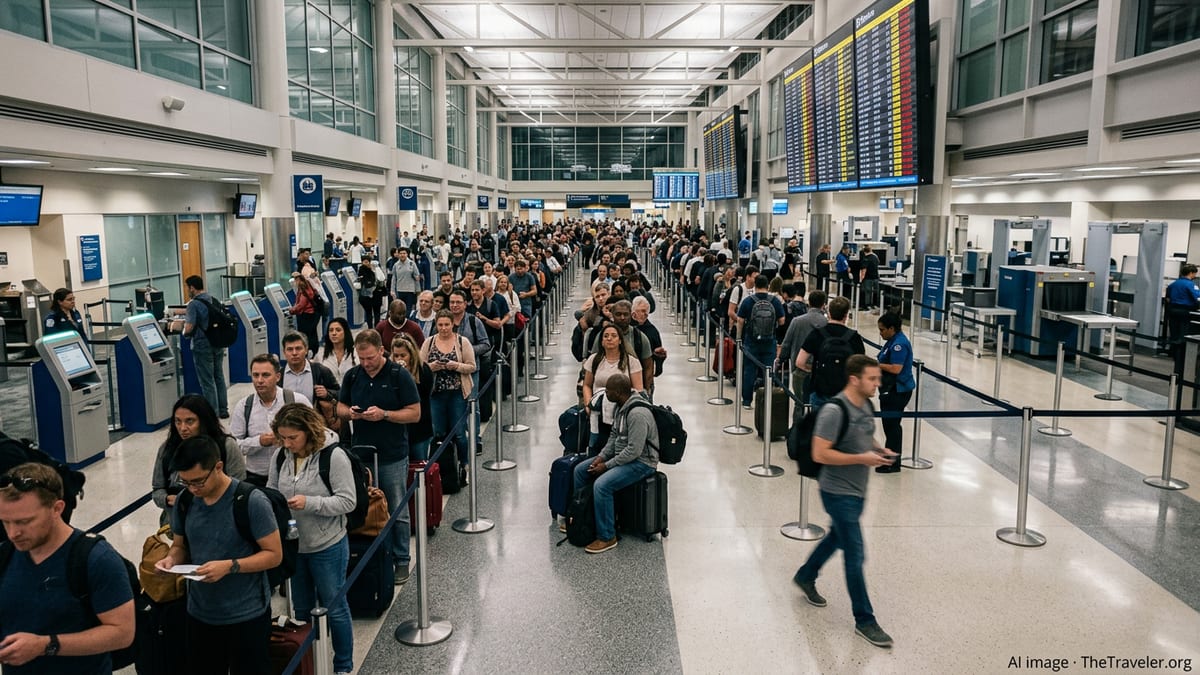
Extraordinary order freezes departures nationwide
Publicly available information from federal aviation systems and major news outlets indicates that the ground stop took effect on the afternoon of Friday, November 13, 2026, after air traffic control centers reported significant communications issues. The directive suspended most departures nationwide, marking only the second broad halt to U.S. air traffic since a brief system outage in January 2023 and one of the most extensive interruptions since the aftermath of the September 11, 2001 attacks.
Reports describe the order as stemming from failures affecting multiple Air Route Traffic Control Centers, the facilities that manage en route aircraft between takeoff and landing phases. An advisory circulated within the aviation system cited “extraordinary circumstances” and “reasons of safety,” language that underscores how unusual it is for regulators to halt flights across the entire network rather than targeting a specific airport or region.
Flight tracking services cited in published coverage show that thousands of flights scheduled to depart or arrive in the United States on Friday were delayed or canceled as a result. Several analyses noted that more than 10,000 domestic delays and thousands of cancellations were recorded over the course of the day, with ripple effects expected to extend through the weekend as airlines work through displaced passengers and aircraft.
Officials in Washington have acknowledged that the disruption is linked to communications problems inside the air traffic control system. Public briefings and statements indicate that early assessments did not point to a deliberate cyberattack, but technical investigations into the precise cause of the outage were still in progress as the ground stop continued into Friday evening.
Stranded passengers face long waits and scarce information
Scenes from major hubs such as Chicago O’Hare, Atlanta, Dallas Fort Worth, Los Angeles and New York area airports show crowded concourses, long lines at customer service desks and departure boards filled with red “canceled” and “delayed” notices. Passengers posting on social media platforms describe being held on parked aircraft, turned back from departure gates or told to deplane as the scope of the nationwide stop became clear.
Airport advisories and airline alerts reviewed by news organizations have urged travelers not to head to the airport without first confirming their flight status. Many carriers have activated travel waivers, allowing customers scheduled to fly on November 13 or over the following days to rebook once or, in some cases, multiple times without change fees, provided they travel within specific date ranges and keep the same city pairs.
Because the order applies to departures rather than aircraft already in the air, arrivals have continued in many parts of the country, creating congestion on taxiways and at gates as inbound planes arrive faster than outbound flights can be released. Industry reports note that some aircraft have been forced to wait for extended periods on remote stands while operators juggle limited gate space and try to position planes for when the system begins to restart.
Travelers with onward international connections face particular uncertainty. Airlines with extensive transatlantic and transpacific networks have warned that evening departures could be delayed or re-timed, which may affect minimum connection windows at overseas hubs. Some overseas-bound flights have been prioritized for departure slots once local ground restrictions ease, but this remains subject to evolving air traffic control capacity.
Sports events, cruises and holidays thrown into disarray
The fallout from the ground stop has extended far beyond leisure and business travelers. According to national sports coverage, professional basketball and hockey teams, as well as college programs, have been stranded in cities around the country while trying to reach weekend games. League statements cited in media reports indicate that contingency plans are being developed, including possible schedule changes if teams cannot arrive in time by air.
Disruptions have also affected other parts of the travel and tourism sector. A separate incident on the Mississippi River near New Orleans on Friday, in which a cruise vessel collided with a tanker, triggered a large-scale rescue effort. Coverage from local and national outlets notes that investigators and federal safety officials faced delays reaching the scene because the nationwide ground stop limited flights into the region, complicating the immediate response.
The timing of the outage, less than two weeks before the peak Thanksgiving travel period in the United States, has raised concerns among airlines, airports and travelers about system resilience. Commentaries in major national publications point out that delays and cancellations have become a recurring feature of U.S. air travel during high-demand periods, and that another large-scale disruption may further erode confidence among passengers already wary of tight connections and crowded flights.
In some cities, rail and intercity bus operators have reported higher inquiries and bookings as would-be fliers look for alternative ways to complete regional trips. However, those options remain limited on many long-distance routes, leaving a significant number of travelers with little choice but to wait for flights to resume.
Spotlight on fragile aviation technology and modernization
The incident has renewed scrutiny of the aging technology that underpins the U.S. air traffic control system. Independent audits and government watchdog reports published in recent months have highlighted longstanding modernization challenges, including reliance on decades-old software and hardware in key systems. A widely cited government analysis noted that critical information platforms have been in service for more than 30 years and have already been implicated in earlier outages that forced temporary suspensions of departures.
According to specialized aviation and technology coverage, the FAA has been rolling out new tools intended to improve traffic management and reduce delays, including systems that use advanced analytics to help controllers optimize airspace. At the same time, the agency has acknowledged that upgrading complex national infrastructure while maintaining day-to-day operations is a lengthy process that will extend toward the end of this decade.
Recent incidents at individual airports, such as equipment outages in Philadelphia and other Northeast hubs earlier this fall, had already prompted renewed debate about the pace of modernization. Industry groups and passenger advocates are now arguing that the nationwide ground stop demonstrates how a single point of failure in communications or data networks can quickly cascade into a full-scale transportation crisis.
Policy analysts note that the latest disruption is occurring against the backdrop of wider technology vulnerabilities across sectors. A major global software update failure in 2024, for example, temporarily grounded flights at multiple U.S. carriers and left travelers stuck in terminals around the world. Those events, together with Friday’s systemwide halt, are likely to feature prominently in upcoming discussions about funding and oversight of aviation technology.
What travelers can do if their flight is affected
For passengers currently holding tickets, publicly available guidance from airlines, airports and consumer advocates emphasizes preparation and flexibility. Travelers are being advised to use airline apps, text alerts and airport notification systems to monitor their flight status frequently, since schedules may change multiple times as the ground stop is lifted and backlogs are cleared.
Many carriers are allowing same-city rebookings at no additional fare on nearby dates, particularly for passengers with nonrefundable economy tickets who might otherwise pay substantial change fees. In some cases, longer rebooking windows are being offered to those willing to delay trips until later in November, when operations are expected to stabilize. Travelers are encouraged to keep receipts for meals and hotels in case individual airlines extend goodwill reimbursement policies, although these vary by carrier and are not guaranteed for disruptions categorized as air traffic control issues.
Experts cited in travel industry reporting suggest that passengers stranded far from home consider whether driving or taking ground transportation to a different airport may improve their chances of departure once flights resume. However, due to the nationwide scope of the halt, options that worked during local weather or airport-specific ground stops may be less effective, especially on the day of the outage itself.
In the days ahead, travelers with nonessential trips may decide to postpone journeys until airlines have cleared the backlog of stranded passengers. Those with time-sensitive travel, such as family events or cruises with fixed departure times, face more difficult choices and may need to coordinate closely with travel providers for refunds or credits if they cannot reach their destinations in time.