


More news on this day
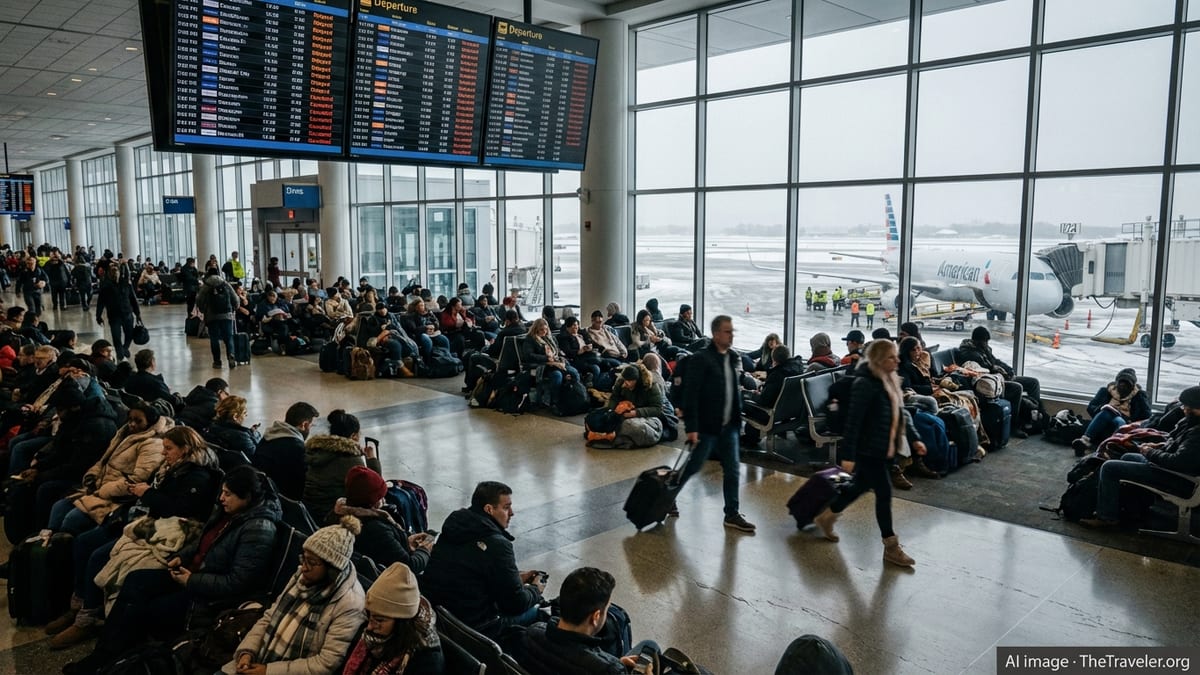
A widespread information technology outage at American Airlines triggered a nationwide ground stop this week, leaving passengers stranded across the United States and turning major hubs such as Charlotte Douglas International Airport into scenes of extended delays, long lines and mounting frustration.
Get the latest news straight to your inbox!
IT Failure Triggers Nationwide Ground Stop
Publicly available accounts from passengers and aviation observers indicate that American Airlines experienced a systemwide IT failure that halted departures for flights not already in the air. Reports from multiple airports describe boarding paused mid-process, aircraft stuck on taxiways and gate areas filling as departures were frozen until the carrier’s core operating systems could be brought back online.
At the height of the disruption, gate announcements and crew briefings cited a software or systems outage affecting critical tools that flight crews and ground staff rely on to dispatch flights, manage digital flight logs and process passengers. Without those systems functioning, crews were reportedly unable to accept aircraft or receive clearances, prompting the broad halt.
According to published coverage and contemporaneous social media posts, the Federal Aviation Administration coordinated with the airline during the stoppage as American worked to restore its internal systems. Departures gradually resumed once core platforms began rebooting, but the time lost on the ground quickly cascaded into a wider operational tangle.
American Airlines has not publicly detailed the exact technical root cause, but the event fits a broader pattern of complex airline IT infrastructures that can falter when central platforms or device-management tools fail or are updated incorrectly.
Charlotte Hub Hit Hard as Planes and Passengers Back Up
Charlotte Douglas International Airport, one of American’s largest hubs, emerged as one of the hardest-hit locations as the outage unfolded. Passengers described long lines, crowded gate areas and aircraft waiting on the tarmac for gates that could not be freed because departures were frozen.
Travelers arriving into Charlotte reported being held on taxiways while crews awaited guidance, even as thunderstorms approached the region. Public posts from the airport described multiple aircraft idling on the airfield and a growing queue of inbound flights with no available parking positions at the gates.
The operational strain in Charlotte coincided with lingering weather issues, compounding the disruption. Reports from within the terminal referenced a “double hit” of storms and systems failure, as lightning and heavy rain periodically halted ramp operations just as the carrier’s IT backbone faltered.
For connecting passengers, the timing was especially damaging. With American’s banked schedule in Charlotte designed around tightly timed connections, the ground stop quickly unraveled onward itineraries, leaving many travelers scrambling for later flights, hotel rooms or alternative routes.
Passenger Stranded in Charlotte Highlights Human Impact
Among those caught in the disruption was passenger Ignacio Buse, whose experience in Charlotte encapsulated the uncertainty confronting many travelers. According to public posts associated with the incident, Buse found himself stranded at the hub as flights halted and the terminal filled with waiting passengers.
Accounts tied to his itinerary describe a stalled journey in which departure boards repeatedly shifted, boarding times slipped and available information changed as American’s systems flickered back to life in stages. The interruption left him and others unsure whether to remain by the gate, seek rebooking options or arrange overnight accommodation.
While each traveler’s situation differed, Buse’s case illustrates the practical consequences of a sudden system outage: missed connections, potential overnight stays, disrupted work and family plans, and difficulty accessing reliable, up-to-date information while airline staff worked with limited tools.
Similar stories surfaced from travelers in other hubs, where those already seated on aircraft were asked to wait as systems were diagnosed, while others in security lines or check-in halls were told that boarding and departure processes were on hold until further notice.
Systems Slowly Restart, but Disruption Lingers
Passenger reports indicate that American’s systems began to come back online in phases, with airport displays flickering on, mobile apps resuming check-in functions and boarding processes restarting in some cities before others. Travelers at large hubs such as Miami and Chicago described partial functionality returning first for customers who already held boarding passes, while new check-ins and reprints remained limited.
Even after the core outage was addressed, the airline’s operation remained fragile through the remainder of the day. Aircraft and crews were out of position, some flights missed their departure windows because storms moved in, and duty-time limits for pilots and flight attendants introduced further constraints as delays stretched into the evening.
Historical data from previous airline IT disruptions show that the most severe knock-on effects often appear several hours after systems are technically restored. Once crews and aircraft are scattered away from their planned schedules, it can take a full day or more for a carrier of American’s size to fully rebalance its network.
Travelers reported ongoing delays and isolated cancellations into the following operating period, especially on routes dependent on tight connections through congested hubs. Many passengers turned to rebooking tools, customer-service phone lines and third-party travel partners to find workable alternatives.
IT Fragility Raises Fresh Questions for Airline Reliability
This latest American Airlines outage underscores how dependent modern air travel has become on complex digital infrastructure. From dispatch and maintenance systems to crew scheduling and passenger processing, a single failure point can ripple across an entire network, grounding hundreds of flights and stranding tens of thousands of passengers.
Analysts studying previous disruptions have highlighted how legacy systems, aggressive cost controls and layered software updates can leave airlines vulnerable to outages that are difficult to predict and even harder to resolve quickly. While large carriers invest heavily in redundancy and backup systems, events like this demonstrate that safeguards do not always prevent ground stops or mass delays.
For travelers, the episode serves as another reminder to build buffer time into connections, keep essential items in carry-on bags and understand their rebooking and compensation options when severe delays occur. Insurance products and certain credit cards may offer coverage for trip interruptions tied to carrier-caused disruptions, including IT outages.
Regulators in the United States have previously signaled interest in understanding how airline technology failures affect consumer rights and operational resilience. As outages continue to affect multiple major carriers globally, public discussion is likely to intensify around what standards, contingency plans and investments are necessary to keep the airline system functioning reliably, even when critical software falters.