


More news on this day
Air travel across the United Kingdom has faced major disruption after a failure in the National Air Traffic Services (NATS) flight planning system led to widespread delays and cancellations affecting close to 1,000 flights at UK airports and in surrounding airspace.
Get the latest news straight to your inbox!
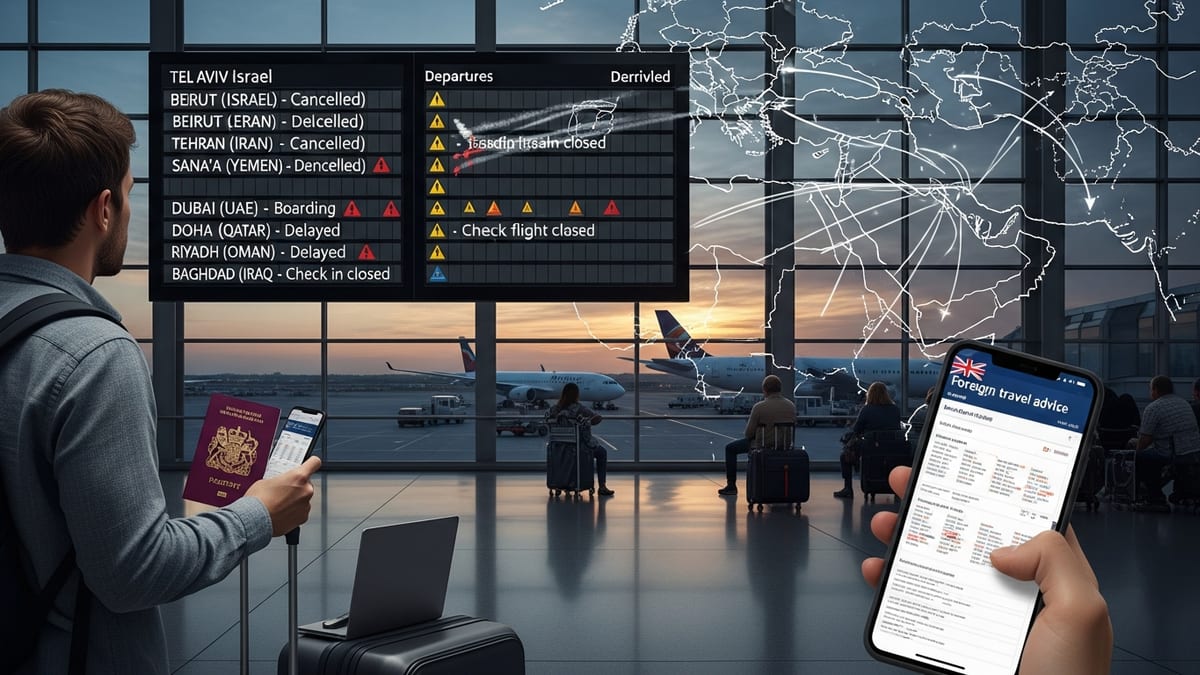
Major Outage Hits One of Europe’s Busiest Skies
The disruption stems from a technical issue affecting the automated flight planning system used by NATS, the UK’s main provider of air traffic control. Publicly available information indicates that the system failure forced controllers to restrict the flow of aircraft while plans were processed manually, significantly reducing capacity across UK airspace.
Independent aviation data and media coverage from the day of the outage show that hundreds of departures and arrivals were either delayed or cancelled, with the total impact approaching 1,000 affected flights across UK airports. Some assessments describe it as the most severe single day of disruption to UK aviation since the Icelandic volcanic ash crisis in 2010, underscoring the scale of the incident.
The outage coincided with a peak travel period, amplifying its impact. Large hubs such as London Heathrow and London Gatwick, already operating with limited spare capacity, saw queues build rapidly as aircraft, crews and passengers fell out of position. Knock-on effects rippled through European and transatlantic networks, with delays and cancellations continuing into subsequent days.
Information published after the event indicates that while the immediate technical fault was resolved within hours, it was not possible to quickly restore schedules. Aircraft and crew were left in the wrong locations, and airports faced curfews, stand shortages and staffing constraints that slowed the recovery.
What Went Wrong Inside the NATS System
According to reports summarising NATS’ own technical investigation and the subsequent independent review commissioned by the UK Civil Aviation Authority (CAA), the disruption was triggered by an anomaly in flight data received by the system on the day of the incident. The flight planning subsystem encountered data it could not correctly interpret and, by design, shut down normal automated processing to protect the integrity of air traffic operations.
Published documentation indicates that when this occurred, controllers were unable to rely on standard automated tools to handle the high volume of flight plans. Instead, they had to input and verify data manually to maintain safe separation between aircraft. This safeguard is intended to prevent unsafe instructions from entering the system, but it also drastically reduces the rate at which flights can be handled.
Technical reports made public after the event describe the failure as highly unusual, the result of a rare combination of routing information that exposed a software vulnerability. The issue did not stem from a cyberattack or loss of radar coverage; rather, it was a fault in the way the system processed specific flight plan data under particular conditions.
The independent review points to both software and system design lessons, including the need for more robust handling of unexpected data inputs and improved contingency arrangements when automated systems are forced offline. It also highlights the importance of comprehensive testing against complex, atypical scenarios that may occur only rarely but can have outsized operational consequences.
Impact on Passengers, Airlines and Airports
Passenger disruption was immediate and widespread. Travel reports from the day of the outage describe long queues, crowded terminal halls and passengers facing extended waits on board aircraft parked on taxiways and remote stands while new departure slots were arranged. Many travellers missed onward connections, while others faced overnight delays or diversions to alternative airports.
For airlines, the sudden collapse in airspace capacity translated into extensive schedule reshaping. Carriers prioritised certain routes, repositioned aircraft and crews where possible, and in many cases cancelled flights outright once it became clear that standard schedules could not be delivered. Publicly available estimates by industry groups and regulators suggest that the total cost to airlines and passengers ran into tens of millions of pounds, taking into account lost revenue, duty-of-care expenses and compensation under European passenger rights rules where applicable.
Airports across the UK and Ireland, including London Heathrow, London Gatwick, Manchester, Edinburgh and Dublin, reported disruption as arrivals and departures banked up. Ground handling operations and airport infrastructure came under strain as stands filled, baggage systems struggled with irregular flows, and staff tried to manage information for thousands of disrupted passengers.
According to subsequent analysis published by the CAA and industry bodies, the effects of the outage were felt for several days. Even after the technical problem was resolved, airlines had to work through a backlog of displaced passengers and aircraft, while airports sought to balance recovery flights with already busy peak schedules.
Regulatory Scrutiny and Independent Review Findings
In the wake of the incident, the UK Civil Aviation Authority launched an independent review of the NATS system failure. The final report, now publicly available, provides a detailed account of the technical causes, operational responses and passenger impacts, and makes recommendations aimed at reducing the likelihood and impact of similar failures in future.
The review concludes that the immediate safety response by NATS and other aviation stakeholders prioritised safe operations, but that the event exposed vulnerabilities in system resilience and contingency planning. It highlights the absence of certain fallback options that could have preserved higher levels of capacity while still maintaining safety margins, as well as opportunities to improve cross-industry coordination during major technical incidents.
Recommendations in the report cover a range of areas, from software robustness and data validation to incident response procedures and communication with airlines and airports. The CAA has also used the findings to consider whether changes are needed in consumer protection rules, including how passengers are informed and supported during large-scale disruption originating from infrastructure providers rather than airlines themselves.
Publicly available government statements describe the incident as a significant event for the UK’s aviation system and indicate that regulators expect NATS and the wider industry to implement recommended improvements. Follow-up publications track progress on these actions, reflecting ongoing regulatory interest in both technical and customer-experience outcomes.
Longer-Term Questions Over Air Traffic Resilience
The NATS system failure has revived debate over the resilience of complex, software-driven infrastructure in modern aviation. Air traffic control systems must handle vast volumes of data in real time and cannot easily be shut down for testing or upgrades. Incidents such as this highlight how a single failure in a critical subsystem can cascade across an entire network, disrupting flights far beyond national borders.
Industry analysis notes that demand for air travel, particularly during peak holiday periods, now operates close to capacity in many regions. When unforeseen technical problems arise, the lack of spare capacity makes it difficult to absorb the shock. The result is often a prolonged recovery period, during which passengers, airlines and airports continue to experience disruption even after the initial fault is fixed.
The independent review into the NATS outage suggests that building more robust safeguards, redundant systems and flexible operating procedures will be essential as air traffic volumes grow. It also indicates that clear, consistent communication with passengers and coordinated decision-making among airlines, airports and service providers are critical to managing the fallout from any future incident.
For travellers, the episode serves as a reminder that aviation, while statistically very safe, depends on highly complex, interconnected systems. When one piece fails, the immediate priority is safety, but the consequences for travel plans can be substantial and long-lasting, particularly when an outage affects nearly 1,000 flights in one of Europe’s busiest airspaces.
UK Civil Aviation Authority – Independent Review of August 2023 NATS System Failure
CAP2993 – Independent Review of NATS Flight Planning System Failure
UK Government – Publication of Independent Report into NATS Technical Failure