


More news on this day
A new artificial intelligence system designed to predict and ease air traffic bottlenecks is beginning live operations over the Washington, D.C. region, a high-stakes test of whether advanced automation can meaningfully reduce flight delays without disrupting safety in some of the country’s most complex airspace.
Get the latest news straight to your inbox!
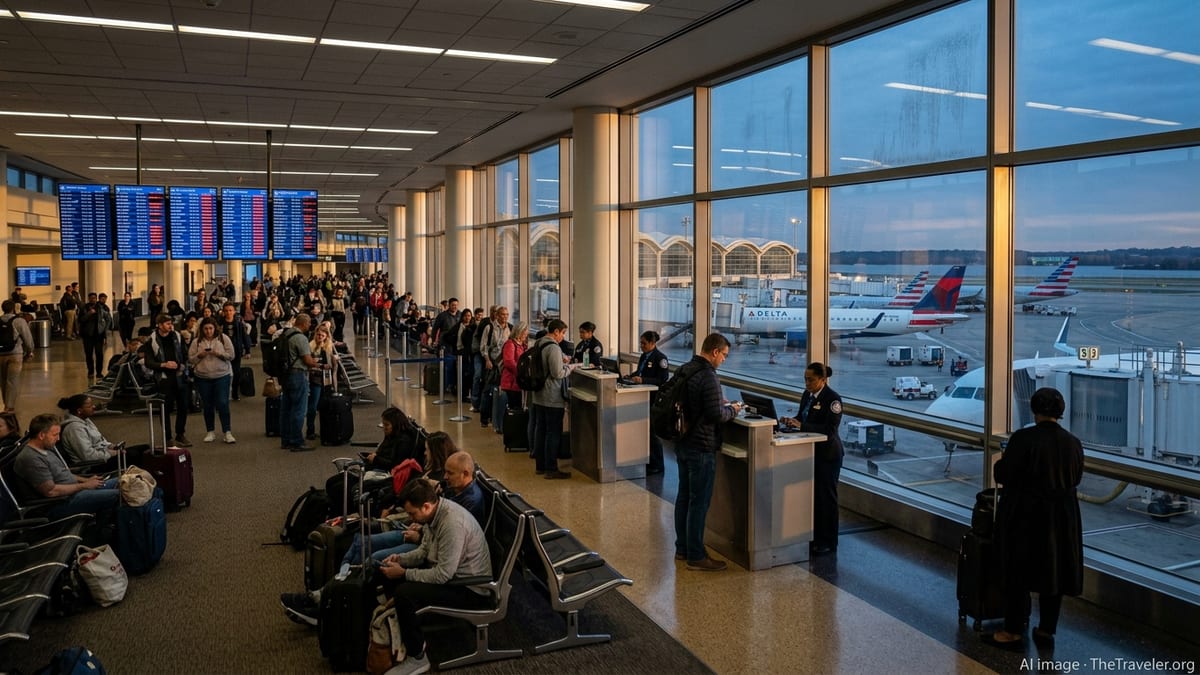
SMART debuts over Washington’s congested air corridor
Publicly available information indicates that the Federal Aviation Administration has begun an initial operational rollout of an AI-supported traffic management tool known as SMART, short for Strategic Management of Airspace, Routes and Trajectories, with the Washington, D.C. area as its first real-world proving ground. The system is intended to help manage congestion affecting Ronald Reagan Washington National, Washington Dulles International and Baltimore/Washington International Thurgood Marshall airports, along with dense flows of military and general aviation traffic that share the region’s skies.
According to federal contracting records and agency releases, SMART is being delivered under a multiyear agreement valued at up to 875 million dollars with Boston-based software firm Air Space Intelligence, awarded in June 2026 as part of a broader modernization effort to refresh aging air traffic flow infrastructure. The AI tool builds on earlier NextGen investments and NASA research into data-driven decision support, but represents one of the most ambitious attempts yet to embed machine learning into day-to-day traffic-flow planning in the National Airspace System.
Reports describe the Washington deployment as a scaled-back introduction after airlines expressed concern about the pace and scope of the original plan. Rather than immediately influencing all traffic nationwide, SMART is starting in a single, tightly monitored region that combines busy commercial schedules, high levels of government and military flying, and some of the country’s most restrictive security airspace.
How the new AI system is supposed to reduce delays
SMART is designed to process a wide range of live and scheduled data, including airline timetables, filed flight plans, radar tracks, weather forecasts, known bottlenecks in the airspace, runway and gate capacity and staffing information at key facilities. By fusing those streams, the tool generates forecasts of where congestion is likely to build, then suggests reroutes and revised schedules intended to keep traffic flowing more smoothly when demand begins to exceed capacity.
Public descriptions from federal aviation documents and industry coverage indicate that the system is focused on traffic flow management rather than direct control of individual aircraft. It is meant to complement existing tools such as Time Based Flow Management that already meter traffic into constrained sectors, adding AI-driven pattern recognition and prediction to anticipate problems earlier and with more granularity.
Some of SMART’s logic appears to mirror NASA prototypes that have been tested in other metroplex regions, where decision-support software looked for opportunities to reroute flights around weather or congestion while still honoring airline preferences. NASA case studies on digital trajectory rerouting show that similar systems in Texas and Houston reduced aggregate delay by minutes per flight and saved tens of thousands of dollars per event in passenger delay costs, results that aviation planners hope can be replicated or improved in the D.C. corridor.
Airlines, regulators and travelers weigh potential risks
The decision to start live operations in Washington follows months of scrutiny from airlines and lawmakers about how much autonomy any AI tool should have in a safety-critical system. Press reports on industry consultations suggest that carriers pushed back against early concepts that would have tightly integrated AI recommendations into traffic management directives, arguing that performance needed to be proven in more limited roles first.
As a result, the current approach in the D.C. area keeps human management firmly in charge. According to published coverage, SMART’s role is confined to providing suggested reroutes and schedule adjustments when traffic is already backing up, with controllers and traffic managers retaining discretion over which options to adopt. The system does not clear aircraft for takeoff or landing, issue instructions to pilots or alter flight plans without human review.
Travelers have nonetheless begun to react to the news, particularly after a separate technical outage at an air traffic facility in the Northeast recently triggered widespread delays that rippled into Washington-area flights. Online discussions show a mix of curiosity and anxiety, with some passengers expressing concern about becoming “test cases” for a new technology and others pointing out that today’s delays are already shaped by complex software tools, even without AI branding.
Why Washington was chosen as the testbed
Washington’s airspace offers an unusually dense and varied operating environment, which appears to be one reason it was selected for the first SMART deployment. The region includes a slot-controlled airport at Reagan National with strict perimeter rules, a major international hub at Dulles, and BWI as a key base for low-cost carriers and domestic operations, along with nearby military fields and a heavy volume of government-related travel.
The FAA’s own descriptions of the Washington Metroplex initiative, completed in recent years, highlight the area as a focus of NextGen modernization, with redesigned arrival and departure paths and performance-based navigation already in place. By layering an AI-supported flow tool on top of that foundation, planners are effectively testing whether smarter use of schedules and trajectories can extract additional capacity and resilience without building new runways or significantly changing community noise footprints.
The choice of Washington also allows federal managers and technical teams to observe SMART’s performance at close range, since the key command centers and policy offices overseeing the system are located in or near the capital. If the tool performs as intended through the busy fall travel period, officials have signaled that they may expand its footprint to other congested metro areas along the East Coast.
What passengers using DC airports should expect
For travelers heading into or out of the Washington region this fall, the most visible sign of SMART’s presence may simply be how gate agents and airline apps describe delay causes and reroutes. Instead of broad references to volume or weather, some operations updates may increasingly reflect more targeted flow decisions where flights are shifted between routes or departure windows based on the AI system’s forecasts of downstream congestion.
Industry and government documents reviewed by news outlets suggest that the goal is to smooth peaks in traffic rather than to eliminate all delays. In practice, that could mean more modest schedule adjustments earlier in the day in order to avoid severe disruptions later, especially when storms threaten the East Coast or when capacity is reduced at a key facility. Passengers might see some flights depart a little earlier or later than initially scheduled if the system predicts that such changes will prevent longer waits.
At the same time, publicly available planning material emphasizes that SMART is still considered a developmental capability. The Washington rollout is framed as a live operational test, with performance benchmarks and safeguards in place. Travelers who experience delays in the coming weeks may not be able to tell whether a particular disruption was eased or worsened by the AI tool, but the aggregated data from thousands of flights through the capital region is expected to shape how widely and how quickly similar systems are used elsewhere in the U.S. aviation network.