


More news on this day
British travellers heading to Europe are being urged to prepare for tougher border checks as the EU’s long-delayed digital Entry/Exit System becomes fully operational this week, reshaping how UK passport holders enter and leave the Schengen area.
Get the latest news straight to your inbox!
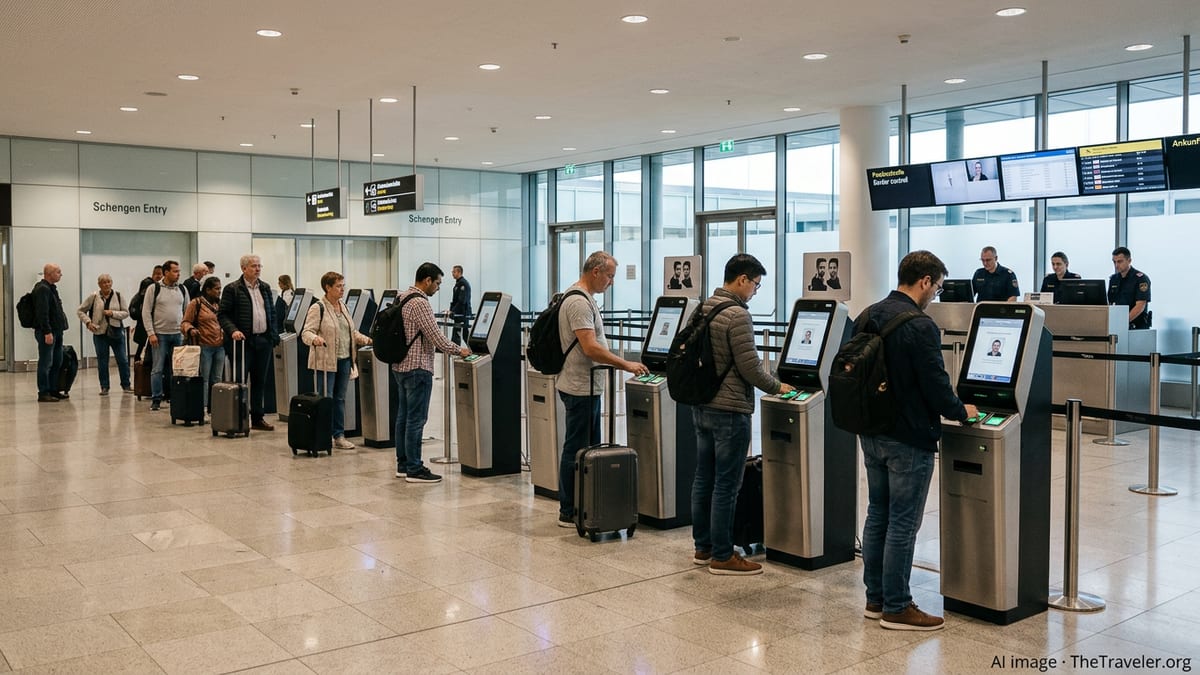
What is changing at European borders for UK travellers
The EU’s Entry/Exit System, known as EES, is a new bloc-wide IT system that replaces the manual stamping of passports for non-EU nationals visiting the Schengen area for short stays. Instead of ink stamps, travellers’ details are recorded electronically at the border, including passport information, the date and place of entry or exit, and biometric data such as fingerprints and a facial image. According to official EU material, the system is designed to speed up checks in the long term and to improve security by creating a reliable digital record of movements across the external Schengen borders.
EES began a phased launch in October 2025 and has been gradually deployed at land, sea and air borders, with transitional arrangements in some locations. EU publications now indicate that the system is fully in force across 29 participating European countries, which include nearly all popular holiday destinations for British tourists inside the Schengen zone and several microstates that apply Schengen rules. In practice, this week marks the point at which EES registration is treated as the normal procedure for UK visitors rather than an early roll-out.
For most British holidaymakers, the key change is that border officials no longer rely on passport stamps to calculate how long someone has spent in the Schengen area. The digital system automatically calculates and stores entries and exits, which helps enforce the rule that non-EU nationals can stay for a maximum of 90 days in any rolling 180-day period without a visa. That means travellers who previously relied on partially stamped passports or faded ink will now face a much more precise record of their movements.
How the new checks work in practice
When a British traveller first arrives at an external Schengen border under the fully operational EES regime, they are required to complete a one-off registration. Publicly available technical explanations describe a process in which the passport is scanned and the system captures four fingerprints and a live facial image, linking these to the traveller’s biographical details. This creates an individual EES file that will be updated on later trips with each entry and exit.
Subsequent journeys should be quicker, as the traveller’s biometric and passport data will already be on file. On later visits, border checks focus on verifying the identity against the stored record and confirming that the person still complies with the short-stay rules. EU guidance suggests that a standard check, once registered, is intended to take around one to two minutes per person, though real-world timings will depend on how busy a crossing is and how smoothly systems operate at specific airports, stations and ferry ports.
The system applies to most non-EU and non-Schengen nationals, including British citizens, who do not need a visa for short stays. It covers travel by air, sea and land, including at the busy Channel crossing points. Travellers remain subject to questions on purpose of visit, proof of accommodation or return tickets, and sufficient funds, but the recording of entries and exits is now handled digitally rather than through manual stamps.
Why there is a fresh warning for Brits this week
The renewed travel warning for British holidaymakers reflects the fact that EES has moved from a transitional roll-out to full operation, meaning that more UK travellers will experience the new process for the first time in the coming days. Government travel advisories and EU briefings have consistently highlighted the potential for longer queues when large numbers of people need to complete biometric registration at once, especially at peak holiday periods and at major crossing points between the UK and mainland Europe.
Particular concern has focused on so-called juxtaposed controls, where French border checks take place on UK soil before departure, such as at the Port of Dover, Eurotunnel’s Folkestone terminal and London St Pancras for Eurostar services. British government information notes that EES registration for these routes is carried out before travellers leave the UK, which could shift congestion and waiting times to check-in areas, coach parks and embarkation lanes rather than on arrival in France. Operators have previously warned that processing each car or coachload of passengers could take several minutes longer when large numbers of people require first-time enrolment.
As schools break up and late-summer and autumn travel ramps up, British holidaymakers heading to popular destinations such as France, Spain, Italy, Portugal and Greece are being advised to allow extra time for border formalities. Reports from early adopters of the system show that, while some airports and ports have handled the transition smoothly, there have been occasional bottlenecks when kiosks, staffing or passenger flows have not kept pace with demand.
What British travellers need to do before and during their trip
With EES now fully operational, British visitors do not have to complete any online pre-registration before travel, but they should prepare for the new checks at the border itself. Official EU resources explain that travellers will be asked to remove hats, glasses or face coverings when their live facial image is captured and may be directed either to staffed booths or to self-service kiosks, depending on the airport or port. Having passports ready and travelling as a family or group in the correct lane should help keep lines moving.
It is crucial for UK travellers to plan within the 90-days-in-180-days rule, since EES gives border authorities an accurate picture of time spent in the Schengen area. Frequent visitors, second-home owners and remote workers who combine multiple trips should carefully track their days; overstaying can lead to fines, entry bans or difficulties on future journeys. Because the system logs both entry and exit automatically, relying on flexible interpretation of unclear stamps will no longer be an option.
In addition to EES, British travellers should be aware that a separate scheme, the European Travel Information and Authorisation System (ETIAS), is planned to start in the last quarter of 2026. According to information from the European Commission, ETIAS will introduce a low-cost online travel authorisation requirement for visa-exempt nationals, including UK citizens, visiting most EU and Schengen countries. However, ETIAS is not yet in operation and no applications are required at this stage; current changes relate only to the border checks carried out under EES.
Impact on flights, ferries and rail routes from the UK
The way EES is implemented varies by mode of transport and border crossing, which may influence where British travellers feel the impact most strongly. At major European airports, many UK arrivals will complete registration on landing, using self-service kiosks or staffed desks in designated non-EU lanes. Some airports have begun to integrate EES into existing e-gate infrastructure, with certain hubs allowing British passport holders to use automated gates while still capturing the necessary biometric and travel data.
On cross-Channel routes, the presence of French border officers on British soil means the new system is activated before departure. Passengers taking Eurostar from London, or boarding ferries and shuttle services at Dover and Folkestone, undergo EES checks in departure terminals. Government briefings highlight that the UK has allocated additional funding to help ports adapt their facilities, but busy holiday periods may still see slower boarding as more travellers are processed through the system.
Rail and coach operators have urged passengers to arrive earlier than they might have done before the new rules, while airlines are expected to build extra time into their turnaround schedules where necessary. Travel industry analysis suggests that, after an initial bedding-in period, EES should allow for more predictable border operations, but the short term is likely to be characterised by uneven experiences, with some crossings running smoothly and others encountering queues.
Looking ahead: EES now, ETIAS to follow
For now, the headline change for British holidaymakers is the full roll-out of EES and the move from passport stamping to biometric registration at the border. The system’s arrival means that UK travellers heading to Europe this week and beyond face a more structured, data-driven approach to entry checks, with clear consequences for anyone close to or beyond the permitted 90-day stay in the Schengen area. Those who have not travelled to the bloc since the new regime began can expect their first trip to involve a longer initial enrolment process than subsequent journeys.
Further changes are on the horizon. EU home affairs communications confirm that ETIAS, a pre-travel authorisation similar in concept to systems used by the United States and the United Kingdom, is scheduled to launch in the latter part of 2026, once EES is firmly established. British travellers are therefore likely to face a two-step framework in future years: an online authorisation obtained before departure and biometric confirmation at the border itself.
In the meantime, experts in border policy recommend that UK travellers stay informed by checking the latest official advice from both the UK government and the EU before departure, and by allowing extra time for border formalities during the first months of full EES operation. For those heading to Europe this week, a bit of preparation and patience at the frontier will be essential parts of the journey.
European Commission: Smart Borders, EES and ETIAS overview
Official EU EES information portal