


More news on this day
France, Germany and Spain are bracing for a fresh wave of aviation disruption in 2026, as airline groups warn that newly agreed European Union air passenger rights rules could unintentionally trigger mass flight cancellations and operational chaos at major hubs.
Get the latest news straight to your inbox!
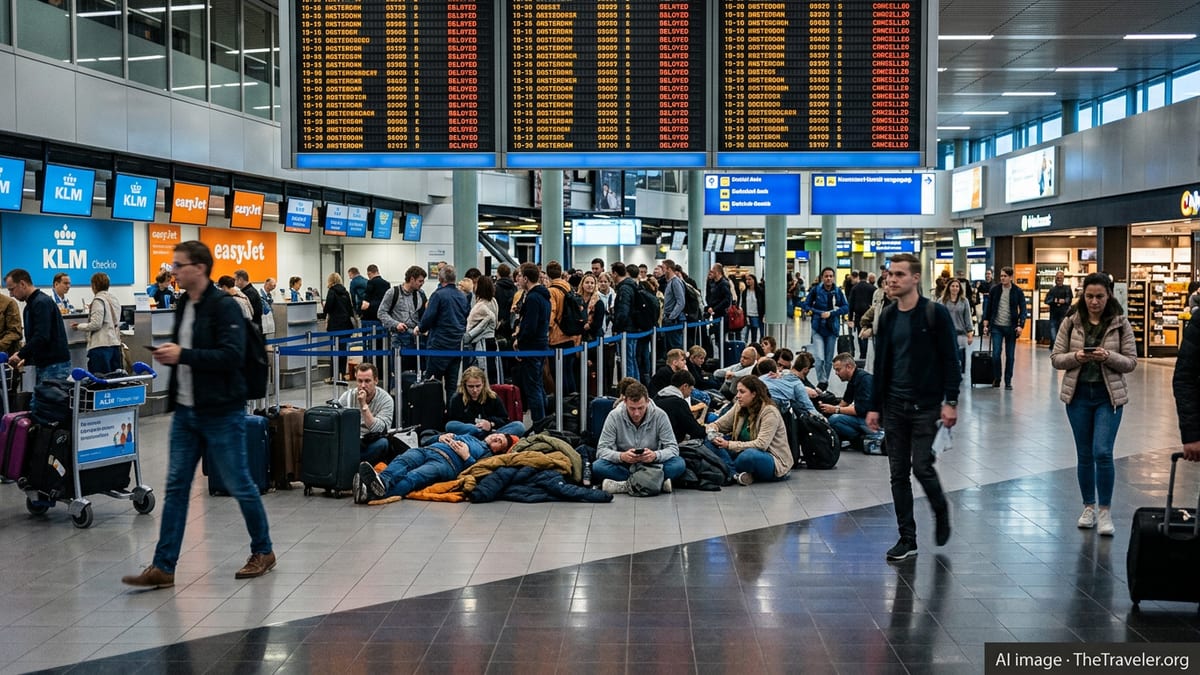
Airlines Warn of Unintended Consequences From EU261 Overhaul
The European Union has reached a political deal to overhaul its cornerstone air passenger rights framework, commonly known as EU261, with the revised rules expected to start taking effect from 2026 following formal approval and a transition period. According to publicly available information from EU institutions, the reform aims to modernize compensation thresholds, clarify rerouting duties and extend protections in areas such as baggage and assistance during major disruption.
Industry bodies, led by the International Air Transport Association (IATA), argue that the package risks going in what they describe as the wrong direction. In a series of position papers and joint letters submitted in 2025 and 2026, IATA and European airline groups caution that higher compliance costs and stricter service obligations could force carriers to cut capacity, especially at congested hubs, in order to manage financial and operational risk.
Recent estimates circulated by European airline associations suggest that the draft rules, taken together, could lift annual cost pressures on the sector by around 40 percent compared with today’s regime. While consumer groups dispute the scale of the impact, aviation analysts note that even a smaller increase in disruption-related expenses would likely push carriers to adjust schedules, thin marginal routes and become more conservative about operating in challenging conditions.
Observers point to the IndiGo scheduling crisis in India in late 2025, when new crew duty rules triggered thousands of cancellations in a matter of days, as a cautionary example of how regulatory shifts can cascade into large-scale disruption if airlines are forced to restructure operations quickly. Airline lobby groups say a poorly calibrated EU261 reform could produce similar effects in Europe if carriers respond by preemptively canceling flights whenever delay risks rise beyond predictable limits.
France, Germany and Spain at the Center of Connectivity Fears
Concerns are particularly acute in France, Germany and Spain, home to some of Europe’s busiest hub airports and most complex transfer operations. Public data from IATA and EU briefings show that these three countries anchor a large share of intra-European and long haul connectivity, with Paris Charles de Gaulle, Frankfurt, Munich, Madrid Barajas and Barcelona all functioning as critical transfer points.
IATA’s connectivity research has already highlighted relatively sluggish growth in some major European markets over the past decade, with Germany in particular showing weak expansion compared with global peers. Airline groups warn that imposing heavier compensation and rerouting liabilities on flights passing through these hubs risks further undermining their competitiveness, especially against non-EU hubs in the Middle East and Turkey that are not bound by EU261-style rules for most itineraries.
French, German and Spanish carriers have publicly argued that the current compromise on delay thresholds and new rerouting duties could exacerbate congestion during peak periods or in adverse weather. If airlines face significantly higher financial exposure for missed connections and long delays, they may respond by scheduling with larger buffers, reducing the number of daily rotations per aircraft and canceling more flights ahead of time whenever disruptions are forecast.
Airport stakeholders in the three countries have also raised alarms about knock-on effects on terminal capacity, staffing and slot coordination. If carriers increasingly opt to consolidate passengers from multiple lightly booked flights onto fewer services in order to limit compensation exposure, hubs could see more intense peaks and deeper troughs in activity, complicating resource planning for ground handling, security and border control.
New Rights on Rerouting and Information Could Drive Costs Higher
One of the most contentious elements of the reform is a reinforced right for passengers to be rerouted quickly when flights are canceled or severely delayed. According to recent consumer-facing summaries of the political agreement, airlines would in many cases be required to secure alternative transport within tight time limits, including on rival carriers, or reimburse passengers for self-booked alternatives up to a capped multiple of the original fare.
Advocacy groups welcome these changes as a long overdue correction to longstanding problems in the enforcement of existing EU261 rules, which already give travelers rights to rerouting and care in disruption scenarios. Passenger organizations have documented widespread cases in which customers were left to organize and pay for their own itineraries, sometimes waiting months for partial refunds or compensation.
However, airline economics specialists note that binding rerouting obligations, particularly at high-demand hubs, will be expensive to meet during major disruption such as air traffic control strikes, storms or knock-on delays from earlier rotations. If carriers must budget for purchasing last-minute seats on competitors or offering generous reimbursement for self-rebooking, they are likely to adjust schedules and fleet deployment to limit exposure, especially on thinner routes feeding into Paris, Frankfurt and Madrid.
The reform also tightens requirements on communication and claims handling, compelling airlines to provide clearer, earlier and more standardized information on rights and to respond to passenger complaints within set deadlines. While these provisions are seen as beneficial for travelers, airline groups describe them as another layer of administrative cost, arguing that the cumulative burden of the package encourages defensive operational behavior.
Risk of Preemptive Cancellations and Slot Turbulence in 2026
A key fear shared by industry associations is that the new rules may unintentionally incentivize airlines to cancel flights earlier and more frequently when there is a risk of systemic disruption, rather than attempting to operate and potentially incurring large compensation liabilities. Analysts describe this as a shift from “disruption management” to “risk avoidance,” in which carriers prioritize protecting balance sheets over maximizing the number of flights that eventually operate.
In practical terms, that could translate into more day-before or even week-before cancellations on routes feeding into major hubs in France, Germany and Spain during periods prone to weather or air traffic control instability. Travelers might receive earlier notice, but at the cost of reduced flexibility and fewer available alternatives, particularly for time-sensitive trips and long haul connections.
There are also concerns about how the revised regime will interact with Europe’s slot coordination rules. Recent guidance from the European Commission has already clarified that, in certain crisis situations such as widespread fuel disruption, airlines may benefit from “justified non-use” of slots without penalty. Observers warn that a stronger passenger rights framework, layered on top of more flexible slot usage rules in exceptional circumstances, could encourage airlines to concentrate cancellations on particular days or waves in order to manage compensation and operational complexity.
Hub airports in Paris, Frankfurt, Munich, Madrid and Barcelona could therefore face sharper peaks of disruption whenever large blocks of flights are withdrawn at short notice, followed by scramble periods as airlines attempt to re-accommodate passengers and reposition aircraft. Ground operations managers in these hubs will be under pressure in 2026 to refine contingency plans, staff reserves and communication channels in anticipation of more frequent, if better signposted, schedule upheavals.
Consumers Caught Between Stronger Rights and Reduced Capacity
Consumer organizations broadly welcome the political deal on EU261 reform, describing it in their own statements as an overdue strengthening and clarification of rules that have, in practice, often been difficult for passengers to enforce. The updated regulation is expected to codify several years of case law from the Court of Justice of the European Union and to close loopholes that allowed airlines to resist or delay compensation payments.
Yet passenger advocates also acknowledge the risk that some travelers could ultimately face a trade-off between more robust rights on paper and fewer flight options in practice. If airlines respond to the new framework by trimming networks, pulling marginal routes and avoiding tight connections through congested hubs, residents of smaller cities in France, Germany and Spain could see reduced connectivity and higher fares, even as protections improve when disruption occurs.
Public debate in Europe is now centering on whether the final legal text strikes the right balance between deterring poor operational performance and preserving the economic role of aviation. France, Germany and Spain, with their heavy reliance on hub-and-spoke models and their status as major tourist destinations and business centers, are likely to serve as early test cases for how the new regime functions in real-world conditions once it begins to apply in 2026.
For travelers planning trips next year, experts advise close attention to the final implementation timetable, airline schedule changes and the specific conditions attached to new rerouting and reimbursement rights. While the reformed EU261 promises clearer protections, the transition period may bring a bumpier ride through some of Europe’s busiest skies.