


More news on this day
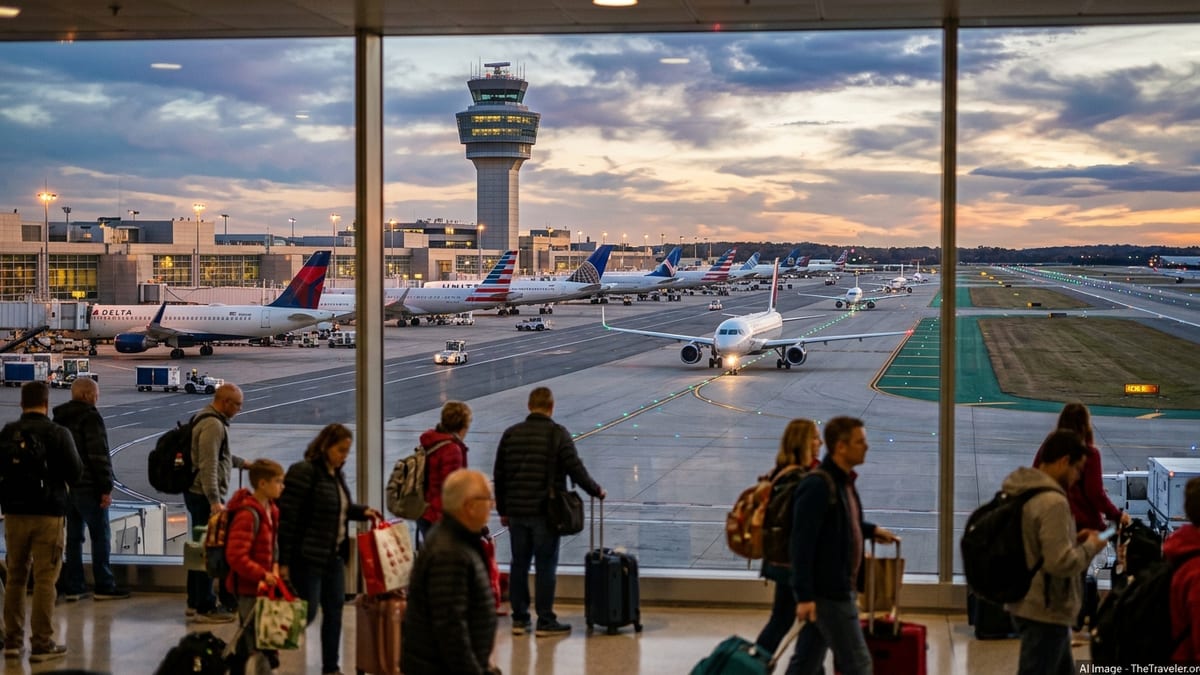
A new Federal Aviation Administration rule limiting when controllers can use the “line up and wait” procedure on runways came into effect on November 24, 2026, just as U.S. airports entered one of their busiest Thanksgiving travel periods, prompting concern that departures could slow at towers already struggling with staffing shortages even as the agency insists the change should not disrupt operations.
Get the latest news straight to your inbox!
What the new “line up and wait” rule changes
The policy change affects a standard air traffic control technique known as “line up and wait,” or LUAW, in which controllers instruct departing aircraft to enter a runway and hold in position while they sequence departures and arrivals. Under the updated rule, towers may now use LUAW only when a dedicated operations supervisor or controller in charge is on duty solely to oversee runway operations and is not simultaneously working another control position.
The requirement is laid out in an internal FAA notice, identified in industry reports as JO 7210.979, which took effect nationwide on November 24. The notice tightens language in the FAA controller handbook, which previously said aircraft should not remain in LUAW for more than 90 seconds without further instructions. The new directive effectively converts that guidance into a firm limit and links the use of LUAW to a minimum staffing configuration that includes a stand‑alone supervisory watch on the runway.
The FAA has described the change as a safety‑driven clarification intended to “elevate the safety standard” for LUAW operations by removing ambiguity about when the procedure may be used. The agency notes that LUAW can place aircraft on an active runway near potential crossing or arriving traffic, and that requiring a dedicated supervisor provides an additional layer of oversight at a time when several high‑profile runway incursions have drawn scrutiny to surface operations.
Why the timing matters for Thanksgiving travelers
The rule’s start date falls squarely in the middle of the 2026 Thanksgiving travel window. FAA planning figures shared with U.S. media forecast roughly 417,775 flights between November 23 and December 1, a volume that would make this one of the busiest holiday periods in 16 years. Trade and government forecasts also anticipate more than 80 million people traveling at least 50 miles from home over the wider Thanksgiving week, with a substantial share moving through major hub airports.
Those schedules come on top of a year in which airline and technology disruptions have already tested the system. In the week before Thanksgiving, a Delta automation issue affecting weight‑and‑balance calculations forced delays to hundreds of flights, while separate outages at other carriers and a FedEx runway overrun at Miami on November 25 contributed to congestion and temporary ground delays in some regions. None of those incidents were related to the new LUAW rule, but they have heightened public sensitivity to any additional source of delay.
Industry coverage notes that the LUAW notice went live only days before the peak travel days, with November 24 and 25 expected to carry some of the heaviest departure loads. Some air traffic controllers quoted in news reports and online forums say they were still digesting the implications of the staffing requirement as the holiday period began and that they expect to use LUAW less frequently when towers cannot free up a dedicated supervisor, particularly during overnight or leanly staffed shifts.
Staffing constraints and differing views on delay risk
Whether the new rule will translate into measurable delays remains uncertain. As of November 25, media outlets that tracked operations on the first full day of enforcement reported no confirmed, system‑wide disruptions directly attributable to the LUAW change. The FAA has said publicly that it does not expect the rule to affect airport capacity or departure flows, arguing that supervisors were already expected to provide focused oversight during complex runway operations and that towers can adjust procedures to keep traffic moving safely.
Front‑line controllers and some labor representatives have expressed a different concern. They point out that many towers, particularly during early morning, late evening and overnight periods, operate with tight staffing. In those conditions, supervisors often combine roles, taking on active control positions in addition to their oversight responsibilities. Under the new rule, a tower that cannot spare a stand‑alone supervisor may be required to stage fewer aircraft on the runway or avoid LUAW altogether, potentially stretching out the spacing between departures.
Long‑running staffing pressures provide context for those worries. The FAA’s 2026–2028 Controller Workforce Plan sets a target of 12,563 certified professional controllers, and reports indicate that as of April 2026 roughly 11,000 certified controllers were on duty, with about 4,000 more in training. Separately, a 2026 report from the Department of Transportation’s Inspector General found that staffing shortfalls persist at contract towers, even after efforts to tighten requirements and boost hiring. While those numbers reflect the broader system rather than any single tower, they underscore why some facilities may struggle to assign a dedicated runway supervisor at all times.
How the rule could affect departures at specific airports
The operational impact of the LUAW change is likely to vary significantly between airports. Large hubs with round‑the‑clock staffing and multiple supervisors on duty may be able to comply with the new requirement with limited adjustment, especially during daytime peaks when additional personnel are scheduled. At such facilities, controllers may continue to use LUAW extensively to keep departure queues moving, particularly on parallel runway systems designed to handle heavy traffic.
Medium‑sized and smaller airports, as well as towers operated under contract to the FAA, may feel the rule more acutely during off‑peak hours. Industry reporting ahead of Thanksgiving cited an example at Albuquerque International Sunport, where a tower controller told a Southwest Airlines crew that LUAW limits previously applied mainly on midnight shifts would now extend throughout the day once the new notice took effect. Similar comments from controllers at other fields suggest that, in practice, towers which had used LUAW to stage departures when staffing was tight could now need to hold aircraft short of the runway until both the runway and a standalone supervisor are available.
Weather adds another layer of complexity. The FAA and meteorological agencies warned of rain, wind and potential storms affecting the East Coast, parts of the Midwest and sections of the Gulf Coast during the holiday period. In poor visibility or with wet runways, controllers may already need to increase spacing between takeoffs and landings. If a tower under weather stress cannot staff a dedicated supervisor, it may have to rely on more conservative procedures that do not involve LUAW, which could slightly lengthen departure queues at affected times, even though no comprehensive data on that effect exists yet.
What travelers should watch for as the policy beds in
For individual passengers, the LUAW rule change is one of several factors that could influence departure times during the Thanksgiving rush and in the weeks ahead. Unlike a published schedule change or fare adjustment, the policy operates behind the scenes and is unlikely to appear on itineraries or booking confirmations. Travelers may simply experience it as a longer taxi‑out or a wait in line for takeoff when tower staffing, traffic levels and weather conditions combine in ways that limit the use of LUAW.
Because the extent of any delay effect is not yet documented, agencies and airlines are not advising specific booking changes in response to the rule alone. However, standard precautions remain advisable during busy periods when margins are thin. Passengers connecting through congested hubs may wish to allow extra time between flights, particularly on routes where afternoon and evening storms are forecast. Those with fixed‑time commitments at their destination, such as holiday meals or cruises, may prefer earlier departures that provide a buffer if takeoff queues lengthen.
Looking beyond Thanksgiving week, the FAA and oversight bodies are likely to monitor how the LUAW policy interacts with ongoing staffing initiatives, including a new program to standardize controller training and efforts mandated by the 2024 FAA Reauthorization Act to refine staffing models. If consistent, LUAW‑related delays emerge at particular airports, the agency could respond by adjusting tower staffing plans or clarifying further guidance. Until then, the rule remains a safety‑oriented change whose operational impact is still unfolding, and travelers should continue to pay close attention to real‑time airline and airport updates whenever flying at peak holiday times.