


More news on this day
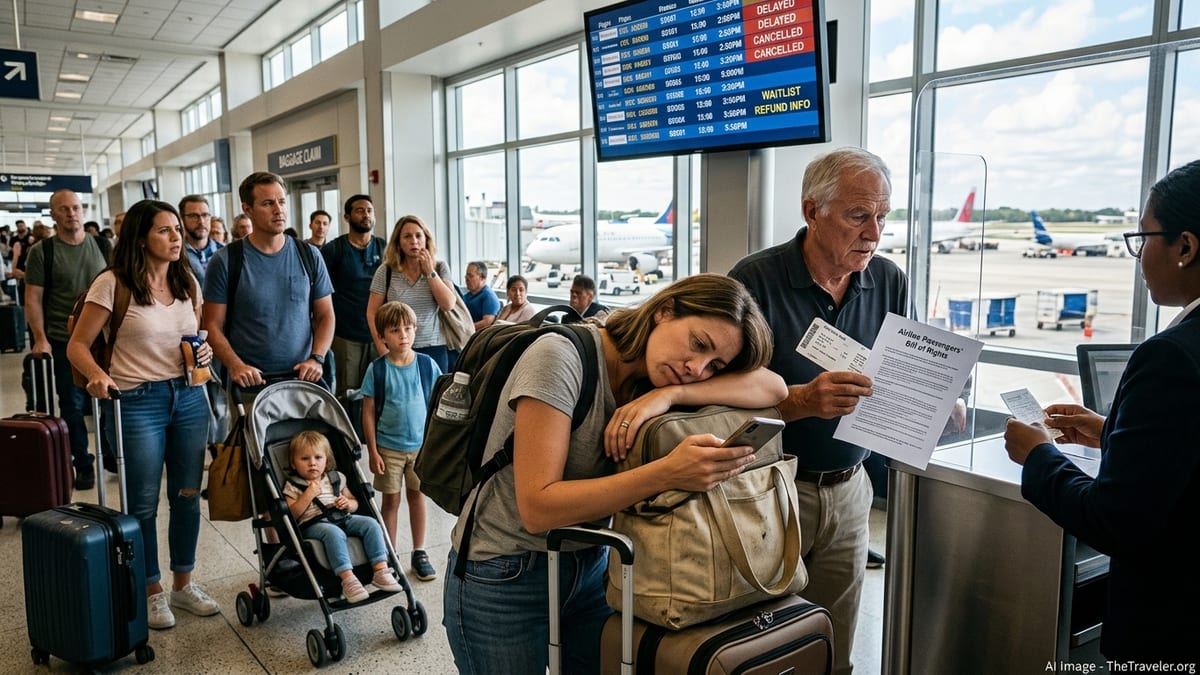
With U.S. holiday travel again marked by tech glitches, ground stops and crowded terminals, Oregon senators Jeff Merkley and Ron Wyden have swung behind a renewed push in Congress for an Airline Passengers’ Bill of Rights, a wide‑ranging proposal that would set national standards for compensation when flights are delayed or canceled, curb opaque fees and strengthen enforcement beyond existing U.S. Department of Transportation refund rules.
Get the latest news straight to your inbox!
What The New Proposal Would Do Differently
The latest Airline Passengers’ Bill of Rights, led by Senators Richard Blumenthal of Connecticut and Edward J. Markey of Massachusetts, has been reintroduced in the current Congress and is backed this week by Merkley and Wyden, who highlighted its relevance as millions of Americans travel for Thanksgiving. The bill aims to add protections that go beyond the U.S. Department of Transportation’s 2024 rules requiring automatic cash refunds when airlines cancel or significantly change flights and the passenger does not accept alternative travel. Supporters say those refund rules are an important baseline but do not guarantee additional compensation for lost time, stress or out‑of‑pocket costs when disruptions are within an airline’s control.
Under the proposal, airlines would be required to provide both a refund and defined compensation when a flight is delayed or canceled for reasons attributed to the carrier, such as crew scheduling problems or certain maintenance and IT failures. While the exact thresholds and amounts are laid out in the bill text, Blumenthal and Markey have emphasized a minimum cash payment of 1,350 dollars for passengers who are involuntarily denied boarding after a flight is oversold, matching the upper tier of current U.S. Department of Transportation bumping rules but converting it into a guaranteed cash sum rather than a multiple of the fare. For travelers, that would replace today’s often confusing mix of vouchers, mileage offers and variable payments at the gate with a single clear standard.
The measure would also require airlines to immediately refund checked baggage fees any time a bag is lost, damaged or not delivered within a set number of hours after arrival. That provision builds on an existing Department of Transportation rule, finalized in 2024, which already obliges carriers to refund bag fees when delivery is significantly delayed, but would harden and simplify the timelines and make refunds automatic rather than dependent on a customer claim. In practice, that would mean travelers whose luggage fails to appear at the carousel would no longer need to negotiate with customer service over whether a delay was long enough to qualify for a refund of the fee they paid to check the bag.
How It Fits With Current U.S. Passenger Rights
The Airline Passengers’ Bill of Rights is being debated against a backdrop of recent rule‑making by the Department of Transportation. Since May 2024, airlines have been legally required to provide automatic cash refunds when they cancel or significantly delay a flight to, from or within the United States and the passenger either refuses the changed itinerary or is not offered alternative transportation. The department has also defined, for the first time, what counts as a “significant change” for schedules and created new obligations around vouchers and credits in cases where travelers cannot fly because of serious communicable diseases. Those rules, which came fully into effect in late 2024, already cover situations in which a flight is severely delayed or canceled.
What they do not mandate is additional cash compensation on top of a refund, even when the disruption clearly stems from the airline’s own operations. In most such cases today, compensation for hotels, meals or inconvenience is governed by each airline’s customer service plan and is largely voluntary, although many carriers provide vouchers in extended delays categorized as within their control. The Blumenthal‑Markey bill is designed to close that gap by converting voluntary commitments into enforceable rights. It would also give passengers clearer legal recourse in disputes with airlines, including the ability to pursue certain claims in court that today are steered toward administrative channels at the Department of Transportation.
Another element of the proposal focuses on price transparency and so‑called “junk fees.” The Department of Transportation has already issued refund rules related to optional services that are paid for but not delivered, such as early boarding or Wi‑Fi that does not function. Lawmakers behind the Airline Passengers’ Bill of Rights want to go further by requiring airlines and ticket agents to disclose the full cost of travel, including common ancillary charges, upfront at the time of search and booking. For travelers, that would make it easier to compare the total cost of itineraries across different carriers, especially on routes where the base fare appears low but common add‑ons for seats, bags and changes can significantly increase the final price.
Why Senators Are Reviving The Push Now
Merkley and Wyden announced their support for the bill on November 24, 2026, as the U.S. entered one of the busiest travel weeks of the year. Their backing came just days after a string of high‑profile disruptions, including a Federal Aviation Administration network malfunction that triggered a nationwide ground stop and separate IT outages at Delta Air Lines and United Airlines that forced hundreds of delays. Those events added to holiday‑season congestion caused by storms across multiple regions, underscoring how quickly airline networks can become strained and how difficult it can be for passengers to secure timely assistance, rebooking and refunds.
Senators in favor of the measure point to data from the past two years showing persistent reliability problems. Federal statistics analyzed by independent outlets indicate that nearly one quarter of U.S. flights in November and December 2025 arrived at least 15 minutes late, a threshold the government uses to classify delays. At the same time, disruptions tied to airline‑related issues, including crew and maintenance problems and software outages, have accounted for a significant share of those delays at a number of airports. While weather remains a major cause of irregular operations, lawmakers argue that controllable disruptions are common enough to justify automatic, standardized compensation when they do occur.
Blumenthal, who has campaigned for tougher passenger protections since before the pandemic, has also cited past crises such as the 2022 Southwest Airlines scheduling collapse and the 2024 Delta Air Lines IT disruption to make the case that existing incentives are not strong enough. In both cases, the Department of Transportation launched investigations and, in Southwest’s case, ultimately imposed a record civil penalty for consumer protection violations. Proponents of the new bill say those after‑the‑fact enforcement actions, while significant, did not guarantee immediate relief to every traveler stranded at the height of the disruptions. Codifying clear per‑passenger payments, they argue, would both deter airlines from allowing such failures and simplify the path to compensation when failures nevertheless occur.
Key Provisions Affecting Comfort, Safety And Legal Rights
Beyond money and refunds, the Airline Passengers’ Bill of Rights touches on several issues that directly affect comfort and perceived safety on board. One section seeks to halt further reductions in seat size by instructing regulators to establish minimum standards for seat width and pitch that take into account emergency evacuation requirements and passenger health considerations. While the Federal Aviation Administration currently certifies that aircraft can be evacuated within established time limits, seat dimensions and legroom have gradually shrunk on many U.S. airlines as they have added more rows to cabins. The proposed legislation would effectively draw a line under that trend, preventing carriers from tightening layouts further without regulatory review.
The bill also proposes a set of baseline “humanity” standards during lengthy ground delays and onboard disruptions. These would formalize expectations around access to drinking water, functioning lavatories and adequate cabin temperatures, complementing existing three‑hour tarmac delay limits that the Department of Transportation began enforcing in 2010. At present, airlines can face substantial fines for keeping passengers on taxiways for more than three hours without an opportunity to deplane in most circumstances, but the quality of conditions on board during shorter delays is often governed by each carrier’s internal policies. Writing core service obligations into law would seek to ensure a consistent experience when delays extend far beyond scheduled arrival times.
Another significant piece of the proposal deals with passengers’ ability to bring complaints and claims against airlines. U.S. aviation law currently channels many disputes to the Department of Transportation’s consumer protection office, which can investigate and fine carriers but does not typically award individual damages beyond refunds that are already owed. The Airline Passengers’ Bill of Rights would restore or clarify travelers’ options to pursue certain cases in court, particularly when seeking compensation above a refund for out‑of‑pocket expenses linked to airline‑caused disruptions. For frequent flyers and consumer advocates, that aspect of the bill is as important as the compensation tables themselves, since it could change how airlines weigh the legal risks of failing to deliver promised services.
Prospects In Congress And What Travelers Should Do Now
The measure remains a proposal and has not yet cleared either chamber of Congress. Earlier versions introduced in previous sessions stalled amid partisan disagreements over the scope of federal regulation and opposition from airlines that argue mandatory compensation would increase operating costs and, ultimately, fares. Blumenthal and Markey are now betting that repeated holiday‑period disruptions and growing public frustration will give the idea new momentum in the 119th Congress. Merkley and Wyden’s endorsement adds to a bloc of Democrats who want to anchor stronger consumer protections in statute rather than rely solely on departmental rules, which can be revised by future administrations.
Even if the bill gathers additional co‑sponsors, it is expected to face intensive lobbying from the airline industry and will likely be debated alongside other aviation measures, including future Federal Aviation Administration reauthorization packages and ongoing rule‑making at the Department of Transportation. Any changes to seat size requirements or mandatory compensation would also need to be coordinated with safety regulators and possibly phased in over several years to give carriers time to adjust fleets and systems. For now, there is no set date by which the Airline Passengers’ Bill of Rights might receive a vote, and travelers booking tickets for the 2026 holiday season should not assume that the proposed compensation rules are already in force.
In the meantime, consumer advocates advise passengers to make full use of rights that already exist under current law. Those include automatic cash refunds when a flight is canceled or significantly delayed and the passenger declines alternative travel, refunds of bag fees when checked luggage is substantially delayed, and 24‑hour free cancellation for reservations made directly with airlines in most cases. Travelers are also encouraged to review their chosen carrier’s customer service plan before travel, since many U.S. airlines pledge meal vouchers or hotel accommodations during controllable disruptions even though they are not yet legally required to do so. If the Airline Passengers’ Bill of Rights advances, those voluntary commitments and the new legal standards are likely to be central points of comparison in the debate over what protections U.S. flyers should be able to count on as a matter of law.