


More news on this day
Thousands of flights across the United States are facing delays during the busy Thanksgiving travel period, as a powerful storm system sweeps both coasts and recent technology outages at major airlines and the Federal Aviation Administration continue to ripple through airline schedules.
Get the latest news straight to your inbox!
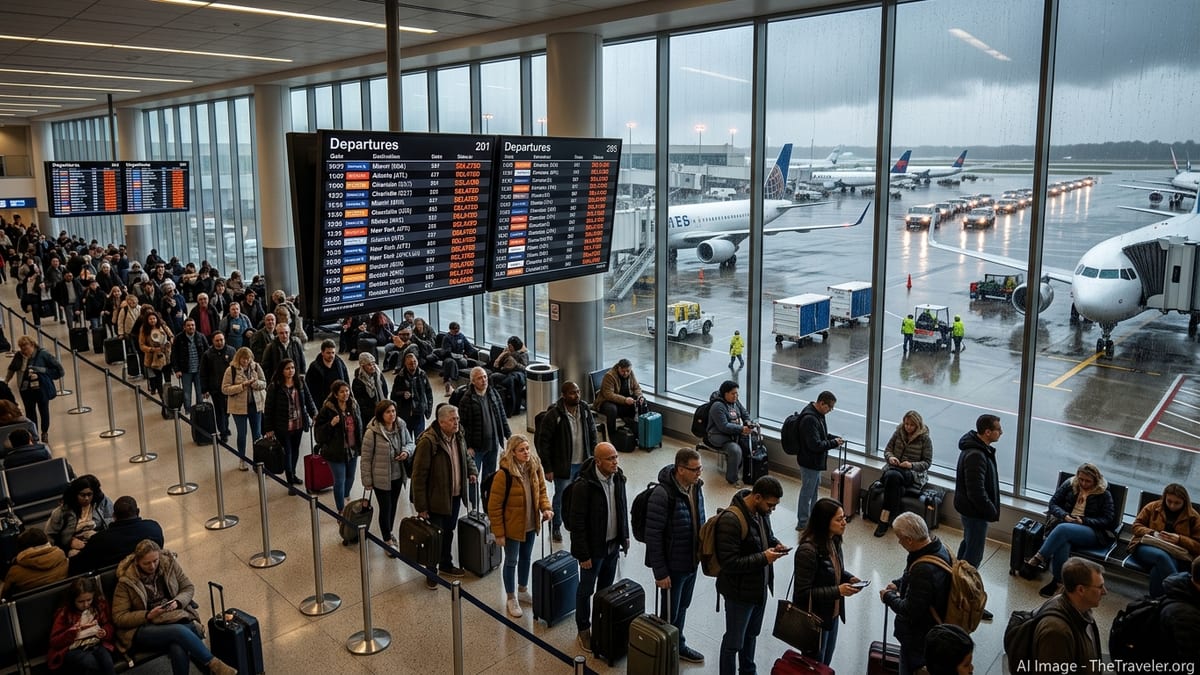
Current scale of delays and where disruptions are worst
Live tracking data on Thursday, November 26 shows several thousand flights within, into or out of the United States operating behind schedule, with delays far exceeding routine daily averages for this time of year. Public dashboards that aggregate airline and air traffic control data indicate that the number of delayed flights has climbed into the mid‑thousands by early afternoon, compared with the few hundred that would typically be expected on a quiet travel day. While exact totals fluctuate by the minute as flights depart and arrive, the impact is now clearly nationwide, affecting major hubs on the East Coast, in the Southeast and along the West Coast.
Although cancellations remain relatively limited compared with the number of delays, hundreds of flights have been scrubbed entirely as carriers adjust schedules around storms and temporary operational constraints. Travel authorities describe the situation as disruptive but not on the scale of a systemwide shutdown, noting that most large hubs remain open and operating even as they cycle through waves of long departure queues, diversions and in‑route holding patterns. The heaviest delays are being reported at airports under the core of the Thanksgiving storm system or along its trailing fronts, where low ceilings, heavy rain and strong winds are periodically reducing capacity on arrival and departure runways.
Miami International Airport is among the facilities under particular strain after a FedEx cargo jet overran a runway late Wednesday, temporarily closing all but one runway and forcing the airport to rely on a reduced configuration just as passenger volumes for the holiday peaked. Federal Aviation Administration updates overnight indicated that the incident contributed to hours‑long delays for some flights into and out of Miami, with knock‑on effects for connecting services around the country as aircraft and crews missed their originally planned rotations.
Weather system driving holiday disruption
The immediate driver of many of Thursday’s delays is a sprawling autumn storm system that has moved from the Gulf States into the eastern United States and off the Atlantic coast. Forecasts from the National Weather Service and the National Oceanic and Atmospheric Administration earlier in the week highlighted the potential for heavy rain, coastal flooding, mountain snow and strong winds to coincide with peak Thanksgiving travel from Wednesday through Sunday. That outlook is now playing out, with bands of rain and gusty winds sweeping from the Carolinas into the Mid‑Atlantic and Northeast, and a separate arm of the system bringing rain and higher‑elevation snow to parts of the Pacific Northwest and northern California.
In the East, aviation forecasters warned that low clouds, reduced visibility and crosswinds could periodically limit the number of takeoffs and landings airports can safely handle per hour. Major hubs flagged for potential delays include Atlanta, Charlotte, Washington, New York and Boston, all of which sit within zones that forecasters expected to see the worst of the wind and rain around Thanksgiving Day. On the ground, some states and cities have also taken precautionary measures, such as restricting high‑profile vehicles on bridges in high wind areas and alerting coastal communities to flooding risks, which in turn can slow access to airports and lengthen the total journey time for passengers.
On the West Coast, a separate series of Pacific storms is delivering heavy rain, rough surf and mountain snow, particularly in northern California and the Pacific Northwest. Weather agencies have issued advisories for large waves and coastal flooding in parts of California, which can complicate operations at airports near the shoreline and affect ground transport routes feeding those facilities. While the western storms are not producing the same level of publicity as the East Coast system, they are contributing to localized delays at airports like Seattle, Portland and San Francisco when low ceilings or strong crosswinds intersect with peak traffic periods.
Recent ground stop and airline outages add to strain
This week’s weather‑related disruption comes shortly after a series of high‑profile technology problems in the U.S. aviation system, which have contributed to a more fragile operating environment heading into Thanksgiving. On November 13, the FAA ordered a rare nationwide ground stop following issues linked to an air traffic system upgrade, briefly halting departures across the country. Although the stop lasted only a few hours, it generated widespread route‑wide delays and prompted airlines to reposition aircraft and crews for days afterward, leaving schedules more vulnerable to further shocks.
In the days that followed, two of the country’s largest carriers, Delta Air Lines and United Airlines, each reported separate technology outages that interfered with core operational systems. Delta was forced to halt flights to and from its Atlanta megahub for a period due to problems with an automated weight‑and‑balance calculation system, a critical component of safe flight dispatch. United reported its own network issues that slowed or temporarily halted operations at several airports. Both carriers have since restored normal operations and stated that the immediate outages have been resolved, but some passengers whose trips were disrupted during those events are still moving through the system this week on rebooked itineraries.
Industry data and federal oversight reports show that when significant ground stops or large‑scale airline outages occur close together, the impacts can combine with routine weather delays to create a more persistent pattern of disruption. Aircraft and crews that were displaced during earlier incidents may not yet be fully back in their optimal positions, leaving airlines with less flexibility to swap equipment or staff when storms flare along busy corridors. That dynamic appears to be at work this Thanksgiving week, where a mix of residual scheduling imbalances and active weather is translating into longer average delays even on routes that are not directly under severe weather warnings.
Passenger volumes near record levels despite challenges
Despite the operational difficulties, overall travel demand around Thanksgiving remains extremely high. AAA has projected that roughly 81.5 million people in the United States will travel at least 50 miles between Tuesday and the following Monday, including nearly 6 million air travelers. Federal transportation data and industry forecasts indicate that domestic airlines scheduled tens of thousands of flights across the holiday period, with some days approaching or surpassing pre‑pandemic records for the number of departures and seats offered.
Security screening statistics from the Transportation Security Administration show that passenger throughput has surged in the days leading up to Thanksgiving. On Wednesday, some of the longest reported checkpoint wait times exceeded an hour at major hubs such as Miami, while other busy airports including Newark in New Jersey and Portland in Oregon reported waits on the order of 30 to 40 minutes during the busiest waves. TSA officials have repeatedly urged travelers to arrive at airports earlier than they might during quieter periods in order to clear check‑in, security and any terminal‑to‑gate transport without rushing.
At several of the nation’s largest airports, the combination of high passenger volumes, weather‑related runway constraints and the need to manage residual effects of recent outages has produced noticeably longer queues both inside and outside terminal buildings. Some airports are using overflow areas for vehicle drop‑offs and expanding curbside staffing to keep traffic flowing. While these measures help prevent gridlock, they do not eliminate the risk of missed flights for passengers who have not built extra time into their journeys, particularly when security wait times spike unexpectedly or when last‑minute gate changes occur as airlines juggle arrival and departure banks around storms.
What travelers can expect over the next several days
Looking beyond Thursday, meteorological agencies and private forecasting services expect the current storm system to move gradually away from the East Coast while the Pacific storm train continues to send new disturbances into the West. Forecast products issued on Wednesday and Thursday indicate that rain and strong winds will persist into the post‑Thanksgiving period in parts of the Northeast and Mid‑Atlantic, potentially affecting some return flights over the weekend. In the interior of the country, forecasters are highlighting the risk of snow and freezing rain in certain regions, which could introduce new sets of delays or cancellations if conditions deteriorate near key Midwest hubs.
Flight operations for Friday through Sunday remain fully scheduled, and airlines have not announced broad preemptive cuts beyond route‑specific adjustments tied to aircraft availability and expected weather. Passengers with upcoming trips are being advised by airlines, airports and weather services to check their flight status frequently, use mobile apps or text alerts where available, and pay particular attention to the status of inbound aircraft for early‑morning departures, as overnight disruptions can cascade into the first bank of flights each day. Travelers connecting through Miami, Atlanta, Charlotte, New York and other major hubs exposed to the strongest weather bands should be prepared for the possibility of additional delays, even if their origin and destination airports are under clear skies.
For those still planning journeys this holiday week, practical steps can help reduce the risk of severe inconvenience. Booking longer connection windows, traveling with carry‑on baggage when possible to simplify reaccommodation, and monitoring government and airline alerts about evolving weather hazards can all improve the chances of reaching a destination close to the original schedule. Because the situation remains fluid, with both storms and residual technology impacts influencing operations, travelers should treat all forward‑looking information as subject to change and verify details directly with their airline before setting out for the airport.