


More news on this day
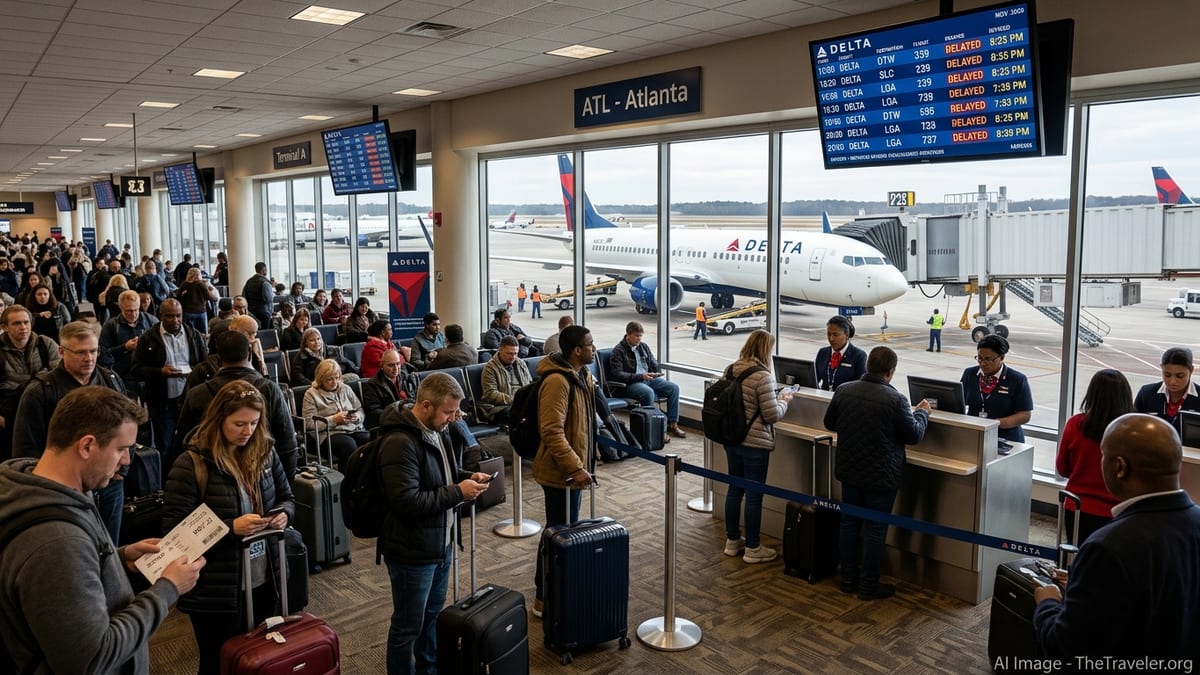
Delta Air Lines passengers at the start of the 2026 Thanksgiving travel period faced widespread delays after an outage in the carrier’s automated weight‑and‑balance system on Sunday, November 22, triggered ground holds at its Atlanta hub and disrupted operations nationwide, underscoring both airlines’ growing dependence on complex technology and how quickly a single failure can ripple through one of the busiest weeks of the U.S. travel year.
Get the latest news straight to your inbox!
What happened to Delta’s systems ahead of Thanksgiving
The disruption began on Sunday, November 22, 2026, when Delta reported a problem with one of its automated systems used to calculate aircraft weight and balance before departure. The carrier said the outage affected departing flights across its network, with the most acute impact at Hartsfield–Jackson Atlanta International Airport, Delta’s largest hub and the world’s busiest airport by passenger volume.
According to figures the airline shared with U.S. media, more than 1,600 Delta flights were delayed at some point on Sunday, representing roughly half of its schedule that day. Nearly 49% of all Delta services operated Sunday were delayed by at least 15 minutes, largely because dispatchers and crews had to perform weight and balance checks manually while engineers worked to restore automated tools.
Public data from flight tracking service FlightAware showed Delta accounting for a significant share of global delays on November 22, with several hundred more delays and cancellations reported into the evening. The Federal Aviation Administration confirmed that a ground delay program was implemented in Atlanta while Delta dealt with the outage, slowing departures there and contributing to congestion and missed connections across the network.
How quickly the problem was resolved and what the airline says
By the early hours of Monday, November 23, Delta said it had restored automation for weight and balance calculations and that the underlying system issue was resolved. In statements to several outlets, the airline said its “automation for departing flight weight and balance calculations” was once again functioning and that operations on Monday were “stable,” while acknowledging that crews were still working through residual disruptions from the previous day.
The carrier has said internally that about 70% of the delays and cancellations recorded for its flights on Sunday were directly linked to the automation failure, with the remainder attributed to weather and routine operational factors. Delta has not publicly detailed the exact technical cause of the malfunction beyond describing it as an outage affecting a critical weight and balance tool, and there is no indication from regulators that it was related to a cyberattack or external breach.
While Delta’s core system was back online by Monday, travelers continued to report scattered delays into Tuesday, November 24, as aircraft and crews remained out of position. Social media posts from passengers and crew described captains waiting for manual dispatch clearance on some routes and cautioned that, in practice, the workaround and catch‑up process took longer to normalize than formal statements might suggest, particularly at busy hubs such as Atlanta, Salt Lake City and New York’s LaGuardia.
Why this outage hit so hard during Thanksgiving week
The timing of the malfunction amplified its impact. The outage unfolded just as the U.S. holiday travel period was ramping up, with the American Automobile Association projecting more than 80 million Americans traveling at least 50 miles from home between Tuesday, November 24, and the Monday after Thanksgiving. Airlines had scheduled near-peak capacity for the week, leaving little spare aircraft or crew to absorb unexpected disruptions.
Industry data from the U.S. Bureau of Transportation Statistics show that late November and December are typically among the most delay‑prone months even in normal years, as winter weather, tight schedules and high load factors leave less room for recovery when problems arise. An Axios analysis of federal data found that roughly a quarter of U.S. departures and arrivals were delayed at least 15 minutes during the 2025 holiday season, highlighting how small disruptions can quickly cascade when flights are full and turnaround times are compressed.
This month’s Delta outage occurred within days of a separate, rare nationwide ground stop ordered after a Federal Aviation Administration network malfunction, as well as a recent system outage at United Airlines that also triggered hundreds of delays. Technology reporters have noted that, while such failures are still uncommon relative to the volume of daily flights, the concentration of several high‑profile outages in a short period has renewed scrutiny of aviation IT resilience, particularly when millions of travelers are on the move for major holidays.
What the Delta case shows about airlines’ reliance on automation
Weight and balance systems are essential for safe flight operations. Before each departure, airlines must calculate how passengers, baggage, cargo and fuel are distributed on an aircraft to ensure it remains within strict limits. For large carriers operating thousands of daily flights, these calculations are normally performed by integrated software that draws on reservation, cargo and fueling systems and then sends performance data to cockpit crews.
In Delta’s case, the outage did not involve the aircraft themselves but rather one of the automation layers that feed dispatch information to flights. Safety regulators emphasize that airlines retain manual procedures for performing these calculations if automation fails, and Delta’s response on Sunday reflected that fall‑back approach. However, reverting to manual methods at scale significantly slows departures, particularly at an airport like Atlanta where Delta routinely operates more than 800 daily flights and turnarounds are closely timed.
The incident also underlines how deeply embedded digital infrastructure has become in modern airline operations. Beyond weight and balance, carriers rely on complex systems for crew scheduling, maintenance tracking, airport resource management and passenger check‑in. Recent reporting on aviation IT incidents has pointed to aging legacy systems interfacing with newer automation tools, rapid software update cycles and the sheer complexity of global networks as contributing factors that can make occasional large‑scale failures more likely, even when safety is not compromised.
Implications and practical advice for Thanksgiving travelers
For travelers heading out for Thanksgiving between Tuesday, November 24, and the holiday weekend, Delta’s automation issue appears largely resolved, but its effects have not vanished entirely. Airlines and flight tracking services indicate that while Delta’s daily operation has moved closer to normal, some residual delays and isolated cancellations continue as aircraft and crews are repositioned. Weather across parts of the United States is also adding a layer of uncertainty at certain hubs.
Passengers flying with Delta or connecting through Atlanta in the coming days should treat their itineraries as workable but subject to change. Practical steps include monitoring flight status frequently through airline apps or airport displays, enabling notifications, and checking in online as early as allowed. Arriving at the airport earlier than usual is sensible during this period: around two hours before a domestic flight and three hours before an international departure, or longer at the very busiest times of day.
Travelers with tight connections, particularly those changing planes in Atlanta or other major hubs, may want to review alternative routings and later backup options in advance, especially if they are traveling on or around Thanksgiving Day itself. Although there is no indication of an ongoing system failure at Delta, the combination of residual knock‑on effects, high passenger volumes and seasonal weather means that schedules can still shift at short notice, and being prepared with flexible plans and essential items in carry‑on luggage can make it easier to adapt if further delays occur.