


More news on this day
Flight cancellations at Newark Liberty International Airport and Philadelphia International Airport fell sharply on Tuesday after a Federal Aviation Administration equipment failure triggered widespread disruptions across the Northeast a day earlier, according to published coverage and flight-tracking data.
Get the latest news straight to your inbox!
From ground stops to gradual recovery
Published reports indicate that an equipment outage on Monday at a Federal Aviation Administration air traffic control facility that manages traffic for both Newark and Philadelphia forced a temporary halt to many incoming flights. The issue, linked in coverage to problems with communications frequencies at the Philadelphia Terminal Radar Approach Control center, led to ground stops affecting Newark Liberty International Airport, Philadelphia International Airport and nearby Teterboro Airport.
Data cited in multiple news reports show that more than 1,000 flights were canceled nationwide on Monday, with Newark and Philadelphia among the hardest hit. Flight-tracking service figures referenced in those reports indicate that Newark alone saw roughly several hundred cancellations and diversions during the height of the outage, while Philadelphia recorded several hundred delays and more than 200 cancellations.
By Tuesday morning, coverage from outlets summarizing CNBC’s reporting indicated that normal operations were largely restored, with only residual disruptions remaining. FlightAware data referenced in network and local news reports showed that early Tuesday activity at Newark included several dozen delays and under 100 cancellations, a marked reduction from the levels seen during the outage.
Philadelphia International also showed improvement, with local coverage drawing on FlightAware figures to note that delays and cancellations continued but at lower volumes than on Monday. Airport operations were described as returning closer to a standard schedule as the affected FAA systems were brought back online and airspace constraints were eased.
What caused the disruption
According to news coverage that drew on FAA public statements, the chain of events began with an equipment failure in a communications system serving the Philadelphia air traffic control region. Reports attribute the outage to damage affecting both a primary circuit and a backup line, which in turn disrupted the flow of crucial data used to guide aircraft in and out of the busy Northeast corridor.
Because the affected air traffic facility manages approach and departure services not only for Philadelphia but also for Newark and other airports in the region, the technical problem quickly translated into restrictions on arrivals and departures. To maintain safety margins, flights bound for Newark, Philadelphia and several nearby airports were held at origin points or rerouted, and some en route aircraft were diverted to alternate destinations.
Coverage based on FAA updates indicates that technicians worked through Monday to restore service to the impacted systems. Once communications stability was confirmed, the agency began lifting ground stops and gradually increasing arrival and departure rates, allowing airlines to restart more of their scheduled operations into both Newark and Philadelphia.
Industry analysts quoted in broader reporting on recent air traffic disruptions have highlighted how dependent modern schedules are on uninterrupted data and communications feeds. When a single node in the system experiences a prolonged outage, the resulting ground stops and flow restrictions can cascade across airlines and airports, especially in regions with dense traffic like the New York–Philadelphia corridor.
Impact on travelers and airlines
For travelers, Monday’s outage translated into missed connections, overnight stays and rebooked itineraries across the country. Flight-tracking dashboards cited in news stories showed that delays extended well beyond the immediate New York and Philadelphia region, as aircraft and crews that would normally pass through Newark and Philadelphia were held elsewhere or repositioned.
Published reports referencing airline statements note that major carriers with hubs or significant operations at Newark and Philadelphia issued waivers to give passengers more flexibility. United Airlines, which uses Newark as a key international hub, publicly outlined temporary change-fee waivers for affected travelers with trips scheduled between September 21 and September 23, allowing rebooking within the same cabin without additional charges on qualifying itineraries.
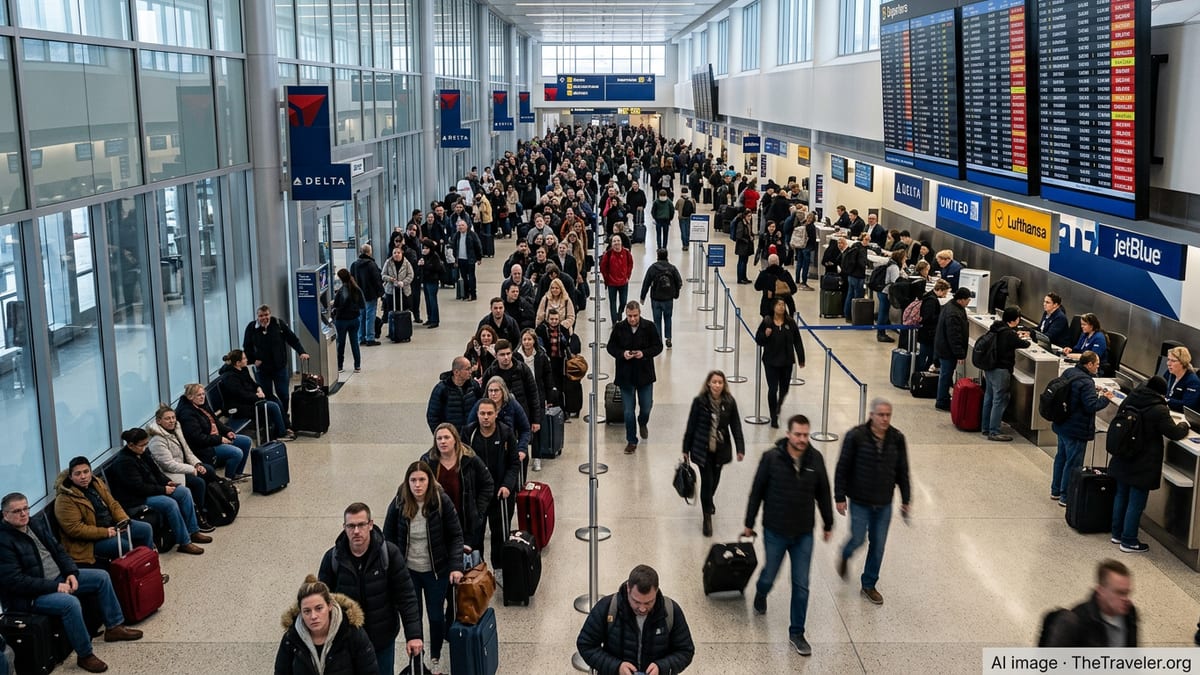
At Philadelphia International, local television coverage described lingering queues at ticket counters and customer service desks on Tuesday morning, as travelers whose Monday flights were canceled or heavily delayed sought new options. While the volume of same-day cancellations fell, some passengers experienced extended total trip times because of missed onward connections and limited remaining seat availability on peak routes.
The episode also added to operational pressure on airline staffing and aircraft utilization. When large numbers of flights are canceled in a short period, airlines must reposition planes and crews, adhere to duty-time rules and rebuild schedules for subsequent days. Reports summarizing airline and industry data suggest that this reconstruction process can take several days to fully normalize, even after the underlying technical issue is resolved.
How current disruption compares with past volatility
The sharp decline in cancellations on Tuesday drew attention in part because it contrasted with the sustained irregular operations travelers have seen in some past disruption events. During earlier periods of aviation strain, such as the busy travel seasons of 2022 and 2023, labor shortages, weather systems and air traffic control staffing issues sometimes led to elevated cancellation rates that persisted for multiple days.
Recent coverage notes that while Monday’s Northeast outage was severe, its cause was narrowly technical and geographically concentrated, which helped to limit the duration of the worst effects. Once the damaged circuits were repaired and system redundancy restored, traffic managers were able to raise arrival and departure rates at Newark and Philadelphia relatively quickly compared with more prolonged disruptions linked to widespread storms or chronic staffing shortages.
Flight performance statistics compiled by aviation data providers and referenced in public reporting show that both Newark and Philadelphia have historically recorded higher rates of delays and cancellations than some other large U.S. airports, in part due to airspace congestion and weather exposure. Against that backdrop, the rapid moderation in Tuesday’s cancellation counts is being seen as an indicator that, for this particular incident, recovery planning and system restoration were comparatively effective.
However, analysts cited in broader industry coverage continue to point out that the incident underscores ongoing vulnerabilities in the U.S. air traffic system’s aging infrastructure. The reliance on individual high-capacity facilities and critical communications circuits means that localized damage or failures can still cause regionwide disruption, even as technology upgrades and modernization efforts move forward.
What travelers should watch now
For travelers with upcoming itineraries through Newark or Philadelphia in the days following the outage, publicly available information from airlines and airports indicates that most scheduled flights are operating. Nevertheless, some residual delays may persist as carriers reposition aircraft and crews and accommodate passengers displaced by Monday’s cancellations.
Travel experts quoted across multiple outlets often recommend that passengers monitor flight status frequently, particularly after major operational events. Checking airline apps or departure boards before leaving for the airport can provide early warning of gate changes, rolling delays or last-minute cancellations that may still arise as schedules are fine-tuned.
Reports also note that travelers affected by Monday’s disruptions who have not yet rebooked or sought compensation options may still be eligible for certain accommodations, depending on carrier policies and the details of their tickets. While weather- or air traffic-related disruptions are typically categorized as outside airlines’ direct control for compensation rules, many carriers issue limited-time fee waivers or flexible rebooking windows in response to large-scale operational events.
As the autumn travel period approaches, industry coverage indicates that both airlines and regulators are likely to review the circumstances of the Philadelphia-area equipment failure and any lessons for redundancy and contingency planning. For travelers, the episode serves as a reminder that even on otherwise clear-weather days, infrastructure faults can rapidly reshape air travel plans, making flexibility and real-time information key tools for navigating the modern aviation network.