


More news on this day
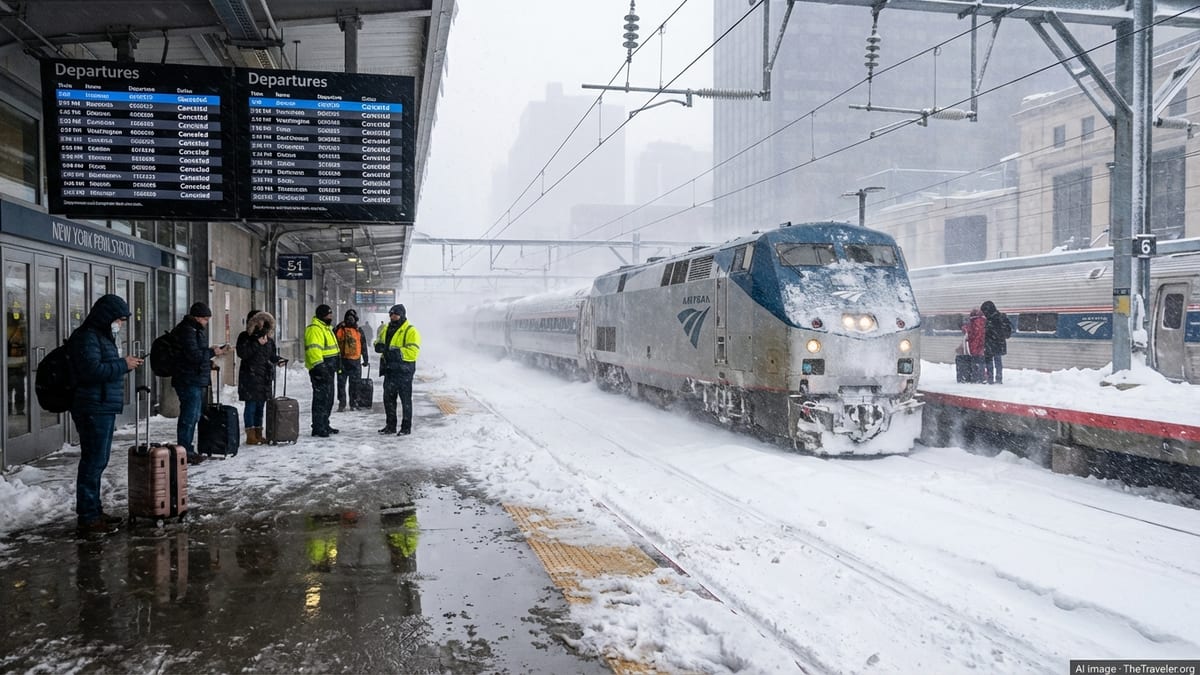
Last minute train cancellations with little or no notice are increasingly leaving passengers stranded at stations in Europe and the United States, according to recent reports and official data, spotlighting gaps between rail operators’ contractual terms and expanding passenger rights frameworks.
Get the latest news straight to your inbox!
Complaints Rise Over Short-Notice Cancellations
Across major rail markets, travelers are reporting cases in which scheduled services are cancelled shortly before departure, with limited information and few practical alternatives provided. Online passenger forums in 2026 highlight instances on intercity and long distance routes where trains were withdrawn after passengers had already arrived at stations or were en route, forcing last minute changes and, in some cases, overnight stays at personal expense.
In the United Kingdom, the Office of Rail and Road’s annual rail consumer report for 2025 to 2026 notes a continuing focus on how operators handle stranded train incidents and passenger welfare. The regulator reports hundreds of thousands of consumer complaints being handled by operators, with disruption and refunds remaining among the most frequent issues raised by rail users.
In the United States, Amtrak’s published conditions of carriage allow the company, in a force majeure situation, to cancel, divert or postpone trains without prior notice, limiting liability mainly to ticket refunds. Passenger accounts shared on public forums in 2026 describe cases where travelers were left in major hubs such as Washington, DC after overnight cancellations or rolling delays, with passengers relying on periodic app updates or station announcements rather than structured rebooking options.
Similar experiences are reported on European cross border services, where multiple operators and ticket vendors are involved. Reports from routes linking Amsterdam, Brussels, Paris and London describe passengers discovering cancellations only upon arriving at departure stations, especially when disruption follows serious incidents on the line or infrastructure failures, leaving them to seek last minute hotel rooms or alternative modes of transport.
Evolving Legal Frameworks for Rail Passenger Rights
In the European Union, Regulation (EU) 2021/782 on rail passengers’ rights and obligations sets out core protections for travelers whose services are cancelled or significantly delayed. The regulation requires railway undertakings to provide clear travel information before and during journeys and, when a delay of at least 60 minutes is expected at the final destination, to offer passengers a choice between reimbursement and rerouting, including on alternative routes where necessary.
Under the regulation, when arrival at the final destination is expected to be delayed by 60 minutes or more, passengers must be offered three options: reimbursement of the full ticket price, continuation or rerouting at the earliest opportunity, or continuation or rerouting at a later date convenient to the passenger. The rules apply regardless of the cause of the disruption, although there are exemptions and transitional arrangements for certain services such as purely domestic operations or historic and tourist trains.
A summary published by the European Commission in 2024 highlights further steps to make compensation and reimbursement easier to claim, including a standard form for rail passengers to use after cancellations or delays. Parliamentary briefings also emphasize that the obligation to inform passengers covers both pre journey information at the time of ticket purchase and real time updates during travel, whether via station displays, announcements or digital channels.
Despite these legal guarantees, recent analysis by transport advocacy groups notes that practice on the ground can diverge from the regulation’s intent. Complex ticketing chains, separate reservations on connecting services and differences between national enforcement bodies can all limit how quickly stranded passengers are rerouted, particularly when the cancelled train is part of a multi leg international journey.
New UK Measures Aim to End “Passenger Limbo”
In Britain, the government has announced a national “cancellation cover” scheme intended to reduce the number of passengers stranded when trains are withdrawn at short notice. According to a government news release in September 2026, from 20 September passengers whose trains are cancelled will be able to transfer to another operator’s service to complete their journey at no additional cost, rather than being required to buy a fresh ticket and seek reimbursement later.
The scheme is described as a way to end the “passenger limbo” that occurs when a service is cancelled close to departure and replacement services are run by different companies. It is designed to work alongside the National Rail Conditions of Travel, updated in July 2026, which state that passengers who do not travel because their train is cancelled or severely disrupted are entitled to a refund from the retailer of their ticket.
The reforms are taking place in parallel with wider structural changes to rail oversight. A planned passenger watchdog, outlined in a House of Commons factsheet on the Railways Bill, is expected to set service standards, investigate recurring issues with passenger experience and provide clearer routes for complaint escalation. Consumer regulators indicate that passenger welfare during disruption, including access to information, refunds and assistance, will be a core focus.
Nonetheless, the effectiveness of the new framework will depend on implementation at station level. For stranded travelers, the key questions remain whether replacement services are available in practice, how quickly staff can reissue tickets for alternative operators and how consistently the rules are communicated across the network during major disruption.
North American Policies Leave Gaps for Stranded Travelers
While the European Union and United Kingdom are tightening statutory rules, passenger protections on North American rail networks remain more heavily governed by operator terms and conditions. Amtrak’s public customer service commitments focus on providing quality onboard and station experiences, but the company’s formal carriage terms specify broad discretion to cancel services in case of severe weather, infrastructure problems or other force majeure events, even without advance notice.
Under these terms, the primary remedy for a cancelled train is a refund of the unused portion of the ticket or, in some circumstances, re accommodation on another Amtrak service. There is no overarching federal regulation comparable to the European rail passengers’ rights framework that would routinely require immediate rerouting on other carriers or the provision of meals and accommodation when passengers are stranded overnight because of cancellations.
Published passenger accounts in 2026 describe cancellations communicated through app notifications or last minute station announcements, sometimes after a series of rolling delays. Travelers report instances of arriving for early morning departures to find their train removed from the departure board, as well as multi day service suspensions on specific corridors where alternative rail options were limited and bus bridges or replacement services were not immediately evident.
consumer advocates note that the lack of uniform statutory rights can leave passengers facing out of pocket costs for hotels and onward travel when trains do not operate as scheduled. Unlike in some air travel jurisdictions, where written notices of rights must be provided following cancellations, rail customers in North America generally depend on each operator’s own policies and goodwill measures when no notice is given.
What Stranded Passengers Can Realistically Expect
For travelers caught by last minute rail cancellations, the level of support available varies considerably by region and by the type of ticket purchased. In countries covered by Regulation (EU) 2021/782, passengers holding a valid ticket for a cancelled or severely delayed service can normally insist on a choice between reimbursement and rerouting, and in some cases assistance such as refreshments and accommodation, although real world delivery may depend on staff training and capacity during major incidents.
In the United Kingdom, updated National Rail conditions and the 2026 cancellation cover scheme are intended to allow passengers whose trains are cancelled to board alternative services on different operators without extra ticket costs, while still preserving their right to a refund if they decide not to travel. Consumer bodies advise passengers to keep proof of disruption such as photos of departure boards and booking confirmations when making later claims.
In the United States, passengers on national services can usually expect refunds or travel credits when trains are cancelled, but should check the specific fare rules for restrictions. Assistance with hotels, meals or transfers is more limited in formal policy, particularly where the cancellation is categorized as beyond the operator’s control. Publicly available information suggests that travelers often need to arrange their own accommodation and seek any discretionary reimbursement later through customer service channels.
Across all markets, recent reports underline the importance of real time information. With many cancellations communicated through mobile apps and online trackers rather than personal contact, travelers are increasingly encouraged by regulators and consumer organizations to monitor service status shortly before departure, ensure contact details are up to date in booking systems and familiarize themselves in advance with the refund and rerouting options that apply if their train does not run.