


Nice Côte d’Azur Airport is the main gateway to the French Riviera, handling everything from early easyJet hops to Paris to summer long haul departures to New York and Dubai. If you are flying out of Nice, understanding how the terminals work, when to arrive, and what you will find after security can make the difference between a rushed sprint to the gate and a genuinely relaxed send off by the Mediterranean. This guide walks you, step by step, through a typical departure from Nice in 2026, with concrete examples covering check in, security, shops, food, lounges and boarding.
Get the latest updates straight to your inbox!
Know Your Terminals and When to Arrive
Nice Côte d’Azur Airport has two main passenger terminals: Terminal 1 and Terminal 2. Most full service and long haul airlines, such as Air France, Lufthansa, Emirates and Air Canada, currently operate from Terminal 2, while many low cost and European carriers, including easyJet and Norwegian, use both terminals depending on route and season. Your booking confirmation and boarding pass will clearly state “T1” or “T2,” and it is worth double checking on the morning of departure, as airlines occasionally move check in zones between the two buildings for operational reasons.
For timing, a safe rule for most departures from Nice is to arrive at the airport 2 hours before a European Schengen flight and around 3 hours before a non Schengen or long haul flight. For example, for an 11:00 easyJet flight to Amsterdam from Terminal 2, aim to be at the terminal around 09:00; for a 15:10 Emirates departure to Dubai, be in Terminal 2 by 12:00. At quieter periods, local residents frequently report sailing through security in less than 10 minutes, but during peak summer Saturdays, major events like the Monaco Grand Prix or Cannes Lions, or when the new EU Entry and Exit System creates extra passport checks, queues can stretch to 30–60 minutes. Arriving with a buffer gives you options if something unexpected happens at security or passport control.
Both terminals are on the same side of the airport road and are linked by a frequent free shuttle bus and by the coastal tram line that stops at “Aéroport Terminal 1” and “Aéroport Terminal 2.” If you accidentally get off at the wrong terminal, it is usually a 5 to 10 minute transfer to the other building, but if you are traveling at busy times with checked luggage, you do not want that extra stress. Check your airline and terminal the day before and again before you leave your hotel to avoid last minute surprises.
If you are connecting from a train at Nice Saint Augustin station or from the city tram, factor in a 10 to 15 minute walk to Terminal 1 and a few minutes more to Terminal 2, depending on your luggage and mobility. Taxis and ride hailing services can drop directly at each departure level, but at peak times near 08:00 to 10:00 and 17:00 to 19:00 there can be short traffic queues at the terminal forecourt, which is another reason not to cut your arrival time too fine.
Check In, Bag Drop and Fast Track Options
Check in at Nice follows the standard European pattern, with airline desks grouped by zone inside each terminal. In Terminal 2, for instance, Air France and SkyTeam partners typically use one area, while easyJet and other carriers use another. It is common to see self service kiosks and automated bag drop machines for major airlines such as Air France and easyJet, which let you print your own bag tags and hand luggage over in a dedicated lane. If you are flying to Paris for a same day connection, using these machines can easily save 10 to 15 minutes compared with waiting in the general check in queue.
Most airlines at Nice open check in approximately 2 hours before departure for European flights and up to 3 hours before for long haul services, though some early morning banks of flights use common check in areas that open as early as 05:00. As concrete examples, summer transatlantic flights to New York or Montreal often start check in around 3 hours before departure in Terminal 2, while a mid morning Lufthansa flight to Frankfurt might start around 2 hours prior. If you arrive much earlier than your airline’s desks open, you may find yourself waiting in the public departures hall with your luggage and limited seating, so there is little benefit in arriving 4 or 5 hours ahead unless you plan to work or relax at an arrivals side café.
Priority and fast track services are widely available in both terminals. Business and first class passengers, as well as many frequent flyer elites on airlines like Air France, Lufthansa or British Airways, typically receive dedicated check in counters and a fast track security lane marked on their boarding pass. In addition, Nice sells a paid “priority security” product that allows economy passengers to buy access to a separate, faster security line, bookable in advance for a fixed fee per person. This can be particularly useful on Friday evenings in summer, when holiday flights to London, Manchester, Copenhagen and Berlin leave in tight waves and security lines for standard passengers can grow quickly.
Families traveling with young children and passengers with reduced mobility will find dedicated assistance desks in each terminal. If you have mobility needs, it is worth requesting assistance at least 48 hours before departure via your airline so that airport staff can meet you at check in or even at the drop off zone and help you through to the gate. In practice, an elderly traveler flying from Nice to Brussels with wheelchair assistance can expect to be escorted directly to the priority security lane and then taken by buggy or wheelchair to the correct boarding gate.
Security, Liquids and Passport Control
Once you have dropped your bags, the next step is security, located on the departure level of both terminals. Nice generally has a reputation for reasonably fast security checks by European standards, and at off peak times it is not unusual to clear the scanners in 5 to 15 minutes. You place your coat, laptop, liquids bag and any large electronics in the trays and walk through a metal detector or body scanner. On busy mornings, queues in Terminal 1 in particular can build at the central checkpoint, so if you see a very long line, look for staff directing passengers toward additional lanes that sometimes open slightly around the corner.
Liquids rules at Nice follow standard European Union aviation security requirements. That means each liquid, gel or paste must be in containers of 100 millilitres or less, comfortably fitting inside a transparent resealable bag of roughly one litre. In practice, this covers your sunscreen for the Côte d’Azur sun, travel sized toiletries and small cosmetics. Local security staff are familiar with beach related items, but they will still require you to remove any large bottles of sun cream or perfume over 100 millilitres from your cabin bag. If you forget and try to bring a 200 millilitre bottle of facial cream you bought in the city, it will be taken at the checkpoint, so it is better to place such products in your checked luggage.
After security, the next step depends on your destination. For Schengen flights, such as to Paris, Rome, Barcelona or Amsterdam, you usually proceed directly to the departure lounge and gate area without passport control, since France shares open internal borders with these countries. For non Schengen flights, such as to London, Dublin, Istanbul or Dubai, you must clear exit passport control run by French border police. Passport booths are located just beyond security in each relevant concourse, and at peak times you may see separate queues for EU/EEA/Swiss passengers and for all other nationalities. In 2026, the new EU Entry Exit System is gradually being introduced, which means that on some routes passengers will be asked to use fingerprint or facial recognition kiosks on their first entry into the Schengen area, but for departures from Nice most travelers still experience a traditional passport stamp or electronic e gate.
Real world experience at Nice suggests that passport control is usually fairly quick outside a handful of busy waves. A British family leaving on a Saturday afternoon flight to London might wait 5 to 15 minutes to have passports checked, while an early morning London departure after several long haul arrivals can generate queues of up to 30 minutes. If you are connecting onward in London or another non Schengen hub, give yourself enough time to pass both passport control and the walk to the gate by arriving at the airport toward the earlier end of the suggested window.
Shops, Duty Free and Last Minute Purchases
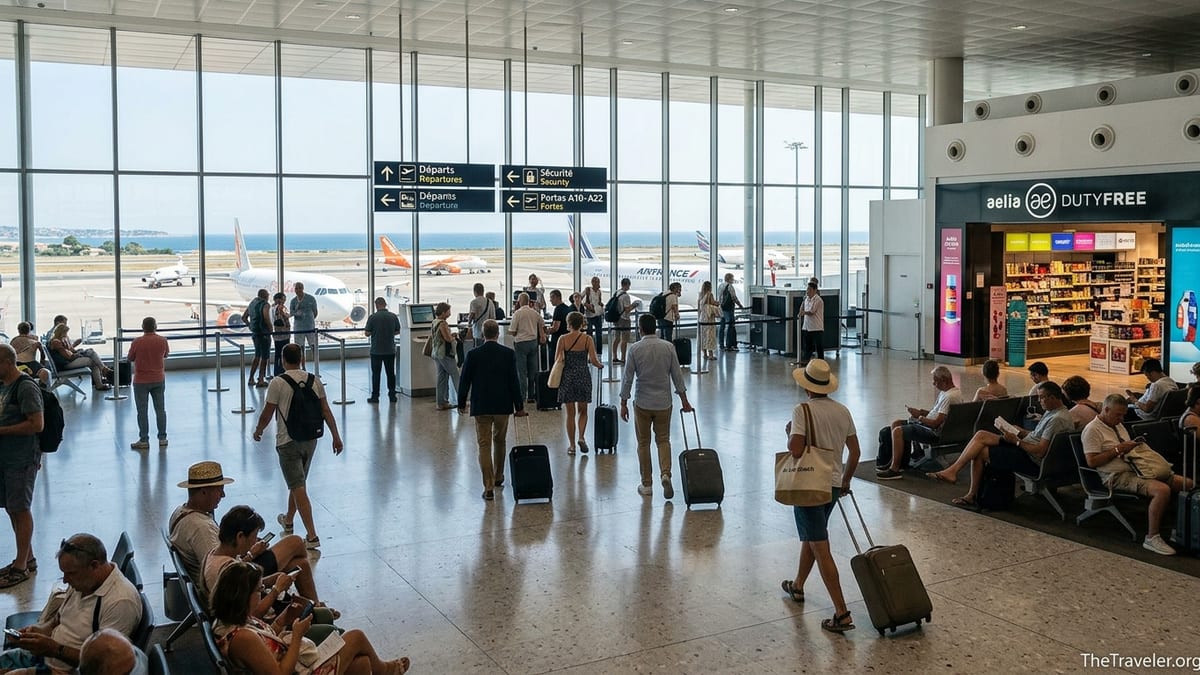
Once airside, Nice Côte d’Azur offers a mix of international brands and local Riviera boutiques. Both Terminal 1 and Terminal 2 have Aelia Duty Free stores positioned immediately after security, which stock a wide range of perfumes, cosmetics, skincare, wine, champagne, spirits, confectionery and travel retail exclusives. It is common to see French classics such as Chanel and Dior fragrance counters, as well as dedicated areas for regional rosé wines from Provence, olive oils and gourmet treats from the Côte d’Azur. Many travelers pick up a last bottle of Provençal rosé or a box of Calisson d’Aix as gifts while walking through these shops.
Beyond duty free, Terminal 2 in particular has a cluster of fashion and luxury boutiques in the departure lounge. Passengers will find brands like Hermès and Dolce & Gabbana, reflecting the affluent clientele that flies in and out of the Riviera. Prices generally match other major French airports, so a silk scarf or small leather good will cost similar to what you would pay at Nice city boutiques, but with the added convenience of being able to use duty free savings on some items if you are flying outside the European Union. For a more casual purchase, there are newsstands and convenience style stores selling books, magazines, snacks and travel essentials such as power adapters or charging cables.
One practical service many travelers do not know about is the airport’s shop and collect option at participating duty free outlets. With this, you can buy duty free items such as wine, spirits or beauty products before departure and leave them at the store to be collected on your return to Nice, avoiding having to carry heavy bottles through your entire trip. This can be particularly helpful if you are flying with hand luggage only to a short city break in London or Geneva and want to avoid checking a bag just for a few bottles of wine.
Prices for everyday items are in line with typical European airports. A paperback novel in a newsstand will usually cost around the same as in a city bookstore, while travel sized toiletries and headphones can carry a small airport premium. If you need a last minute swimsuit, sun hat or sunglasses before heading straight from your flight to the beach, some fashion outlets stock seasonal beachwear, though you will pay more than you would in a supermarket in Nice or Antibes. As always, if you plan major shopping, compare prices in the city before deciding whether to buy at the airport.
Food, Coffee and Lounges
Nice Côte d’Azur’s food offering is better than many regional European airports and reflects the local Mediterranean character. On the landside, before security, you will find café convenience concepts such as Chez Jean in Terminal 2, which combines coffee, pastries, sandwiches and basic groceries. It is a convenient stop if you arrive very early or are seeing someone off and want a quick espresso and croissant. Prices are typical for a French airport, with a coffee and pastry combination usually costing roughly the same as in a mid range café in central Nice.
Airside, both terminals include a mix of grab and go counters and seated restaurants. It is common to see French style brasseries offering salads, Niçoise specialities and hot dishes, alongside international options such as burgers, pasta and Asian inspired rice bowls. For instance, you might order a salade niçoise and a glass of local rosé in a Terminal 2 restaurant while watching aircraft movements through floor to ceiling windows, or pick up a jambon beurre baguette and bottle of sparkling water from a quick service counter if your boarding time is approaching. Vegetarian and gluten free options are increasingly labeled, though if you have strict dietary requirements you may prefer to eat in the city before arriving.
For a quieter and more premium experience, Nice has several lounges in both terminals. In Terminal 1, there is a main airport operated lounge used by multiple airlines and accessible to holders of certain credit cards and lounge programs. Terminal 2 has airline branded lounges such as the Air France lounge and independent spaces open to business class customers and eligible frequent flyers. Typical amenities include comfortable seating, a self service cold and hot buffet with French and international dishes, local snacks such as socca chips or tapenade spreads in rotation, a selection of wines including Provençal rosé and Champagne, beers, soft drinks and hot beverages. Wi fi, newspapers and device charging points are standard.
Access rules depend on the lounge. If you are flying business class on Air France to Paris or Amsterdam, or if you are a SkyTeam Elite Plus member, you can usually access the Air France lounge in Terminal 2 free of charge. Passengers flying economy on low cost airlines may purchase one time lounge entry at some facilities, either directly at the entrance or through common digital lounge passes, subject to availability and dress code. A typical stay might involve arriving at the lounge 90 minutes before a flight to enjoy a light meal, connect to wi fi and relax away from the busy main departure hall, which can be crowded during peak summer weekends.
Boarding, Gate Areas and Getting to the Aircraft
Boarding at Nice varies depending on your airline and destination. Larger aircraft such as wide bodies to Dubai or North America often use jet bridges directly from the terminal, while many European flights use bus gates. At a bus gate, you board a shuttle that takes you out onto the apron, then climb stairs up to the aircraft. This is very common for airlines like easyJet operating Airbus A320 or A321 aircraft, and it means you should allow a few extra minutes between the departure lounge shops and your gate, since the buses often depart shortly after boarding starts.
Gate areas in both Terminal 1 and Terminal 2 are generally bright, with good natural light and views of the runways and the Mediterranean in the distance. Seating is a mix of standard rows of chairs and high top tables with charging points at some newer gates. Information screens clearly show boarding groups and zones when airlines use them. For example, Air France often boards by SkyPriority passengers first, followed by zone numbers, while easyJet uses a group boarding system with Speedy Boarding called first. Listen for announcements in both French and English, since sometimes additional information about bus boarding order or gate changes is given only via the loudspeakers and not immediately updated on screens.
As a practical pattern, boarding for a typical European flight from Nice starts around 30 to 40 minutes before scheduled departure time. For instance, a 10:00 departure to London might begin boarding at roughly 09:25, with final calls around 09:50. Long haul flights may start boarding earlier, around 45 to 60 minutes before departure, especially if there are multiple cabin classes and families with children. When gates are bus boarding positions, standing near the gate when your group is called can help you secure overhead bin space near your seat on busy leisure routes where many passengers travel with large cabin bags.
Travelers with reduced mobility or families with strollers are usually invited to pre board. If you are traveling with a small child and a collapsible stroller, staff will normally tag the stroller at the gate and ask you to leave it at the bottom of the aircraft steps before boarding. On arrival, it is often returned either on the jet bridge or at the foot of the stairs, though on some routes it may arrive on the baggage belt. If this process is important to you, ask at the gate desk before boarding begins so there are no surprises when you land.
Realistic Timing Scenarios and Local Tips
To make the abstract timings more concrete, imagine a summer Saturday morning flight from Nice to London Gatwick at 09:45 from Terminal 2. If you arrive at the terminal by 07:45, you should find your airline’s bag drop already open. Check in and bag drop might take 10 to 20 minutes, security another 10 to 25 depending on queues, and passport control for the non Schengen departure perhaps another 5 to 15. In a typical scenario you would reach the duty free area by around 08:30 to 09:00, leaving you 30 to 45 minutes to grab a coffee, buy a snack and walk to the gate, which might be a 5 to 10 minute stroll away. If everything is unexpectedly quiet, you simply gain more time to relax; if there is a disruption, you still have a buffer.
By contrast, for a midweek winter afternoon flight to Paris from Terminal 1 at 16:30, with no passport control required because it is a Schengen route, you might comfortably arrive around 14:45 to 15:00. With online check in and cabin baggage only, a frequent traveler based in Nice might even cut that to 75 to 90 minutes, arriving at 15:00 to 15:15 and still usually making the flight, though this leaves little margin if security has an unexpected queue. First time visitors should stick to the standard 2 hour guideline rather than trying to copy the habits of locals who know the airport well.
Local travelers also advise paying attention to major events on the Riviera calendar. During the Monaco Grand Prix, Cannes Film Festival, and Cannes Lions advertising festival, the airport can be noticeably busier, both on leisure routes to northern Europe and on long haul flights catering to business travelers. Flights on the Monday after Cannes Lions, for instance, often see higher demand and more queues at late morning and late afternoon departures. If your trip coincides with one of these events, it is sensible to add an extra 30 minutes to your usual arrival time.
A final tip is to keep an eye on your gate even if you are settled in a restaurant or lounge. Gate changes are not uncommon, especially within Terminal 2, where several piers serve a mix of Schengen and non Schengen flights. On a typical day you might see a Paris flight moved from one end of the pier to the other with 40 minutes to go; if you only check the screens once at security and then bury your boarding pass in your bag, you risk heading to the wrong side of the terminal. Glance at the screens each time you pass one, and if you are sitting in a lounge, pay attention to the flight monitors inside, which usually update in sync with the main terminal displays.
The Takeaway
Departing from Nice Côte d’Azur Airport can be an efficient and even enjoyable experience if you understand how the terminals operate and plan realistic timings. For most travelers, arriving 2 hours before a European Schengen flight and 3 hours before a non Schengen or long haul flight provides a comfortable buffer for check in, security and passport control, without leaving you idle at the gate for half a day. Knowing which terminal your airline uses, whether your route requires passport control, and whether you have access to fast track or a lounge allows you to fine tune that window.
Once airside, Nice offers enough shopping, food and lounge options to fill the time without boredom, from duty free perfume and Provençal rosé to salade niçoise with a runway view. Boarding procedures are straightforward, though the mix of jet bridges and bus gates means you should pay attention to announcements and be ready to move when your group is called. With a bit of advance thought and an eye on the local event calendar, your departure from the French Riviera can feel like a smooth extension of your holiday rather than a stressful finale.
FAQ
Q1. How early should I arrive at Nice Côte d’Azur Airport before my flight?
For most European Schengen flights, plan to arrive about 2 hours before departure. For non Schengen or long haul flights, aim for roughly 3 hours, especially in summer or during major events.
Q2. How do I know whether my flight leaves from Terminal 1 or Terminal 2?
Your booking confirmation and boarding pass will show “T1” or “T2.” Most low cost European routes may use both terminals, while many full service and long haul airlines operate primarily from Terminal 2.
Q3. Is security at Nice Airport usually busy?
Security is often quite efficient, with off peak waits of 5 to 15 minutes. At peak holiday periods or during early morning and evening waves, waits can stretch to 30 minutes or more, so it is wise to keep a time buffer.
Q4. Are there fast track or priority security options?
Yes. Business and first class passengers and many frequent flyer elites receive priority lanes automatically, and there is also a paid priority security service available to economy passengers on participating flights.
Q5. What are the rules for liquids and hand baggage at Nice?
Liquids must be in containers of 100 millilitres or less, all fitting into a one litre transparent resealable bag, and laptops and large electronics should be removed from your bag at security unless staff indicate otherwise.
Q6. Are there good food options after security?
Both terminals offer cafés, quick service counters and sit down restaurants, with choices ranging from baguette sandwiches and pastries to salads, hot dishes and local Mediterranean style meals.
Q7. Does Nice Airport have lounges I can use if I am not flying business class?
Yes. In addition to airline lounges, there are independent or airport operated lounges that may be accessed with certain credit cards or lounge passes, or with paid entry subject to availability.
Q8. Can I do last minute shopping at the airport?
Nice has Aelia Duty Free shops in both terminals, plus fashion, accessories and convenience outlets. You can buy items like perfume, wine and local specialties, and in some cases use a shop and collect service for your return.
Q9. How long before departure does boarding usually start?
Boarding for most European flights typically starts 30 to 40 minutes before departure, while long haul flights may begin around 45 to 60 minutes before, particularly when multiple cabin classes are involved.
Q10. What should I do if there is a long queue at passport control for non Schengen flights?
Stay in the correct line for your nationality, follow staff directions and allow plenty of time. If your departure time is close, speak to an airport agent or your airline representative, who may be able to prioritize passengers on imminent flights.