


More news on this day
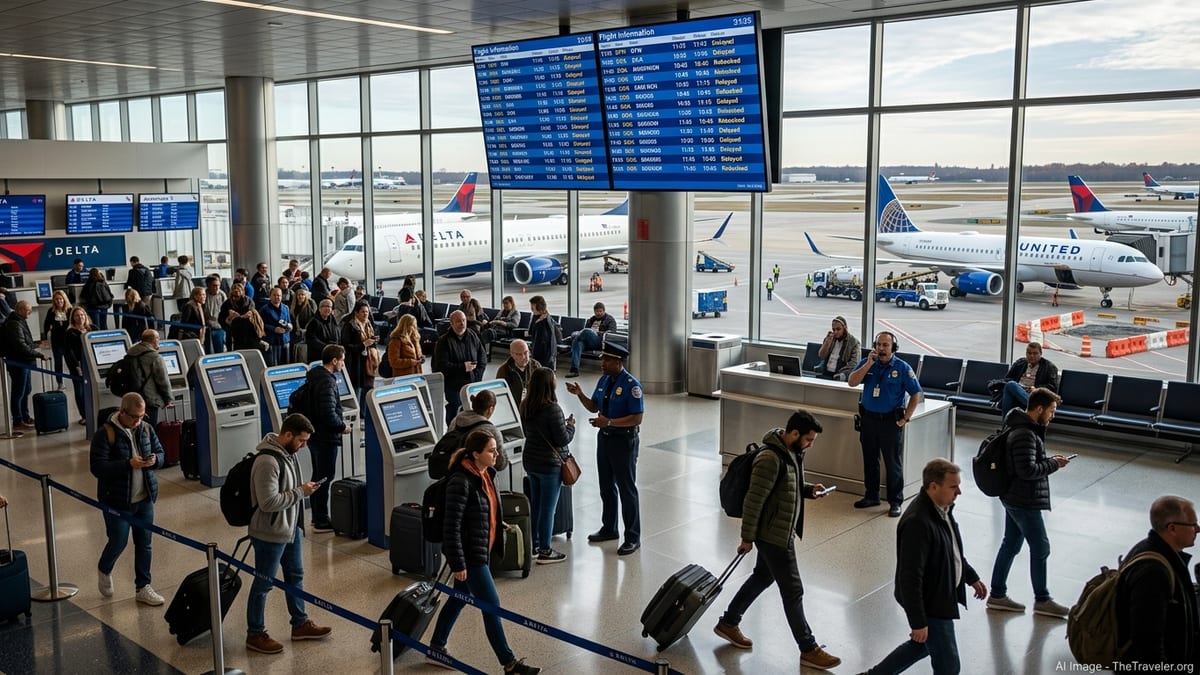
U.S. air travelers are not facing a new Federal Aviation Administration rule that will automatically disrupt flights at all airports from November 24, despite viral claims circulating online. Current information from the FAA, recent Federal Register filings and airline advisories shows no fresh nationwide regulation taking effect on that date, although existing temporary caps at some busy airports and the systemwide ground stop earlier in November continue to affect certain schedules.
Get the latest news straight to your inbox!
What Has Actually Changed In The National Airspace System
Recent disruption warnings for U.S. travelers are rooted not in a new rule starting November 24, but in two separate developments that have already taken place. First, the FAA ordered carriers in late 2025 to temporarily reduce scheduled operations at 40 high-traffic “High Impact Airports” to ease pressure on an overstretched air traffic system. That safety-driven order, later adjusted so airlines needed to cut planned domestic flights by 3 percent instead of 6 percent, remains a constraint at specific airports rather than a fresh, systemwide rule covering every field in the country.
Second, on November 13, 2026, the FAA imposed a rare nationwide ground stop after recently installed communications network equipment overloaded aging infrastructure, causing intermittent radar and radio issues. Operations resumed the same day, and the agency has since published a detailed explanation of the incident along with mitigation steps, including disabling certain router broadcast functions and adding safeguards to prevent similar data floods. While this event did cause days of knock-on delays for some passengers, it was a one-time outage rather than the start of a standing new operational rule.
Beyond those measures, the FAA continues to publish its routine updates to instrument procedures and airport operating standards in the Federal Register. These technical amendments, which become effective on various dates including in November 2024, are largely invisible to passengers and are described by the agency as having “minimal” economic impact. They fine-tune approach procedures, departure paths and chart data at individual airports instead of creating blanket restrictions that would trigger a broad disruption warning for all U.S. travelers.
How Airport-Specific Flight Limits Differ From A Nationwide Rule
The operating limitations at the 40 High Impact Airports are central to understanding current capacity constraints. Under an emergency order issued in November 2025 and later updated, certain airlines at these large, congested hubs must keep their total daily scheduled domestic operations between 6:00 a.m. and 10:00 p.m. below an agreed percentage of pre-capacity-cut levels. General aviation and most charter flights are restricted at some of these fields during peak hours, with exceptions for based aircraft, helicopters and urgent medical or emergency operations. The stated purpose is to relieve stress on the national airspace system and reduce the risk of serious runway and airspace incidents.
From a traveler’s perspective, these limitations can translate into fewer flight options, busier remaining departures and higher load factors during peak times at affected airports such as New York-area hubs, Washington, D.C., and other large markets. Airlines have adjusted schedules, retimed some services and, in a few cases, shifted flights to nearby secondary airports to remain within the caps. However, these are targeted safety and capacity measures. They do not amount to a rule that suddenly changes how every airport in the country operates on a single date like November 24, and they have been in place, in adjusted form, for months rather than emerging as a brand-new disruption trigger for the 2026 Thanksgiving period.
It is also important to distinguish these FAA requirements from airline commercial decisions. Carriers may cancel or consolidate services for their own operational or financial reasons, particularly around construction projects, aircraft delivery delays or staffing constraints. While such changes can compound the impact of FAA caps at busy airports, they are not mandated nationwide policy shifts and they vary by airline and route. Travelers seeing reduced options from a particular airport should therefore check whether their carrier has adjusted its own network rather than assuming a new across-the-board government rule is responsible.
Why Recent Outages Are Fueling Fresh Disruption Fears
The recent nationwide ground stop and separate airline technology failures are a major reason warnings about Thanksgiving air chaos have gained traction. In mid November 2026, a malfunction in new routers on the FAA’s telecommunication network led to unstable communications and radar data flows across several air route traffic control centers. As a precaution, the FAA halted departures nationwide until it could confirm that controllers retained reliable communications and surveillance coverage. The agency later noted that certain radio frequencies and radar feeds remained available, enabling it to safely manage aircraft already in the air, but thousands of flights experienced delays or cancellations while the system was stabilized.
Within days of that event, Delta Air Lines reported problems with an internal automated system used for aircraft weight and balance calculations. The issue prompted an FAA ground stop affecting some flights into the airline’s main hub at Hartsfield-Jackson Atlanta International Airport. Operations gradually normalized later the same day, but the disruption caused added delays and missed connections at one of the world’s busiest airports just as Thanksgiving travel ramped up. The episode followed other technology-related glitches at major carriers earlier in the week, amplifying concern among travelers that more systemic problems could resurface without warning.
For passengers, the practical effect is that some still see residual schedule changes, aircraft swaps and crew reassignments stemming from events earlier in November, especially at large connecting hubs and on tightly timed itineraries. Industry data for recent holiday seasons also show that about one quarter of U.S. flights in November and December typically arrive at least 15 minutes late, a baseline of disruption that can be made worse by storms or system outages. Yet neither the FAA nor the major airlines have announced a new standing rule set to automatically restrict operations at all airports beginning November 24. Instead, the risk lies in potential further technical or weather shocks hitting a network already running close to its capacity limits.
What Travelers Should Expect Around November 24 And Thanksgiving
By November 24, 2026, U.S. airlines and the FAA were already forecasting a very busy nine-day Thanksgiving travel period, with hundreds of thousands of domestic and international flights scheduled. Federal data and industry forecasts point to the highest holiday traffic levels in more than a decade, reflecting strong demand rather than a newly loosened or tightened federal rulebook. At the same time, meteorologists have warned of possible storms along the East Coast and in parts of the Midwest, conditions that can quickly trigger ground delay programs and localized ground stops unrelated to any new regulation.
Travelers can therefore expect a familiar mix of pressures: high passenger volumes at security and boarding gates; congested airspace around major hubs; and a heightened chance of knock-on delays when route-weather disruptions or localized equipment problems occur. The FAA’s Air Traffic Control System Command Center continues to issue real-time traffic management advisories for specific airports and regions, sometimes suspending preferred routing programs or briefly holding flights at origin airports during peak congestion or storms. These tactical measures are not new rules, but they directly affect departure times and connection reliability on a given day.
At the individual airport level, there are also numerous short-term closures and runway or taxiway restrictions linked to construction or maintenance. For example, some aerodrome notices temporarily close a runway at night or for part of a morning on a specified date, requiring airlines to adjust bank structures or reduce movements during the affected window. Such localized changes are common and are published through official notice systems that airlines and pilots monitor closely. They can cause delays or cancellations on the day they apply, yet they are far from the sweeping, indefinite nationwide shutdown implied by some online warnings about November 24.
How Passengers Can Check For Real Disruptions And Plan Ahead
Given the complexity of the current operating environment, it is reasonable for U.S. travelers to be cautious about possible delays when flying around November 24 and through the Thanksgiving period. However, planning around verified information is more effective than reacting to generalized social media alerts about a supposed new nationwide FAA rule. The most reliable day-of-travel indicators remain airline apps and websites, which reflect both regulatory constraints and each carrier’s internal operational decisions. Airlines receive official air traffic advisories and airport notices in real time and translate them into gate changes, revised departure times or, when necessary, cancellations and rebookings.
Passengers who want to monitor systemic issues can also consult publicly available FAA resources that summarize delays and ground stops at U.S. airports. These tools show whether specific fields are subject to holding programs, low-visibility restrictions or ground stops, and they identify the primary cause, such as volume, weather, construction or equipment problems. Because such programs are time-limited and tailored, their presence signals real, localized disruption rather than a standing, indefinite rule. Travelers can then adjust expectations for connections and consider backup plans, particularly when flying through historically congested hubs or in regions expecting severe weather.
Looking ahead, the FAA continues to work through long-term safety initiatives, including new rules on safety management systems, runway incursion risk studies and airport surface technology deployments. Some of these measures may eventually influence how traffic is metered at certain airports or how quickly operations recover after an incident, but they roll out through formal rulemaking and public notice rather than appearing suddenly as an unannounced nationwide restriction on a single date. For now, there is no confirmed new FAA regulation taking effect on November 24 that would itself cause automatic flight disruptions across all U.S. airports. Travelers should instead focus on real-time operational updates, forecast weather and airline-specific advisories when assessing the likelihood of delays or cancellations on their own itineraries.