


More news on this day
Delta Air Lines says it has restored an automated weight-and-balance system that caused hours of delays at Hartsfield-Jackson Atlanta International Airport on Sunday, November 22, 2026, disrupting flights at the carrier’s largest hub at the start of the busy U.S. Thanksgiving travel period.
Get the latest news straight to your inbox!
What happened at Atlanta and how long it lasted
The disruption began on the morning of Sunday, November 22, when Delta experienced problems with an automated system used to calculate aircraft weight and balance data. The carrier asked the Federal Aviation Administration to hold some flights bound for Hartsfield-Jackson Atlanta International Airport while it worked on the issue, and the FAA initially implemented a brief ground stop for Delta flights headed to the airport before converting it to a ground-delay program to meter arrivals.
According to FAA advisories and local media reports, the delay program affecting Delta flights into and out of Atlanta started shortly after 8:20 a.m. local time and was lifted around 1:30 p.m., meaning the most acute operational restrictions lasted roughly five hours. During that window, many departures were held at gates while new performance data were generated, and some flights to Atlanta were held at their origin airports to prevent gridlock at the hub.
Flight-tracking data compiled on Sunday showed a sharp spike in delays across Delta’s network. One major tracker indicated that more than 1,000 Delta and Delta Connection flights were running late on November 22, with Atlanta seeing several hundred delayed departures and arrivals during the peak of the outage. While the formal arrival delay program ended early in the afternoon, the knock-on effects extended into Sunday evening as aircraft and crews fell out of position and the airline worked to recover its schedule.
Nature of the tech issue and how operations were restored
Delta has attributed the disruption to a fault in an automated system that provides weight-and-balance calculations needed before takeoff. Airlines rely on such tools to combine data on passengers, baggage, cargo, fuel loads and aircraft configuration into the performance numbers required for safe departures. When that automation fails, crews and ground teams must revert to slower, more manual procedures or wait for alternative electronic approvals, which can significantly slow pushback and taxi times.
In statements to U.S. media on Sunday afternoon and Monday, Delta said the underlying automation problem had been fixed and that operations were stabilized. The carrier indicated that the majority of delays and any limited cancellations on Sunday were directly tied to the automation system issue, while some additional disruption was caused by weather in parts of its network. By Monday, November 23, Delta described its operation as stable, although residual delays persisted on some routes as the airline fully repositioned aircraft and crews.
The Federal Aviation Administration emphasized that the delay program at Atlanta was requested by Delta and applied specifically to Delta and its regional partners flying into the airport from the contiguous United States. Other airlines at Hartsfield-Jackson were not subject to the same automation-related restrictions, although they may have experienced some secondary congestion as Delta managed its queues on ramps, gates and taxiways. There were no indications that air traffic control or airport infrastructure were affected beyond the temporary arrival flow controls tied to Delta’s request.
Scale of the disruption and impact on Thanksgiving travel
The outage struck at the start of one of the busiest travel periods of the year in the United States, as passengers began heading to and from family gatherings for the Thanksgiving holiday on Thursday, November 26, 2026. Hartsfield-Jackson Atlanta International Airport, which is Delta’s principal hub and one of the world’s busiest airports, was already expecting heavy traffic. The timing meant that even a several-hour automation failure had an outsized impact on travelers transiting Atlanta or relying on single-connection itineraries through the hub.
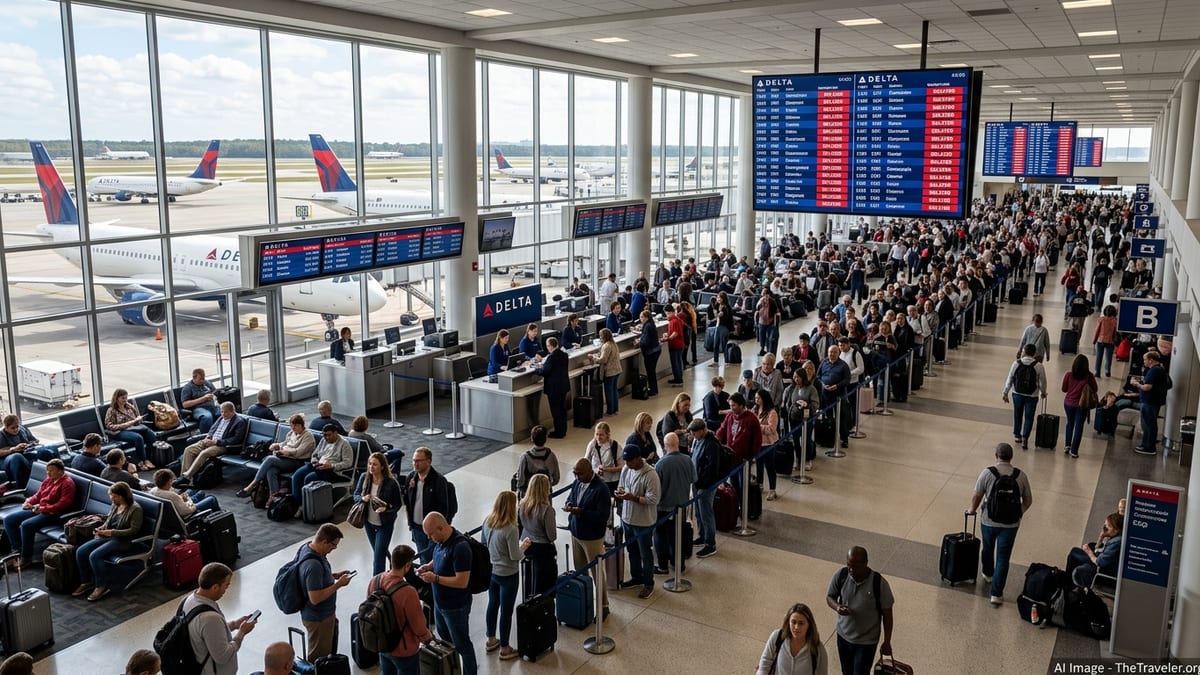
Throughout Sunday, Atlanta television outlets and national networks showed images of crowded gate areas and long customer service lines at the airport as passengers sought rebooking options, food vouchers or hotel accommodations when their connections were missed. Travelers posting on social media from airports including Atlanta, Detroit, New York and Boise described being told by flight crews that performance calculations were being handled manually or that they were waiting for updated weight-and-balance numbers before departure.
By Sunday afternoon, some flights that had been delayed by an hour or more were able to depart as the system came back online and Delta began clearing the backlog. However, the wave of delays created missed connections across the network, particularly for travelers with tighter layovers in Atlanta. On Monday, November 23, passengers at Hartsfield-Jackson reported that queues had shortened and that most departures were operating, but with some flights still departing later than scheduled as the airline continued its recovery.
How the Atlanta outage fits into a broader run of tech problems
The Atlanta disruption came shortly after a separate, unrelated technology failure had already put stress on the U.S. air travel system in mid-November. On Friday, November 13, a communications network problem affecting the Federal Aviation Administration led to a nationwide ground stop, disrupting tens of thousands of flights across multiple airlines and leaving airports managing crowded terminals and rolling delays into the weekend. Investigators have been examining telecommunications equipment as a potential factor in that earlier event.
In addition, the Delta outage is the second notable airline technology problem reported in roughly a week. In the days before the Atlanta incident, United Airlines experienced its own outage that briefly interrupted departures and caused delays across its system. Taken together, the recent episodes highlight how dependent modern airline operations are on complex, highly integrated IT systems for everything from flight planning and dispatch to baggage tracking and aircraft performance calculations.
For travelers, the cluster of technology-related issues has practical implications, especially during peak periods like Thanksgiving, Christmas and the New Year holidays. Even when a particular outage is limited to one carrier or one airport, the resulting schedule disruptions can ripple outward as aircraft and crews miss rotations, connections are broken and airport resources become strained. Travelers connecting through major hubs such as Atlanta can feel the effects for 24 hours or more after an underlying technical problem is declared fixed, simply because the operation takes time to rebalance.
What Delta customers should do next
Delta has advised customers affected by the automation system issue to check their flight status frequently using the airline’s website or mobile app, where same-day changes and rebooking options are typically displayed. For Sunday’s disruption, the carrier offered to work with customers whose travel was significantly affected to find alternative routings, including on later Delta flights. Fee waiver policies for this particular incident have not been universally detailed in public, so impacted travelers may need to contact the airline directly or review any alerts attached to their specific reservations.
Passengers traveling in the days following the outage, particularly those transiting Atlanta in the lead-up to Thanksgiving, are being encouraged by airports and airlines alike to allow extra time at departure airports. Even as Delta’s operation stabilizes, residual congestion at security checkpoints, check-in counters and gate areas can persist as the airline clears any remaining backlog and handles reaccommodated passengers. Allowing a longer layover in Atlanta, where possible, may reduce the risk of missed onward connections while schedules fully normalize.
Looking ahead, both Delta and federal transportation authorities are expected to review the circumstances around the automation system fault and the sequence of ground-stop and ground-delay measures at Atlanta. Those assessments typically inform updates to contingency plans, backup processes and communication protocols intended to keep future disruptions as contained as possible. For now, travelers with upcoming itineraries on Delta should rely on real-time flight status tools and any direct notifications from the airline to understand whether their specific flights are operating on time or require adjustments.