


More news on this day
Chicago O’Hare International has been named the most disrupted major U.S. airport for Thanksgiving travel between 2023 and 2025, with New York’s John F. Kennedy International ranked second in a new data study that highlights how vulnerable some of the country’s busiest hubs are to holiday delays and cancellations.
Get the latest news straight to your inbox!
What the new study found about Thanksgiving disruption
The latest ranking comes from a Nomad eSIM analysis of three recent Thanksgiving travel periods, covering 2023, 2024 and 2025. Using publicly available flight performance data, the company created a “Chaos Score” that combines factors such as the share of delayed and canceled flights, the average length of delays and the volume of passenger traffic. Although the Chaos Score is a proprietary index rather than an industry standard, it is grounded in federal on-time performance statistics and other operational data.
Across the three-year window, Chicago O’Hare International Airport emerged as the most disrupted major airport on Thanksgiving Day itself, with a Chaos Score of 96.7 out of 100. New York’s JFK followed as the second most disrupted, with a score of 72.66. Fort Lauderdale–Hollywood International, Detroit Metropolitan Wayne County and Dallas–Fort Worth International rounded out the top five worst performers. Other large hubs in the top ten included Orlando, Philadelphia, Miami, Newark Liberty and Minneapolis–St. Paul.
Nomad’s findings broadly align with independent reviews of federal data showing that O’Hare and several northern hub airports saw elevated disruption around the late November holidays, especially in 2025 when a significant winter storm hit the Midwest. However, other researchers who focus on the full week or month, rather than Thanksgiving Day alone, have reached slightly different rankings, underlining that results depend heavily on the time window and definitions used.
How Chicago O’Hare became the top Thanksgiving trouble spot
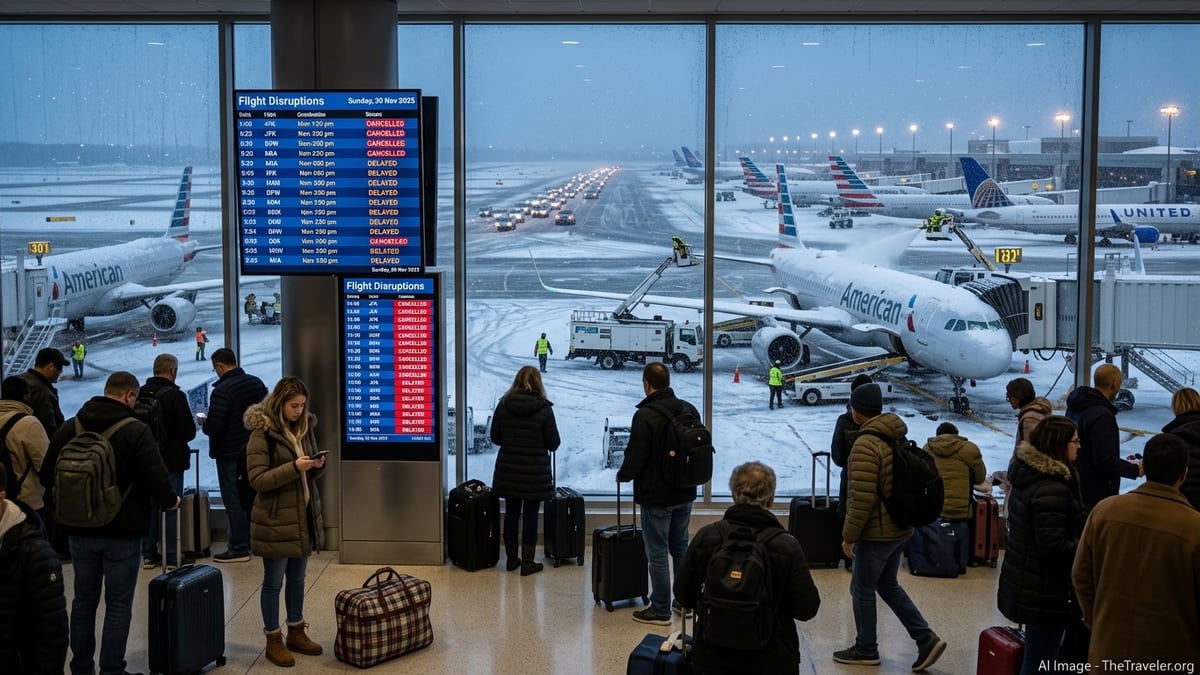
Chicago O’Hare’s position at the top of the list is closely tied to weather and network effects during the Thanksgiving 2025 period. On Saturday 29 November and Sunday 30 November 2025, when many travelers were returning home, a winter storm brought snow and wintry conditions to the Chicago area. Data compiled from flight tracking and federal statistics show that on 30 November 2025 around 86% of O’Hare flights experienced delays, with more than one in five cancelled altogether. Some analyses of the two days combined indicate that roughly 800 of more than 2,000 scheduled departures were cancelled, an unusually high level of disruption even for a busy hub.
Because O’Hare is one of the largest connecting hubs in the country, disruption there tends to spread quickly through airline networks. Reports at the time from flight-tracking firms and local media documented hundreds of delayed and cancelled flights across the Midwest and beyond as airlines worked through the weather-related backlog. For the 2025 Thanksgiving week as a whole, O’Hare’s on-time performance fell well below its normal November average, which heavily influenced its three-year Chaos Score in the Nomad eSIM ranking.
Importantly, the study focuses on historical performance rather than a forecast for 2026. While past issues at O’Hare, including the 2025 storm and earlier holiday weather events, highlight the airport’s vulnerability when conditions deteriorate, they do not guarantee similar disruption this year. Forecasts for this Thanksgiving period are being driven by current weather models, Federal Aviation Administration planning and airline scheduling decisions, which are separate from the retrospective Nomad analysis.
JFK’s Thanksgiving record and how it compares with other New York airports
New York’s John F. Kennedy International took second place in the Nomad eSIM list, but for different reasons. According to the report summary, JFK saw a notable spike in disruption on Thanksgiving Day 2025, with 51 flights cancelled and just over 23% of departing flights delayed. Average delays for affected flights reached about 75 minutes, and 183 flights were delayed by at least an hour. Those figures are substantially higher than JFK’s typical November performance, when a smaller share of flights experience long delays.
When measured across the three Thanksgiving periods from 2023 to 2025, JFK’s overall Chaos Score of 72.66 put it comfortably behind O’Hare but still well above many other large U.S. airports. The Nomad ranking also incorporated passenger feedback by examining Google review scores. Around 20% of JFK reviews in the dataset were one or two stars, and recurring traveler complaints focused on long queues, limited seating and difficulties getting timely information during disruptions.
In the New York region, Newark Liberty International Airport has historically had a reputation for congestion and delays, and other disruption-focused studies of 2025 place Newark among the more challenging major airports. In the Nomad Thanksgiving-only analysis, however, Newark ranked ninth, with a lower Chaos Score than JFK. That reflects, in part, that weather patterns and airline scheduling can hit nearby airports differently on a given day. It also underlines that Nomad’s list is specific to Thanksgiving Day, not a year-round assessment of reliability.
What broader data show about holiday-season punctuality
The Nomad eSIM ranking sits within a wider body of recent analysis on U.S. holiday air travel performance. An Axios review of more than 1 million flights using Bureau of Transportation Statistics data found that in November and December 2025, nearly a quarter of U.S. flights arrived at least 15 minutes late. The same analysis highlighted that Sunday 30 November 2025, the final day of the Thanksgiving weekend, was one of the most delay-prone days of the year, largely because of the same winter storm that walloped Chicago and other northern hubs.
Other independent tools that aggregate federal data present a somewhat more moderate picture for JFK itself over a longer run of holidays. One service that tracks disruption at individual airports estimates that over the five Thanksgivings from 2021 to 2025, about 7% of JFK departures were heavily disrupted, defined as an hour or more late, cancelled or diverted. That is slightly below JFK’s disruption rate in the surrounding weeks, suggesting that the airport’s performance on Thanksgiving is not consistently worse than usual, even though specific years such as 2025 stand out for elevated delay and cancellation levels.
There are also signs that conditions may be changing in 2026. Federal and industry forecasts indicate that nationwide Thanksgiving-week flight volumes are expected to exceed last year’s totals, and AAA anticipates that more than 80 million Americans will travel 50 miles or more from home over the holiday period. At the same time, the Federal Aviation Administration and airlines say they are applying additional traffic-management tools and contingency plans following a rare nationwide ground stop and separate airline technology outages earlier in November. Those efforts could help limit the spread of disruptions, but they cannot eliminate the impact of severe weather or technical failures at individual hubs.
Practical implications for travelers using high-risk hubs
For travelers booked through O’Hare, JFK or other airports that rank poorly in the Nomad eSIM analysis, the main takeaway is that past Thanksgiving periods have seen higher-than-normal risks of long delays and cancellations at these hubs, especially when weather or operational issues arise. The study itself does not recommend specific airlines or routes, but the pattern of disruption at large connecting airports suggests that passengers with tight connections should be particularly cautious about itineraries that rely on brief transfer windows through Chicago, New York, Detroit or Minneapolis around the holiday.
Travel industry guidance ahead of the 2026 holidays stresses many of the same tactics highlighted by Nomad’s marketing lead in the report. Checking flight status repeatedly before leaving for the airport, allowing extra time for check-in and security and monitoring the operating carrier’s app for same-day rebooking options can all reduce the impact of unexpected timetable changes. For those who must connect through a historically disruption-prone hub, booking earlier departures in the day can sometimes improve the odds of getting to the destination on the same date, because airlines have more remaining flights and seats to work with if an early leg is cancelled or heavily delayed.
Passengers concerned about potential disruptions can also consider building additional flexibility into their plans where possible. That might mean flying a day earlier or later than the busiest dates, opting for nonstop routes instead of connections where they exist at a reasonable fare, or choosing an alternative airport in multi-airport cities such as New York, Chicago, Miami or Dallas–Fort Worth. However, such changes are not practical for every traveler, and not all independent datasets agree that the same airports are always the worst performers, so decisions should be based on current-year schedules, weather forecasts and personal tolerance for risk.
What to watch as Thanksgiving 2026 travel unfolds
The Nomad eSIM Thanksgiving disruption ranking is a backward-looking snapshot, and travelers planning trips for 2026 should treat it as context rather than a prediction. Weather forecasts for the days around Thanksgiving, along with updates from airlines, airports and the Federal Aviation Administration, will be more important indicators of actual disruption risk in the coming week. Travelers with itineraries through Chicago O’Hare, JFK, Detroit, Minneapolis or other northern hubs may want to pay particular attention to storm systems forecast for the Great Lakes and Northeast, which have previously driven large spikes in holiday-week delays and cancellations.
Airports and airlines are, in turn, preparing for another very busy season. Some carriers have been adjusting schedules to add slack to operations, and major hubs have invested in additional de-icing capacity, snow-removal equipment and staffing for irregular operations. These measures can help mitigate, though not prevent, cascading problems when a single day’s disruption overlaps with the peak demand of a national holiday. The experience of 2025, when Sunday and Monday after Thanksgiving were far more difficult travel days nationally than Thanksgiving Day itself, is a reminder that passengers should look beyond a single date when assessing their own risk.
In practical terms, that means monitoring flights closely from the moment a ticket is booked through the completion of the journey, being prepared with backup plans for airport transfers and overnight stays and keeping contact information for airlines and travel agents easily accessible. Travelers who understand how their chosen airport has performed in past Thanksgiving periods, and who follow real-time information from official sources as this year’s holiday approaches, are better positioned to navigate any renewed turbulence at the country’s busiest hubs.