


More news on this day
Delta Air Lines says it has restored an automated system that calculates aircraft weight and balance, after a technical outage centered on its Atlanta hub delayed more than 1,600 flights nationwide on Sunday, November 22, just as the U.S. Thanksgiving rush was getting underway.
Get the latest news straight to your inbox!
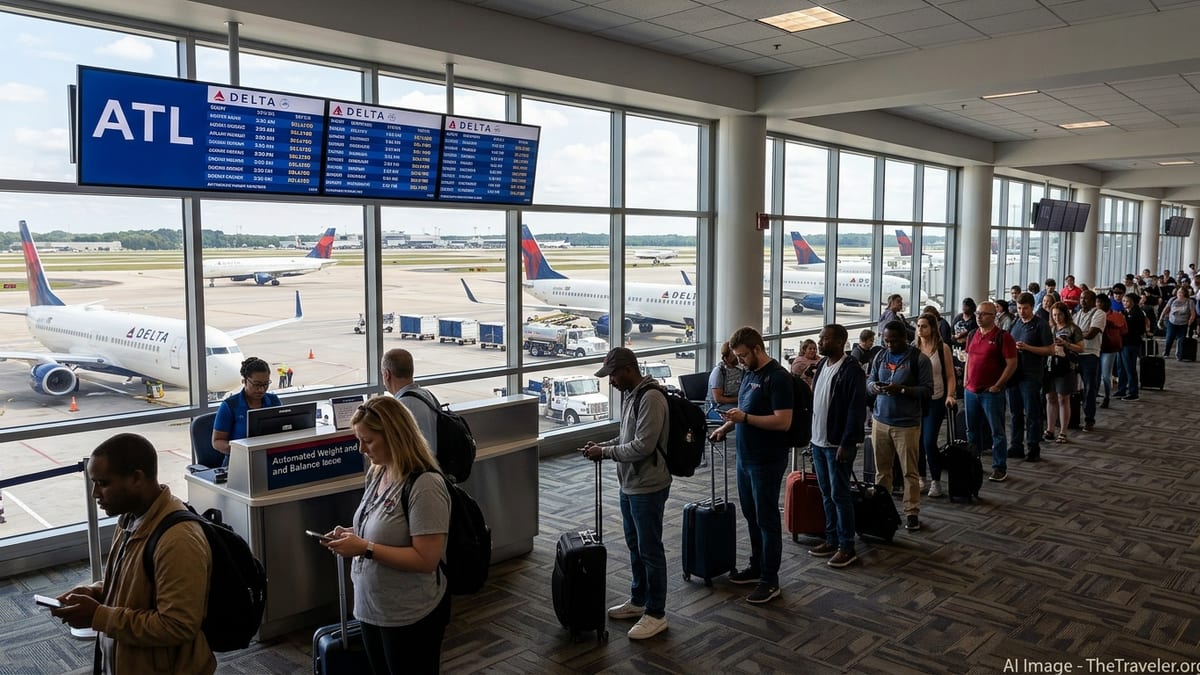
What happened to Delta’s operations in Atlanta
The disruption began on the morning of Sunday, November 22, when Delta reported problems with the automated system it uses to calculate each aircraft’s weight and balance before departure. That software supports performance calculations needed for safe takeoff, including fuel, passenger, baggage and cargo loads. With the system partially offline, crews across the network had to fall back on manual processes, slowing pre-departure checks and triggering a growing wave of delays.
Atlanta’s Hartsfield-Jackson International Airport, Delta’s largest hub and the world’s busiest airport by passenger traffic in many years, became the focal point of the outage. The Federal Aviation Administration briefly implemented a ground delay program specifically for Delta flights bound for Atlanta to ease congestion while the airline coped with the backlog. Although the technical issue originated within Delta’s systems, the combination of delayed departures and arriving aircraft waiting for gates affected operations more broadly at the airport.
By midday Sunday, flight-tracking data showed more than 1,300 Delta-operated flights delayed, a figure that later climbed above 1,600 as knock-on effects rippled through the schedule. The delays affected departures and arrivals nationwide, not only in Atlanta, because aircraft and crews scheduled to operate later segments were held up on earlier flights. Delta has said that about 70 percent of its delays and cancellations reported that day were directly linked to the automation problem, with the remainder primarily attributed to weather and other routine factors.
How long the outage lasted and when systems were restored
Delta first acknowledged the problem publicly on Sunday morning, citing an issue with its weight-and-balance automation. As engineers worked to diagnose and repair the affected systems, airport and air traffic management authorities temporarily slowed Delta-bound traffic into Atlanta to prevent gridlock on the ground. During the outage, flight crews and ground staff used what the airline described as manual workarounds to keep limited departures moving while waiting for the automated calculations to come back online.
Later on Sunday, Delta said the automation system had been restored and that performance calculations were once again being processed normally. Local television affiliates in Atlanta subsequently reported that the airline considered the technical issue resolved and that it expected to move the remaining delayed flights into the air by the end of the day, although recovery of the full schedule would take longer. Despite the system fix, many aircraft and crews were out of position, meaning residual disruption continued into Monday.
By Monday, November 23, coverage from Atlanta indicated that operations at Hartsfield-Jackson were stabilizing. Delta said its flight schedule was largely back on track, although travelers were still advised to expect lingering delays and irregular operations during the clean-up period. Independent reporting and airport observations suggested that while queues and gate areas were still busier than usual, conditions had eased significantly compared with the height of Sunday’s disruption.
Impact on travelers ahead of Thanksgiving
The timing of the outage magnified its effect on passengers. The system failure occurred at the start of one of the busiest travel weeks of the year in the United States, with airlines and transportation officials expecting Thanksgiving-period air travel to reach or exceed pre-pandemic highs. On Sunday alone, tens of thousands of Delta customers were on itineraries connecting through Atlanta and other hubs, and many of those journeys were disrupted by cascading delays.
Travelers reported extended ground holds, some of several hours, as aircraft waited for updated performance numbers before takeoff. In some cases, flights that had already boarded remained at the gate for long periods while crews awaited clearance to depart, only to be delayed further by congestion once taxiing. A smaller number of flights were eventually canceled when delays grew too long, forcing passengers to rebook onto later departures or alternate routings.
Delta said it was providing assistance to affected customers who required overnight accommodation or meal support and encouraged travelers to use its app and website to check the latest status of their flights and rebook where necessary. Given the high passenger volumes typical of the Thanksgiving period, rebooking options were more limited than on a routine travel day, and some travelers faced waits for the next available seats. The disruption added to an already challenging start to the holiday week following a separate nationwide ground stop ordered by the FAA earlier in November because of a telecommunications issue unrelated to Delta’s systems.
How this outage fits into a broader pattern of system glitches
The Atlanta incident was the latest in a series of technology-related disruptions that have affected air travel in the United States in November. Earlier in the month, the FAA imposed a rare nationwide ground stop on departing flights after equipment installation problems caused a communications failure in parts of the air traffic control network. Shortly afterward, United Airlines dealt with its own system outage that forced a temporary halt to some departures before operations were restored.
Although these events were not directly connected in technical terms, they have highlighted the aviation sector’s dependence on complex and often aging information technology infrastructure. In Delta’s case, the weight-and-balance automation that failed on November 22 is a critical safety and performance tool, but it also represents a single point where an outage can slow operations throughout the network. When such a system goes offline, even briefly, manual backup procedures can maintain safety but at a much lower throughput, quickly generating long chains of delays.
Regulators and industry groups have previously warned that both airline and air traffic control systems require ongoing investment to remain resilient as traffic levels grow. Recent disruptions have renewed attention on modernization programs, contingency planning and the need for robust redundancy in mission-critical functions such as flight planning, dispatch, baggage handling and performance calculations. For travelers, the immediate concern is less about the technical root causes and more about the practical consequences, from missed connections to extended time spent in crowded terminals during peak holiday periods.
What Delta passengers should do next
With Delta’s weight-and-balance automation now restored, the airline’s schedule is expected to normalize progressively through Tuesday, November 24, barring separate weather or air traffic issues. However, residual delays are still possible as aircraft and crews return to their planned rotations. Travelers booked on Delta in the days immediately following the outage, especially those connecting through Atlanta, should continue to monitor their flight status frequently and allow extra time at the airport.
Passengers whose flights on Sunday or Monday were delayed or canceled because of the system issue may be eligible for rebooking at no additional fare and, in some cases, hotel or meal support if they were stranded overnight. Specific accommodations and any flexible travel policies depend on Delta’s current customer service rules and any temporary waivers the airline has chosen to implement for this incident. Travelers seeking assistance should review their reservation details in the Delta app or contact the airline directly, keeping boarding passes, receipts and disruption notifications for potential use in claims.
Looking ahead to the remainder of the Thanksgiving period, Delta customers should treat the system outage as largely resolved but remain prepared for knock-on congestion and typical holiday pressures in terminals and at security checkpoints. Building additional buffer time into connections, traveling with essential items in a carry-on bag, and checking flight information repeatedly on the day of departure can help mitigate the risk of further disruption. While the airline is now operating with its key automation tools back online, the combination of seasonal demand and the lingering effects of Sunday’s delays means that conditions may remain tighter than usual for at least another day.