


More news on this day
A national strike by Belgian trade unions against Prime Minister Bart De Wever’s proposed austerity measures has brought passenger flights at major airports to a standstill and severely disrupted metro, tram and bus services in Brussels on Monday 23 November 2026, forcing tens of thousands of travelers to alter or cancel their plans.
Get the latest news straight to your inbox!
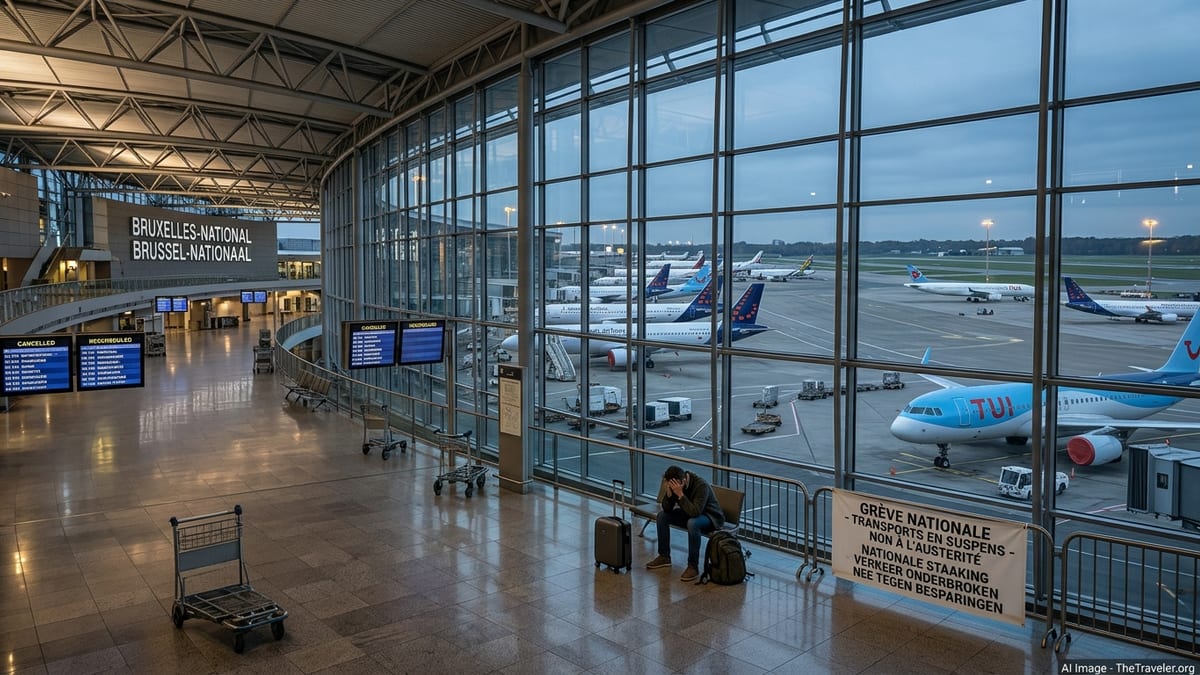
Air traffic largely suspended across Belgian airports
Passenger air traffic in Belgium is facing widespread cancellations on 23 November 2026 as air traffic control and airport staff participate in the national day of action against the De Wever I government’s socio-economic plans. According to notices issued ahead of the strike, Brussels Airport expected to suspend almost all scheduled passenger movements between approximately 07:00 and 21:00 local time after air navigation service provider Skeyes warned it could not guarantee safe, regular operations during the protest period. Airport communications indicated that most departing flights and a large share of arrivals would be cancelled or rescheduled, with exact figures varying by airline.
Regional airports are also heavily affected. Information released in the run-up to the strike indicated that Brussels South Charleroi Airport did not expect any normal commercial departures or arrivals on Monday, and that the strike would have a similar impact on scheduled services at other Belgian airports. Some cargo and diversion movements may still operate outside the peak protest window or under special arrangements, but these are the exception rather than the rule. Travelers who had planned to fly to, from or via Belgium on 23 November have generally been advised to assume that services will not operate unless their airline has provided specific written confirmation.
Airlines have responded by activating disruption plans that include automatic rebooking, change-fee waivers and, in some cases, refunds. However, the conditions differ by carrier and by fare type. As of the morning of 23 November, many passengers reported receiving cancellation notices only the day before or overnight as airlines adjusted to the final operational assessment from Skeyes and airport operators. Travelers already in transit have been particularly affected, with onward connections via Brussels that fall within the strike window frequently cancelled while long-haul inbound flights scheduled to arrive outside the most affected hours continue to operate.
Severe disruption to Brussels metro, tram and bus services
Within the Brussels Capital Region, local public transport operator STIB-MIVB confirmed significant disruption across its metro, tram and bus networks on 23 November. On its dedicated strike information page, the operator stated that the network would be “heavily disrupted” for the duration of the national demonstration. An initial forecast published ahead of the strike, and updated on the morning of 23 November, shows that only metro lines 1 and 5 are operating, providing an east–west backbone across the city but leaving large parts of the network without metro service.
Tram operations are also reduced. STIB-MIVB’s real-time traffic pages list only a subset of lines in service, generally focusing on high-demand corridors. Typical examples during national actions include lines linking major residential areas with key interchange points and hospital zones, although the exact combination of lines in service on 23 November is determined by which depots have sufficient staff available. On the bus network, only a limited set of routes are running, again concentrated on corridors where the operator can maintain at least a basic frequency. Even on the lines that are running, intervals can be longer than usual and short-notice interruptions remain possible.
The operator has emphasized that forecasts published the evening before a strike are indicative and that the definitive situation can only be confirmed on the morning of the action once staff availability is known. STIB-MIVB has therefore directed passengers to check real-time information through its website, mobile app and customer service before setting out. The company’s general transport conditions clarify that during strikes and demonstrations it cannot guarantee normal service levels and is not usually liable for wider consequential losses beyond the value of the disrupted journey itself, something travelers should be aware of if they are connecting to time-sensitive appointments or flights.
Rail and intercity transport impacts beyond Brussels
While urban transport in Brussels is heavily affected, the impact on national rail appears more limited in this particular day of action. Based on indications provided ahead of 23 November, no general strike notice was registered that would shut down the entire network of the national rail operator SNCB/NMBS. That contrasts with past nationwide actions in Belgium when trade unions also targeted the railways and long-distance services were extensively reduced or halted. On this occasion, rail services are expected to run closer to normal, although delays and cancellations remain possible if staff at certain locations choose to participate or if demonstrations near key stations require operational adjustments.
International rail links provide an alternative for some travelers affected by flight cancellations. High-speed connections such as Thalys-branded services and Eurostar routes linking Brussels with Paris, London, Amsterdam and Cologne are not at the center of the current protest but can still experience higher demand as passengers attempt to rebook their journeys. Seats on popular departures around the strike date can sell out quickly or become more expensive, and timetable adjustments remain possible if the strike indirectly affects staffing or infrastructure access. Travelers aiming to reroute via neighboring countries on 23 November are advised to verify availability before traveling to stations and to allow extra time for border and security checks where applicable.
Coach operators offering international routes from Brussels and other Belgian cities may also see increased demand. Larger European carriers have not announced systemwide cancellations linked specifically to the Belgian national strike, but their services can still be affected by local road closures or diversions around protest marches, especially in central Brussels where major boulevards are used as demonstration routes. As with rail, coach passengers should check departure locations, as temporary relocation of stops is sometimes used to avoid heavily disrupted central zones.
Political context and scale of the national demonstration
The transport disruption is part of a broader national demonstration called by Belgium’s main trade union federations in opposition to the De Wever I government’s planned austerity measures. Union communications and media reports describe the action as a protest against proposed budget cuts affecting pensions, healthcare, unemployment benefits and other elements of the social protection system. The demonstration in Brussels on 23 November includes a large central march through the city, with participants converging from across the country by coach and train.
The choice to target transport, and aviation in particular, reflects the unions’ strategy to maximize visibility and economic impact while remaining within the framework of legally notified industrial action. Earlier Belgian general strikes in the 2020s that focused on similar themes also led to major disruptions at Brussels Airport and to partial shutdowns of public transport systems in several cities. In parliamentary debates and official impact assessments about previous actions, Brussels Airport has estimated substantial revenue losses when multi-day strikes halted or significantly reduced flight operations, illustrating the leverage that coordinated industrial action can exert on policymakers.
For travelers, the political arguments are primarily relevant insofar as they shape expectations for further disruptions. Trade union leaders have indicated that 23 November is intended as a strong signal to the federal government during ongoing budget negotiations. Whether additional strike days or targeted sectoral actions follow will depend on how those talks evolve in the coming weeks. As of the morning of 23 November, no specific future dates for further nationwide transport strikes have been formally confirmed, but unions have not ruled out renewed action if they judge the government’s response to be insufficient.
Practical guidance for travelers caught up in the strike
Travelers in Belgium on 23 November face two main challenges: reaching or leaving airports in the absence of regular flights, and moving around Brussels with a sharply reduced public transport network. Those whose flights have been cancelled should first follow instructions from their airline, which is responsible for rebooking or refunding under European passenger rights legislation where applicable. Many carriers allow self-service rebooking via their apps or websites, but hotline wait times can be long on strike days. Passengers with urgent travel needs may wish to explore alternative routings via neighboring countries such as France, the Netherlands, Germany or Luxembourg, bearing in mind that cross-border trains and buses may also be busier than usual.
Within Brussels, STIB-MIVB advises passengers to consult real-time information rather than relying solely on prestrike forecasts of which lines will operate. Metro lines 1 and 5 provide the backbone of the limited service and are a useful first option where available. However, travelers should be prepared for crowded vehicles and possible queuing at stations, especially around the morning and late afternoon peaks when the demonstration attracts the most participants. For journeys not covered by the operating lines, walking or cycling can be practical alternatives in the compact city center, provided weather conditions allow and travelers are comfortable navigating around police cordons and large crowds.
Hotel guests and visitors with fixed appointments in central Brussels on 23 November should allow extra time to move between districts, as some streets may be temporarily closed for the main march and for smaller gatherings. Taxis and ride-hailing services can provide additional capacity, but they too can be delayed by congestion and diversions around demonstration routes. Travelers who must catch early-morning or late-evening international trains may wish to stay near major stations such as Bruxelles-Midi/Brussel-Zuid or Bruxelles-Central/Brussel-Centraal to reduce the risk that limited local transport prevents them from reaching their departure point.
Looking beyond the strike day itself, observers expect flights and local public transport to resume largely normal operations on Tuesday 24 November, although some residual delays and knock-on disruptions are likely, particularly for long-haul flight rotations and early-morning services as aircraft and crews reposition. Travelers with bookings on 24 November should monitor airline and operator notifications, as a small number of services may still be retimed or cancelled as schedules are rebalanced. For those planning trips to or through Belgium later in the year, it remains prudent to keep an eye on union announcements and government budget negotiations, since any escalation in the dispute could bring further episodes of disruption affecting airports and public transport.