


More news on this day
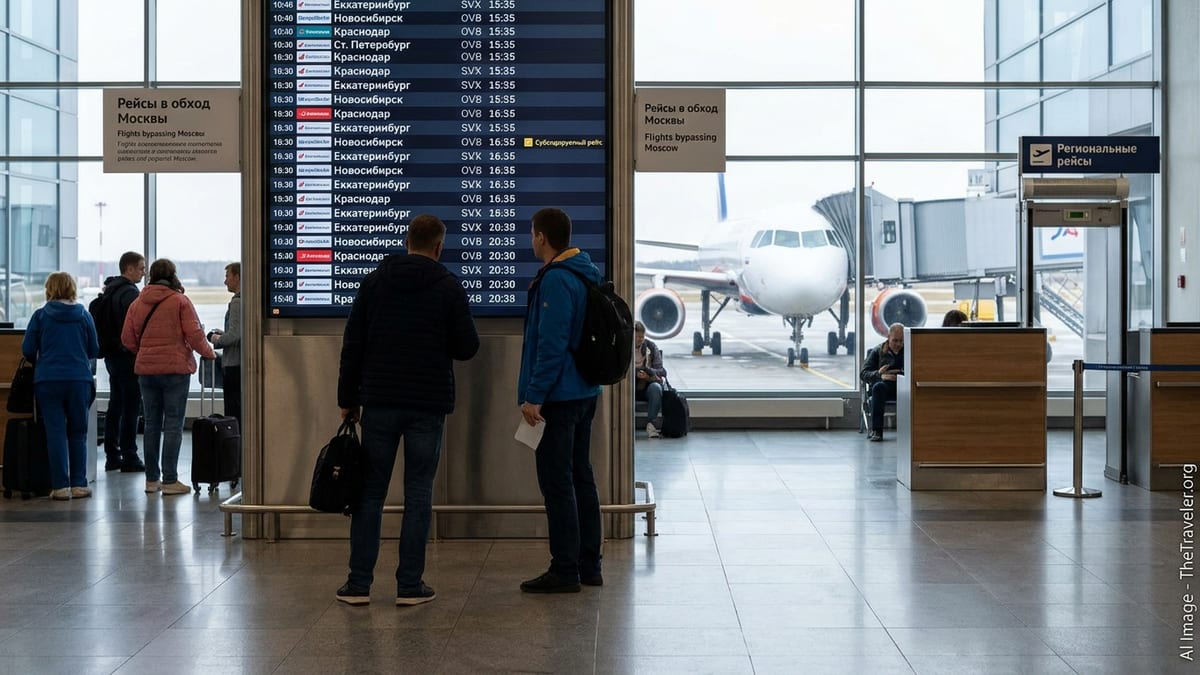
Russia’s Transport Ministry is preparing to retarget federal air travel subsidies to expand direct flights between regions that bypass Moscow, after a surge in drone related airspace restrictions repeatedly disrupted operations at the capital’s four airports and dampened passenger traffic through the country’s main hub system.
Get the latest news straight to your inbox!
Subsidies Shift Toward Non‑Moscow Routes
Speaking at the Transport of Russia forum in Moscow on November 19, Transport Minister Dmitry Yadrov said his ministry and the Federal Air Transport Agency Rosaviatsia will revise how state subsidies for domestic air services are allocated. According to a summary from the Association of Tour Operators of Russia, Yadrov stated that 431 routes are currently supported by federal funding and that almost 55 percent of subsidized flights already operate without transiting Moscow. He said that share could increase once the redistribution is complete, although no formal timeline or target figure has been publicly approved.
The minister outlined three main subsidy streams that would be affected: a regional aviation program that now supports more than 300 routes linking Russian regions directly with each other, a separate scheme covering around 100 routes for defined categories of passengers such as students, pensioners and people with disabilities, and 39 so called socially important routes in the Far East. The proposal under discussion is to prioritize subsidies that strengthen point to point connectivity between the country’s regions, rather than itineraries routed through Moscow’s hub airports.
For travelers inside Russia, the practical effect, if the plans advance in their current form, would be more options to fly between regional centers without backtracking through the capital, potentially shortening travel times and reducing exposure to the airspace closures that have become more frequent in the Moscow area. However, officials have not yet published a list of specific new or expanded routes, and carriers have not announced new schedules tied explicitly to this shift, so the exact changes passengers will see in 2027 and beyond remain to be confirmed.
Drone Alerts Repeatedly Disrupt Moscow’s Four Airports
The policy move comes against a backdrop of intense and recurring drone related disruptions in the skies above Moscow. According to specialist aviation outlet Aviatorshchina, Russia’s four Moscow area airports Sheremetyevo, Domodedovo, Vnukovo and Zhukovsky imposed temporary flight restrictions 82 times in October 2026 alone, out of 495 such incidents nationwide. All four airports were simultaneously under restrictions on 13 separate days that month, resulting in about 262 hours of cumulatively limited operations across the capital’s air hub.
The restrictions are introduced when the authorities declare air raid or drone alerts, typically closing arrivals and departures for periods that can last from under an hour to most of a day. On October 13, following a large scale drone attack on the Moscow region, all four airports halted operations for several hours, with hundreds of flights delayed or canceled before traffic gradually resumed. Similar, if somewhat shorter, suspensions continued into November. While most of these interruptions have affected domestic travel, they have also complicated some international connections for passengers using Moscow as a transfer point.
For travelers, the immediate impact has been a marked increase in delays, cancellations and diversions on routes using Moscow’s airports, particularly in the evening and overnight periods when many drone alerts have been declared. Some foreign airlines that continue to serve Moscow have kept operating despite the disruptions, but travelers on those services have also faced overnight delays and missed onward connections. The repeated closures have encouraged some passengers and airlines to favor itineraries that bypass the capital entirely when possible, reinforcing the government’s interest in strengthening regional links.
Passenger Traffic at Moscow Hubs Edges Down
Statistics compiled from Rosaviatsia data indicate that traffic through Moscow’s main airports has already begun to soften. Interfax, citing the federal aviation agency’s figures, reported that Sheremetyevo, Domodedovo and Vnukovo handled a combined 53.7 million passengers in the first nine months of 2026. That total represented a decline of about 4 percent compared with the same period of 2025, even as many regional airports either held steady or saw modest growth off a smaller base.
Earlier data for the first seven months of the year showed total passenger numbers at the three Moscow airports down 3.5 percent year on year to 40.4 million passengers, with Domodedovo posting the steepest individual drop. While the statistics do not isolate the effect of drone driven closures from other factors such as macroeconomic pressures and shifts in airline networks, they confirm that the country’s dominant air hub system has lost some traffic relative to the previous year at the same time as operational disruptions have intensified.
For domestic travelers who previously relied on Moscow as the default transfer point for trips between Russian regions, the combination of weaker reliability and slightly reduced capacity at the capital’s airports is one reason to look more closely at direct regional connections where available. Conversely, for routes where Moscow remains the only realistic connection point, passengers may need to allow greater schedule buffers and prepare for short notice changes in departure times when airspace alerts are issued.
Budget Plans Trim, Then Restore, Funding Levels
The shift in subsidy priorities is taking place within a medium term federal budget that marginally reduces total support for flights bypassing Moscow compared with earlier plans. According to draft budget documents that have passed their second reading in the State Duma and coverage by Russian business media, the federal government now plans to allocate 14.3 billion rubles in 2027 and 2028 to support interregional flights that do not route through the capital. That amount is almost 10 percent lower than the 15.9 billion rubles that had previously been earmarked for those two years combined.
Within the new figure, 7.2 billion rubles are scheduled for 2027 and 7.1 billion rubles for 2028. Budget projections for 2029 restore the allocation to 7.2 billion rubles, the same nominal level as in 2027 and similar to the planned support for 2026. The reduction therefore represents a downward revision relative to earlier multi year budget planning, rather than a direct year on year cut from current spending levels. Authorities have indicated that they expect to offset some of the impact by tightening the focus of subsidies onto routes they consider most critical for regional connectivity and social needs.
It remains to be seen how the lower aggregate funding will be divided between the three main program streams and which specific routes or passenger categories, if any, could lose eligibility. The government has not published a detailed breakdown by route for the 2027 to 2029 period, and airlines have not disclosed how they plan to adjust their networks in response. Travelers using subsidized services, especially in the Far East and on thinner regional routes, are likely to see adjustments in schedule frequency, pricing or aircraft type over the coming budget cycle as carriers respond to the new parameters.
What Travelers Should Watch In The Coming Months
For now, the announced changes remain policy directions rather than fully implemented network shifts, and most domestic schedules for winter 2026 to 2027 continue to reflect existing patterns. Travelers booking flights within Russia over the next several months should therefore rely on confirmed airline timetables and fare displays rather than expecting immediate expansion of non Moscow options on the strength of the minister’s remarks alone. Any new or newly subsidized routes that carriers launch for the 2027 season are likely to appear gradually in reservation systems once formal program adjustments are approved and contracts are signed.
At the same time, passengers planning itineraries that still require transfers through Moscow should anticipate that drone related airspace restrictions may continue at short notice, especially while the security situation around the capital remains volatile. Allowing longer connection times, avoiding tightly timed late evening transfers and monitoring airline notifications on the day of travel can help reduce the risk of missed onward flights. Where viable regional to regional options exist, either by air or by rail, some travelers may find it prudent to use those alternatives to limit exposure to potential airspace closures around Moscow.
If and when the revised subsidy allocation takes effect, the most visible changes for travelers are likely to appear on routes linking larger regional centers such as St. Petersburg, Yekaterinburg, Novosibirsk, Krasnodar and cities in the Far East, where demand is sufficient to support additional direct services. Smaller communities in the Far Eastern and Arctic regions will be watching closely to see whether their socially significant routes retain support at current levels. Until the Russian government and airlines publish detailed route lists for the upcoming subsidy cycle, passengers are advised to check schedules frequently and be prepared for adjustments as the country’s domestic air network adapts to both fiscal changes and continuing security related disruptions around its main hub city.