


More news on this day
With U.S. airlines preparing for one of the busiest holiday seasons since before the pandemic and nearly a quarter of flights arriving late during the 2025 holidays, understanding what you can and cannot claim when a trip unravels has become as important as picking the right route.
Get the latest news straight to your inbox!
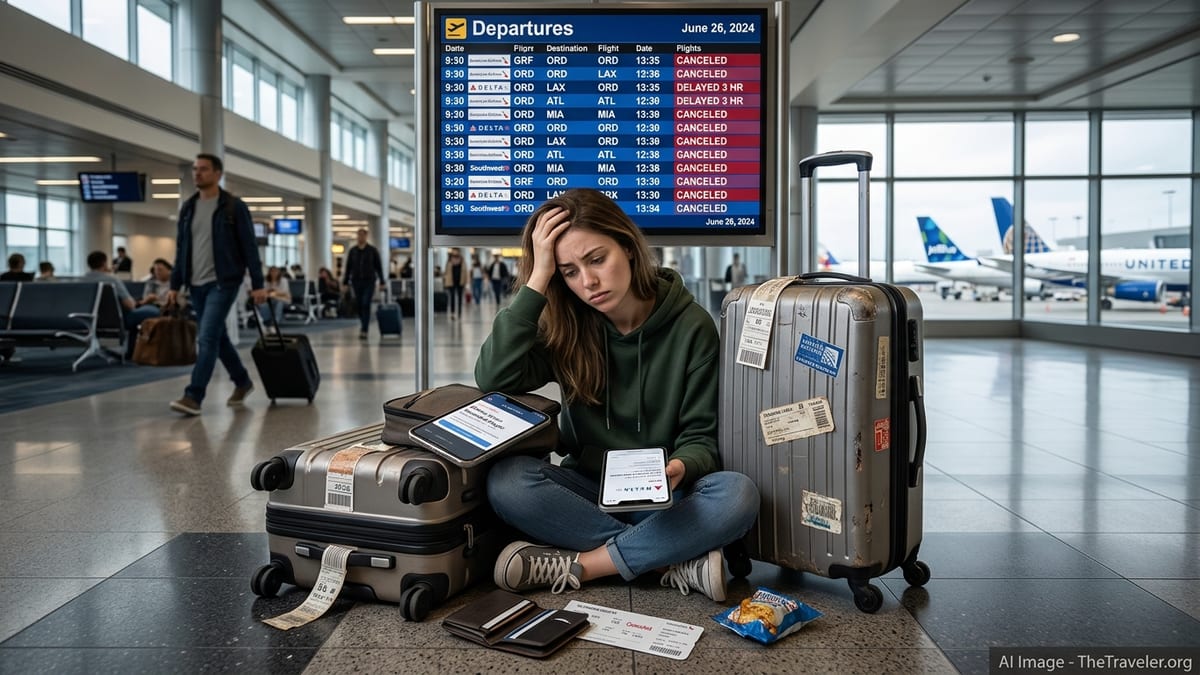
New federal refund rules: when you are owed your money back
The U.S. Department of Transportation’s most significant consumer update in years took effect on June 25, 2024, clarifying when airlines must return your money instead of only offering a credit. If a carrier cancels a flight to, from or within the United States and does not rebook you, or you decline the alternative it offers, you are entitled to a refund of the ticket price and any government taxes and fees you paid for that flight, regardless of the reason for the cancellation. That applies whether the disruption is caused by weather, mechanical problems, crew shortages, air traffic control issues or broader system outages.
The same rule now covers what the DOT defines as a “significant change” to your itinerary. The federal standard, which applies to tickets bought on or after June 25, 2024, treats several situations as significant: if your domestic flight is delayed at least three hours in arrival, your international flight is delayed at least six hours in arrival, you are re-routed to or from a different airport in the same region, your connection points change, or you are moved from a nonstop to a connecting itinerary when you bought a nonstop ticket. In each of those cases, if you decide not to travel on the changed flight and you reject credits or vouchers, the airline must issue a refund back to your original form of payment.
Crucially for holiday travelers watching fares jump as departure day nears, the refund obligation is tied to what you actually purchased, not to the current ticket price. If you paid for seat selection, early boarding, a checked bag, or other ancillary services that you did not receive because of a cancellation or significant schedule change, the carrier must refund those optional fees as well. What these federal rules do not guarantee is extra cash compensation beyond getting your money back; unlike in the European Union, U.S. law does not require airlines to pay fixed sums simply because a flight was delayed or cancelled, although some carriers voluntarily provide vouchers or miles in particular situations.
Delays, cancellations and what each airline promises
Although federal rules set the baseline for when refunds are mandatory, the details of what else you might receive in a disruption still vary by airline. Since 2022 the DOT has maintained a public dashboard summarizing what each major U.S. carrier commits to provide in the event of controllable delays and cancellations, such as those caused by maintenance problems, crew issues or computer outages. Most large airlines now promise to rebook you at no extra cost on their next available flight and to cover hotel accommodation and local ground transportation if an overnight stay is required and the problem is within the airline’s control.
However, when weather, air traffic control programs, airport closures or broader FAA system failures are involved, many of those voluntary benefits do not apply. In those cases, you still retain the right to a refund if your flight is cancelled or significantly changed and you decide not to travel, but meal vouchers, hotel rooms and credits are typically offered at the airline’s discretion. Travelers should also be aware that accepting a voucher or a rebooked itinerary in lieu of a refund can change their rights; under DOT guidance, once you voluntarily take an alternative option, you usually cannot claim a cash refund for the original ticket later.
Because commitments differ, checking your carrier’s contract of carriage and its current customer service plan before you travel is especially useful around the holidays, when disruption cascades can last for days. Many airlines have updated their policies since the severe operational meltdowns of recent years, spelling out when they will provide hotel rooms, meal vouchers or frequent flyer miles. Those documents, along with the DOT dashboard, provide the most up to date description of what each airline has put in writing for both controllable and uncontrollable events.
Tarmac delays and what you can expect on the aircraft
For passengers who do make it onto an aircraft only to sit for hours waiting to depart or to reach a gate, federal protections focus on tarmac delays. Under DOT rules, airlines operating flights at U.S. airports must give passengers on domestic flights the opportunity to get off before a tarmac delay exceeds three hours, and on international flights before the delay exceeds four hours, except when the pilot or air traffic control decides that moving to a gate would be unsafe or would significantly disrupt airport operations. These time limits apply to both U.S. and foreign carriers when they are on the ground at a U.S. airport.
Separate from the deplaning requirement, carriers must provide “adequate” food and drinking water no later than two hours after a tarmac delay begins, again unless the pilot determines that safety or security concerns temporarily prevent cabin service. Lavatories must remain operable during the delay, and airlines have to ensure that medical attention is available if needed. While the definition of adequate food is not spelled out in detail, regulators have fined carriers in the past when passengers were left on board for extended periods with little or nothing offered.
The number of long tarmac delays remains small compared with the overall volume of flights, but DOT enforcement actions show that marathon ground holds do still occur, particularly during severe storms, airport ground stops or crew scheduling bottlenecks. For holiday travelers, the practical implication is that once the clock passes two hours on the tarmac, you can reasonably expect at least basic refreshments, and after three hours for a domestic flight or four hours for an international one, the airline should either be returning to a gate to let people off or be able to point to a specific safety or air traffic control directive preventing it.
Travel insurance, airline waivers and how to protect your itinerary
The strengthened federal refund rules have prompted some consumer advocates to caution travelers against assuming they must buy third party insurance to receive money back when flights do not operate. Since airlines now have to issue refunds automatically in clear cases of cancellation or significant change, an additional policy may duplicate protections you already have. Instead, insurance decisions largely come down to the broader costs at stake, such as prepaid hotels, cruises, tours and nonrefundable ground transport that sit around the flights.
For those who do purchase coverage, reading the policy language carefully remains essential. Not all plans protect against every type of disruption: some exclude pre existing medical conditions, certain weather events or labor disputes, and many cheaper products do not consider missed connections caused by tight self planned itineraries to be covered losses. “Cancel for any reason” options, when available, usually cost more and often reimburse only a portion of the trip cost, within specified deadlines and documentation requirements.
Separate from dedicated insurance, airlines and major online travel agencies now frequently issue fee waivers ahead of major storms, wildfires or other forecast disruptions that may affect holiday travel. These waivers, which are posted on carriers’ websites and apps, typically allow passengers booked on affected dates and routes to change to another flight within a defined rebooking window without paying the usual change fee or fare difference. They do not, by themselves, create a right to a refund if your original flight operates, but they can be valuable tools to move an itinerary earlier or later to avoid the worst of a systemwide disruption without incurring additional cost.
Planning strategies as delays remain elevated
Federal statistics compiled from the Bureau of Transportation Statistics and recent independent analyses show that nearly one in four U.S. flights arrived at least 15 minutes late during the November and December 2025 holiday period, with some airports and Sunday peak travel days experiencing even higher delay rates. Although performance varies year to year and by carrier, those figures underline why building margin into holiday itineraries has become a practical necessity rather than simply a conservative choice.
One of the most effective protections against knock on problems is scheduling extra time where a missed connection would be most costly. Travelers heading to cruises, guided tours or long distance rail departures often choose to arrive in the starting city at least a full day early during winter. Similarly, those connecting to last flights of the day into smaller airports might deliberately choose earlier inbound legs with longer layovers in hub cities, trading some time in the terminal for a far lower risk of an unplanned overnight stay.
Technology can also materially affect how quickly you respond if something goes wrong. Airline smartphone apps typically receive cancellation and delay notices before departure boards update and allow most customers to accept rebookings or search for alternatives without queuing to speak with an agent. Having profile details and contact methods updated in advance of the holidays ensures that those alerts reach you promptly. At the baggage carousel, small location trackers placed in checked suitcases have become a common tool; while they do not force an airline to move a bag differently, they can help you and carrier agents pinpoint where luggage is if it misses a connection or is loaded onto another flight.
What travelers should watch for this holiday season
Looking ahead to the late November and December 2026 peak travel weeks, federal forecasts suggest that scheduled flight volumes will exceed both last year’s levels and those before the pandemic. That combination of heavy traffic and a system still vulnerable to weather, staffing gaps and occasional technological outages means that the risk of delays and cancellations remains significant, even though airlines and the FAA have introduced new tools intended to manage congestion more efficiently.
For individual travelers, the most useful steps in the days before departure are to confirm that contact information is correct in each airline reservation, review the operating carrier’s latest customer service commitments on cancellations and controllable delays, and check for any active weather or air traffic control advisories on your route. If your plans depend on tight timing, such as same day holiday gatherings or onward connections, it may be worth adjusting to an earlier departure while seats remain available, given that rebooking options tend to shrink quickly once widespread disruptions are underway.
Finally, being clear about what current rules actually guarantee can help set expectations at the airport. If your flight is cancelled or significantly changed and you decide not to travel, you can expect a refund without a separate fight over airline policy. During tarmac delays, you are entitled to basic care and, within clear time limits, a chance to deplane unless safety or traffic control decisions prevent it. Beyond those baselines, hotel rooms, meal vouchers and additional compensation still depend heavily on the airline involved, the cause of the disruption and what you accept at the time. Knowing those boundaries before holiday travel begins makes it easier to decide, in real time, whether to wait out a problem, push for a different option or walk away and take the refund you are owed.