


More news on this day
Commercial air traffic across Belgium was largely halted on Monday 23 November as air navigation provider Skeyes suspended regular services for 14 hours during a nationwide anti-austerity strike, forcing airports to cancel hundreds of flights and triggering widespread disruption for travellers across the country.
Get the latest news straight to your inbox!
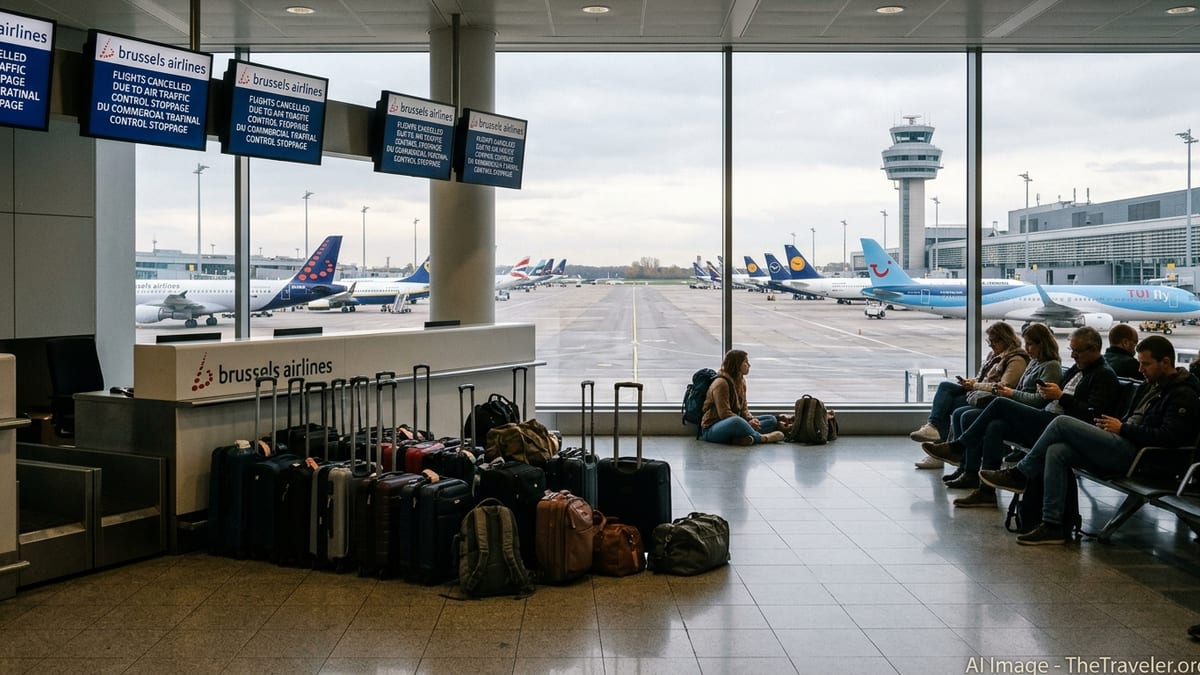
Airports shut to commercial traffic during 14-hour stoppage
The core of Monday’s disruption was a complete suspension of regular air traffic control services by Skeyes, Belgium’s state-owned air navigation service provider, between 07:00 and 21:00 local time on 23 November 2026. The decision, confirmed by Skeyes and Belgian broadcaster RTBF ahead of the walkout, meant that commercial passenger and cargo flights were unable to take off or land at Belgian airports during that window, with only a limited number of exempt movements such as emergency and state flights permitted.
Brussels Airport in Zaventem, the country’s main international hub, announced in advance that all scheduled departures and arrivals during the 14-hour period would be cancelled. Airport guidance specified that its online flight board would only show cancellations once each airline updated its systems, warning passengers not to rely on apparently “on time” listings and instead to check directly with carriers before travelling to the airport.
Brussels South Charleroi Airport, a major base for low-cost carriers including Ryanair, similarly advised that no commercial flights would be able to operate between 07:00 and 21:00 because of the airspace shutdown, despite the airport itself maintaining internal staffing to remain technically open. In practice, all passenger departures and arrivals during the strike window were cancelled, affecting both domestic and international services.
Extent of disruption and knock-on effects for travellers
The combined measures at Brussels and Charleroi effectively shut Belgium’s commercial air traffic for the main part of the operating day. Industry bodies and local media report that this eleventh strike action affecting Belgian airspace in as many months led to several hundred flight cancellations system-wide, with Brussels Airport alone cancelling every scheduled passenger movement during the Skeyes closure period. Early counts from airline and airport data suggest that tens of thousands of passengers were directly impacted, although a precise final total has not yet been consolidated.
Travellers reported a wide range of experiences. Some passengers whose flights fell squarely within the 07:00 to 21:00 window received advance cancellation notices and were rebooked on services later in the week or rerouted via neighbouring countries such as the Netherlands, France or Germany. Others with departures close to the edges of the airspace closure reported more uncertainty, as airlines initially held off cancelling in the hope that some movements just outside the restrictions might still operate. Several carriers subsequently issued operational updates clarifying that they would cancel their full Brussels schedules for the day, including flights originally timed near the cut-off.
The impact was not limited to those starting or ending journeys in Belgium. The shutdown also affected connecting passengers booked through Brussels on long-haul itineraries. With most intra-European feeder flights cancelled, travellers found that onward transatlantic and other long-haul segments were disrupted even if those flights were scheduled to depart from hubs in other countries. Advisories from airlines and specialist travel sites stressed that passengers should check every leg of their ticket, since a cancelled short-haul sector to or from Brussels could invalidate or alter subsequent connections.
Wider transport and city services hit by anti-austerity action
The air traffic stoppage formed part of a broader national day of industrial action called by Belgium’s major trade unions in opposition to the federal government’s austerity plans. The strike was aimed at proposed budget measures and spending cuts intended to reduce Belgium’s deficit by approximately 10 billion euros over the coming years. While the details of the eventual budget package remain under negotiation within the governing coalition, unions have focused their criticism on potential reductions in public services and social spending and on proposed increases to value-added tax, arguing instead for higher taxation on top incomes.
On the ground, the strike led to significant disruption across public services. In Brussels, local media and authorities reported that only a minimal metro service was operating, with just two lines running and at reduced frequencies. Many tram and bus routes were cancelled or heavily thinned out, creating longer journey times and crowding on the services that did run. Public transport disruptions were also reported in other major cities, although the degree of impact varied by region and operator.
National rail operator SNCB announced that it would run its mainline trains largely as scheduled, and early reports on the day indicated that intercity rail connections within Belgium and to neighbouring countries were less severely affected than local urban transport and air traffic. Nonetheless, some travellers attempting to reach alternative airports in Amsterdam, Paris or Düsseldorf reported extended door-to-door journeys because local feeder buses, trams and airport shuttles were operating at reduced capacity or not at all.
Political backdrop: budget deadlock and repeated strikes
The latest strike came against the backdrop of a protracted budget impasse within Belgium’s federal government. Prime Minister Bart De Wever has been attempting to secure agreement among coalition partners on a medium-term consolidation plan, targeting savings and revenue measures worth around 10 billion euros to bring down the national deficit. After several rounds of negotiations failed to produce a breakthrough, De Wever tendered his resignation to King Philippe earlier in November. The monarch declined to accept it, instead granting additional time for the governing parties to reach a compromise.
According to statements from the prime minister’s office and local reporting, De Wever has now indicated that the government must finalise a budget agreement by 31 December 2026. Officials have suggested that if no accord is reached by the end of the year, the cabinet’s ability to govern would be seriously compromised and the government’s survival could be in question. This context has amplified the political sensitivity of union actions and public protests such as Monday’s march in Brussels, which drew many thousands of participants and coincided with the prime minister’s latest audience with the King.
For the travel and transport sector, the political stalemate has translated into a year of recurrent industrial actions. The Board of Airline Representatives in Belgium, which represents around 25 carriers, has stated that Monday’s walkout was the eleventh strike to affect Belgian airspace in an eleven-month period. Previous actions have included targeted stoppages at Charleroi and other Skeyes-controlled facilities, leading to recurring uncertainty for airlines planning schedules and for passengers booking trips months in advance.
What travellers should do next and outlook for coming weeks
With Monday’s national strike now concluded and Belgian airspace reopened to normal traffic from 21:00 local time onward, airlines and airports have shifted focus to recovery operations. Carriers are working to reposition aircraft and crews and to clear backlogs of displaced passengers. Travellers whose flights on 23 November were cancelled should expect to receive rebooking or refund options directly from their airline or travel agent. Because the disruption was primarily caused by an air traffic control strike, many carriers will classify it as an extraordinary circumstance, meaning that while passengers retain rights to rerouting or reimbursement under European air passenger rules, automatic cash compensation may not apply.
Passengers with upcoming journeys via Belgian airports in the next several days are being advised to monitor communications from their airlines and to check flight status before leaving for the airport, as some residual knock-on delays and schedule changes are possible while operations normalise. Travellers connecting through Brussels who have tight onward connections may wish to allow additional buffer time, particularly for early-morning departures on 24 November, when aircraft and crew rotations are still being restored to normal patterns.
Looking ahead, unions representing Skeyes staff have already filed broader strike notices covering the end-of-year period, from early December into early January, although representatives have indicated that they will seek to avoid complete shutdowns during peak Christmas and New Year travel days if possible. These notices do not necessarily mean that further stoppages will occur, but they do signal continued labour tensions over working conditions and broader austerity policies. Anyone planning to fly to, from or over Belgium in the coming weeks should therefore keep a close eye on official updates from Skeyes, Brussels Airport, Brussels South Charleroi Airport and their airline, and be prepared for the possibility of timetable adjustments if additional industrial action is confirmed.