


More news on this day
Recent rail disruptions from London to North America and Asia have left passengers unexpectedly stranded after sudden train cancellations, prompting renewed scrutiny of how operators warn travelers and what help is available when services vanish without notice.
Get the latest news straight to your inbox!
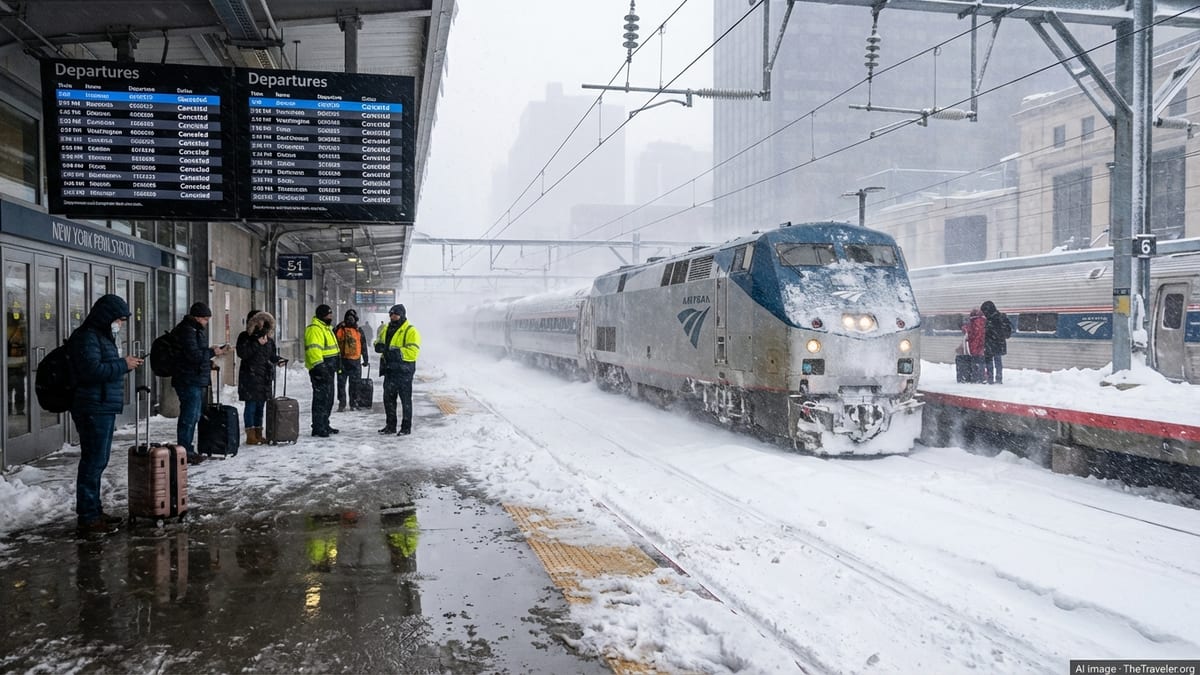
Sudden Cancellations Turn Routine Trips Into Overnight Ordeals
In the United Kingdom, disruption around London Paddington on 5 September 2026 caused severe knock-on effects for travelers heading to and from Heathrow Airport and the west of England. Published coverage describes trains halted near the capital after a trackside fire, with hundreds of passengers evacuated and services cancelled, leaving many searching for last minute alternatives late into the evening.
Just weeks earlier, the intercity operator CrossCountry cancelled almost all of its services across Great Britain for much of Sunday 23 August 2026 after a power failure at its Birmingham control center. Reports indicate that only a handful of trains ran and that passengers were told to seek out other operators or rely on a limited bus replacement service, leading to packed concourses and long waits in cities including Birmingham, Leeds and Bristol.
Elsewhere in Europe, a major rail outage in the Netherlands on 15 September 2026 disrupted rush hour traffic in and around The Hague. According to international news reports, a suspected act of sabotage affecting infrastructure systems left trains stopped and commuters stranded on platforms while operators tried to restore partial service. The incident underscored how quickly large numbers of passengers can be immobilized when core control systems fail without warning.
Long distance passengers have also been affected by more serious incidents. Following the January 2026 Adamuz rail disaster in Spain, in which two high speed trains derailed on the same corridor, Spanish media reported that major stations in Madrid, Córdoba, Seville and Málaga stayed open overnight to shelter hundreds of travelers unable to board scheduled services. Extra flights were added on some domestic airline routes to clear the backlog of stranded rail passengers in the days that followed.
Infrastructure Failures And Extreme Weather Compound Rail Vulnerabilities
Not all disruption stems from internal technical problems. In northern India, a late August 2026 landslide on the Shimla to Kalka mountain railway led to the suspension of at least four services until 1 September. Published accounts describe passengers being transferred by bus over mountain roads after damage near a key bridge made train operations unsafe, highlighting how quickly infrastructure in difficult terrain can be knocked out by heavy rain and unstable slopes.
In the United States, publicly available information shows that Amtrak reserves broad powers to cancel, divert or postpone trains without notice when events beyond its control affect the network. Company conditions explain that in force majeure situations the main obligation is to refund unused tickets, although in cases where disruption is within the operator’s control, Amtrak states that overnight accommodation may be provided when available, including hotel rooms or sleeper car space on later trains.
Similar patterns emerge across different regions. News reports from Mississippi in August 2026 described an Amtrak service halted after a collision with a truck at a highway crossing, leaving passengers stranded until buses could be organized to move them onward. In California in July 2026, a Metrolink commuter train reportedly broke down in Anaheim Hills, immobilizing hundreds of riders for around two hours while rescue locomotives and buses were arranged on short notice.
These events show how quickly routine rail journeys can unravel when infrastructure, weather and external incidents converge. For passengers, the immediate experience is often one of confusion at stations or on trains that stop between cities, compounded when timely announcements and alternative transport are limited.
Rules On Notice And Assistance Differ Sharply By Region
In Europe, rail passenger protections have been progressively strengthened at the continental and national levels. The European Union’s Rail Passenger Rights Regulation sets minimum standards for assistance and compensation when services are cancelled or delayed, including the right to rerouting, refunds and in some situations accommodation and meals. Recent European Commission impact assessments indicate an increasing focus on missed connections within multi operator journeys, with proposals that full rights apply when a through ticket covers several carriers.
National regulators in countries such as the United Kingdom supplement these baseline rules. The Office of Rail and Road’s guidance for passengers explains that travelers whose trains are cancelled and who do not travel are entitled to refunds from retailers, and that those delayed in reaching their destination may receive compensation from train companies under schemes like Delay Repay. The regulator also stresses the importance of clear, real time information and prominent disruption warnings on websites and at stations.
Separate guidance from consumer authorities in Spain notes that when trains are cancelled or significantly delayed, passengers may choose between continuing their journey on an alternative service, re routing at the earliest opportunity or receiving a refund. Information released during a nationwide rail strike in early 2026 reminded travelers that they may also be entitled to necessary food, accommodation and additional compensation in some circumstances, particularly when stranded away from home.
In North America and parts of Asia, frameworks tend to be more fragmented, with each operator or national rail company setting its own conditions of carriage. Amtrak’s published customer service commitments, for example, outline potential goodwill compensation such as travel vouchers or loyalty points, but also emphasize that many disruptions remain outside the company’s control. In India, recent consumer court rulings reported in local media have ordered Indian Railways to compensate passengers who missed flights after serious delays, citing broader consumer protection law rather than specific rail regulations.
Digital Alerts Help Some Travelers, But Gaps Remain
Digital booking platforms and national rail websites increasingly promise advance notifications when booked trains are cancelled or heavily altered. In Britain, the rail regulator has previously highlighted progress on proactive alerts for services cancelled more than two days ahead of travel, and has asked operators to adopt flexible ticket policies that let passengers take earlier or later trains when their original service disappears.
Despite these improvements, recent online discussions show that notice is not always timely. Posts on passenger forums and social platforms in 2026 describe travelers discovering cancellations only on the day of travel, or even after clearing station security checks, when staff announced that a planned departure would not run. Others report learning of disruption through third party journey planners rather than directly from the operator that sold the ticket.
European consumer centers stress that passengers should be informed about delays, cancellations and missed connections in real time, including via station displays, on board announcements and digital channels. Official guidance in Spain specifies that railway companies must make clear how travelers can obtain proof that a service was cancelled or a connection missed, a document that can be crucial when later seeking refunds or compensation.
The uneven rollout of reliable notification systems means that some passengers, particularly those buying tickets at short notice or through intermediaries, still face a risk of reaching the station only to find their train removed from the departure board. For long distance or last train of the day services, that gap can translate into expensive hotel stays or missed flights with little immediate recourse.
What Stranded Passengers Can Do When Trains Vanish
Consumer organizations in Europe advise that when a train is cancelled without notice, passengers should first seek written confirmation of the disruption from station staff, ticket offices or official digital channels. This documentation can support later claims for refunds, rerouting costs or additional expenses such as emergency accommodation or replacement transport when operators fall short of their obligations.
Under European rules, travelers facing delays of more than 60 minutes because of cancellations generally have the right to choose between continuing the journey on a later service, re routing under comparable conditions or obtaining a refund. Guidance also notes that food, refreshments and hotel rooms may be owed when passengers are kept overnight away from home, as long as it is physically possible for operators to provide them.
In Britain, passenger charters published by individual train companies explain how to submit Delay Repay claims and how national rail conditions interact with wider consumer legislation. Case studies from the independent Rail Ombudsman highlight that even when extreme weather or infrastructure problems play a role, companies can be expected to communicate clearly, avoid contradictory advice and consider reasonable claims for out of pocket expenses when information was lacking or misleading.
On routes where legal protections are weaker, travelers may still find support through general consumer rights frameworks or goodwill policies, though outcomes can vary. Recent experiences shared on public forums suggest that some operators provide travel vouchers or partial refunds as a gesture to customers affected by sudden cancellations, while others rely on strict terms and conditions that limit liability to the ticket price. For international tourists and infrequent rail users, understanding these differences before departure can make the shock of a vanished train less financially damaging, even if it cannot prevent the inconvenience of being stranded without notice.