


For Gulf of Alaska cruises in 2027, the classic choice is between northbound and southbound sailings. Northbound itineraries typically run from Vancouver to Seward or Whittier, while southbound cruises reverse the journey. Many of these one-way voyages share the same core ports and glaciers, simply visited in a different sequence, yet the direction can still shape everything from how excited you feel on glacier day to how easily you connect a Denali land tour. This comparison looks at confirmed 2027 schedules from Princess, Holland America, Celebrity, Royal Caribbean and Norwegian, focusing on real itinerary details, logistics and total trip cost rather than simplistic claims that one direction always has better weather.
Get the latest updates straight to your inbox!
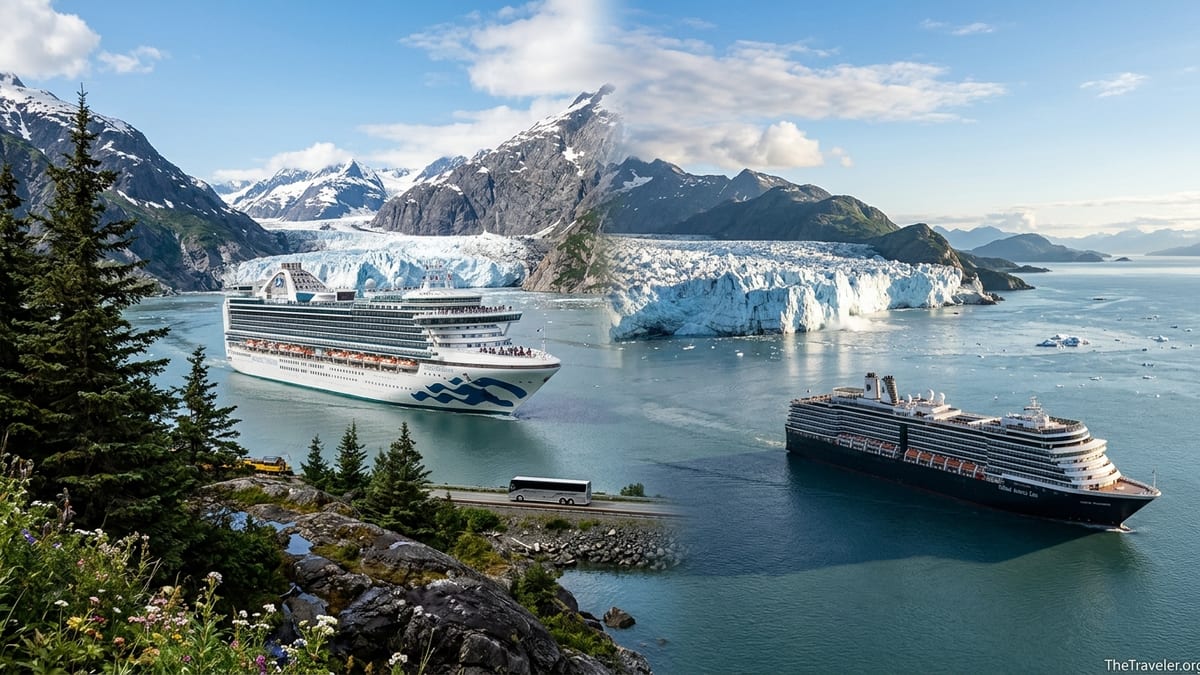
How 2027 Gulf of Alaska Itineraries Differ by Direction
In 2027, the headline Gulf of Alaska pattern is clear across the major lines. Princess and Holland America continue to operate their signature one-way “Voyage of the Glaciers” and “Glacier Discovery” routes between Vancouver and Whittier, branded explicitly as northbound and southbound options. Holland America’s own 2027 season announcement describes seven-day Northbound Glacier Discovery and Southbound Glacier Discovery cruises between Whittier and Vancouver on ships such as Nieuw Amsterdam and Westerdam, with matched routes but different glacier pairings. Royal Caribbean’s deployment puts Anthem of the Seas and related ships on seven-night one-way Vancouver to Seward sailings that they market under names like “Northbound Alaska & Hubbard Glacier,” while Celebrity and Norwegian offer similar one-way Gulf of Alaska journeys using Seward or Whittier as the northern anchor.
The common port spine is remarkably consistent. A typical 2027 northbound voyage will depart from Vancouver, cruise the Inside Passage or outer coast, then call at Ketchikan, Juneau, Skagway and sometimes Sitka or Icy Strait Point, before a dedicated glacier day and final arrival into Whittier or Seward. Southbound versions usually reverse this order: embark in Seward or Whittier, visit a tidewater glacier, then call at Skagway, Juneau and Ketchikan on the way to Vancouver. An example from Royal Caribbean’s 2027 schedule shows a May and June pattern of Vancouver, Ketchikan, Icy Strait Point, Sitka, Skagway, Hubbard Glacier and Seward on seven-night northbound sailings.
The most meaningful direction-based differences involve which glacier you see and when that scenic cruising happens in the week. Holland America’s 2027 program states directly that both Glacier Discovery directions include Glacier Bay National Park, but the northbound itineraries add College Fjord while the southbound cruises instead visit Hubbard Glacier. Princess similarly advertises its Voyage of the Glaciers runs as including Glacier Bay plus either Hubbard Glacier or College Fjord, with the exact pairing depending on ship and direction. That means two people sailing the “same” week in opposite directions can both have seven-night itineraries but experience different marquee glacier days.
Celebrity and Royal Caribbean focus on Hubbard Glacier rather than Glacier Bay, so their directional differences center more on where Hubbard falls in the sequence and which ports sit on either side of the glacier day. For example, Royal Caribbean’s published June 2027 northbound itinerary for Anthem of the Seas lists Hubbard Glacier cruising late in the voyage just before Seward, whereas some southbound deployment documents show Hubbard on day two after leaving Seward. These nuances affect onboard energy, photography conditions and how the broader vacation comes together.
Glacier Pairings, Scheduling and What Direction Really Changes
For travelers comparing 2027 northbound and southbound cruises, glacier days are often the deciding factor. Holland America’s Glacier Discovery statement is unusually specific: northbound sailings feature both Glacier Bay and College Fjord, while southbound routes pair Glacier Bay with Hubbard Glacier. Princess materials for its 2027 Voyage of the Glaciers program show a similar pattern of two glacier-viewing days per week, combining Glacier Bay with either College Fjord or Hubbard Glacier on different voyages. Independent schedule aggregators that list 2027 Gulf of Alaska cruises confirm that Celebrity and Royal Caribbean one-way sailings between Vancouver and Seward are typically tied to Hubbard Glacier rather than Glacier Bay.
College Fjord and Hubbard Glacier also appear in different places in the week depending on direction. On northbound itineraries that end in Whittier, many lines place College Fjord at the very end of the cruise, sometimes in the evening, followed by a late-night or early-morning arrival into Whittier. Itineraries on Princess and Holland America routinely show College Fjord on day seven of an eight-day sequence, with Whittier arrival soon after. By contrast, Holland America’s southbound Glacier Discovery and various Princess southbound Voyage of the Glaciers sailings list Hubbard Glacier earlier in the week, often around day four or five, leaving time for Glacier Bay and additional ports before Vancouver.
This sequencing has tangible effects on the onboard experience. Northbound guests may enjoy a slow build in anticipation, seeing Ketchikan, Juneau and Skagway first, then Glacier Bay, then finishing with a dramatic sail through College Fjord’s cluster of hanging and tidewater glaciers just before disembarkation. Fatigue can also play a role: travelers who pack long port days and independent excursions into the first half of a northbound voyage sometimes arrive at the final scenic cruising tired, which may make an evening glacier session feel more relaxed but less intense. Southbound guests who meet Hubbard Glacier on day two or three often describe an early emotional high, with spectacular calving and a broad ice face setting the tone for the rest of the week.
Photography opportunities are shaped more by timing and ship maneuvers than by simple northbound versus southbound labels. On most glacier days, the ship performs slow rotations or “pirouettes” so both port and starboard balcony cabins face the ice, and passengers on open decks can move freely. Some itineraries reach Hubbard or College Fjord in the early morning, with soft light and low sun angles that favor east- or west-facing slopes depending on the fjord’s orientation. Others schedule midday or late-afternoon visits that provide clearer contrast but harsher light. Comparing actual arrival windows, as shown on 2027 day-by-day itineraries, will give more reliable photographic guidance than choosing a direction on the assumption that one is “better light” overall.
Land Tours, Denali Access and Which Direction Fits Your Plans
Most lines selling Gulf of Alaska cruises in 2027 also promote bundled land programs that link the ship with Denali National Park, Fairbanks, Anchorage, Talkeetna and sometimes Copper River or the Kenai Peninsula. Princess and Holland America market these packages as cruisetours, while Royal Caribbean and Celebrity sell Alaska CruiseTours that add rail and coach segments before or after the voyage. Holland America’s Alaska materials for current seasons already show multi-night Denali and Fairbanks extensions grafted onto Glacier Discovery routes at Whittier, and the line has stated that similar combinations will be available for 2027 once land dates are published.
Direction matters because most Denali-focused land itineraries start or end in the Anchorage area, not Vancouver. Northbound cruises that finish in Whittier or Seward line up naturally with post-cruise land segments: you disembark, transfer by Alaska Railroad or motorcoach toward Anchorage, then continue on to Talkeetna and Denali, often ending in Fairbanks. Southbound cruisetours are usually structured in reverse, beginning with overnights in Fairbanks and Denali, then working back to Anchorage, Seward or Whittier for embarkation before sailing south to Vancouver. For visitors who want to squeeze Denali, Fairbanks and maybe a night in Talkeetna into a single trip, it is easier to rely on prepackaged land tours than to connect them independently to a southbound sailing from Vancouver.
Many travelers find it more comfortable to tackle the demanding overland portion first, then decompress on the cruise. Land days in Alaska often involve early mornings, multi-hour rail segments, packed sightseeing and changes of hotel every night or two. Finishing with a southbound cruise from Seward or Whittier to Vancouver allows you to sleep in the same bed for a week, have meals cooked for you and trade long coach transfers for quiet hours on deck. This is one reason several experienced travelers and advisors recommend a land-first, cruise-second pattern, even if it means choosing a southbound rather than northbound voyage.
On the other hand, some guests prefer to sail northbound first, particularly if they are concerned about seasickness or want to minimize jet lag before active land days. Flying into Vancouver, spending a night or two to adjust, then cruising north distributes long flights, and by the time you reach Whittier or Seward, you are fully acclimated for hikes, flightseeing over Denali or a Kenai Fjords day cruise. If Denali is the core goal, the choice of direction is best driven by how you like to travel: a front-loaded adventure followed by a relaxing southbound cruise, or a gentle warm-up at sea leading to an active inland finale after a northbound voyage.
Flights, Open-Jaw Tickets and Realistic Cost Comparisons
Airfare is one of the most overlooked variables when comparing northbound and southbound Gulf of Alaska cruises. International and US travelers alike must price open-jaw itineraries that arrive at one city and depart from another, usually Vancouver on one end and Anchorage on the other. Major North American carriers and several international airlines offer nonstops into Vancouver, and Anchorage is served from US hubs such as Seattle, Chicago, Denver and Minneapolis, with some longer-haul seasonal services layered on top. Many travelers find that flying into Vancouver and home from Anchorage, or vice versa, costs more than a simple round-trip ticket but less than two separate one-way flights.
In practical terms, a couple from the eastern United States might see round-trip economy fares to Vancouver priced in the mid-hundreds per person for May or early June 2027, while open-jaw itineraries that combine Vancouver and Anchorage run a bit higher. From Europe or Australia, the difference can be more pronounced, and some travelers choose southbound sailings because they are easier to pair with widely available nonstops from Vancouver back to major hubs. It is common to find that airfare differences outweigh modest variations in cruise fare between a northbound and southbound sailing of the same week.
Hotel needs also tilt the calculation. Cruise lines and independent experts alike recommend arriving at least one day before embarkation, especially when international flights or tight connections are involved. Vancouver’s Canada Place terminal sits a short taxi or train ride from the city’s downtown hotels, where shoulder-season room rates may start in the moderate range and climb significantly during peak summer weekends or major events. In Anchorage, many cruise passengers overnight either near the airport or downtown before transferring the next day to Seward or Whittier by rail or motorcoach. Given that these pre-cruise hotel stays add a few hundred dollars for most couples, consolidating nights in the city that is cheaper or easier to reach can narrow or widen the overall cost gap between directions.
When comparing total trip budgets for 2027, it is important to add everything up: cruise fare, airfare, hotel nights, ground transfers and optional land tours. A promotional fare difference of a few hundred dollars on the cruise itself can disappear once you account for a more expensive flight combination or extra hotel nights on a routing that requires long layovers. Conversely, some shoulder-season northbound sailings have competitive fares and line up with relatively low-cost flights into Vancouver and out of Anchorage, creating total trip prices that beat more popular summer southbound departures even if the base cruise fare was slightly higher.
Seward vs Whittier Transfers and On-the-Ground Logistics
Whether you sail northbound or southbound, the northern Gulf of Alaska terminal will almost always be either Seward or Whittier. The choice affects your transfers to Anchorage and onward flights, but not always in the ways first-time visitors expect. Whittier, used heavily by Princess and Holland America, connects to Anchorage by road and rail through the Anton Anderson Memorial Tunnel. The Alaska Railroad’s Glacier Discovery and other services stop at the Whittier cruise terminal area, which sits directly across from the shared dock used by Holland America and Princess ships. Cruise lines coordinate special rail departures on many turnaround days so that passengers and luggage move efficiently from ship to train.
Seward, preferred by Royal Caribbean, Celebrity and Norwegian for some 2027 deployments, lies at the southern end of the Seward Highway and is served by Alaska Railroad coastal trains and a network of motorcoach operators. Royal Caribbean and Celebrity commonly package rail or coach transfers from the Seward pier to Anchorage, with baggage handled through to the airport or downtown hotels. Third-party tour companies also sell Seward to Anchorage transfers combined with sightseeing stops at places such as the Alaska Wildlife Conservation Center and Turnagain Arm viewpoints, effectively turning the travel day into an excursion.
Whittier disembarkation can feel efficient but limited in independent options. Much of the town sits within walking distance of the cruise dock, but the tunnel’s one-way traffic schedule means all buses and trains must clear in timed windows, and many visitors simply board the ship-organized rail direct to Anchorage. By contrast, Seward has a more developed promenade and harbor area, and travelers with extra time can add activities such as a half-day Kenai Fjords boat tour before or after their cruise. This difference may matter more to southbound guests who begin their trip in Seward and want an extra night there, whereas northbound passengers are usually focused on transfers out.
Luggage handling is generally easier when you use cruise line transfers. For bundled cruisetours that combine Denali, Talkeetna or Fairbanks, Princess and Holland America arrange through-checked luggage between hotels and the ship, using color-coded tags and dedicated rail cars. Independent travelers who piece together their own land portion should confirm how many bags are allowed on Alaska Railroad and coach services and factor in hauling suitcases through stations or hotel lobbies. Neither direction has an inherent advantage on baggage alone, but northbound cruisers who plan a significant land extension after disembarking in Whittier or Seward will want to prioritize itineraries that include luggage transfer services between the port and Denali corridor.
Sample Seven-Night Cost Picture and Vacation Structure
While exact prices for 2027 fluctuate with sales and cabin categories, recent published fares and schedule patterns allow a realistic outline of how a weeklong northbound or southbound Gulf of Alaska trip might be structured for two travelers. Consider a northbound Vancouver to Seward sailing on a ship such as Royal Caribbean’s Anthem of the Seas in May 2027. Promotional materials and current pricing snapshots suggest that an entry-level balcony cabin for two on similar sailings can run in the low to mid-thousands of US dollars before taxes and fees, with oceanview and inside cabins somewhat lower. Adding a pre-cruise night at a midrange Vancouver hotel, airport to hotel transfer and hotel to pier transport would add several hundred dollars to the total.
On the land side, these two travelers might then take a bundled transfer from Seward to Anchorage and fly home the same evening, or stay one night in Anchorage for a morning flight. If they add a modest post-cruise land package, such as a two- or three-night independent visit to Denali using Alaska Railroad and local lodging, the rail tickets, hotels and tours could add another meaningful amount per person. The entire northbound plus short land extension trip could easily span 10 to 11 calendar days, door to door, including travel from the lower 48.
For a comparable southbound option, imagine a Princess Voyage of the Glaciers itinerary from Whittier to Vancouver in June 2027 that includes Glacier Bay and College Fjord or Hubbard Glacier. Balcony cabins for two on summer Princess Alaska sailings often price in the mid-range of the market, with occasional promotions that reduce the fare for early or late season departures. Our hypothetical couple might fly to Anchorage, spend one night there, then take a rail or coach transfer to Whittier to board the ship. After seven nights at sea, they would disembark in Vancouver and either fly home the same day or add one or two nights in the city.
When you tally both scenarios, the total outlay and travel days are similar. Each direction requires an open-jaw flight, at least one pre-cruise hotel night and ground transfers on the Alaska end. Southbound trips tend to end in Vancouver, which makes same-day long-haul flights home more practical for many people, potentially shaving a night off the itinerary. Northbound cruises that end in Whittier or Seward may encourage more guests to add land days in Alaska rather than bolt straight to the airport, lengthening the total vacation but also increasing what you see.
Daylight, Port Time and Myths About the Best Side of the Ship
Gulf of Alaska sailings in late spring and summer benefit from long northern daylight, and in 2027 this will again soften many of the differences between northbound and southbound itineraries. Around the solstice, communities like Juneau, Skagway and Seward experience well over 18 hours of light, while Vancouver still offers long evenings for sailaway. This means that whether your ship approaches a glacier from Vancouver or from the Alaska side, you are likely to enjoy usable light for scenic cruising throughout the day. Direction changes sunrise and sunset angles, but it does not dramatically transform how much you can see during a given port call.
In port, small schedule variations sometimes give one direction a modest edge. Holland America’s itinerary descriptions, for example, note that certain northbound Glacier Discovery sailings maintain a late stay in Juneau, while corresponding southbound departures have slightly different timing. However, when you compare side-by-side 2027 calendars compiled by independent Alaska cruise schedule sites, the hours ashore in Ketchikan, Juneau and Skagway for matched northbound and southbound voyages are often within the same broad window. What matters more is whether your chosen sailing offers an evening in Juneau to permit whale watching and Mendenhall Glacier visits, or a long day in Skagway that makes both the White Pass Railway and a second excursion realistic.
The belief that you must book the “right” side of the ship in one direction is persistent but poorly supported by 2027 itineraries. Lines that visit Hubbard Glacier, College Fjord or Glacier Bay routinely rotate the ship, sometimes more than once, so passengers on both port and starboard balconies can view the ice face. On narrow Inside Passage segments, bridge teams adjust routes depending on traffic, weather and wildlife, sometimes sailing close to the mainland shore, other times favoring mid-channel. Princess has even noted in its Alaska brochures that some 2027 Discovery Princess sailings will run on the west side of Vancouver Island, altering which side sees coastline first.
What does matter is your proximity to open deck spaces and your willingness to move. Passengers in interior cabins often report better overall glacier experiences because they spend the entire scenic window on top decks, where they can switch sides quickly and photograph from multiple angles. Balcony guests who stay rooted to their cabin out of a belief that their side is “correct” may miss wildlife or lighting conditions that are better from another vantage. Direction rarely changes this; both northbound and southbound itineraries are planned around maximizing scenic views for the entire ship rather than rewarding one bank of cabins.
Weather, Seas and Direction-Based Advice for Different Travelers
Seasonal weather patterns in the Gulf of Alaska are driven far more by timing and fronts than by whether your ship is sailing northbound or southbound. Historical observations and recent traveler reports from similar itineraries on Holland America and Princess show weeks of brilliant sunshine on both northbound and southbound Glacier Discovery and Voyage of the Glaciers runs, as well as rainy stretches where clouds obscure peaks regardless of direction. Sea conditions in the open Gulf segments can be calm or choppy on either heading, and there is no reliable evidence that southbound crossings are smoother than northbound, or vice versa.
For families, direction may be most usefully chosen around school schedules, port timings and ease of flights. Parents traveling with children might lean toward southbound itineraries that begin in Seward or Whittier after a few active land days, then give the kids a predictable week at sea heading for Vancouver, where nonstops back to major US airports are plentiful. Couples who want a crescendo ending with glacier viewing and a Denali tour may prefer to sail northbound from Vancouver, extend into Interior Alaska and then fly home from Fairbanks or Anchorage after they have seen as much as they can handle.
Photographers often prioritize itineraries that combine Glacier Bay with either Hubbard Glacier or College Fjord, which in 2027 points directly to Princess and Holland America one-way Gulf routes. In that context, direction becomes a question of sequencing: a northbound Glacier Discovery that saves College Fjord for the final evening and visits Glacier Bay earlier, or a southbound version that substitutes Hubbard Glacier for College Fjord while keeping Glacier Bay in the plan. Travelers arriving from overseas may find that southbound itineraries dovetail better with long-haul flights out of Vancouver, whereas North American guests with easy access to Seattle or Anchorage might feel freer to choose either direction based on cruise fare and land tour options.
People with limited time, such as those fitting Alaska into a single week of vacation plus a few travel days, may find northbound or southbound equally workable, but their priorities shift. If you cannot add Denali or Fairbanks, and your focus is purely on the seven-night cruise, you might select the sailing that offers the glacier you care most about: Hubbard Glacier on Royal Caribbean, Celebrity, some Princess and Holland America routes, or College Fjord on certain northbound Princess and Holland America itineraries. In these cases, direction is primarily the vehicle for that glacier choice rather than a driver of weather, seas or day length.
Putting It All Together: When Each Direction Makes Sense
Choosing between northbound and southbound Gulf of Alaska cruises in 2027 is less about chasing mythical “better weather” and more about matching glacier days, land tours and travel logistics to your own style. Northbound itineraries from Vancouver to Seward or Whittier shine for travelers who want a sense of building adventure, starting in a cosmopolitan port, visiting Inside Passage towns and Glacier Bay, then culminating with College Fjord or Hubbard Glacier and perhaps continuing straight on to Denali. Southbound routes from Seward or Whittier to Vancouver, especially those that pair Glacier Bay with Hubbard Glacier, appeal to travelers who prefer to front-load their trip with an inland rail-and-coach journey and then unwind on the cruise toward an easy flight home.
In practical terms, northbound is often preferable if you plan to add a substantial, independent land portion after the cruise, particularly one that includes Denali, Talkeetna and Fairbanks. Ending in Whittier or Seward puts you close to the Alaska Railroad and highway network and makes it straightforward to move inland over several days. Northbound sailings can also be attractive earlier in the season, when fares leaving Vancouver may be lower and daylight is already long enough for extended evening deck time.
Southbound usually makes more sense when your land itinerary is packaged by the cruise line and scheduled before sailing, or when you want the simplest possible trip home from Vancouver. Travelers flying long-haul from Europe, Asia or Australia may find that beginning in Anchorage, touring Denali with the cruise line and then sailing down to Vancouver creates the cleanest flight pattern. Those who know they will be tired after a week of trains and buses also appreciate ending at sea, where unpacking once and relaxing on deck is part of the reward.
Above all, the specific 2027 itinerary matters more than direction alone. Whether you sail northbound or southbound, look closely at which glacier or glaciers are included, how many hours you have in Juneau and Skagway, whether your sailing calls at Sitka or Icy Strait Point, and how glacier days line up with your energy level and photography goals. By focusing on concrete details like glacier pairings, port times, flight options and land-tour connections, you can use direction as a tool rather than a myth and design a Gulf of Alaska trip that fits the way you actually like to travel.