


More news on this day
New York City has postponed the 100th Macy’s Thanksgiving Day Parade from Thanksgiving Day to Saturday, November 28, 2026, as a powerful coastal storm brings high winds, heavy rain and coastal flooding to the region, prompting Mayor Zohran Mamdani to issue a travel advisory and urge New Yorkers to limit non‑essential trips on Thursday.
Get the latest news straight to your inbox!
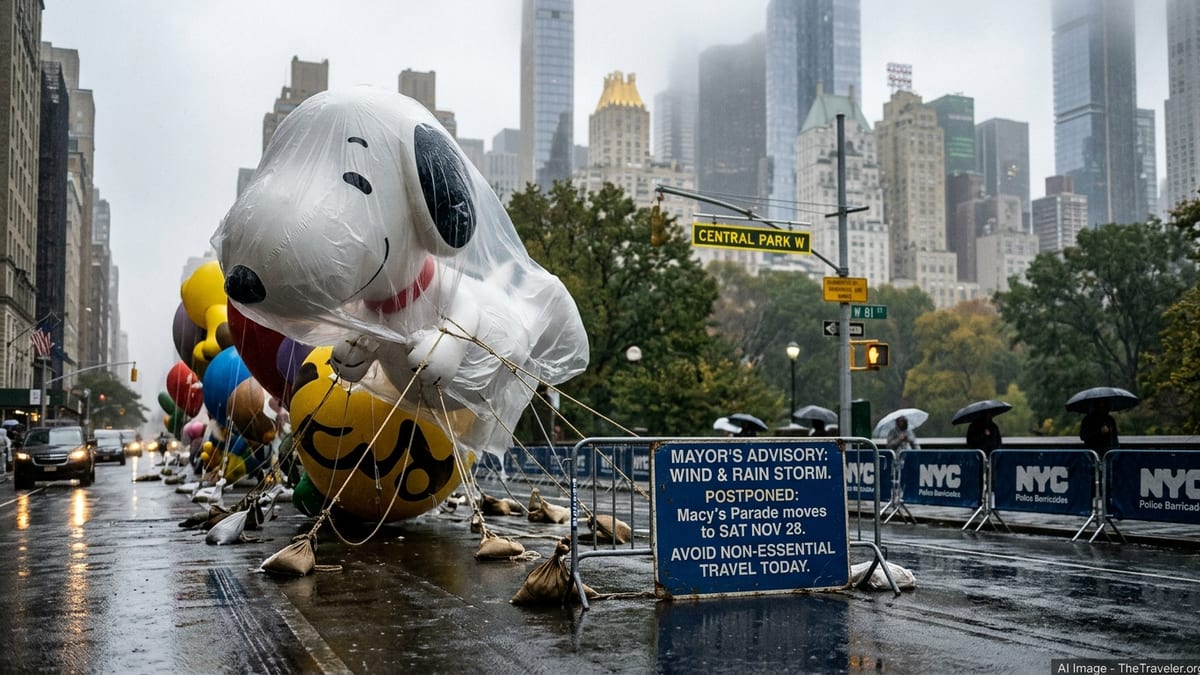
Parade postponement and the mayor’s travel advisory
On Wednesday, November 25, New York City officials confirmed that the 100th Macy’s Thanksgiving Day Parade, originally permitted and planned for Thursday morning, November 26, has been rescheduled to Saturday, November 28, 2026. The move followed updated forecasts calling for strong winds, heavy rain and the risk of coastal flooding across the five boroughs on Thanksgiving Day, conditions that raised safety concerns for the event’s giant balloons, performers and spectators.
Announcing the decision alongside city emergency managers and police officials, Mayor Zohran Mamdani said the rescheduling was made “in the interest of safety” for both participants and viewers. City agencies emphasized that this is the first time in the parade’s 100-year history that it has been postponed to a different day rather than modified or shortened. The city’s events calendar and emergency-management advisory now list the official parade time as 8:30 a.m. on Saturday, with the traditional Midtown Manhattan route unchanged.
At the same briefing, the mayor issued a formal travel advisory for Thanksgiving Day, urging New Yorkers to avoid non‑essential trips during the worst of the storm, particularly Thursday afternoon and evening when winds are expected to peak and flooding is most likely in low-lying coastal areas. Officials are asking residents to work from home where possible, reconsider sightseeing and shopping trips, and build extra time into any essential journeys by road or public transport.
Weather risks driving the changes
The rescheduling of one of the city’s biggest annual tourism draws is rooted in specific safety thresholds and a storm forecast that has steadily worsened in recent days. Forecast models cited by city emergency managers and national forecasters show a strong coastal low tracking up the Eastern Seaboard, with sustained winds in New York City projected to reach levels that approach or exceed the limits set for operating large helium balloons after a 1990s safety review. Gusts are expected to be significantly higher, particularly along the rivers and in exposed Midtown corridors.
City officials noted that balloon operations must be curtailed when sustained winds or gusts surpass defined limits, because of the risk that the 2.5-mile route’s steel and glass street canyons funnel and intensify gusts. In previous years with marginal conditions, the parade proceeded with balloons flown at lower heights or, on rare occasions, grounded entirely while the remainder of the procession continued. In this case, authorities said the combination of projected wind speeds, heavy rain and potential power outages made it more prudent to move the entire event to a day with calmer conditions.
The same storm system is expected to complicate travel across a wide swath of the eastern United States through Thanksgiving Day, with national forecasts pointing to reduced visibility, turbulence and icing risks for aircraft and waterlogged highways from the Mid-Atlantic into New England. Within the city, New York City Emergency Management has warned of widespread ponding on roads, hazardous driving conditions on parkways and bridges, and the potential for downed tree limbs, particularly late Thursday and into early Friday.
Impact on performers, visitors and logistics
The parade postponement has immediate practical consequences for the thousands of performers and marching band members who have already traveled to New York, often with tightly budgeted itineraries funded by fundraising and family contributions. Many school and community groups had scheduled return flights for Thursday evening or Friday morning; they now face decisions about extending their stays through Saturday or withdrawing from the live event while pre-recorded performance segments are used for the broadcast.
During the city’s Wednesday night security briefing, a Macy’s spokesperson acknowledged that the company is still working through the financial and logistical implications of adding two extra days in New York for out-of-town participants. Organizers said they are in direct contact with bands, cheer squads and other groups to determine who can remain in the city, how housing and meal costs will be covered, and what substitutions may be needed if some groups must depart as originally scheduled. As of Thursday morning, Macy’s has not publicly detailed whether it will reimburse additional lodging or travel expenses, telling reporters only that discussions are ongoing with performers and travel partners.
Hotel occupancy in Midtown for the holiday week was already high before the postponement, and online discussions among participants and spectators indicate a scramble to secure Friday and Saturday night rooms near the route. Some visitors who originally booked Wednesday-to-Friday stays report attempting to add nights at properties overlooking the parade, while others are shifting to more distant neighborhoods or outer boroughs to keep costs manageable. Airlines have begun issuing general travel waivers for the storm, but policies on change fees and fare differences vary by carrier and route, and travelers are being directed to check individual airline alerts before modifying itineraries.
City agencies, meanwhile, must extend and adjust existing street-closure plans that had been issued for Wednesday’s balloon inflation and Thursday’s parade. Documents published before the weather decision set construction embargoes and traffic restrictions in parts of Manhattan from November 17 through the end of the event on November 26. With the parade now expected to conclude on November 28, transportation and police officials are updating internal guidance to reflect two additional days of intermittent closures around balloon storage areas, staging zones and the parade route.
Travel conditions in and around New York on Thanksgiving
The mayor’s advisory to limit non‑essential travel on Thanksgiving comes during what is traditionally one of the busiest travel periods of the year in the United States. Nationally, airports and highways were already seeing heavy volumes by Wednesday, with transportation data firms and motoring organizations projecting the worst congestion on the afternoon and evening before Thanksgiving and on the Sunday return. The evolving storm has added a layer of uncertainty for both air and road travelers headed to or through the New York region.
At the aviation level, forecasters expect the storm to bring low clouds, periods of heavy rain and gusty winds to the major New York area airports from Thanksgiving morning into Friday. That combination often triggers ground delays and increased spacing between arrivals and departures, particularly at capacity-constrained hubs. While the Federal Aviation Administration issues tactical advisories closer to real time, airlines were already warning of potential disruption and encouraging customers with flexible plans to consider rebooking away from the Thanksgiving peak or into less affected time windows.
On the ground, New York State transportation authorities had already scheduled holiday restrictions on oversize vehicle movements from midday Wednesday to Friday morning, a standard practice designed to ease traffic and enhance safety over the Thanksgiving period. The coastal storm heightens concerns on roadways like the FDR Drive, the Henry Hudson Parkway and key bridges, where high winds and pooling water can reduce visibility and vehicle control. Local transit agencies have warned of the possibility of temporary speed restrictions on commuter rail and, in low-lying sections, localized flooding that could affect bus routes.
What travelers and residents should do next
For visitors already in New York, the most immediate change is that the parade will now take place on Saturday morning, November 28, with city and Macy’s officials indicating that the route and approximate start time of 8:30 a.m. remain the same as originally planned. Spectators planning to attend in person should adjust hotel check-out and transportation plans accordingly, and check their airline or rail bookings for available waivers or flexible rebooking options if they intend to stay in the city through Saturday.
Residents and commuters who do not need to travel on Thursday are being urged by city officials to stay indoors during the worst of the weather, monitor local forecasts and sign up for city alert systems that provide updates on flooding, transit disruptions and street closures. Those who must be on the roads are advised to allow extra time, avoid driving through standing water and be alert to fallen branches or debris, especially on tree-lined residential streets and parkways. Cyclists and pedestrians should be prepared for strong crosswinds and reduced visibility, and may want to reconsider non-essential trips during the heaviest rain and wind.
Performers, marching band families and school groups should stay in close contact with their parade coordinators, tour operators and group leaders, as arrangements for extended hotel stays, revised rehearsal schedules and Saturday transportation continue to evolve. Macy’s has indicated that it will keep participants updated as logistical details are finalized, and that the goal remains to deliver a full-scale 100th anniversary parade on Saturday if weather conditions allow. Until then, both visitors and New Yorkers are being asked to prioritize safety over tradition, treating Thursday as a day to ride out the storm and reassess plans once conditions improve.